Today we go live on mainnet with the Fusion Rollup, the world's first multi-ledger rollup, connecting 74 blockchain networks in one unified environment, built for institutions.
When I started @quantnetwork in 2015, the vision was simple: make blockchain work for institutions at scale across any network, without the complexity and fragmentation that's held the industry back.
For years, institutions had two bad options: bet everything on a single chain, or stitch together insecure bridges across many. Fusion refuses that trade-off. It connects to many networks at once, moving assets, settling transactions, and messaging across chains as built-in capabilities, not workarounds.
The breakthrough is unified assets. A example of a stablecoin like USDC or tokenised fund like BUIDL or any other digital assetspread across 7 chains collapses into one: uUSDC or uBUIDL. One asset, one liquidity pool, instead of 7 copies and 7 fragmented pools. Each stays anchored to its origin chain and is withdrawable anytime. No custody or compliance trade-offs.
This isn't another layer 2 or a blockchain. It's a new category of infrastructure and it's live.
Read more on: https://t.co/MGfs1FgA6T
→ https://t.co/OQBfu2CEZb
→ https://t.co/4o9nnaA7zc
#QuantFusion #EnterpriseBlockchain #MultiLedgerRolleUp #FusionRollup
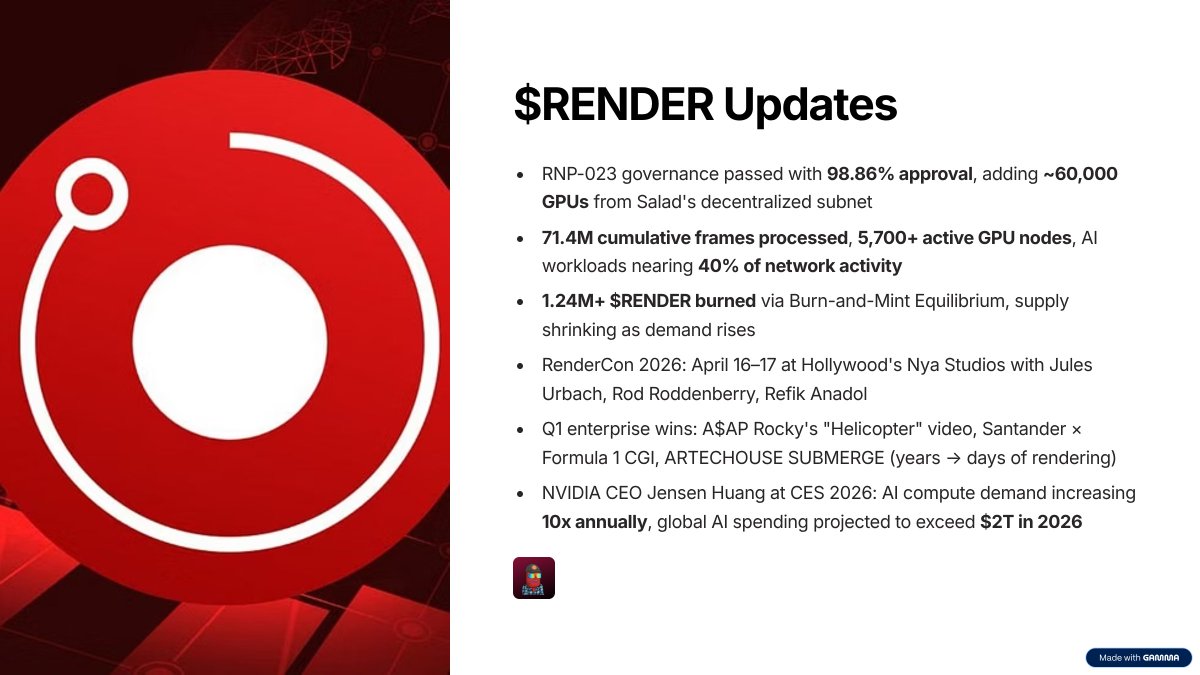
Big moves happening on @rendernetwork | $RENDER.
- RNP-023 governance passed first round with 98.86% approval, adding ~60,000 GPUs from Salad's decentralized subnet as exclusive provider
- 71.4 million cumulative frames processed, over 5,700 active GPU nodes, with AI workloads nearing 40% of network activity
- 1.24M+ $RENDER burned via Burn-and-Mint Equilibrium model, supply shrinking as demand rises
- RenderCon 2026 locked for April 16–17 at Hollywood's Nya Studios, OTOY CEO Jules Urbach, Rod Roddenberry, and Refik Anadol set to present live AI inference and 3D rendering workflows
- Q1 enterprise wins: A$AP Rocky's "Helicopter" video, Santander × Formula 1 CGI, ARTECHOUSE SUBMERGE exhibit (years → days of rendering)
- NVIDIA CEO Jensen Huang at CES 2026, AI compute demand increasing 10x annually, global AI spending projected to exceed $2T in 2026
The decentralized GPU compute thesis is live, revenue-generating, and scaling. $RENDER at $1.92 (+2.62% on the week), MACD bullish at +0.108
#DePIN narrative could send this one flying next.
Murex built the systems capital markets trust. Quant is making those same systems programmable.
Today, we’re announcing a strategic partnership that brings institutional-grade digital asset capabilities directly into MX.3, one of the most widely deployed capital markets platforms in the world.
Banks and capital markets firms can now issue, settle and manage tokenised deposits and digital bonds within the systems already operational across their trading, risk and post-trade workflows. No rip and replace, no parallel infrastructure. The same platforms made ready for the next era of settlement, automation and liquidity.
This partnership comes as tokenised infrastructure moves from pilot to production across the world’s largest markets. Tokenised real-world assets have crossed $100 billion. DTCC has SEC approval to tokenise US Treasuries from mid-2026. Major UK banks are already working with Quant through the Great Britain Tokenised Deposit initiative.
The infrastructure moment is here, and now it runs on MX.3.
Read the full announcement: https://t.co/EcnAa3kiKv
#Tokenisation #DigitalAssets #CapitalMarkets #Programmability
Delighted to share that @quantnetwork has been selected for the @bankofengland’s Synchronisation Lab as part of the RTGS Future Roadmap.
Our use case: atomic, multi-bank treasury operations powered by Quant Flow and PayScript®. All payment legs settle together or not at all, eliminating partial settlement risk across multiple banks in a single action.
This is programmable finance that works within existing market structures, not around them.
https://t.co/I5rmbsDLAu
#RTGS #TreasuryManagement #PaymentsInnovation #FinancialInfrastructure #SynchronisationLab #ProgrammableMoney
Exciting progress on #QuantFusion as we kick off 2026!
1. Fusion Firewall Updates
We recently upgraded Fusion's Multi-Ledger Rollup to deploy critical updates to Fusion Firewall #smartcontracts.
Key enhancements based on institutional feedback:
- Self-managed token whitelists for institutions
- Liquidity isolation options for shared tokens
- Privacy-preserving on-chain whitelist synchronisation
2. Bring Your Own Node (BYON) - Now Live
A foundational upgrade for #QuantConnect users. BYON allows users to attach their own nodes to Fusion via our Quant Connect UI. It’s as simple as selecting the network and entering a URL. Starting with pre-selected node providers to ensure reliability and simplify setup, with plans to expand to user-hosted nodes.
The infrastructure is fully generic, any EVM-compatible node can connect, with minimal adjustments needed for non-EVM chains. Currently testing on Sepolia and Amoy testnets.
3. Staking Infrastructure in Development
We're evaluating staking algorithms that balance inclusivity with meaningful participation. The goal: encourage QNT staking at all levels without disadvantaging smaller holders. Staking will be tied to BYON, users stake QNT against their nodes to earn rewards.
Rather than slashing, we're following proven models (like Avalanche) where withholding rewards effectively incentivises node reliability.
#Blockchain #Interoperability
@nottellingyou73@coinbase I've been invested in $ONDO for a while now, and of course, what they are doing will inevitably thrive, with the TVL already performing really well.
But I cannot help but always have in the back of my mind that the utility of the token is not great at the moment.
We’re honored that Ondo was featured in the @WhiteHouse report by the President’s Working Group on Digital Asset Markets, which recognizes tokenized securities, stablecoins, and programmable settlement as building blocks of the future financial system.
This recognition reflects a growing consensus: tokenization isn’t just an innovation, it’s the future operating system for traditional assets in a global, digital economy.
📄 https://t.co/4QMpldYB8A
At Ondo, this moment reinforces what we've been building toward for years: a more open, efficient, and globally accessible financial system powered by tokenized real-world assets.
We’re proud to have pioneered key infrastructure in this space, from launching the first tokenized Treasuries widely available to global investors, to building the first onchain financial protocol designed to support permissioned tokenized securities alongside stablecoins.
Now, with Ondo Chain, we’re creating a dedicated home for tokenized real-world assets, making it easier for traditional issuers to launch compliant onchain products, and enabling seamless integration between the worlds of traditional and onchain finance.
The report highlights tokenized funds and stablecoins as core infrastructure for modern markets. It emphasizes composability, auditability, and compliance as essential requirements, principles that have shaped Ondo’s architecture from day one. And it signals growing urgency for the United States to lead, not follow in the global transition to tokenized finance.
Ondo’s role in this next chapter:
1. Unlocking access: Making US assets globally available via fully-backed, compliance-first tokenized products.
2. Powering 24/7 markets: Enabling deliver-versus-payment settlement across a range of financial products, from treasuries to equities.
3. Bridging TradFi and DeFi: Connecting institutional-grade assets to programmable, interoperable blockchain infrastructure.
We're grateful for the leadership behind this initiative including @realDonaldTrump, @DavidSacks, @SecScottBessent, @BoHines, and the President's Working Group for recognizing the potential of tokenization to strengthen America's financial leadership.
We’re just getting started, and we’re excited to help shape the global financial system that comes next.
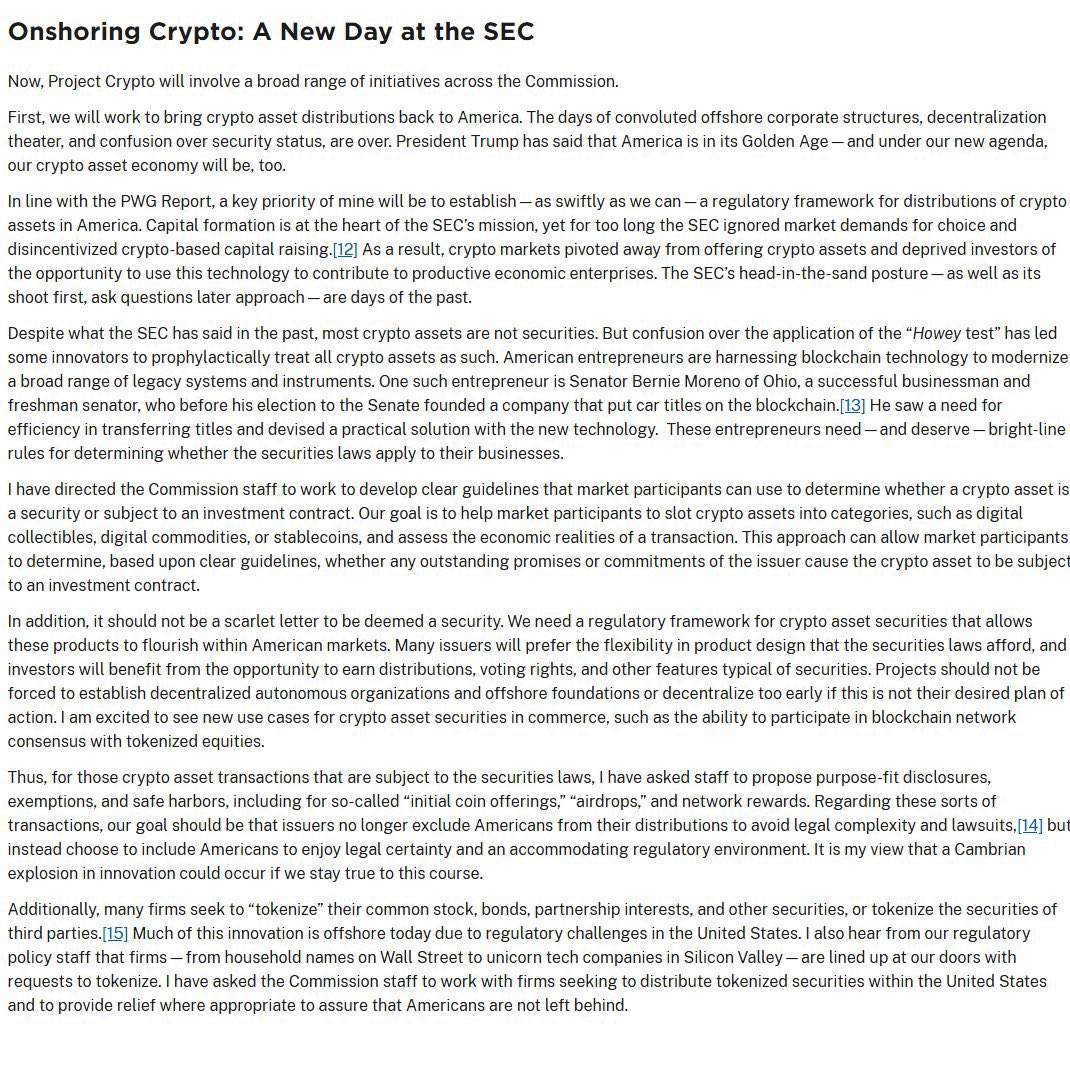
🚨 BREAKING: THE SEC IS LAUNCHING “PROJECT CRYPTO” TO ONBOARD ALL ASSETS ONCHAIN
LATEST WHITE HOUSE REPORT INDICATES THAT $ONDO IS THE GOVERNMENT PREFERRED CHOICE FOR TOKENIZATION
WE PREDICT MASSIVE DEMAND FOR $ONDO IN COMING DAYS, LOAD UP NOW 🚀
https://t.co/a9FmMXhldU
🚨 21Shares just filed for a Spot ONDO ETF with the SEC 🇺🇸
If approved, it’ll be the first ERC-20-based ETF - a big win for real-world asset (RWA) tokens.
No leverage, no derivatives. Just pure $ONDO price tracking. Backed by @coinbase Custody.
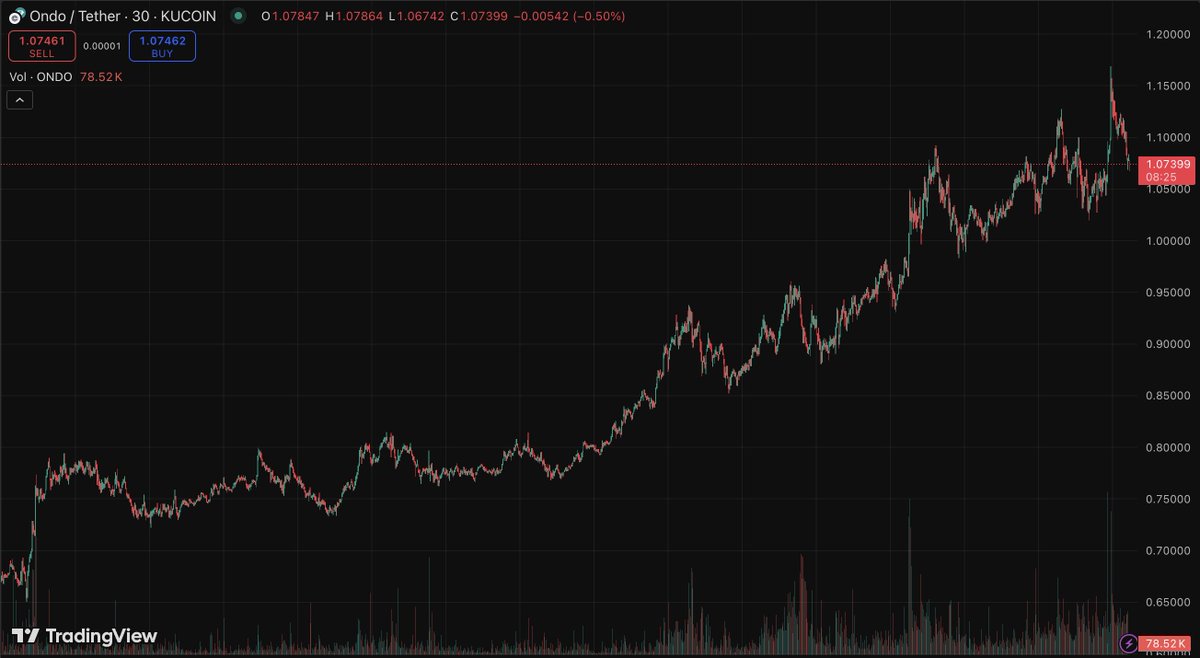
@OndoFinance is already up 64.7% this month… and some are calling it the next institutional darling.
He blocked me so I didn't see his word salad but here it goes.
-> Chainlink moves value and data in a bundled format called a "programmable token transfer."
Correct! But it is entirely reliant on the Cross Chain Token (CCT) standard. Whereas Overledger Fusion can this for digital assets such as Bitcoin and XRP as well.
-> no abstraction of gas or token standardization Chainlink does abstract gas tokens, chains, etc.
CCIP typically requires users to pay fees in specific supported assets (e.g., LINK or native gas token) on the source chain.
The key difference is that Overledger Fusion allows users to pay gas in ANY asset from ANY connected chain. You can pay for all chains' gas fees in BTC if you want to.
This creates a truly universal, asset/chain-agnostic UX, which CCIP doesn’t offer today. Made possible through inventing world's first L2.5
-> fragmentented fees and slippage
Liquidity providers must split funds across bridges or different chains. Price oracles are required to determine fair value.
Overledger Fusion enables tokens from multiple chains to be pooled directly to each other.
BIG difference.
Liquidity aggregation happens on-chain within a single execution environment.
->Doesn't handle bridging or fee optimization
CCIP relies on oracles or relays to monitor state between chains.
With Fusion, the asset is natively recognized and secured via its origin chain. No wrapping or bridging is needed.
->Chainlink doesn't offer native bridging. Chainlink CCIP is the canonical bridge for 20+ chains.
That's not native bridging, CCIP requires adopting the CCT standard to bridge or must wrap them.
-> Doesn't support atomic multi-chain transactions
Yes. With CCIP you fire and forget transactions. Hoping the whole flow is executed eventually.
Overledger ENSURES the entire multi chain transaction happens all together or not. That's atomicity.
Delivery Versus Payment is an atomic swap. Completely different concept.
$QNT
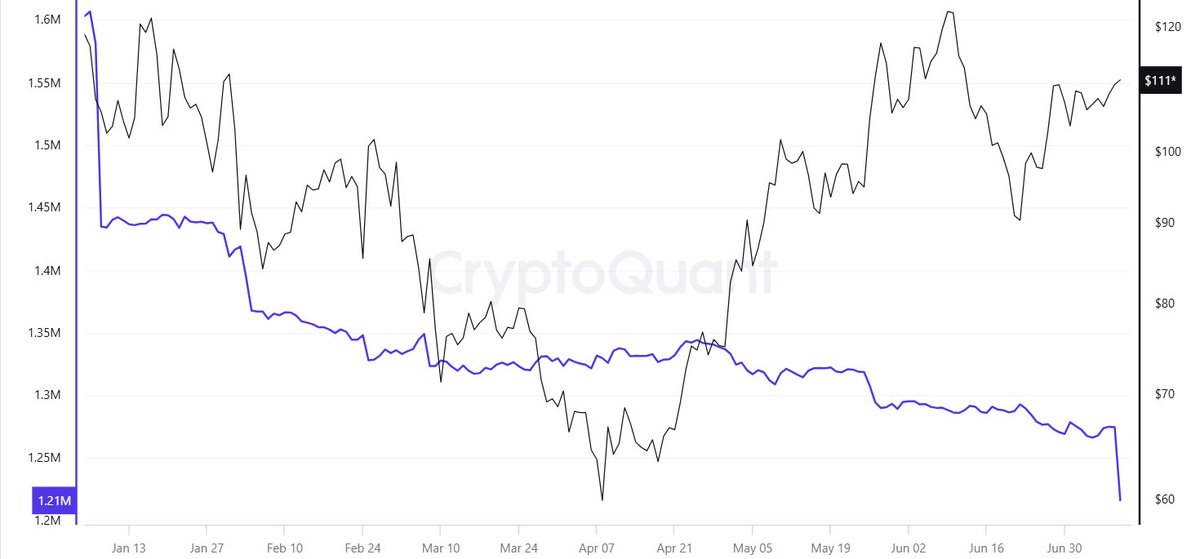
On July 10, 2025, exchange reserves of $QNT tokens reached the lowest amount to date at 1.216m tokens across all reported exchange reserves. This is a sharp decrease from the July 9 balance of 1.274 m tokens.
The increased off exchange accumulation indicates increased investor interest, and possible pre-positioning for the rollout of Quant Network's Overledger Fusion, a multi-ledger roll-up that requires the $QNT token to be staked to run gateway nodes for atomic cross-chain actions such as swaps, bridging etc.
🔧 Quant Fusion Devnet Update – 4 July 2025
We’ve officially launched the Fusion devnet and reached several key milestones in our journey toward secure, interoperable, enterprise-grade blockchain infrastructure.
Here’s what’s happened so far:
•Deployed implementation contracts to Ethereum Sepolia, Polygon Amoy & Avalanche Fuji
•Began transaction testing using Foundry, including with upgradeable proxy contracts
•Initiated smart decisions around transparency, upgradeability, and mainnet/testnet strategy
•Tested sequencer APIs & ETH JSON-RPC integration — ✅ passed
•Deployed our chosen DEX (announcement coming)
•Progressed our open source spec to support scalable, multi-network connectivity
This is a crucial step forward and we’re gathering feedback throughout devnet as we shape the move to public testnet and beyond.
📣 Help shape Quant Fusion → share your feedback:
•Tag @OverledgerDev and use #QuantFusion
•Or get in touch directly
Read the full update: https://t.co/zKjAMIhH9S
#QuantFusion #BlockchainInfrastructure #Layer25 #Interoperability #Web3 #Devnet #QuantNetwork
Institutions are eager to embrace blockchain, but existing infrastructures often force them into a dilemma:
- Engage with public blockchains and face compliance challenges.
- Stick to permissioned networks and miss out on broader ecosystem liquidity.
Quant’s latest blog introduces Layer 2.5, a novel approach designed to bridge this gap.
Discover how Layer 2.5 offers:
- Multi-ledger rollups for seamless interoperability across multiple blockchains.
- Compliance-first architecture allowing institutions to select trusted validators.
- Privacy-preserving smart contracts that don’t compromise on access to public liquidity.
This isn’t just another scaling solution; it’s a reimagined infrastructure tailored for institutional needs.
Dive into the full article to understand how Layer 2.5 is set to redefine institutional blockchain adoption:
👉 https://t.co/GRHUgujEK0
#Multiledgerrollup #QuantNetwork #Layer25 #BlockchainInnovation #InstitutionalAdoption #DigitalAssets #Interoperability
What is the Trusted Node Program?
Overledger Fusion is powered by a flexible and incentivised network of trusted node operators fit for institutional use. Key features include:
- Decentralised control: Approved node operators determine which underlying blockchains to host.
Flexible onboarding: Onboard new ledgers with ease via Bring Your Own Node and Bring Your Own Connector capabilities.
- Granular access control: Define organisational and cross-organisational permissions using customisable API key roles and gateway rules.
- Incentivised participation: Approved node operators of the Layer 2.5 network can determine the underlying blockchains to host to expand the reach of the Layer 2.5 network. Leveraging our previous thinking and experiments in remote connector gateways from 2021, as well as rewards in QNT, node operators can stake QNT for transaction priority from the transactions their nodes process.
Anyone can participate. Users who are currently an https://t.co/h3EubTTjI2 KYC'ed user can participate in the TNP. Of course, enterprise and institutional customers are also invited to participate!
The goal is to expand the Layer 2.5 to interconnect and interoperate as many permissioned and permissionless blockchains as possible.
Great day at #EBADay in Paris where we announced #QuantFlow. We had a good discussion with panelists from Barclays, EPAM and Bain & Co on how fintechs and banks partner to deliver value, referencing our work recently in RLN, ECB and other projects.
Come and visit the @quantnetwork team at stand 5 to find out about #ProgrammableMoney