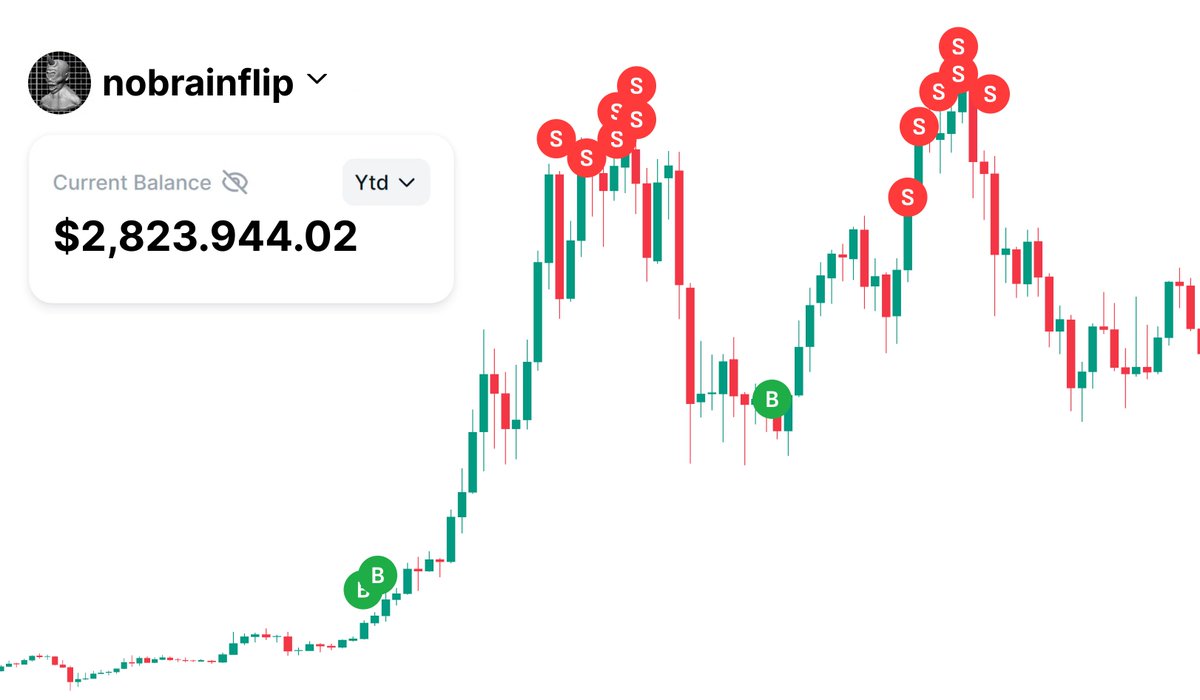
I started in crypto with $0.
Now I'm sitting on $2.8 million.
Just a year ago, I had $8k.
I've been in crypto for 6 years.
For 5 years, I struggled until I understood how to trade alts. Here's my strategy 🧵👇
👀 #Bitcoin agora é o décimo ativo com mais valor de mercado do mundo :
🏅1. Ouro = US$ 13,8T
🖥️2. Microsoft = US$ 3T
🍎3. Apple = US$ 2,9T
🛢️4. Saudi Aramco = US$ 2T
🔎5. Google = US$ 1,8 trilhão
📦6. Amazon = US$ 1,7 trilhão
💾7. NVIDIA = US$ 1,7 trilhão
🥈8. Prata = US$ 1,2T
📱9. Meta = US$ 1,2 T
10. #Bitcoin = US$ 0,8T
“Hey, are you available tonight”?
“Baby, I’m always available and I’m the cheapest date you’ve had. I’m NEAR DA”
What the Frick is Data Availability Anyway?
Imagine a library where every book (block) is not only listed in the catalog (block header) but is also available on the shelves for any reader (node) to verify its contents.
In the case of a sharded library, different sections (shards) hold different books, but readers in one section can still verify the contents of books across the entire library.
Data Availability & Scaling
Although not needed on NEAR Protocol, they are particularly prevalent in the Ethereum space, Layer-2 solutions, such as rollups, are designed to increase a blockchain network's throughput by processing transactions off the main chain.
These rollups batch multiple transactions into a single one that gets recorded on the main blockchain. However, for these to be secure, the underlying data of these transactions must be available so that any participant can verify their correctness.
DA ensures that even though the computation is done off-chain, the data is still accessible for verification purposes.
This allows the main chain to handle more transactions per second without being bogged down by the computational load.
This, of course, is just one aspect of Data Availability and the solving of the Data Availability Problem.
Data Availability enables:
✅Trust minimisation through decentralization
✅Reduction in node storage requirements
✅Modular blockchain architecture
✅The offloading of data storage
Why NEAR DA Matters
NEAR DA offers a robust, cost-effective data availability layer that is thousands of times cheaper than Ethereum's current costs.
However, it’s not simply about the ‘race to the bottom’.
NEAR Protocol has proven to be a battle-tested environment for scaling Web3 applications, with the blockchain itself processing the recent inscription event without issue.
In addition to 3+ years of consistent uptime and 6M+ monthly active users, NEAR is already home to the most used Web3 dApps making it one of the most used blockchains in the world.
That said, the cost of Data Availability on NEAR should not be overlooked.
If the Web3 ecosystem continues to grow and, indeed if it supersedes the modern internet, a variety of solutions will emerge. They need to be robust, scalable, and secure.
NEAR is all this and more.
Launch partners of NEAR DA include @Starknet, @Calderaxyz, @fluentxyz, @vistaralabs, @dymension, and @movementlabsxyz and, as of yesterday, @arbitrum Orbit integrated NEAR DA.
More to come.
But Wait, How Can NEAR Manage DA AND 7m+ MAAs?! (1B goal btw)
It can be summarised simply; technical innovation.
Fundamentally, sharding, and NEAR’s novel implementation of it, is what powers NEAR’s DA and other capabilities including fast finality for Ethereum rollups, being built with @eigencloud, and NEAR Protocol’s existing high throughput and low latency.
Although sharding is indeed just one component of the NEAR tech stack, it's a vital tool in ensuring scalability.
Sharding on NEAR has allowed for securely scalable and cost-efficient blockspace that can be extended to other VM environments.
And this isn’t even NEAR’s final form.
uMm bUT isN’t NEAR jUsT cHASinG HypE
Not at all. This is a part of a grander vision which we’ll touch on below.
See this tweet from NEAR Protocol Co-Founder, @ilblackdragon, made in Sept ‘21 below:
https://t.co/B2bM2F5pm9
Another Piece in the Puzzle
The Web3 world is fragmented.
It has more bridges than Venice. Seemingly more Layer 2s than there are Guilds in WoW.
All contributing to a fractured liquidity flow and disruptions in user experience.
B̵i̵t̵c̵o̵i̵n̵ NEAR solves this. And NEAR DA is another piece of the puzzle.
(intern loves Bitcoin btw, referencing the meme for the culture)
Chain Abstraction is driven by advancements in several technologies such as Data Availability, Zero-Knowledge, and Account Aggregation.
Data Availability is needed as a consequence of the proliferation of L2s, which has resulted in fragmented liquidity and frictions in storing call data in a cost-effective way for rollups, which has in return driven costs for the end user.
The solution?
A universal DA layer, NEAR DA, that can pass data between any L2 to allow for cross-chain settlement (leveraging ZK tech).
The end-user will be in control of all of this via account aggregation.
Keep your ear to the ground. Things are about to change.
https://t.co/egaMniNvQ0
Learn more at https://t.co/qTF9okpA08
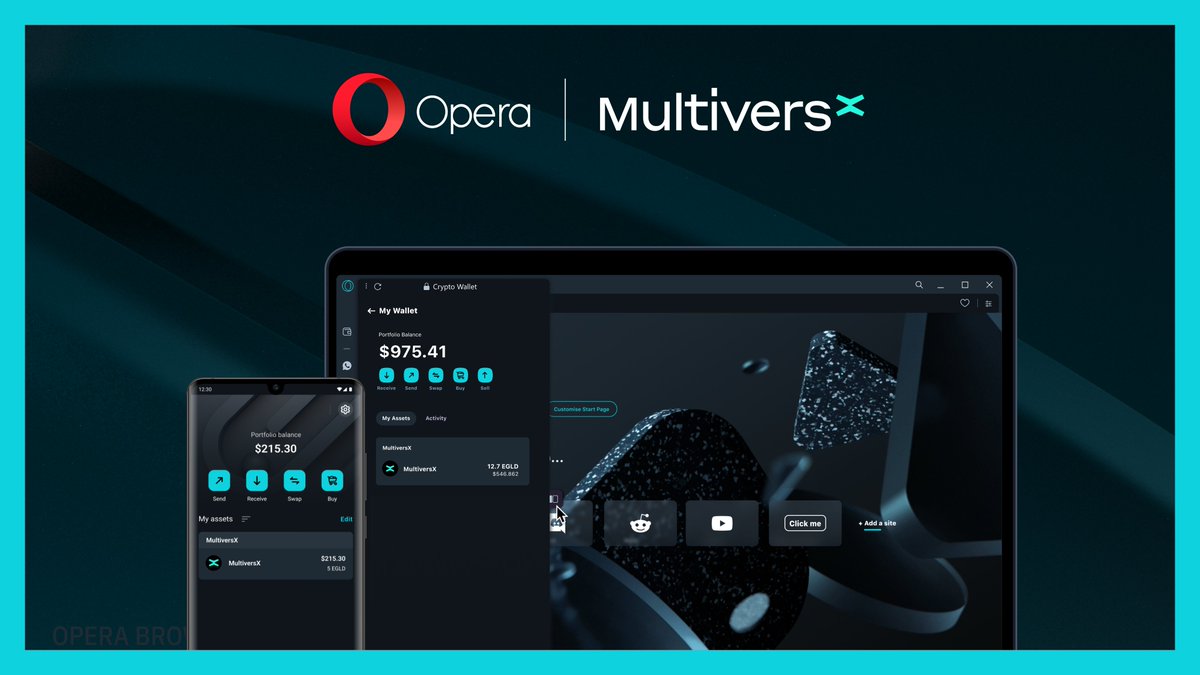
Web3 support for @MultiversX is now available across Opera Browsers. Our users can now explore the MultiversX ecosystem seamlessly across Opera Browsers, from support of EGLD and tokens on MultiversX, to Web3 support to access MultiversX dApps.
https://t.co/jNAviG5bHH
Together with @Microsoft and @Azure, we will provide a powerful industry solution that creates a stronger infrastructure layer for the space ⚡️
The union of technology between Ankr and Microsoft will provide a fully managed node hosting solution 🫡🤝
This is just the beginning 😉
Huawei Cloud announced the launch of the Metaverse and Web 3.0 Alliance.
It partners with Blockchain Solutions, Deepbrain Chain, Polygon, and Morpheus Labs.
Ankr 🤝 @Microsoft
We’ve partnered with Microsoft to support enterprises and organizations needing access to blockchain data with a reliable, easy-to-use node hosting service 🫡
Read more ⬇️
https://t.co/XF8CG1grg5
With ChatGPT API up next, will feed its output right into #RNDR graph for things like OSL shaders, script nodes, scatter nodes & much more. Generative 3D/4D/NeRF AI art is on a separate track for Render Network, but we are testing w/ great results - I hope to share more soon