The NYSE announcement is a monumental milestone for Avalanche, but I would argue it’s an even bigger moment for our entire industry and we're excited to be a part of that progress.
Naturally, I’m proud to see Avalanche technology at the center of infrastructure being developed for one of the world’s most important financial institutions.
But scrolling through the timeline, I’m reminded of how difficult it can be for this industry to recognize progress beyond an individual’s own native ecosystem or bias.
We have spent the better part of a decade debating which chain will ultimately prevail, sometimes losing sight of what we’re actually trying to accomplish. The opportunity in front of us is orders of magnitude larger than the market we’re competing over today.
When an institution like the NYSE moves toward blockchain-based market infrastructure, it lends credibility to an entire industry that has spent years working to establish its place in global finance.
That should be celebrated, regardless of which network is involved.
I want Avalanche to win, and I’ll continue making the case for why our team and technology is uniquely suited for institutional finance. But I also recognize that meaningful progress across other ecosystems strengthens the case for all of us. The pie is infinite for all of us collectively.
We’re still early in a much larger transformation of global finance. There’s plenty of room for healthy competition without losing sight of the fact that we’re building toward the same future.
I hope we can move beyond the old tribalism and start acting like an industry that’s ready for the responsibility being placed in its hands.
Onwards 🔺
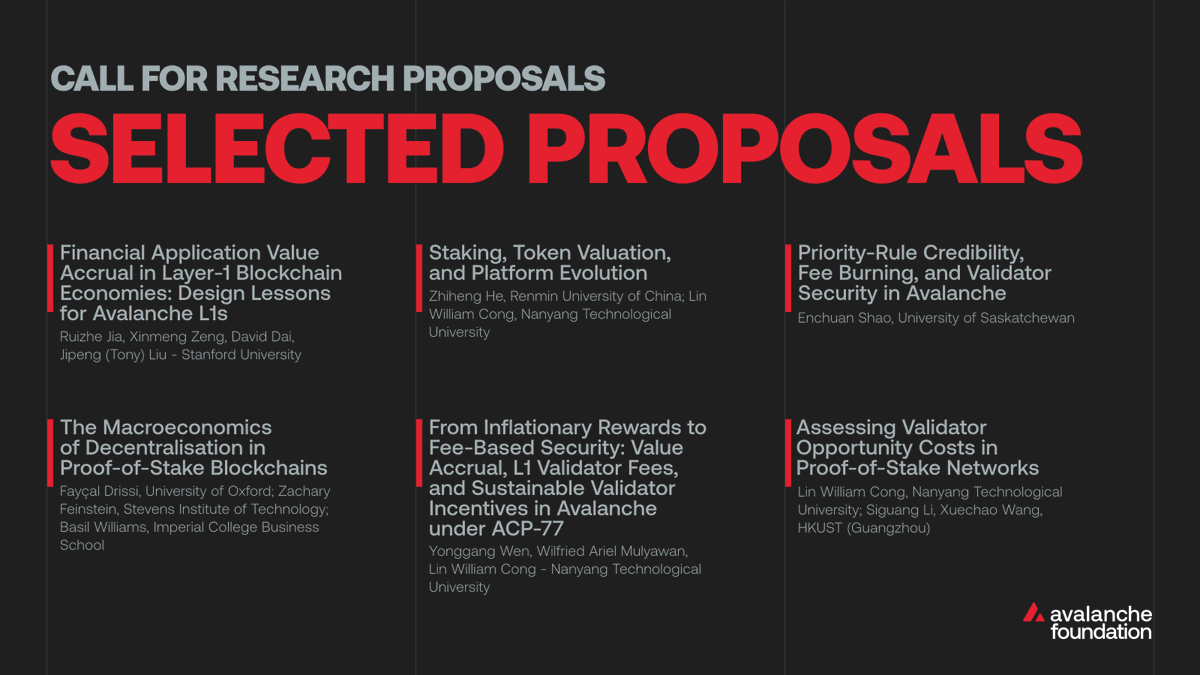
Introducing the six research teams selected through our first Call for Research Proposals 🔺
The teams will take on some of the most important open questions in blockchain economics.
Accelerating research already underway through our economic research agenda.
Today, we honor the veterans in our Team1 community and across the country.
@BKL1023@Nateduwg@kodr_pro@TradingAloha@DRDOOLITT_
Thank you for your service, your sacrifice, and your commitment to others. We’re proud to have you among us.
With gratitude,
Team1 USA ❤️
The economics of decentralized networks deserve the same intellectual rigor as the protocols themselves.
Great to see the Avalanche Foundation bringing together researchers from Stanford, Oxford, Imperial and other leading institutions to tackle fundamental questions around validator incentives, security, and value accrual.
Introducing the six research teams selected through our first Call for Research Proposals 🔺
The teams will take on some of the most important open questions in blockchain economics.
Accelerating research already underway through our economic research agenda.
We turned an Avalanche event into a Halloween musical. 🎃
200 people, 943 on-chain transactions, 933 NFTs minted, and one very cursed costume contest. Many guests made their first blockchain transaction that night, through a game.
Avalanche Halloween, @AvaxTeam1 × @BitkubOfficial
Thank you @TheGrottoL1@Blurrylogics for supporting the event experience.
Six years ago, we understood that the world’s financial infrastructure would never run on a single shared state machine.
We built Avalanche accordingly, and the rest of the industry is beginning to understand why.
Speaking on the Avalanche Q3 Ecosystem Call, Matias A., Chief Investment Officer of the Avalanche Foundation (@frostLedger), shared an update on the Foundation’s economic research agenda.
The measurement framework is now established, work on value capture is underway, and research is now focused on how value is distributed through the ecosystem 🔺
Why Avalanche for NYSE?
It’s important to note that this was not a quick, monetarily-driven decision made without due diligence, as I’ve seen a few posts speculating that. After more than a year of evaluating and testing multiple blockchain networks, NYSE arrived at Avalanche for a multitude of reasons.
For those who have followed Avalanche closely, this shouldn’t come as much of a surprise. For everyone else, it’s worth understanding the fundamental difference between building for speculative crypto markets and building the infrastructure that underpins global capital markets.
For regulated financial institutions, high TPS and low transaction fees are the baseline. Most modern blockchains can offer some version of both, with the much harder problem being architectural.
Monolithic chains share consensus, execution, and blockspace. Conventional EVM L2s introduce dependencies on external settlement layers, sequencing, and data availability. Both models come with constraints that become particularly consequential when institutions need direct control over their infrastructure, especially when it comes to regulatory compliance.
Avalanche was designed around a different premise.
Avalanche L1s operate with independent consensus, dedicated validator sets, customizable virtual machines, configurable fee markets, and protocol-level permissioning. Institutions can define who validates, who participates, how transactions are processed, and how their networks are governed, with the flexibility to implement regulatory requirements directly into the infrastructure.
They can do so without inheriting the congestion or settlement dependencies of another chain, while retaining the ability to interoperate with other networks and access the broader Avalanche ecosystem’s assets and liquidity.
This combination of sovereignty, customization, performance, and interoperability is what makes Avalanche uniquely suited for true capital markets. It’s one thing to offer institutions a place to deploy applications, anyone can do that. It’s another thing to give them the ability to operate the underlying infrastructure on their own terms.
We’ve spent years building around the conviction that the world’s largest financial institutions would eventually need purpose-built blockchains of their own, rather than forcing entirely different businesses and regulatory environments onto a single shared network.
NYSE’s decision is a powerful validation of that thesis.
And I believe we’re only beginning to appreciate just how important these architectural decisions will be as global financial markets continue to move onchain.
The New York Stock Exchange is building on Avalanche 🔺
Their new tokenized stocks platform is designed to support 24/7 trading, clearing and settlement. Exclusively on Avalanche.
WSJ exclusive below 👇