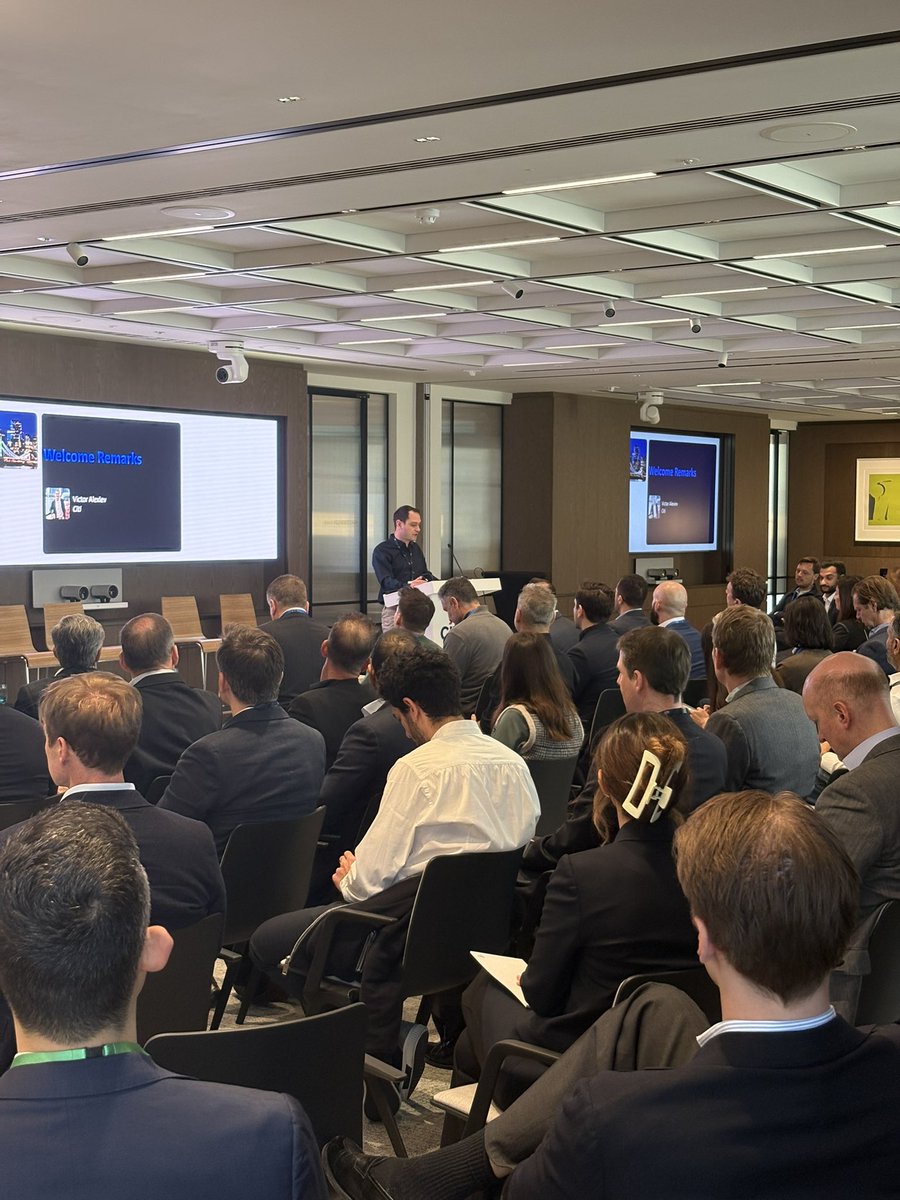
@motherofqianbei Draupnir are in the business of getting funds from 0 to "yes" - working with large issuers and L1s on this - watch this space! @RayBuckton knows what i'm talking about ;)
yay lingling didn’t get kicked out of a tradfi party.
global ABS, here’s the read:
german banks: a polite no. very “not yet.”
uk/us: didn’t need the 101. straight to “settles without the T+5/7 drag, global by default.” they get it. just want someone to go first.
the service providers are very neutral. But don’t move until their client (banks, insurer and fund GP) says go.
so the bottleneck isn’t tech. it’s not even belief.
it’s who says yes first.
when people say crypto is dead, they don't mean the industry
the fundamentals of this industry are looking good
what they mean is that their ability to extract money from dumb retail has vanished - and with it their passion for this space
in this new era of crypto you actually have to build things of value to make money which understandably isn't for everyone
Travessia Credit is live.
Today we’re launching our first vault in partnership with @AccountableData and @withAUSD, bringing Brazilian grain trade finance onchain.
This isn’t another yield product. It’s infrastructure.
Capital flows into essential commodity trade.
Operators execute real transactions.
Cash flows are generated in the real world.
And now — they’re verifiable.
Powered by Accountable’s Data Verification Network, this vault introduces real-time, cryptographic proof of assets and liabilities without exposing sensitive data.
No black boxes. No blind trust.
Just continuously verifiable credit.
Built on AUSD, Agora’s stablecoin, enabling seamless, stable capital deployment into high-velocity trade flows.
What this unlocks:
• Real-world yield backed by essential industries
• Continuous verification of underlying flows
• Onchain credit that institutions can actually trust
• A new standard for how capital moves globally
This is the first step toward a fully programmable financial stack for operators.
All onchain. All verifiable.
We’re not tokenizing assets.
We’re rebuilding the system that finances them.
Welcome to Travessia Credit.
Look guys, it's actually really straightforward, a bunch of people staked their ETH on the Ethereum blockchain to earn yield, except they didn't want their capital to be locked up, so they actually staked with a liquid staking protocol called Lido who provided them a liquid staking receipt token called stETH, except they decided to juice their yield further by depositing their stETH receipt tokens into a restaking protocol called Eigenlayer, except they didn't want to lock up their capital, so they actually restaked with a liquid restaking protocol called KelpDAO who provided them with a liquid restaking receipt token called rsETH, except they decided to juice their yield further by depositing their rsETH tokens into a lending protocol called Aave so that they could open a leveraged looping position that borrows ETH against the rsETH collateral and restakes the ETH into rsETH which is then deposited as collateral, except it turns out rsETH used a cross-chain bridge called LayerZero that was hacked by north koreans causing rsETH to become undercollateralized and now these looping positions are stuck and unprofitable, and everyone is pointing fingers at each other, and also DeFi is a very serious industry
"so you staked your ETH on the Ethereum blockchain to earn yield?"
"yes, Dave"
"except you didn't want your capital to be locked up so you actually staked it with a liquid staking protocol called Lido?"
"that's correct, Dave"
"and Lido gave you a liquid staking receipt token called stETH in return?"
"yes, Dave"
"and then you didn't think that was enough, so you juiced the yield even further by depositing your stETH receipt tokens into a restaking protocol called Eigenlayer?"
"you are correct, Dave"
"and now you didn't want to lock up your capital, so you actually restaked with a liquid restaking protocol called KelpDAO who provided you with a liquid restaking receipt token called rsETH?"
"you got it, Dave"
"and then that was surely not enough juice, so you then deposited your rsETH tokens into a lending protocol called AAVE so that you could open a leveraged looping position that borrows ETH against the rsETH collateral and restakes the ETH into rsETH which is then deposited as collateral, except it turns out rsETH used a cross-chain bridge called LayerZero whose security is held together by a 1/1 toothpick, which was obviously hacked by north koreans causing rsETH to become undercollateralized and now these looping positions are stuck and unprofitable, and everyone is pointing fingers at each other, and also DeFi is a very serious industry"
"you are 100% correct, dave"
jfc.
Britain could have deregulated, cut taxes, rolled back the planning regime and let entrepreneurial capitalism drag us out of the mess we're in.
Instead, we're banning pastry adds and discussing capping CEO salaries and if £35k/ year is a high income.
We're doomed, aren't we?
> Making loud noises is our cultural custom
Be it so. But my nation has also a custom. When people loudly interrupt concerts, we physically remove them from the audience. Let us all act according to national customs.
The UK has a far flatter income distribution than the Communist Soviet Union.
The UK take home minimum wage for working a full time job (40-hours) is now £22,555.
At £100k salary, the take home is £68,558.
That is a net income ratio of 3.04:1
We are now at the point where the wage compression and taxes in the UK means that the difference between minimum wage and a top 5% salary is a net income difference of only ~3x.
In the USSR using the same comparison, this figure never fell below 5:1
It's actually even worse in reality because the person earning £100k in the UK often has student loans.
Britain is nominally capitalist but functionally communist. China is nominally communist but functionally capitalist.
Funny how that works.
My fireside chat with the CEO of Western Union.
> you crypto people think real time settlement is new
> we've been doing real time settlement for 20 years
> you can go to a WU and send money to your mom in guatemala and it lands in 3 seconds
> but that only happens because I have liquidity pool of $1.5B
> stablecoins are going to give me back that $1.5B
> my stock trades at $2.7B
> I'm going to take that $1.5B and use it to buy back a boat load of my stock
> oh and also, we're going to use stablecoins to give all 100m+ customers a US dollar debit card aka mini bank account
Stablecoins aren't going to kill Western Union...
They're going to save it.
El Salvador didn’t just lock up its criminals. Their story is just beginning.
Bukele is now reinvesting into modernizing cities, fixing schools, and improving infrastructure.
The before-and-after results are stunning. El Salvador looks like a genuine first world country.
Cities are being beautified. Slums are being removed. The government is on a mission to renovate every school in the country and introduce university scholarships on a wide scale.
In his words, he’s trying to build a country where kids no longer have incentives to join gangs — ever again.
He’s currently doing everything with his country that progressives claim to want in cities, and yet they call him a dictator.
Why? Because he understood that you have to remove the criminals first. Investments in cities and education mean nothing if there isn’t basic safety.
The 99% can’t thrive if 1% of the population engaging in crime and antisocial behavior are allowed to rule.
And the money to invest doesn’t come from thin air. Economic prosperity can’t exist without public safety.
He’s provided the blueprint to take back every western country. Genuinely one of the best leaders in modern world history.
A better way is possible.
Citibank is supporting exciting DLT / blockchain startups like @AxiymFinance and @TranchedFi among others at the Citi Sprint Fintech Lending Summit. You can feel the wind shifting toward institutional adoption.