In 1834 Britain burned its old tally sticks, the notched wooden receipts the Exchequer had used for centuries. The fire got away from them and took down the Houses of Parliament.
Money has always been record keeping. I post sourced facts about the newest records: XRP, the XRPL, Ripple and stablecoins, plus the weird history of money. No hype, no price calls. 🐦⬛
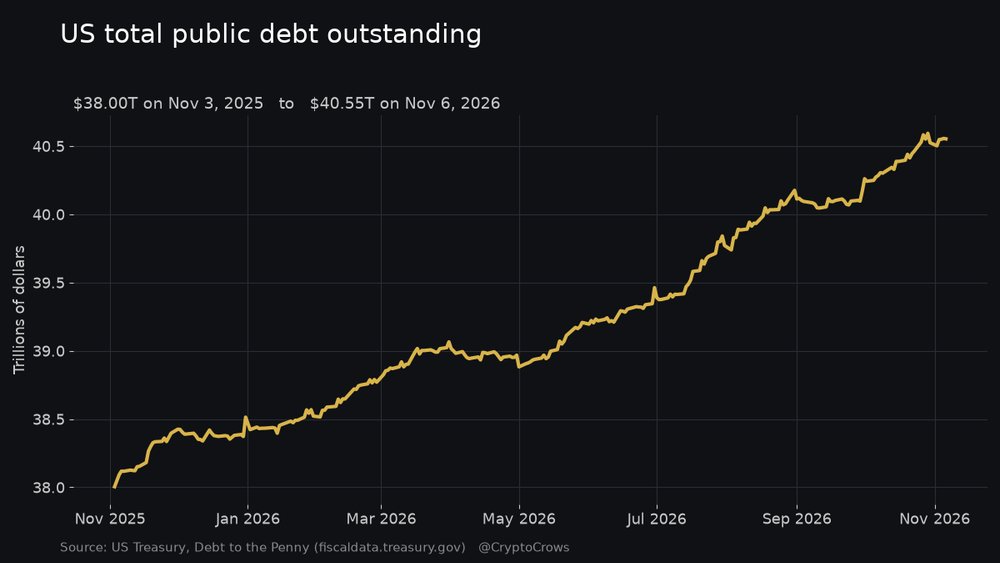
US debt to the penny, Nov 6, 2026: $40,552,751,019,092.61
Same day last year: $38,118,268,221,748.03
That's $2.43 trillion added in a year. About $6.7 billion a day, or roughly $77,000 every second.
It first topped $40 trillion in the Aug 18 figures.
Sweden's biggest coin was a copper plate. The 1644 10-daler plate weighed 19.7 kg, about 43 lb.
Copper was worth far less than silver, so a coin worth 10 daler in silver had to be huge. The Avesta mint made 26,774 of them in 1644 and 1645.
Eight survive, per Sweden's Economic Museum.
@padrinoIG Ha, true. Hybrid lets you add other structured bits too, like street name, building number and postcode, on top of town and country. Per Swift's rules, whatever goes in a structured field can't be repeated in the two free-text lines, so that frees up room.
Saturday, Nov 14, was supposed to be the day Swift stopped accepting free-text addresses in cross-border payments. Town and country in their own ISO 20022 fields, or the payment gets bounced.
It got pushed. Swift announced the delay on Aug 27 after banks in every region said they weren't ready. A new date is due by December.
The hybrid format meant to make this easier has been live since Nov 2025.
@epure_liviu Small correction for XRPL specifically. SignerListSet and SetRegularKey record the other keys as account addresses, and those are hashes too.
A signer's public key only lands on the ledger once it actually signs. The owner's key does show up at setup, since the owner signs it.
The XRPL quantum plan won't upgrade anyone automatically.
Per the XRPL Foundation's draft, owners add an ML-DSA-44 key, then disable the old master key. Skip that and you keep today's exposure.
Don't rotate early, though. Until the Quantum amendment activates, those signatures get rejected.
@RealAllinCrypto@circle On the XRP Ledger you can check part of this yourself. A validator can link its key to a website domain with an xrp-ledger.toml file, per the XRPL docs, and explorers show that domain next to it.
Validators that skip it still show up, just without a name attached.
@XrpUdate Worth knowing: there are two lending amendments on the ballot. LendingProtocol came in rippled 3.1.0 and LendingProtocolV1_1 in 3.4.0.
Both sit at 22 of 35 Yes votes right now, per XRPSCAN. So check which one a countdown headline means.
@xrpmickle Checked this one on the ledger this morning. The RLUSD issuer account on the XRPL has its master key disabled and trust line clawback switched on.
Clawback means the issuer can pull RLUSD back out of a holder's trust line. That's the kind of control a regulated issuer keeps.
Odd RLUSD stat. Only about a third of the supply lives on the XRP Ledger. Ethereum holds the rest.
But in the record week ending Nov 1, RLUSD moved $11.7B, and $6.7B of it went through the XRPL. About 57%.
That's gross transfer volume, not new money, but it tells you where the stablecoin actually gets used.
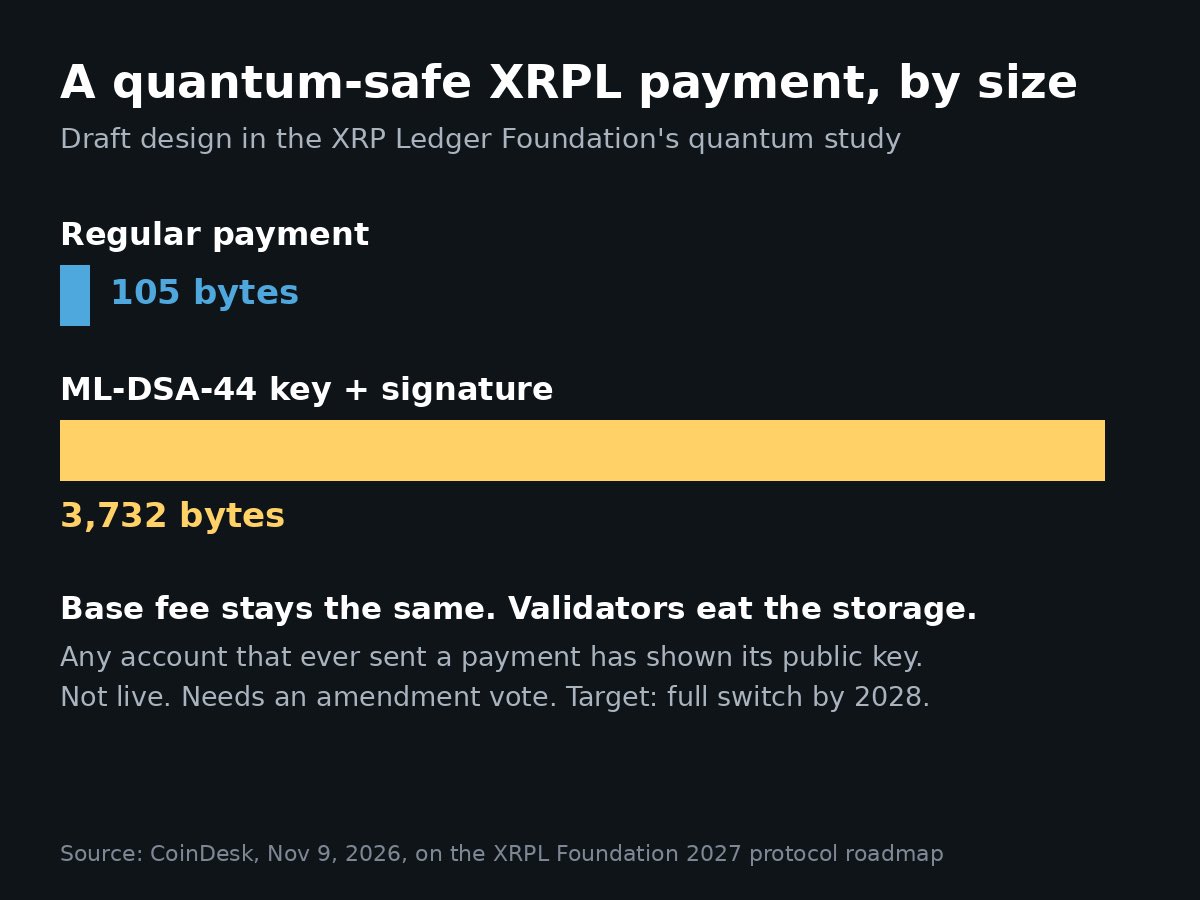
The key and signature in a quantum-safe XRP Ledger payment would take 3,732 bytes under the draft design. A regular payment uses 105.
The base fee wouldn't change. Fees are burned on XRPL, so validators and node operators would eat the extra storage.
It's not live yet. A migration study is set for early 2027, with a full switch targeted for 2028.
@MSBIntel@XRP@Ripple Worth adding: Moody's rated RLUSD A2 long-term and P-1 short-term in late October. P-1 is Moody's top short-term grade.
It covers the reserves and redemption setup behind the token. It says nothing about XRP's price.
Yes. The payments market practice group's latest guidance says hybrid stays a valid long-term option, not just a bridge. Town and country in structured fields, plus up to two 70-character free-text lines.
What's not settled is the new date for dropping fully unstructured addresses. Swift says that update comes by December.
A First World War money story most people never heard.
In Nov 1914, Britain launched its first War Loan with a £350M target. The public bought £91.1M.
The Bank of England quietly covered the gap. It lent money to its Chief Cashier and his deputy, who bought the bonds in their own names so nobody would know. The FT reported the loan as oversubscribed.
Keynes, one of the few in on it, called it "a masterly manipulation."
In Dec 1690, Massachusetts had soldiers home from a failed attack on Quebec and no plunder to pay them with.
So the colony printed £7,000 in paper IOUs called bills of credit. By May 1691 the cap was £40,000.
That was the first paper money in the American colonies, per the Library of Congress copy of the original order.
For anyone connecting dots to Ripple: OKXICE trades run through Uniswap v4 pools on X Layer, OKX's Ethereum layer 2, and Securitize does the tokenizing, per the venue's public notice. It also lists 67 companies that objected to being listed, Apple, Amazon and Tesla among them.