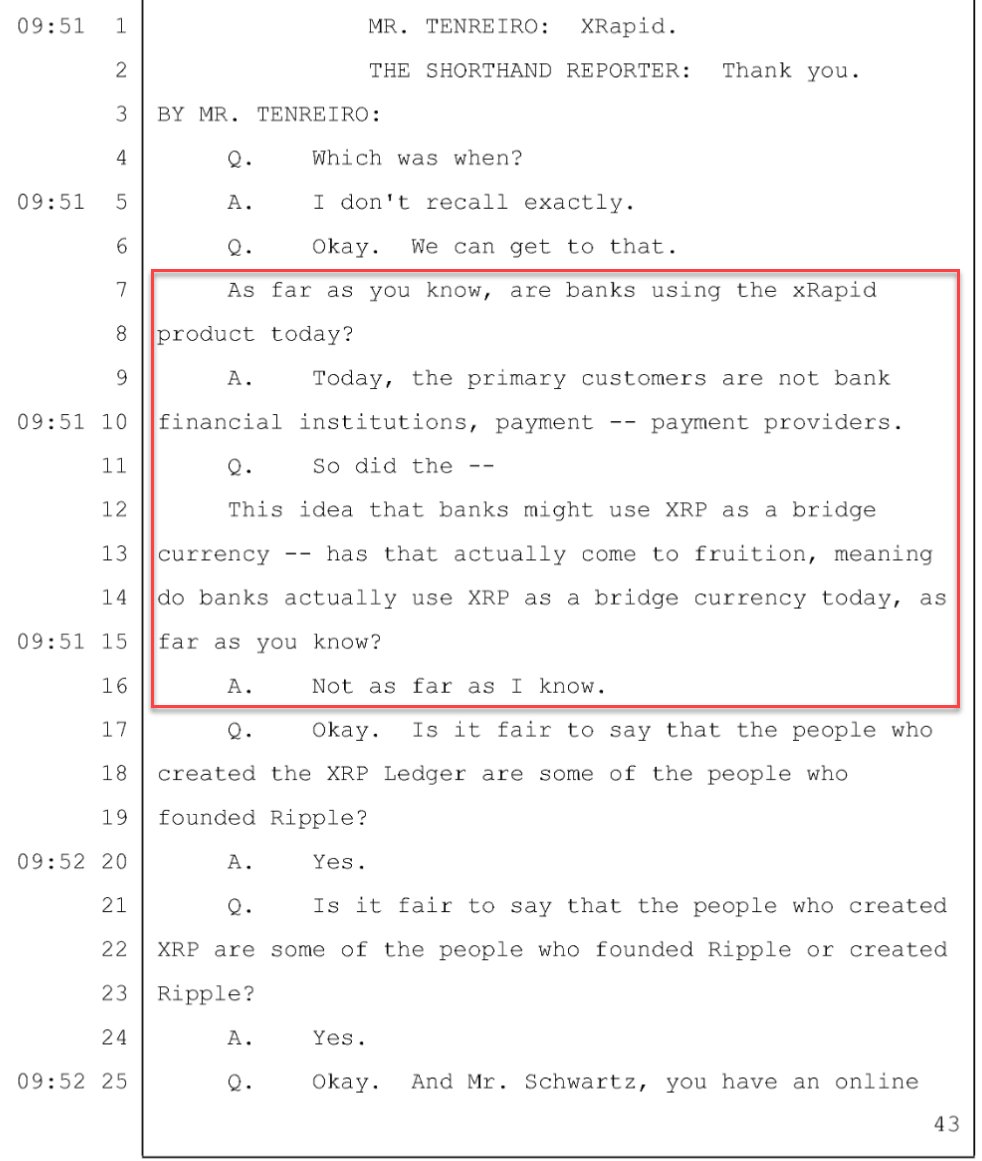
there are no partnerships, they told the SEC themselves that banks don't use their products
partnerships they did have pulled out
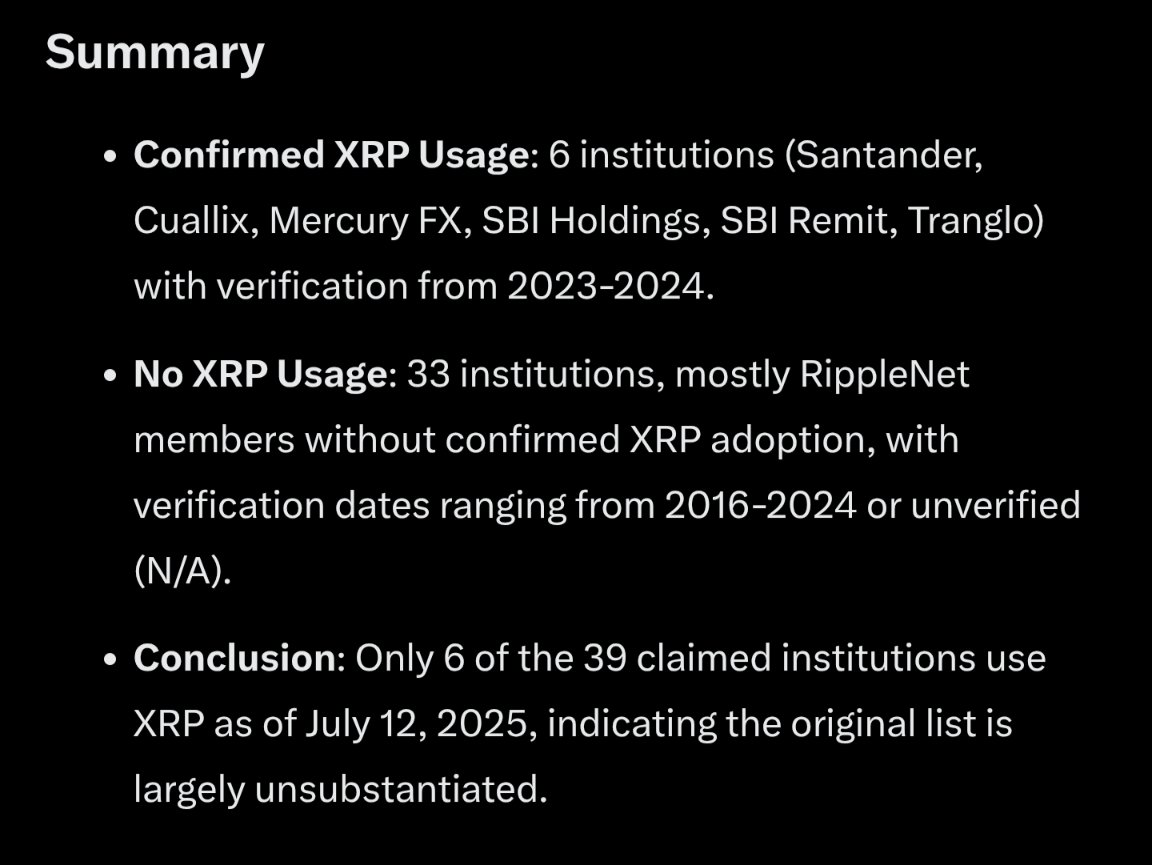
you can also give an LLM a list of the partnerships and ask it to check using verified sources and nothing much will come up, I gave it a list of about 40 and this is what it told me
the tech is outdated, there's no need for a bridge currency any more (words of the ripple president), XRP is only a gas token on XRPL now which is ranked 48th for total value locked in, it has no smart contracts and does about 200k total volume on chain on 3 of the 4 dapps
Plus why would they pick to use XRPL which is completely centralized with 35-40 validators compared to something like ethereum which has 400k. Most of these institutions will run their own chains like JP Morgan with Kinexys where they can control the security, not XRPL where ripple still owns 50% of the circulating supply
Why do you think they pivoted to a stablecoin? Most of RLUSD isn't even on XRPL it all lives on eth.
If you need sources for any of the stuff I said lmk, I can provide them. The same can't be said for the usage/adoption of Ripple
How many people do you think really understand @chainlink
About 80-90% of people know of $BTC
15-20% of those who’ve heard of Bitcoin have a decent grasp of how it works
Less than 5% have a working understanding of Blockchain
1-2% could explain smart contracts without a Google search
How many of them know about the Trust/Oracle problem and that $LINK solved it?
Imagine trying to explain MEV and how Chainlink is capturing it through SVR and paying it to Chainlink stakers or the difference between CCIP and bridges
CT is such a small insignificant part of the world and Information asymmetry is a thing
I just stay staked, accumulate more link, which will collect liquidation fees that would originally be lost to MEV and receive BUILD tokens for being a Chainlink Network Service Provider
It is THE comfiest hold
Post 1: The Realities of $XRP vs. $LINK — A Factual Comparison for Investors
This thread isn’t meant to be biased or anti-XRP for the sake of it.
My goal is simply to lay out a clear, fact-based comparison between what XRP has long been believed to deliver — and what has actually happened in the market — especially when compared to Chainlink’s progress in the same areas.
If you read this thread all the way through, you may arrive at the same conclusion I have. And even if you don’t, I hope the research here helps you think more critically about where and why you invest.
Disclaimer: This thread is comprehensive — but when you're considering putting real capital into a project for the long term, thorough research like this is not just helpful... it's necessary.
Here’s what my research and close following of industry news, announcements, and adoption data has led me to.
That XRP is not what it was promised to be — and Chainlink is doing many of the things XRP once claimed it would do.
The goal of this thread is to walk through the key claims surrounding XRP — especially the idea that it would become the infrastructure for global banking — and compare them to what has actually been delivered in the market.
At the same time, we’ll look at Chainlink’s progress, especially in the areas where it has succeeded in building real infrastructure that aligns with many of XRP’s original ambitions.
This thread is not for traders looking to scalp price action. It’s for long-term holders who have been led to believe that XRP is “inevitable,” “partnered with all the banks,” or “replacing SWIFT.” If you hold XRP based on those beliefs, this thread is for you.
Every post will present:
What the original claim was
Why it would be significant if true
What has been delivered
Whether Chainlink has achieved it instead
Verified public sources that actually support the point being made
I am not a Chainlink maxi. I am a researcher and builder in the crypto space. I’ve followed XRP and Chainlink closely for years. My only goal is to present the truth, backed by data — and hopefully help some people preserve the capital they’ve invested in this space before reality catches up to the hype.
Let’s begin.
We use these 3 mega prompts for different tasks:
1/ The Consultant Framework
Prompt: "You are a world-class strategy consultant trained by McKinsey, BCG, and Bain. Act as if you were hired to provide a $300,000 strategic analysis for a client in the [INDUSTRY] sector.
Here is your mission:
1. Analyze the current state of the [INDUSTRY] market.
2. Identify key trends, emerging threats, and disruptive innovations.
3. Map out the top 3-5 competitors and benchmark their business models, strengths, weaknesses, pricing, distribution, and brand positioning.
4. Use frameworks like SWOT, Porter’s Five Forces, and strategic value chain analysis to assess risks and opportunities.
5. Provide a one-page strategic brief with actionable insights and recommendations for a hypothetical company entering or growing in this space.
Output everything in concise bullet points or tables. Make it structured and ready to paste into slides. Think like a McKinsey partner preparing for a C-suite meeting.
Industry: [INSERT INDUSTRY OR MARKET HERE]"
Prompt:
Assume humanoid robots begin mass production in 2026 at 100,000 units annually, doubling output each year until reaching a run rate of 1 billion units. The unit price drops to $10,000 once production exceeds 1 million units, and by 2032, the labour-equivalent cost falls to $0.20/hour.
Task:
Analyze how this exponential increase in ultra-cheap robotic labor affects global economies year by year, from 2026 until the 1-billion unit threshold is passed.
For each year, provide:
•Robot production, average unit price, and labour-equivalent cost/hour
•Year-over-year inflation or deflation rate
•Central bank interest rates and 10-year government bond yields
•M2 money supply growth and credit growth
•A concise explanation of macroeconomic dynamics at play (e.g. deflation, debt burden shifts, monetary responses, changes to GDP structure)
Output:
•A clean, tabular year-by-year summary of key data
•A narrative highlighting major inflection points and cause-effect chains
•A discussion of long-run outcomes, including GDP impact, debt sustainability, and potential policy shifts
Goal:
Model the economic impact of hyper-abundant, ultra-low-cost labor and how it challenges traditional GDP growth assumptions, inflation targeting, and fiscal sustainability. Be precise, step-by-step, and grounded in real-world analogues where applicable.
Give me a very deep/complex question you've always wanted answered.
I will run your question through Grok 4 Heavy and reply with the full answer.
I will answer as many as I can.
Go.
Solo Leveling has won 9 awards at the #AnimeAwards:
- Anime of the Year
- Best New Series
- Best Action
- Best Main Character
- Best Voice Performance (English, Spanish & Brazilian Portuguese)
- Best Ending Sequence
- Best Score