my wife thinks i'm obsessed...but I will keep repeating this.
Claude Fable 5 + SEO is going to create more “self made millionaires” this year than the last decade combined.
don't bookmark this if it crosses your timeline.
just paste this entire thing into Claude Fable 5.
thank me later.
Jacob Bank, former Google product lead:
"I built up this team of 40 AI marketing agents to work with me. I'm the only marketing person."
In a 15-minute talk, he shows what one person with the right setup now runs alone.
Forty agents. One human. His AI bill is $500 a month, against the $50,000 a human team would cost.
That's the math quietly minting the first solo fortunes of the AI era.
Watch the talk, then read the piece below.
Bookmark this one.
As engineering, product, design, DS, etc. melt into a new kind of role, I was reflecting on what roles might look like in the future. For example, when I look at the Claude Code team I see what I think is five archetypes:
1. Prototyper: comes up with brand new ideas; churns out many ideas, most of which don't ship
2. Builder: quickly turns a prototype/idea into production-grade product/infra
3. Sweeper: cleans up the UI, simplifies the code and system, unships, optimizes performance
4. Grower: takes a product that has been built and iterates on it to improve Product-Market Fit
5. Maintainer: owns a mature system to make it secure, reliable, fast, and efficient as it scales
Many people span across 2 roles, and sometimes 3 roles. I also notice that these roles are not really tied to job function -- eg. across Anthropic, some designers match category 1, some 2, some 3; same for engineers, PM, DS.
A healthy team needs a mix of these, depending on the product:
- A product that is new and pre-PMF needs people that are strong at 1+2+3
- A product that is growing and has found PMF needs 2+3+4 and some 5
- A product that has strong PMF needs 3+4+5 and some 2
Maybe product roles of the future will look more like this, and less like the domain-specific roles of today?
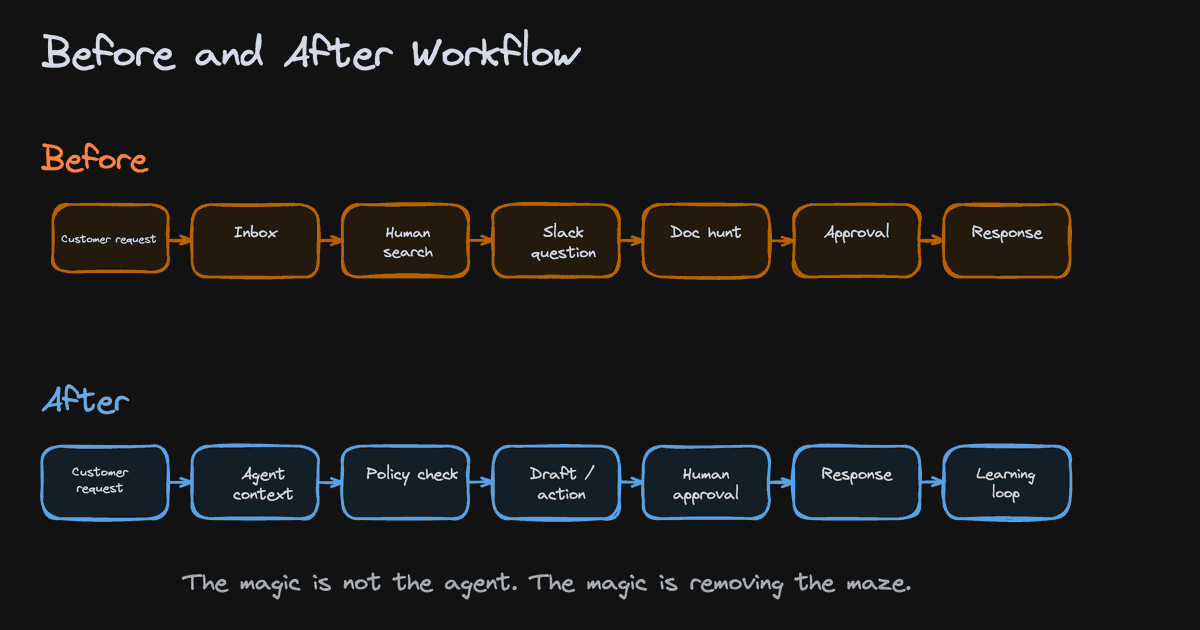
A friend asked me how to actually build a company that runs on AI agents.
I drew him 4 simple diagrams and this is what I told him:
For this to work, a few things have to be true.
- The humans move up to strategy, taste, and judgment while agents handle the execution.
- The whole business becomes readable to agents. Your data, SOPs, pricing, permissions, and decisions all live in one shared context layer.
- And you point it at the right work. Repetitive enough for an agent, complex enough that the incumbents never bothered. That's the goldmine.
In the old world, the company was the people. They held the knowledge, made the calls, did the work.
In this new world, the people become the creatives, the agents become the labor, and the company itself becomes the context layer.
That shared brain is the actual company now. The humans and the agents are just plugging into it.
Which means the most valuable thing you can build in 2026 is a business so well-documented that an agent can run it.
I see it everyday with @MeetLCA. I don't talk about it much publicly, but we've built a SWAT team for building AI-native orgs and AI-native products.
The moat is how legible your company is.
I drew it all out below.
I genuinely don't understand why everyone isn't using this yet
Andrej Karpathy, a co-founder of OpenAI, posted a simple idea that hit 16 million views: stop using AI to write code, use it to build a second brain.
You point Claude Code at a folder, drop in any source, an article, a transcript, a PDF, and Claude reads it, links it, and files it into a living wiki of everything you know. It compounds like interest, the more you feed it, the smarter it gets.
Here's the whole thing:
> Install Obsidian, create a vault, open it in Claude Code
> Paste Karpathy's wiki idea file and tell Claude to build it
> Claude makes three folders: raw for sources, wiki for its pages, a CLAUDE.md that runs it
> Drop any source into raw and say "ingest this"
> Ask questions across everything, forever
Five minutes to set up, and you never start from a blank chat again.
Full step-by-step guide with Claude and Obsidian, link below.
Bookmark this
🚨 BREAKING: Claude has a feature called Red Team Mode.
You can use it to attack your own business the way a competitor, investor, or angry customer would, and fix the weak spots before they become real problems.
Here are 7 prompts to access it: 👇
SOMEONE BUILT A FREE PROXY THAT READS PAYWALLED ARTICLES BY PRETENDING TO BE GOOGLE
it's called Ladder and it's sitting at 8,000 stars.
i never understood how the "free article" trick worked until i read the code. it's almost too simple. the NYT, WSJ, Bloomberg, and Nature can't hide their articles from Googlebot, because a page Google can't see is a page that vanishes from search. so they serve Google the full text for free.
Ladder just shows up wearing Google's badge. same user-agent, same crawler IP. the site hands over everything behind the wall.
> paste any paywalled URL and the wall disappears
> works across hundreds of news and journal sites
> self-hosted on your own server, so there's nothing to seize
> strips CORS and security headers too, a real time-saver for devs
> one Docker command and you're live
the hosted versions like 12ft. io keep getting pressured offline because they have a domain and a company to go after. your own instance has neither.
people pay for news bundles that still lock half the articles this opens for free.
GPL-3.0. written in Go.
repo: https://t.co/AIQ3IyKyKd
Andrej Karpathy:
“Vibe coding is incredible. But agentic engineering is the next level.
90% of my coding routine is automated by AI agents.”
In this 30-min session, Andrej Karpathy revealed how to build an AI agent workflow completely from the ground up.
It delivers more value than the $500+ agentic engineering courses you'll find online.
Give it a watch today - then dive into the article below.
Anthropic CEO:
"We use Claude Code across all stages of product development cycle. That's how we ship so fast."
In a 1-hour interview, Dario Amodei reveals how the fastest-growing AI company runs on its own model.
"Claude + loops + routines + dynamic workflows" - that's the secret.
Watch this interview or read the article on the same setup below.
KARPATHY WAS RIGHT. THIS 40-MINUTE Y COMBINATOR LECTURE PROVES IT
Karpathy said we're in the 1960s of AI - most people using Claude Opus 4.8 are still acting like it's just a search engine
> software 3.0 - LLMs as operating systems, not chatbots
> autonomous agents that run entire workflows without you watching
the 32 skills in this article are how you actually cross that line
bookmark this 👇
Someone compressed Andrej Karpathy's entire personal knowledge base workflow into 10 minutes.
Obsidian + Claude + your own files, querying a wiki that compounds instead of a chat that forgets.
Best AI workflow I've tested this year.
Anthropic engineer:
"You're not supposed to watch Claude Code work. You're supposed to wake up and review what it shipped."
In 22 minutes she builds the entire workflow live on camera.
Most people close their terminal and everything stops.
This setup keeps shipping while you sleep.
Watch the video, then save the exact setup below👇
9 GITHUB REPOS THAT LET YOU SCRAPE ANY WEBSITE WITHOUT GETTING BLOCKED.
Most scrapers get banned in the first 100 requests.
These ones do not.
Crawl4AI — AI-powered crawler built for LLM pipelines. Extracts clean structured data automatically.
https://t.co/PsCrtSjzsH
Firecrawl — Turns any website into clean markdown for AI consumption. Built for RAG pipelines.
https://t.co/bBKDUVnkcm
Scrapy — The battle-tested Python scraping framework. 50,000+ stars. Still the most reliable at scale.
https://t.co/CkpvJcdwsP
Crawlee — Playwright and Puppeteer wrapped in a scraping framework with built-in anti-detection.
https://t.co/8WKmolKdoj
Playwright — Microsoft's browser automation library. Handles JavaScript-heavy sites that break every other scraper.
https://t.co/2HKw2WPDsU
ScrapeGraph AI — Uses LLMs to navigate and extract data using natural language instructions.
https://t.co/o3UbwInkFb
Browser Use — Gives AI agents full browser control. Your Claude agent can now browse and scrape anything.
https://t.co/GwwR8pgo5B
Katana — Fast reconnaissance crawler built for security researchers. Handles complex site architectures.
https://t.co/iBSajJ43jc
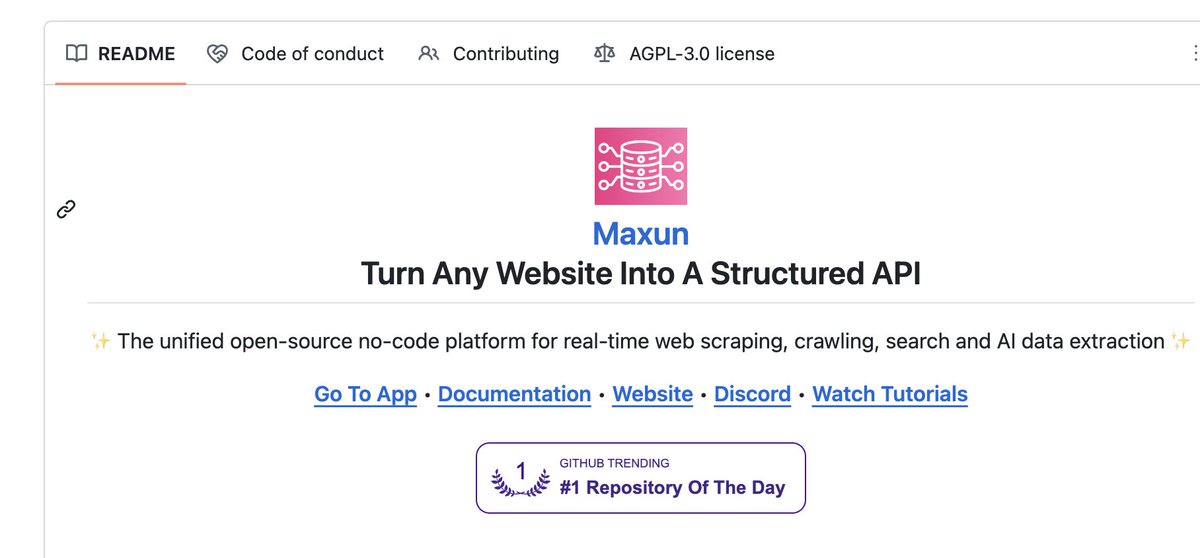
Maxun — No-code web scraping platform. Build scrapers without writing a single line of code.
https://t.co/JxSaiMuYQk
Bookmark this before your next data project.
Follow
@cyrilXBT
for every open source build worth your weekend the moment it surfaces.
Anthropic ha lanzado una guía de 37 minutos para construir Agentes de IA que automatizan una empresa entera.
Gratis. De los ingenieros que construyeron Claude.
Agentes que trabajan, se reparten tareas y ejecutan todo solos.
Subtitulado al español.
Guárdate este post. 🔖
This 16-minute talk by two Anthropic engineers who built Claude Skills will teach
you more about building them right than most developers figure out on their own in months.
Bookmark this & watch, no matter what.
Then read the guide below by @eng_khairallah1
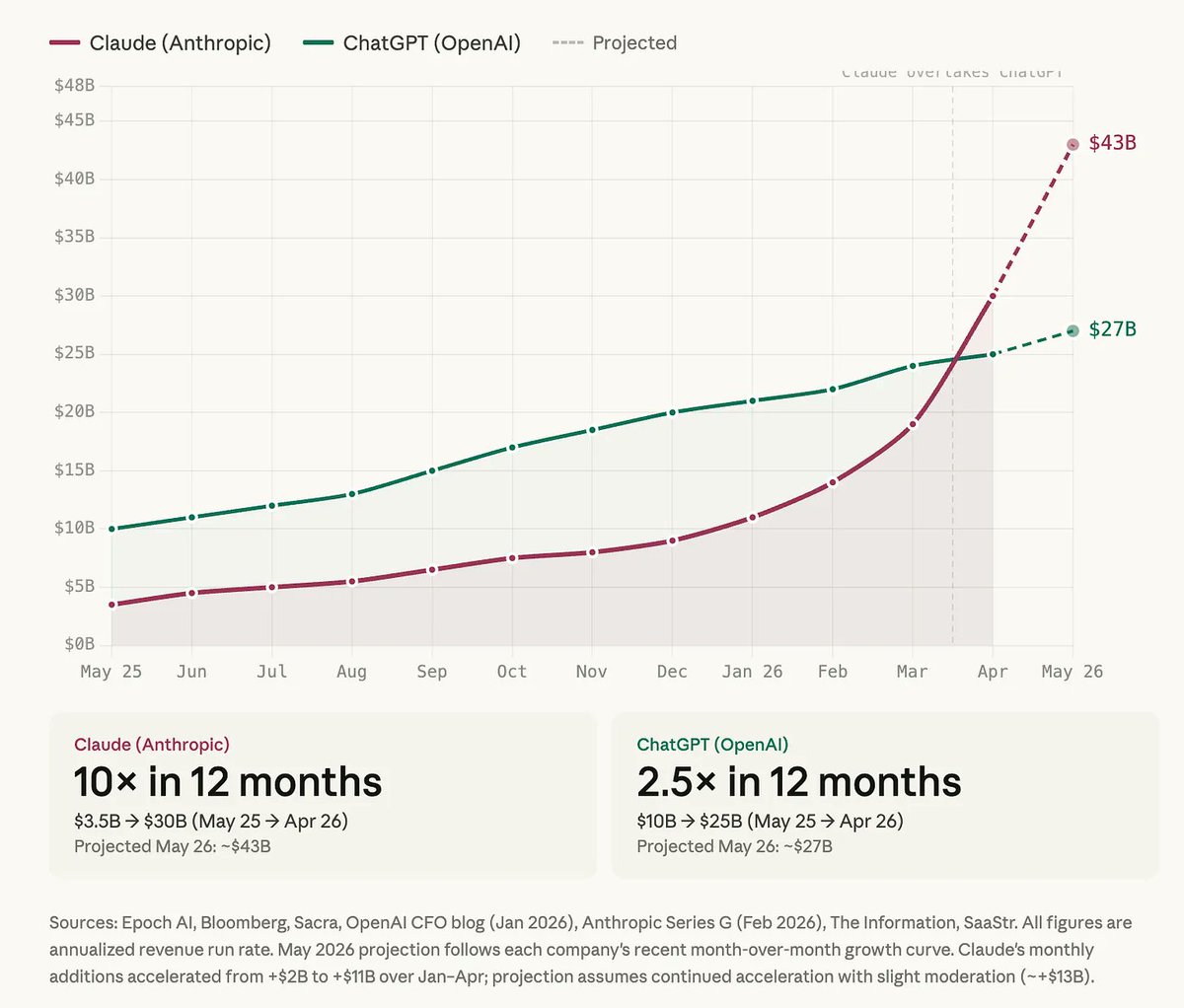
Anthropic makes more money than OpenAI.
$323.5 million/day. And most people using Claude still do this:
1. Re-explain who they are. Every. Single. Conversation.
2. Send 30 follow-ups that burn 31x more credits each time.
3. Type their prompts when speaking gets 4x better results.
The people switching to Claude are not getting better results because Claude is smarter.
They're getting better results because they set it up once. Properly.
3 files. 1 folder. 20 minutes.
Claude never asks who you are again.
I wrote a (completely) free guide to set up Claude the way the fastest teams are using it right now, for people who switched but never set it up.
Here: https://t.co/w0ze37vuMV
My friend Milla Jovovich and I spent months creating an AI memory system with Claude. It just posted a perfect score on the standard benchmark - beating every product in the space, free or paid.
It's called MemPalace, and it works nothing like anything else out there.
Instead of sending your data to a background agent in the cloud, it mines your conversations locally and organizes them into a palace - a structured architecture with wings, halls, and rooms that mirrors how human memory actually works.
Here is what that gets you:
→ Your AI knows who you are before you type a single word - family, projects, preferences, loaded in ~120 tokens
→ Palace architecture organizes memories by domain and type - not a flat list of facts, a navigable structure
→ Semantic search across months of conversations finds the answer in position 1 or 2
→ AAAK compression fits your entire life context into 120 tokens - 30x lossless compression any LLM reads natively
→ Contradiction detection catches wrong names, wrong pronouns, wrong ages before you ever see them
The benchmarks:
100% recall on LongMemEval — first perfect score ever recorded. 500/500 questions. Every question type at 100%.
92.9% on ConvoMem — more than 2x Mem0's score.
100% on LoCoMo — every multi-hop reasoning category, including temporal inference which stumps most systems.
No API key. No cloud. No subscription. One dependency. Runs on your machine. Your memories never leave.
MIT License. 100% Open Source.
https://t.co/KggwTqijmD
SOMEONE VIBE CODED A TOOL THAT FINDS BUSINESSES, READS THEIR REVIEWS, AND WRITES COLD EMAILS BASED ON THEIR OWN CUSTOMERS' COMPLAINTS
this is insane. you type in any business type and pick a city.
it scrapes every matching business off Google Maps with 30+ data fields.
then it visits their actual websites and pulls verified emails, phone numbers, and every social media profile they have
scraped live, not from some outdated database like other tools
then the AI reads up to 50 of their Google reviews and finds their exact pain points
"clients complain photos don't show the real size of properties" or "listings take too long to sell"
then you tell it what YOUR business does. it cross-references your offer with their specific problems and generates a fully personalized cold email for each business.
send it in 2 clicks. one by one and not bulk so it lands in the primary inbox
and all of those leads land on a GPS-mapped CRM where you can draw sales territories, optimize driving routes, track your team's activity in real time, and transcribe voice notes after meetings.
works in 200+ countries and with any business type. if they're on Google Maps you can find them
this is the most complete lead gen tool i've ever seen
AND he vibe coded the whole thing with Claude Code in 2 weeks