@mecceree Esa es la verdad, guste o no. Cualquiera que observe la realidad y reflexione 5 minutos de va a dar cuenta.
El problema es la gran cantidad cree que enojandose con la realidad la va a cambiar.
@Aristoteles_per "esta sembrando las semillas de su derrota cultural", esto resonó, sobre todo en relación a postulados absurdos pero generalizados del feminismo actual.
@CasazzaXS Es cierto. El tema es que los simps siempre han existido, sólo que ahora son visibles con esos "me gusta", a mujeres que, por otro lado, jamás siquiera los mirarían.
The reason Americans defend billionaires with such genuine passion:
Not cynical passion. Genuine. Heartfelt. "How dare you tax him more, he earned it."
The reason is that the billionaire is not experienced as a class enemy.
He is experienced as a possible future self.
And you cannot tax your future self. You cannot regulate your future self. You cannot speak with contempt about your future self without experiencing it as self-hatred.
The fantasy protects him better than any security team.
The fantasy is the security team.
The gate that keeps the pitch fork away from the manor is not made of iron.
It is made of the unexamined belief, held by people who are one medical bill from catastrophe, that they are fundamentally more similar to the man with nine houses than to the man sleeping in a doorway.
It costs him nothing to maintain.
It costs you everything.
The industry is in a tough spot right now, with AI-driven attacks spiking and the volume still climbing. If you hold anything digital, assume every link, every DM, and every message marked urgent is hostile until you’ve verified it yourself, and never share seed phrases or wallet access with anyone regardless of how legitimate they appear to be.
It’s also worth drawing a clear line between cryptocurrency and tokenized real-world assets, because they get lumped together but there are differences. In crypto the asset is the bearer instrument, so if someone takes your keys they take your funds, whereas in digital securities ownership is registered and sits inside regulated infrastructure with an issuer and transfer agent behind it, which means you can’t simply have a security stolen the way a wallet can be drained (if it was structured and issued properly).
That structural difference is going to become a lot more obvious as this space matures. None of this is meant as a criticism of crypto, since Bitcoin and the broader ecosystem genuinely opened the door to programmable value, a world of new assets and opportunities, innovations and a whole lot more and that foundation still matters. The world is highly volatile but crypto will continue to grow and thrive, the macro issues we face have not changed that much, the overall crypto thesis remains very much in tact.
Digital securities, which are most RWAs, are simply a different category with different products and different access, covering things like commodities, private credit, pre-IPO shares, and real estate that can now be fractionalized and put on-chain. While headlines keep chasing Bitcoin’s price, the real-world asset side continues growing underneath all of it, with inbound interest running extraordinarily high across those asset classes.
The real economy is far larger than the crypto economy, as there are simply many more real world assets out there, it’s an infinite TAM, it’s trillions and more, and that’s exactly where IXS is positioned, on regulated rails with institutional-grade infrastructure and a network of partners who see tokenization as infrastructure rather than a passing trend.
To everyone in the community, stay safe, stay sharp, verify everything, and trust slowly, because the noise will eventually settle and the builders will still be standing. If you’re new here, welcome, there’s a whole lot more coming.
@IxsFinance
The $IXS Unicorn:
Licensed RWA infra with a ~$15M FDV, sitting in a $9.4T market
@IxsFinance only needs a win a minor share for meaningful token buyback and burns (20%).
100% circulating supply. Worth a look I think.
Thread 👇
$IXS | @IxsFinance - THE RWA DISTRIBUTION THESIS
🧵
There’s a reason $IXS is gaining attention from T1 VC's to the fundamental utility gem hunters.
Most people looking at RWA are focused on who tokenizes the assets.
I think the bigger opportunity could be who distributes them.
That’s the market $IXS is positioning itself for.
◼️ THE MISSING PIECE
#BlackRock, Fidelity, Franklin Templeton and others are increasingly bringing traditional financial products onchain.
But creating the product is only step one.
Those products still need compliant infrastructure capable of putting them in front of exchanges, wallets, apps, institutions and eventually autonomous AI agents.
That’s where IXS comes in.
Rather than being another RWA issuer, IXS is building the licensed infrastructure connecting products to distribution.
In simple terms:
Institutions create the assets.
@IxsFinance provides the rails.
Exchanges, apps and agents provide the users.
◼️ YEARS OF BUILDING BEFORE THE MARKET ARRIVED
IXS started life as IXSwap in 2021.
Back then the RWA opportunity looked very different.
Institutional adoption was limited, regulation was hostile and much of what is happening today simply wasn't possible.
So the company spent the intervening years building the difficult stuff:
Licensing.
Compliance.
Technology.
Custody relationships.
Institutional connections.
The business is backed by Coinbase Ventures, UOB Venture Management and others, with advisers including Gabriel Abed and former Coinbase CTO Balaji Srinivasan.
When the US regulatory environment changed in 2025, IXS was already positioned to expand into a much bigger vision.
◼️ ONE INTEGRATION, AN RWA MARKETPLACE
The result is essentially an RWA infrastructure API.
An exchange, wallet, fintech or AI agent shouldn't need to spend years recreating the legal, regulatory and technical stack required to offer tokenized financial products.
They integrate the infrastructure instead.
And importantly, IXS isn't building empty rails.
The aim is to populate them with products including Treasuries, bonds, private credit and other tokenized assets from major financial institutions.
Then distribute those products wherever users already are.
That distinction matters.
◼️ THE BTC OPPORTUNITY
This is one of the most interesting pieces of the $IXS thesis.
In April 2026, IXS partnered with BitGo.
Together they've developed infrastructure allowing institutional BTC holders to access yield generated through RWA products.
BitGo has 1,500+ institutional clients and is involved in marketing the product to that network.
Think about the potential market here.
Enormous amounts of BTC sit in institutional custody.
IXS is creating a bridge between that dormant BTC and yield-bearing real-world assets.
Then there's WBTC.
IXS has also announced a partnership designed to enable WBTC holders to access real yield through the same RWA infrastructure.
You don't need to capture the whole market for the numbers to become interesting.
◼️ THE NEXT USER MAY NOT BE HUMAN
There's another part of this story that I think is being overlooked.
AI agents are going to hold, allocate and manage capital.
Those agents will need somewhere compliant to put idle funds.
IXS is building for exactly that.
Its Agentic Vault infrastructure enables agents to access RWA products from major asset managers through an API.
BNB Chain announced the IXS RWA Agentic API was live in July.
IXS is also positioning across the developing agent ecosystem around Coinbase, Circle and others.
If agentic finance becomes meaningful, the infrastructure layer connecting AI capital to regulated yield could become extremely valuable.
◼️ DISTRIBUTION IS THE MOAT
This is ultimately what makes the story interesting to me.
LINE: ~180M users.
UnionChain: 20M+ KYC'd users.
BitGo: 1,500+ institutional clients.
BNB ecosystem.
WBTC.
Potential exchange integrations.
And further chain expansion ahead.
The objective isn't to build another destination users have to discover.
It's to embed IXS underneath platforms where the users and capital already exist.
That's a very different model.
◼️ WHERE VALUE FLOWS
Then comes the token.
20% of platform fees are allocated to $IXS buyback and burn.
Which creates a simple flywheel:
More integrations
→ more assets
→ more users
→ more volume
→ more fees
→ more $IXS bought and burned.
The important variable isn't how many partnerships can be announced.
It's how much capital eventually moves through the rails.
At scale, that's where the token economics become interesting.
◼️ WHY I'M WATCHING Q4
The infrastructure phase appears to be turning into the distribution phase.
BNB is live.
Further major-chain expansion is planned.
Robinhood and Base have been flagged as next steps.
IXS has discussed advanced conversations with major exchanges and a Tier 1 fund managing $1T+.
More institutional products are expected to come through the platform.
And management has signalled significant Q4 developments.
All of this against a current FDV of roughly $20M.
The $IXS bet isn't simply that RWA gets bigger.
That's already happening.
The bet is that as trillions of dollars of assets move onchain, distribution becomes one of the most valuable layers of the stack.
And IXS is trying to own part of that layer before the market fully realizes it exists.
$IXS
CA:
0x73d7c860998CA3c01Ce8c808F5577d94d545d1b4
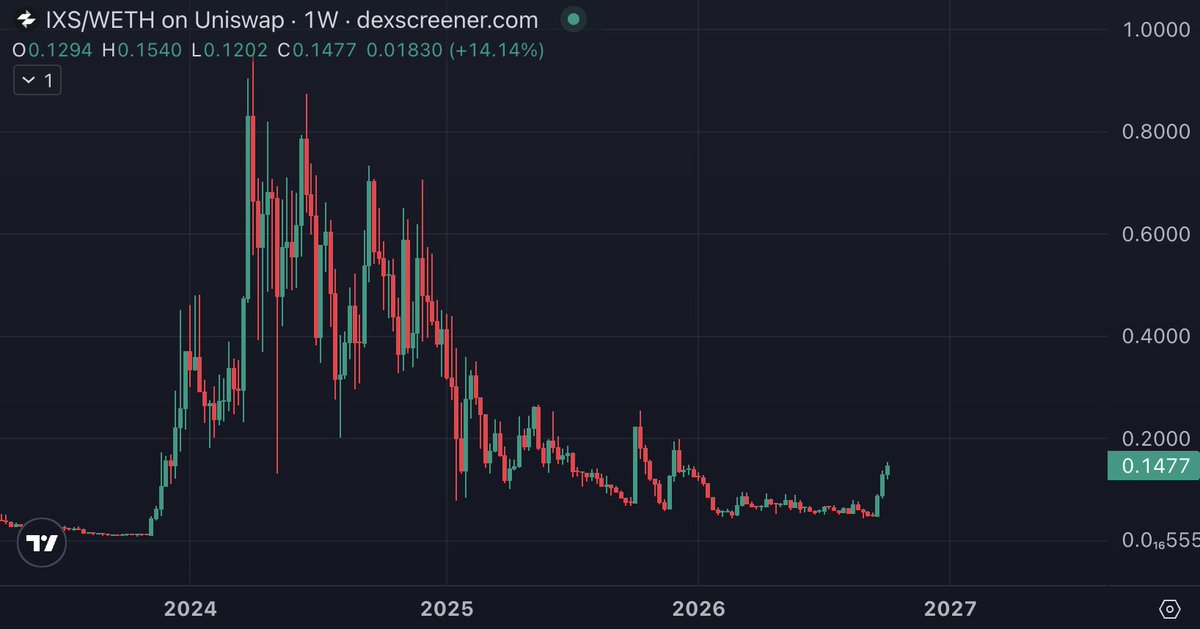
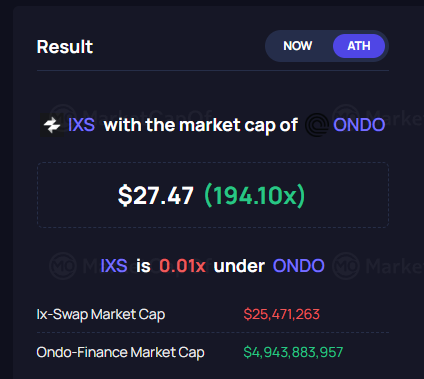
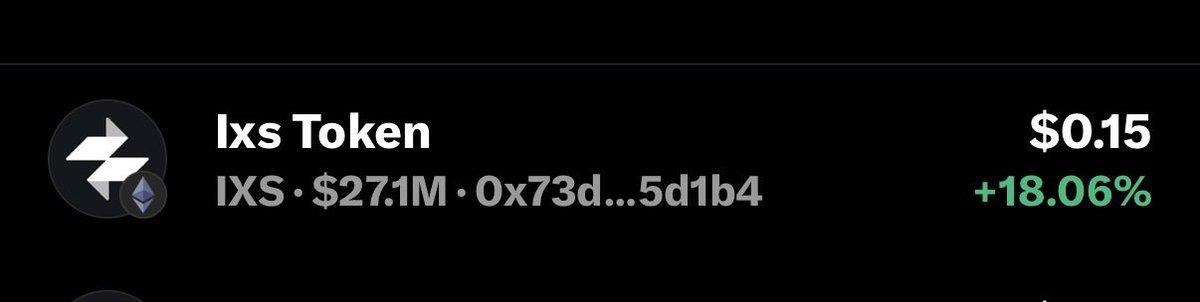
At just $26M fdv today, one would think $IXS is just a small player in the RWA space
But if you actually dig into their products, their licences, infrastructure build, platform integrations, partnerships, backers, and what's coming in the pipeline... you'll find a huge disconnect between its scope/TAM vs current valuation
This disconnect only exists because nobody is paying attention to crypto or RWAs right now
But this is rapidly changing and the gap is starting to close
So $IXS was $200M in 2024, back when tokenization and RWA was minor narrative.
Now RWA and tokenization are crypto's largest narrative. As now we see the SEC pushing regulations and clarity, opening up crypto to TradFi's trillions$.
Yet @IxsFinance is at $25M? 200x from $ONDO
Standard Chartered taking tokenized RWA and stablecoin custody to Singapore is the institutional side of this market getting proper plumbing.
Once live, that's four bank custody hubs.
It's the direction we've been building toward: real-world assets held onchain and earning onchain.
We've built for the holder that comes next too.
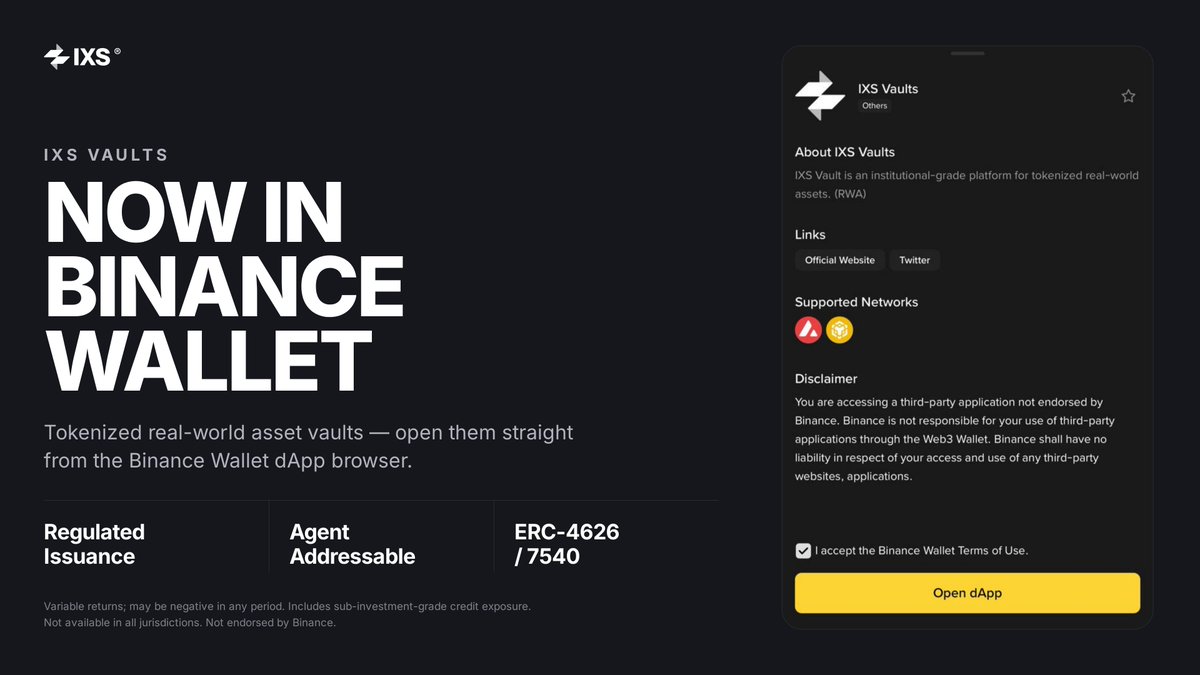
Our ERC-4626/7540 vaults are agent-compatible, so an AI agent's wallet can hold the position and earn the yield directly
ethereum:0x73d7c860998ca3c01ce8c808f5577d94d545d1b4 Vaults in Binance Wallet flipped the narrative.
Not: "How do we acquire every user?"
But: "Which platforms with users can we plug into?"
TOKEN2049 showed the next step: new issuers, new distribution talks.
That distribution is how #RWA rails scale
IXS is a licensed RWA platform bringing real-world yield onchain:
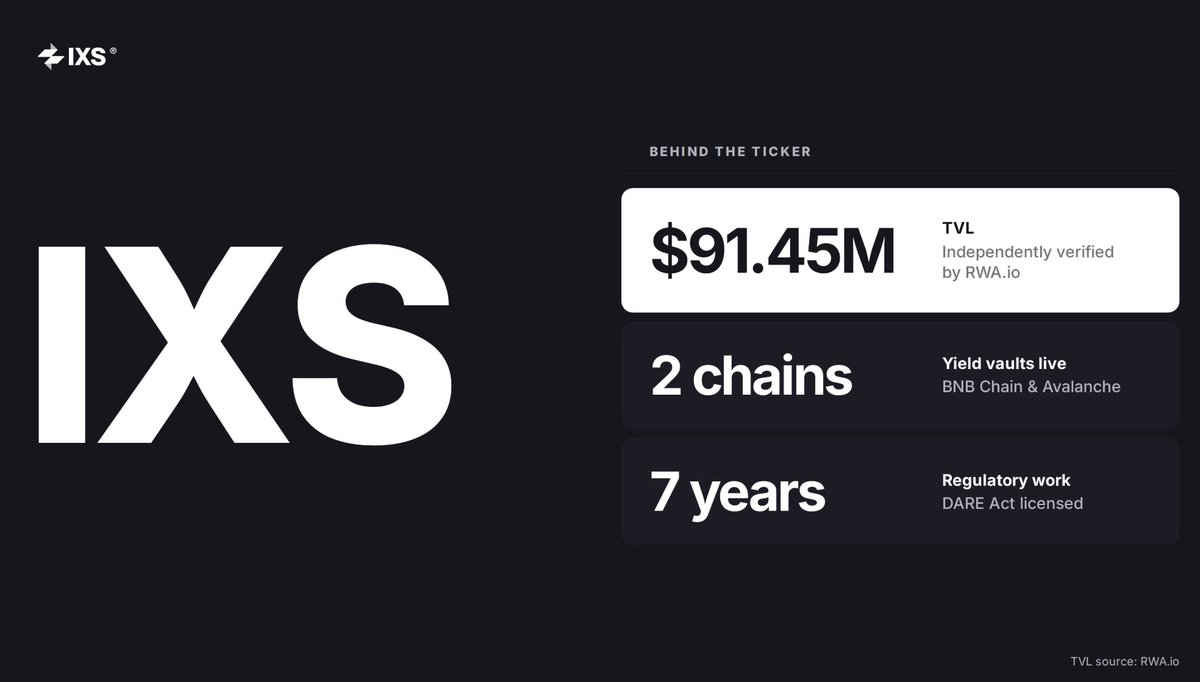
money market funds, investment-grade corporate bonds and private credit, across 10+ blockchains, with $91.45M in TVL verified by https://t.co/exICxhyor6.
Next: the yield layer for agentic finance.
Here's the plan 🧵
$IXS to $10B is what I read here.
Bitgo + Flowdesk + $1T asset fund + wBTC tokenisation + 20% buyback and burn on fees.
@IxsFinance doesn’t need retail money.
Lockheed Martin generated $54 billion in U.S. government revenue in 2025.
Fifty-four billion dollars. From one company. In one year.
This is not a defense budget line item.
This is a structural relationship.
A company that size, dependent on government contracts that size, does not wait passively for the government to decide what weapons it needs.
It employs more lobbyists than most countries have diplomats.
It funds think tanks that produce the strategic frameworks that define what threats require what responses.
It employs retired generals whose job is to explain, on cable news, why the current geopolitical situation requires the capabilities Lockheed produces.
It has manufacturing facilities distributed across enough congressional districts that cutting its contracts would mean cutting jobs in enough members' home states to make the vote politically fatal.
The weapons do not exist because the threat was assessed and the weapon was deemed necessary.
In many cases, the threat is assessed, at least in part, by people whose income depends on the weapon being deemed necessary.
This is not conspiracy theory.
This is published lobbying data, publicly available employment records, and observable congressional behavior.
The question is not whether this happens.
The question is why it's not the first thing taught in every American civics class.