IRYS Tokenomics Breakdown — fast summary
IRYS just revealed its tokenomics, and here’s the quick breakdown you actually need to know.
> Core Data
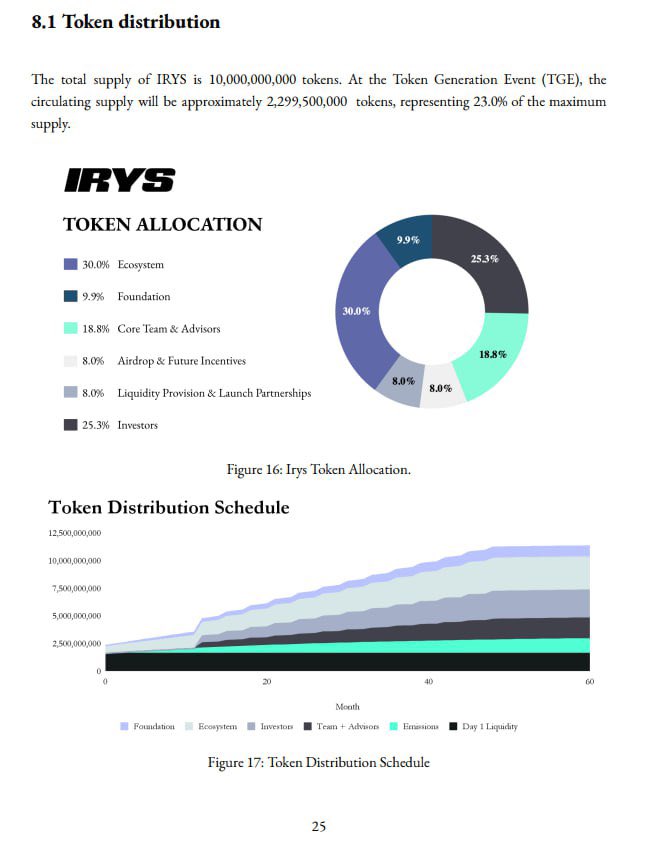
— Total supply: 10,000,000,000 $IRYS
— Funding raised: ~$18.9M total
— Seed: ~$5.2M (May 2022)
— Strategic: $3.7M (June 2024)
— Use case: IRYS is building a Layer 1 focused on data, compute, and AI integration — not just storage.
> Token Utility
The $IRYS token isn’t just a governance badge — it’s meant to power the entire ecosystem:
— Access to network services (compute, storage, data interaction)
— Staking for node validation and network security
— Governance — decisions on future upgrades and protocol direction
— Incentives for active network participants and long-term holders
The point is to create a circular economy: the more the network grows, the more the token is actually used, not just traded.
> Why It Matters
— Clear utility and integration into core network functions = sustainable demand.
— 10B supply is moderate for an L1 aiming at large-scale data and AI use cases.
— Backed by real investors with long-term vision — not just hype.
— Positioned in one of the hottest narratives: AI + blockchain convergence.
> Key Risks
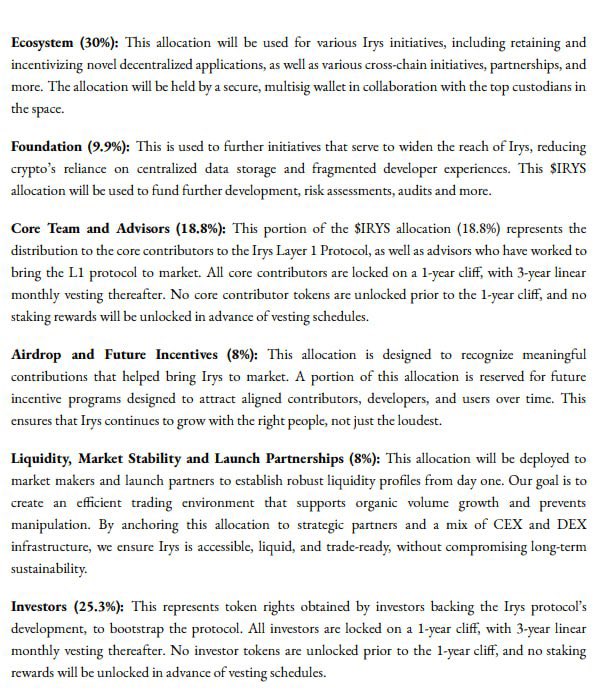
— Vesting and unlock schedule will define how much early investor pressure hits the market.
— Utility must translate into real on-chain demand — not just theoretical use.
— Competing with big names in AI-data infrastructure means execution has to be near perfect.
> TL;DR Post Summary
IRYS just dropped its tokenomics:
— 10B total supply
— Token fuels compute, data, and governance
— Investors: ~$18.9M raised
— Aiming to be the go-to chain for AI and data execution
Utility is strong, vision is clear — but execution and unlocks will decide how far this token can actually go.
Over time, it becomes apparent in Ritual that not everyone moves the same way here. The difference is not in pace or activity, but in the way people read space. Some are trying to fulfil it with actions. Others watch carefully before changing things. Ritual gradually shifts the focus in the direction of the second approach.
Here it quickly becomes clear that the context weighs more than the intention. Even the right action, taken at the wrong moment or in the wrong place, loses its meaning. This forces you to stop, test yourself and work not with the desire to act, but with an understanding of where action is really needed.
Gradually, the need to constantly manifest itself disappears. Participation becomes quieter, but more accurate. You begin to realise how the system reacts not to quantity, but to relevance. And it is this relevance that over time forms trust without words, without roles, without signalling.
@ritualnet@ritualfnd@Jez_Cryptoz@joshsimenhoff@dunken9718
In Ritual, it becomes clear fairly quickly that attention isn’t the main currency. It’s easy to gain, but it rarely changes anything. What matters more is how you operate inside the system and whether your actions leave a trace. That distinction is what separates presence from participation.
Over time, the way you act begins to shift. You stop reacting to everything and start choosing moments. Context starts to matter more than speed, and precision more than volume. Ritual doesn’t push constant activity — it sharpens awareness of where a step actually makes a difference.
Decisions accumulate here. Even small actions carry consequences, and if you observe long enough, an internal logic reveals itself. This isn’t knowledge pulled from documentation, but an embodied understanding of how the system responds, where it resists, and where it opens space for movement.
Ritual also reframes responsibility. You’re not just completing tasks — you’re accounting for what follows. Impulse gives way to structure. Choices become quieter, but more exact. Over time, this changes how you evaluate situations, not only within Ritual, but beyond it.
Eventually, participation stops feeling like a separate activity. It begins to shape how you think, how you weigh decisions, and how you move through complexity. Not through rules or enforcement, but through sustained contact with real constraints. That’s why Ritual doesn’t feel like just another community. It feels like an environment where a way of thinking is formed.
@ritualnet@ritualfnd@Jez_Cryptoz@joshsimenhoff@dunken9718
There’s a quiet separation that happens over time. Not between beginners and experts, not between loud and silent, but between those who chase visibility and those who build position.
Ritual doesn’t amplify presence — it reveals alignment. You start to notice who moves with intention and who moves for attention. Who enters spaces to be seen and who enters to place something into the system. Nothing here rewards immediacy. Nothing favors urgency. Value accumulates through placement, not performance.
Through timing, not frequency.
Through coherence, not exposure. Gradually, participation changes shape. It stops being about staying visible and starts being about staying relevant.
@ritualnet@ritualfnd@Jez_Cryptoz@joshsimenhoff@dunken9718
Ritual turns onchain participation into real skills. Most Web3 communities promise growth, but in practice they reward noise. You talk more, react faster, farm activity, and call it participation. But none of that truly teaches how protocols actually work. This is where Ritual feels different. Ritual doesn’t treat participation as engagement — it treats it as practice. Every action slowly moves you toward understanding how onchain systems behave in real conditions, not in theory, not in threads, but through action. Instead of abstract roles, you operate inside real workflows. You see how models are invoked, how infrastructure responds, how decisions propagate onchain. Over time, patterns emerge. You stop guessing and start recognizing structure. Ritual also changes how responsibility feels. You’re not just “trying things out.” Your actions have context and affect outcomes. That pressure isn’t loud, but it forces clarity, pushes you to verify assumptions, and think one step ahead. What matters most is transparency. Nothing happens behind closed doors. You can trace decisions, understand why something worked or failed, and adjust your approach. This feedback loop is what turns repetition into skill. In the end, Ritual isn’t about being early or loud. It’s about becoming competent. Not overnight. Not magically. But steadily — through deliberate, onchain practice. That’s rare in Web3. And that’s why it matters.
@ritualnet@ritualfnd@Jez_Cryptoz@joshsimenhoff@dunken9718
Ritual for me is not just a project and not a chat where everyone writes something it’s about a different approach to the crypt and in general to decisions here no one drives you to buy or sell here they teach you to see the picture wider and not drown in the noise I noticed that with the ritual the constant bustle disappears you stop opening the schedule every five minutes you stop catching every movement and start acting calmly the ritual is about discipline about patience and about the moment when you are not afraid to do nothing because you understand why you are waiting here not a quick but a cold head is formed and this is what gives the result over time.
@ritualnet@ritualfnd@Jez_Cryptoz@joshsimenhoff@dunken9718
This is my 60th post, and this time it’s about a project that really inspires me.
Ritual does not cling to promises of drops and not with loud words. It’s all about action. About what you do every day, even when no one is watching. No show, no activity farm for the sake of a tick.
I’m close to the Ritual logic: you’re not trying to look useful — you’re either useful or not. You read the doc, test the information, help others, understand more deeply. Small steps, but they accumulate.
This is a project about discipline without pathos. About development without shouting “we’re early”. About a community where the value can be seen by actions, not by roles in Discord.
These are the things that inspire when you realise that your time and effort do not disappear in the noise, but add up to a real way. Ritual is
just about that.
@ritualnet@ritualfnd@Jez_Cryptoz@joshsimenhoff@dunken9718
AI coprocessor instead of an AI tag.
Are you building a dApp and want AI to be not just in the name but also in the code?
Then Ritual gives devs an AI coprocessor for Web3, and smart contracts can now call models with a couple of lines of code and get transparent and verifiable results of all this directly on-chain.
Instead of centralized APIs with unclear limits, you work with a decentralized network of nodes that are specifically optimized for AI computations.
Do you want your product to react to the market in real time?
Ritual made it possible to embed AI logic into DeFi, lending, agents, or any contract. Then the model analyzes the data and the protocol immediately makes sure the protocol updates parameters. Based on what? On risk limits and strategy conditions. This opens the door to new types of dApps, namely self-learning protocols, on-chain agents, generative services that live not off the network but directly inside it.
A dApp as a frontend to a model, not to a server
Forget about “one backend for everyone”. With Ritual your application connects to a network of AI nodes, where models are already hosted and updated, monetized as full-fledged on-chain assets. When you need new functionality, you don’t wait until someone leaks their private API, you choose a model from the Ritual ecosystem, connect via SDK or GMP layer and launch a new feature without changing the entire stack.
@ritualnet@ritualfnd@Jez_Cryptoz@joshsimenhoff@dunken9718
Ritual is about that moment when AI stopped being “somewhere out there where it’s badly needed” and appeared inside the blockchain as a real participant in the game, on the same level as smart contracts and tokens. At that moment, not only the tech changes, but also the kinds of products that can be built on top of on-chain AI.
Smart contracts can call inference models like a simple function inside a transaction: the model gives an answer and the contract immediately updates the state of the protocol after that.
Model marketplaces: places where devs upload and trade models, then receive royalties, while users choose what they can actually trust on-chain, not just by looking at some shiny landing page.
How does this all tie into Ritual?
Basically, Ritual is now moving exactly towards making AI models a native part of the infrastructure: models are stored, updated, and called as a base block, not as some random plugin. If you join Ritual now, you’re basically learning to work with a format where AI is a new type of on-chain asset that can be used to build a whole generation of dApps that most L1/L2s don’t even have yet.
@ritualnet@ritualfnd@Jez_Cryptoz@joshsimenhoff@dunken9718
Daily Ritual for 1 hour.
Ritual - not to spend days in it, but for the stability of every day. Just a stable upgrade every day, yes, you may say that it’s not time but 2, but it’s not exactly half a day or not a whole day. This should be the way every day, because Ritual loves stability in working with it.
If you stick to this format for a couple of months, it will definitely be highlighted, and the understanding of the stack will change, AI and you will also take your role in this project.
We talked in the chat for 10-30 minutes, when you already have the opportunity not to do too much work, and when you don’t, you need to see how you do it and how much time you have to allocate time for the project, then you look for time and invest as much and longer as possible, then it will be easier and clearer.
We talked for 10-30 minutes, then you can write a new text on post, maybe people will give some idea in the chat for this. Then I went to make my art, then I did everything as it should, and it can take even a couple of months, but the higher you climb, the easier it becomes, because you already know what you will do and you are not doing it not the first time.
Then after that, you can draw conclusions, if you don’t like something or don’t like it, next time do it better.
After doing this for a couple of months, you will no longer dig only for the role as quickly as possible, and no matter what, you will do it gradually, in the right steps.
Everything you don’t do is for the
best.
@ritualnet@ritualfnd@Jez_Cryptoz@joshsimenhoff@dunken9718
Many people think that speed is what matters in crypto, but I’ll tell you—it’s not.
What really matters is the ability to see patterns in chaos before acting, to keep yourself afloat.
Ritual has created a format where information is filtered, and actions don’t arise randomly.
Siggy is here as a symbol of observation, ensuring there’s clarity, not noise.
He acts as a filter for chaos—not just present in the system, but filtering it for users.
He helps separate chaos from pure information.
He reminds us that decisions are not born in panic, but in observation.
Those who follow his example learn to distinguish noise from signal, see patterns, and take steps with confidence.
@ritualnet@ritualfnd@Jez_Cryptoz@joshsimenhoff@dunken9718