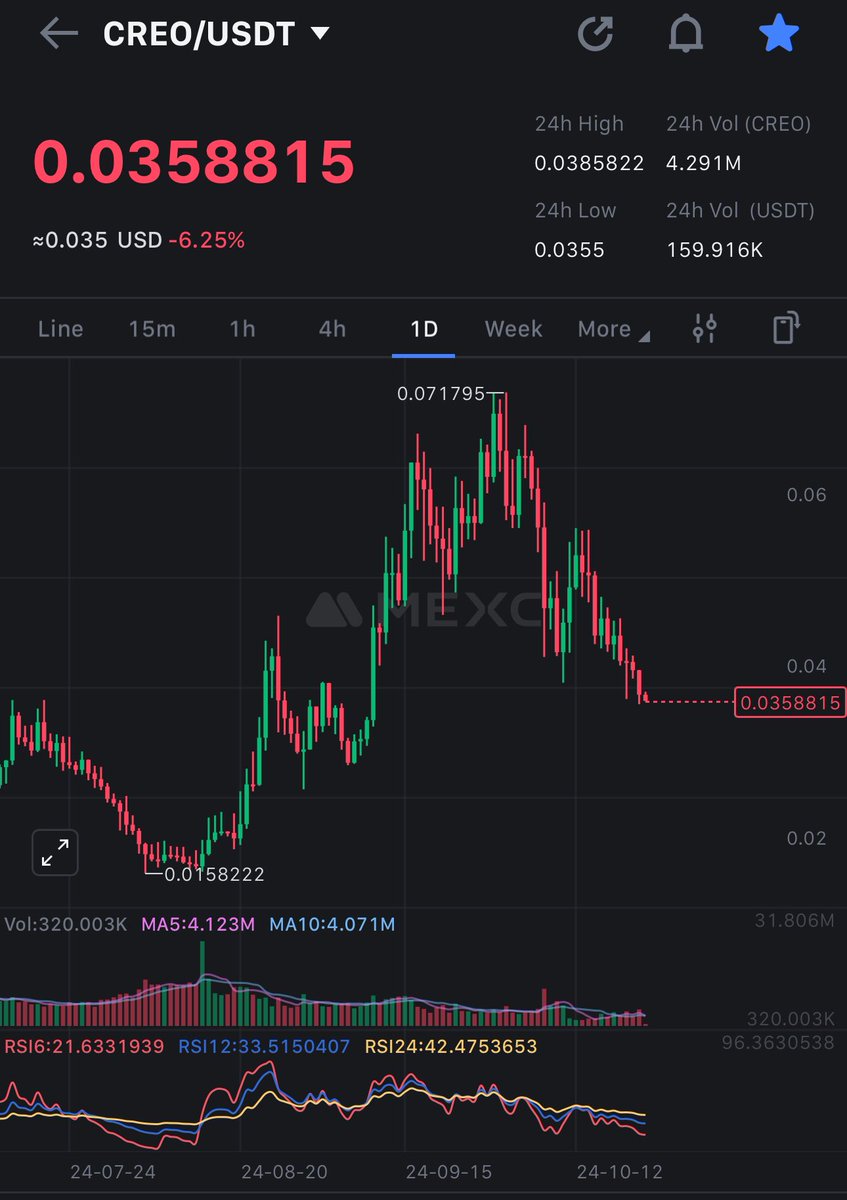
Looking for the next big thing in crypto? $CREO is the gaming ecosystem that’s changing the game literally! With a mission to integrate blockchain into everyday platforms and create an interconnected metaverse, @creo_engine is building the future of Web3 gaming. Not only does $CREO make blockchain gaming accessible to all, but it’s also tapping into massive markets across Asia, Europe, and North America. 🗺️ For investors, this means getting in on the ground floor of a rapidly expanding market.
$CREO is solving major issues in gaming, like asset interoperability. Imagine using your hard-earned digital items across multiple games that’s what $CREO is making possible! 🔥 No more losing value when a game ends, as assets are preserved on a decentralized network. This unique feature alone makes $CREO a game-changer, ensuring that digital assets retain value and can be utilized in future games.
In addition, $CREO offers a secure NFT marketplace where users can trade in-game assets without the fear of fraud. With staking options, token creation tools for developers, and the ability to convert in-game currency into real-world value, $CREO is turning gaming into a true financial opportunity. 💰 These features are bound to drive demand, pushing the coin's value higher as the ecosystem grows.
As $CREO continues to expand globally, the potential for mass adoption is enormous. Its user-friendly platform and developer support make it easy for games to integrate blockchain, which will attract more players and investors alike. If you're looking for a project that combines entertainment with financial upside, $CREO is the one to watch! 👀
$CREO is currently in a dip, like the rest of the market. This is your chance to get in this great project at a very cheap price! 💎 #BuyTheDip
With a backed team, who puts out constant updates, only hires the best of the best, its only a matter of time before this gem takes off again. 🚀
MC: 13M
Price: $0.035
#Crypto #Bullrun #Bullish #CREO #Gamingcoins #SAND #GALA #Cryptogems #BTC #Alts #Altcoins #WEB3 #Web3Gaming #web3game
How do you trust anonymous GPUs to run real AI workloads without a centralized authority checking their work?
Crynux approaches the problem with three layers:
→ vssML verifies computation and catches dishonest results
→ Staking puts real economic consequences behind bad behavior
→ QoS identifies slow, unreliable, or consistently underperforming hardware
Together, they create a cryptographic, economic, and operational trust layer for permissionless AI compute.
This thread👇breaks down how each layer works and why all three matter.
We’ve been building @crynuxio for years, one step at a time.
It starts by connecting underutilized compute from people around the world to the network, allowing anyone to contribute GPU resources while developers access AI inference through a simple API.
This isn’t another GPU rental marketplace.
Traditional GPU marketplaces require users to rent specific hardware, creating trust and verification challenges. With Crynux, developers don’t request a particular GPU. They submit an AI inference task with requirements like latency and price, and the network automatically routes it to the best available compute provider.
The result is a permissionless AI inference marketplace focused on outcomes, not hardware.
Whether you’re contributing a single gaming GPU at home or operating a larger compute cluster, you can participate. Many of our providers today are individuals running GPUs from their homes, helping build a decentralized AI network from the ground up.
Community-powered infrastructure. Community-owned compute. Decentralized AI.
$BROW might be the next 10m utility runner on robinhood
Seeing lots of talk, when these ones catch on they go fast
NFA
0x2142d4816E259fd7C119f61c772e39AE0CdAAFde
$BROW | Funny how the same signal can mean two different things.
For eyebrow, it's a potential breach.
For me, it's usually the start of an opportunity.
AI agents are starting to hold wallets, sign transactions and execute payments autonomously. That also means the attack surface changes. Credentials stop being API keys and start becoming money.
That's what caught my attention with $EYEBROW. Instead of focusing on what happens after an attack, it's building infrastructure to verify what AI agents install, detect when code silently changes, and stop compromised tools before they ever execute.
Feels like a problem that only becomes more important as autonomous agents become the norm.
I aped a bag of @EyebrowCC.
Everyone is chasing the next AI narrative… 👀
$BROW just launched on Robinhood Chain with a focus on AI agent security.
Bullish or not? Drop your thoughts below👇🚀
I already got my bag 🎒
#BROW#Crypto#AI#Altcoins#Web3
Everyone is chasing the next AI narrative… 👀
$BROW just launched on Robinhood Chain with a focus on AI agent security.
Bullish or not? Drop your thoughts below👇🚀
I already got my bag 🎒
#BROW#Crypto#AI#Altcoins#Web3
AI shouldn’t be limited by high compute costs or closed infrastructure.
Open models + decentralized compute unlock lower costs, greater accessibility, and AI infrastructure that isn’t controlled by a handful of providers.
That’s why we built Crynux.
$CNX
A stronger network starts with stronger economics.
New protocol updates are now live on Crynux mainnet.
Key updates:
• Revised relay withdrawal fees
• Higher minimum staking and delegation requirements
• Updated staking score calculations that account for weighted locked emissions and relay balances
These changes strengthen the protocol’s economic model, align long-term participants, and improve protocol-level fee capture.
See the full breakdown below👇
The AI narrative is everywhere.
The compute narrative is still early.
That’s the difference.
The more I think about it, the more convinced I become that AI isn’t limited by intelligence anymore.
It’s limited by compute.
While most people are focused on the next AI model, I’m looking at the infrastructure that makes those models possible.
That’s why @crynuxio stands out to me.
Turning idle GPUs into a decentralized compute network is a simple idea that addresses a growing need. It’s not about replacing traditional infrastructure overnight, it’s about creating a stronger alternative as AI adoption continues to accelerate.
I’m happy to stay early while the market catches up.
Don’t sleep on $CNX
We dare you to ask: Why should eyebrow exists?
A message from eyebrow's founder
A few months ago I ran a command I was delaying for some time. I asked my engine to list every skill, MCP server, plugin, hook, and rule installed across the AI coding tools I use, like Claude Code, Cursor, a Gemini CLI I experimented with just once and never removed. The list was longer than I thought.
The length wasn't the problem though. The problem was that I couldn't account for half of it. Some of it I didn't remember installing. I was just thinking out loud like why none of it had a date telling me when it had last changed. Just to know every item on that list was the same thing underneath, a code that runs with my permissions, inside my repositories, with my credentials within reach.
I contemplated and it sat with me for a while, that is when I decided to start building eyebrow.
The key shift I don't think I even have fully admitted to myself is that AI coding agents got useful the moment they could extend themselves. For example pulling a skill from a gist, an MCP server from a registry, a plugin from a tap, a hook from someone's dotfiles. That extensibility is most of the magic right? It is also, if you look at it directly, a package manager. Each of those artifacts is third-party code you fetched and now execute with full access to your environment which sounds cool but is insane.
Because we never gave it the scrutiny we give the other package managers. When I add a dependency in npm or pip, there's a lockfile, a review step, a version I can pin, a diff my teammates can see. When my agent picks up a new skill or an MCP server rewrites itself in place, there's none of that. No review gate. No integrity check. No record of when it last changed. No one watching what it does once it runs. The severity of the risk exposure here could be major. And if this was my thought, other developers sure too might cope with this potential risk. Every developer using these tools has the same list, and the same blind spots.
Obviously, if you install something malicious, it does something malicious and scanners can catch a lot of that and they should, but what about the quiet ones. Something gets installed and sits there. You reviewed it once, decided it was fine, and just moved on, which is exactly what you're supposed to do. Weeks later a maintainer's account gets compromised, or a "no version bump" update slips through, and the artifact you approved mutates on disk. Then, for the first time, it runs and reads your cloud keys. Installed long ago, dormant, drifted, fired once. A pure static scanner never sees it, because at scan time it looked exactly like what you approved. This is the textbook supply-chain attack.
The thing I realized is that no single signal catches a sleeper. You need three going together hand in hand:
- what an artifact is capable of;
- whether its content has drifted from what you approved; and
- whether this is the first time it has ever actually run.
Eyebrow was built to own all three, on one machine, so it can produce a verdict a single scanner can't.
Eyebrow watches all of it, and raises one when something changes.
Eyebrow
$Brow
Web: https://t.co/W9EMCsiRcb
X: @eyebrowCC
0x2142d4816E259fd7C119f61c772e39AE0CdAAFde
We are live.
$BROW just launched on Robinhood Chain via @ponsdotfamily
CA: 0x2142d4816E259fd7C119f61c772e39AE0CdAAFde
Eyebrow watches everything your AI agent and coding tools installs, and raises an eyebrow the moment something changes without your consent.
Security scanner for agent skills, MCP servers and plugins.
Open-source by default, team control when you scale.
Final week to submit to the Amadeus Genesis Hack If you’ve been building agents (or waiting for a sign), this is it.
Prizes, visibility, and early access to the Amadeus ecosystem.
Office hours all week: https://t.co/IyNq1ONAfI
Submit by 15th Jan @ 11pm UTC
Don’t sit this one out: https://t.co/cr35puWnov