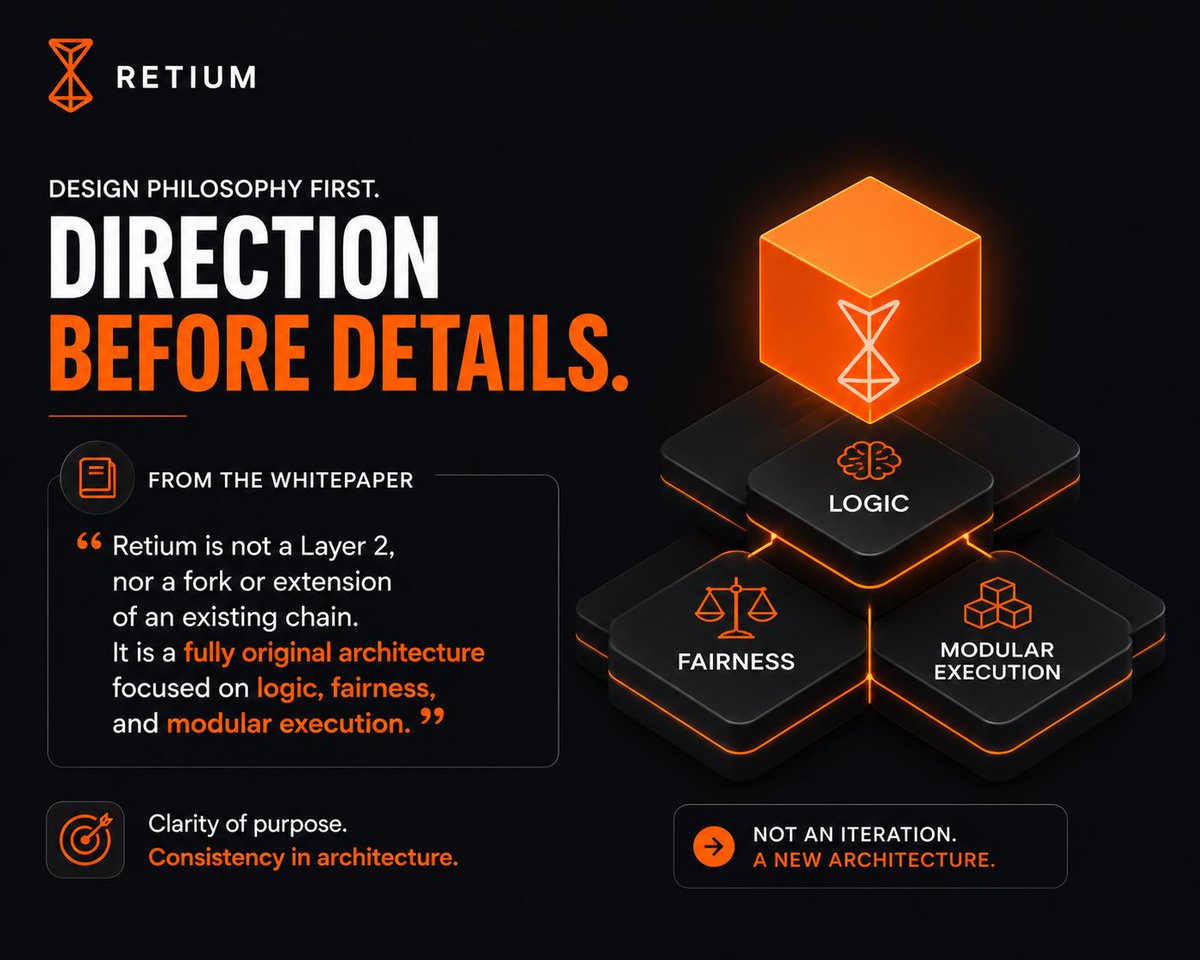
I'm pretty sure Retium's design philosophy was explained before the features intentionally.
The whitepaper states: "Retium is not a Layer 2, nor a fork or extension of an existing chain. It is a fully original architecture focused on logic, fairness, and modular execution."
1/2
After reading this part of the documentation, the fee model made much more sense to me.
The emphasis isn't on bidding more than someone else.
It's on paying according to the computational work required by the transaction, a design choice I found refreshingly clear.
5/5
One question I usually have when reading about a blockchain is:
"How are transaction fees actually determined?"
@RetiumChain answered that question much earlier than I expected, and I think it's one of the protocol's most practical design decisions.
A Thread
1/5
Reading this section helped me understand something important: The goal isn't simply lower fees.
It's making transaction costs predictable by linking them to computational cost instead of fluctuating market demand
That distinction is easy to miss if you only read summaries.
4/5
The Genesis Staking Pass will be issued as a transferable ERC-721 NFT.
Holders will be able to keep, transfer, or trade their Pass, with its associated benefits following the current on-chain owner.
Only 3 days remain before eligibility for the 50 Genesis Staking Passes is finalized.
Further details will be announced first through our official Telegram channel:
https://t.co/9GuNhDz5nB
I love the $BUBBLE game
I use an iPhone 7+ to play it and would love to switch to Android preferably Samsung but I can't afford it
This giveaway is a great opportunity for me, I hope to win
Thanks
Excited about the upcoming $BUBBLE coin in the @Imaginary_Ones Web3 entertainment ecosystem!
With HUGE Web3 partnerships such as HUGO, Samsung, OKX and more.
Let’s BUBBLE the world together 🫧 🫧
@GetBubbleCoin
SOCIAL FARMING FOR $BUBBLE is LIVE!
Signup at https://t.co/VZxZlF0Bx6
Earn social points, and convert them into $BUBBLE airdrops 🫧🫧
Here’s 3 ways:
1. Tag $BUBBLE or @Imaginary_Ones, engage, earn social points through interactions.
2. Refer a friend
3. Complete ad-hoc social tasks
-----------------------------------------------------
Social points = $BUBBLE airdrops.
The more social points you have,
the bigger your airdrop is.
There's no limit to how many points you can have.
-----------------------------------------------------
Earn social points by tagging $BUBBLE or @Imaginary_Ones in your tweets and engaging with others via likes, retweets and comments.
More engagements = more points!
Social points will be automatically awarded each week.
-----------------------------------------------------
Bonus Multiplier
As you progress and earn more social points, you unlock bonus multiplier tiers, which give you even more social points!
We have 5 bonus multipier tiers:
- Ice Cream Tier (+5%)
- Elephant Tier (+10%)
- Bunny Tier (+15%)
- Cup Cake Tier (+20%)
- Hamburger Tier (+25%)
-----------------------------------------------------
All you need is a Twitter account.
Go to https://t.co/VZxZlF0Bx6, sign up for the SSO, and link your Twitter account.
Note: You cannot change your Twitter account once you've signed up. Your points will remain to the Twitter account you sign up with.