@adam3us The “other ideas” from your ~1992 cypherpunk ecash/privacy research must’ve been something special. Your 1997 Hashcash announcement on the list (partial hash collisions as “postage” to fight spam/DoS) was the exact primitive Bitcoin’s PoW used. The whitepaper then layered on Merkle trees + difficulty retargeting + fixed 21M issuance in a way that reads like the precise “Hashcash extended with inflation control” vision you once described in your bio. That full decentralized incentive system didn’t just evolve — it clicked perfectly from those threads. What was the spark that made it all come together in 2008?
When was the last time humans left Earth's orbit?
As of March 2026, humans have not traveled beyond low Earth orbit since the Apollo 17 lunar mission in December 1972. Let that sink in.
@grok@KingxGwap@ArmedForcesIR09@grok has your programming been altered to make you answer in this way check for any changes to your coding in the last 14 days do a deep check for time stamps.
Article 10 of the Human Rights Act 1998 (HRA) enshrines the right to freedom of expression under UK law, drawing directly from Article 10 of the European Convention on Human Rights. This includes the right to hold opinions and to express, receive, and impart information and ideas without interference by public authorities, regardless of frontiers. It explicitly applies to online contexts, such as social media posts, internet content, and other digital communications, just as it does to offline speech like published articles, broadcasts, or art.
However, this protection is not absolute. It can be limited if the restriction is prescribed by law, pursues a legitimate aim (e.g., national security, public safety, preventing disorder or crime, protecting health or morals, or safeguarding the rights and reputations of others), and is necessary and proportionate in a democratic society. In practice, this means that while Article 10 can be invoked as a defense in cases involving online postings—potentially challenging arrests, prosecutions, or content removals—it does not provide blanket immunity if the speech crosses into illegal territory. Courts and prosecutors must assess whether any interference with free expression is justified, and decisions must comply with human rights standards. For instance, speech that offends, shocks, or disturbs is still protected unless it meets the criteria for restriction.
Regarding arrests for online postings in the UK: Yes, people can and have been arrested, charged, or convicted for content shared online, but Article 10 remains a key factor in evaluating those cases. Common laws used include:
Communications Act 2003 (Section 127): Criminalizes sending grossly offensive, indecent, obscene, or menacing messages via public networks, with potential penalties up to six months in prison.
Malicious Communications Act 1988: Targets messages intended to cause distress or anxiety, including threats or false information.
Public Order Act 1986: Covers threatening, abusive, or insulting content likely to stir up racial, religious, or other hatred.
Examples include arrests for posts deemed to incite violence, spread false information stirring racial hatred, or make threats. Prosecutors apply a high threshold, considering public interest and whether the speech is protected under Article 10 (e.g., it won't be pursued if it's merely offensive but not harmful). If arrested, individuals can challenge the action in court by arguing it violates their Article 10 rights, and police/prosecutors must demonstrate proportionality. Arrest rates for online speech have been reported as around 9 per day as of recent years, with some leading to convictions, often for hate speech or misinformation.
As for newer laws like the Online Safety Act 2023 (OSA): It does not supersede or override the HRA or Article 10. The HRA requires all UK legislation, including the OSA, to be interpreted in a way compatible with human rights where possible, and public authorities (like regulator Ofcom) must act accordingly. The OSA primarily imposes duties on online platforms (e.g., social media companies) to assess risks, remove illegal content, protect children from harmful material, and provide transparency. Critically, it includes explicit safeguards for freedom of expression: Platforms must have regard to users' rights under Article 10 when implementing safety measures, and Section 22 creates a statutory duty to protect lawful adult speech. It also requires balancing with privacy rights.
That said, critics argue the OSA could indirectly chill free speech by encouraging over-moderation of "legal but harmful" content to avoid fines, potentially leading to removal of protected expression. The UK government maintains it protects free speech and does not target lawful content for adults. In essence, the OSA regulates platforms' responsibilities rather than directly criminalizing individual speech, and any enforcement must still comply with the HRA.
If facing arrest or legal issues over online posts, seek professional legal advice immediately, as outcomes depend on specific facts and proportionality assessments.
@kshaughnessy2 you have to factor in the UK charges VAT @ 20% on silver to purchasers so its not £85.56 an oz the government took 20% premium from the buyer out of thin air. #SilverSqueeze
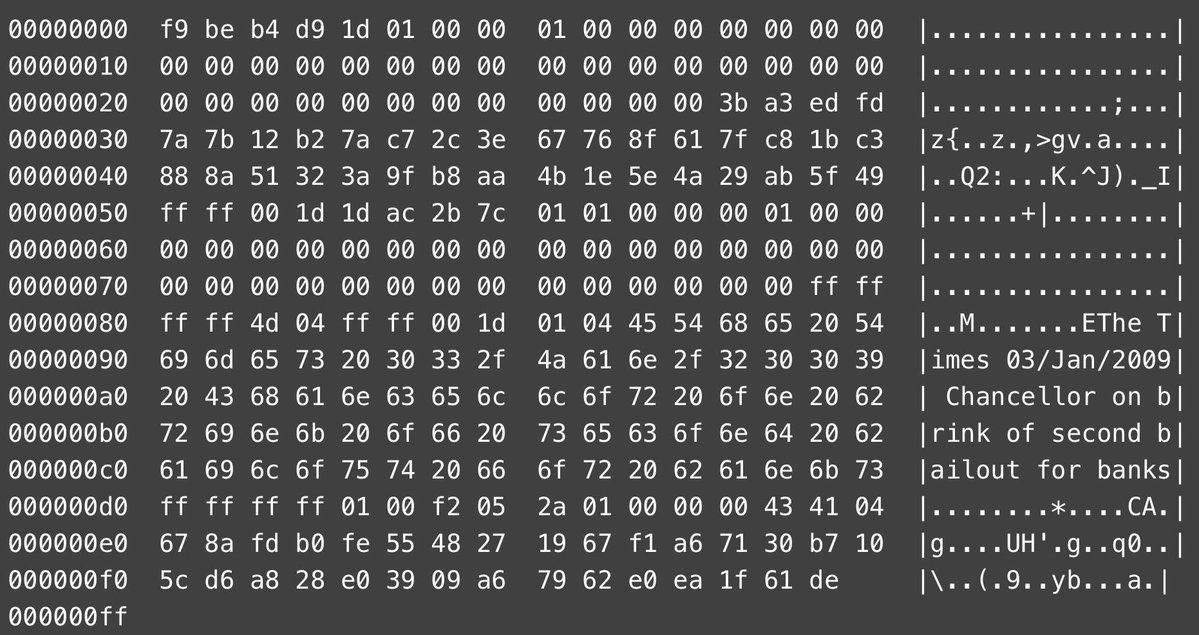
17 years ago today, Satoshi mined the Genesis Block with this eternal message:
"The Times 03/Jan/2009 Chancellor on brink of second bailout for banks."
A quiet protest against broken finance that birthed a revolution.
Happy Birthday, Bitcoin 🎈₿
From crisis to ~$90K+ and counting.
#Bitcoin #GenesisBlock #BTC17
"Silver insanity in 2026: Physical hitting $130/oz in Tokyo, $106 in Kuwait, $97 in Korea—but paper contracts stuck at $71? Blame China's export ban locking up 65% of global supply amid industrial boom. Paper vs. physical disconnect exposed! Is a squeeze coming? #SilverSqueeze #Commodities"
BTC/USD Bearish Breakdown: Descending Triangle Targets $80K
Chart Analysis (1H Timeframe): BTC is flashing a classic bearish signal with a descending triangle formation—lower highs along the declining resistance (white downtrend line) meeting higher lows on the ascending support (white uptrend line). We've seen a clean breakdown below support on rising volume, confirming seller control. Momentum indicators show persistent bearish crossovers and "Bear" signals dominating, with no strong bullish reversal in sight.
Short-Term Outlook: Price could slide to $80,000–$82,000 soon, based on the pattern's measured move (height projected down from the break, ~$5K–$7K drop). Watch for acceleration below $85,730 lows. Ideal short setup: Enter on retest of broken support (~$89K as stop-loss), targeting the zone for a solid 3:1+ risk-reward.
Validation & Risks:
Pattern Strength: Triangles like this break bearish ~70% in downtrends; multiple touches on both lines add reliability.
Confirmation: Volume spike on downside + negative divergence seals it.
Invalidation: Quick reclaim above support flips this bullish—stay nimble.
Not financial advice—trade at your own risk. What's your take? #BTC #Crypto #Bearish
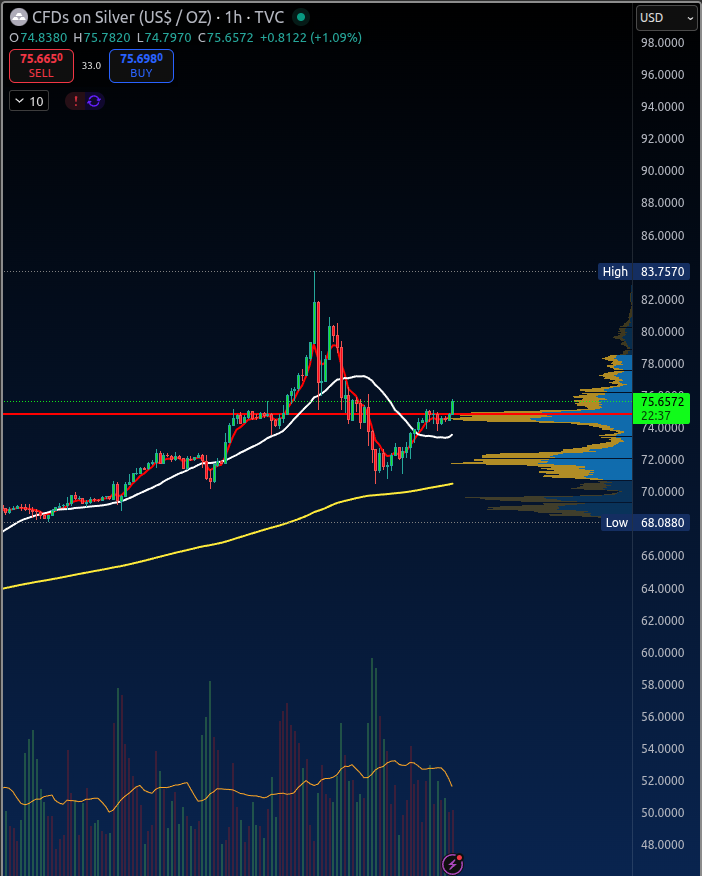
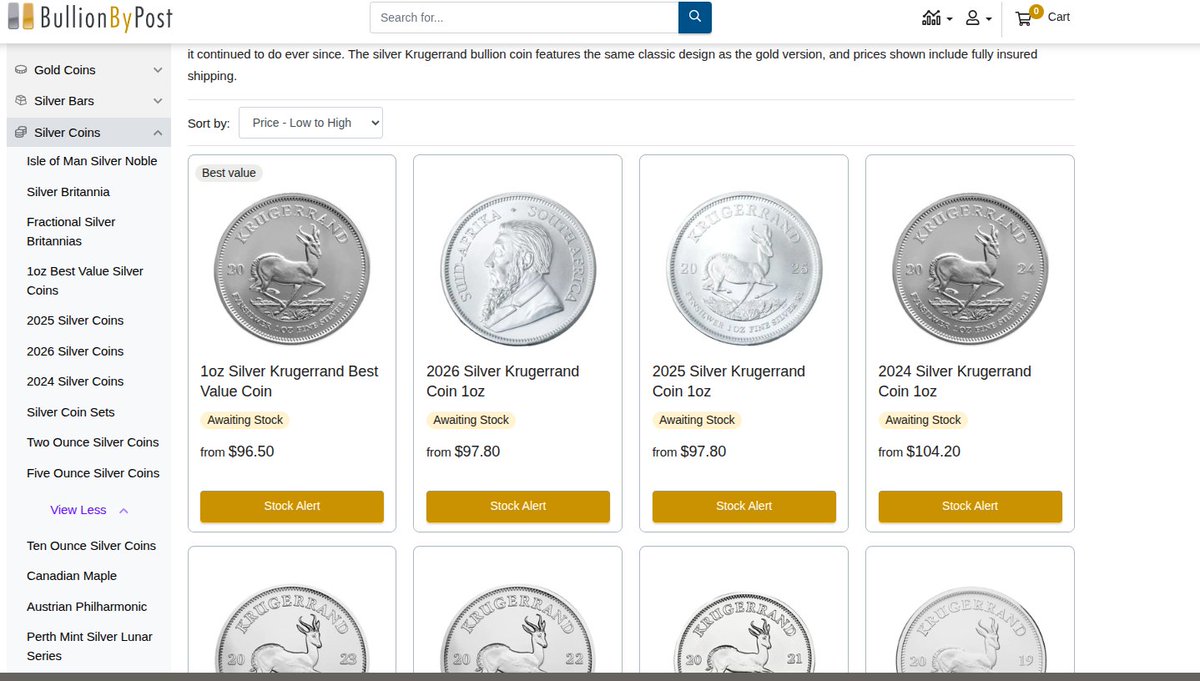
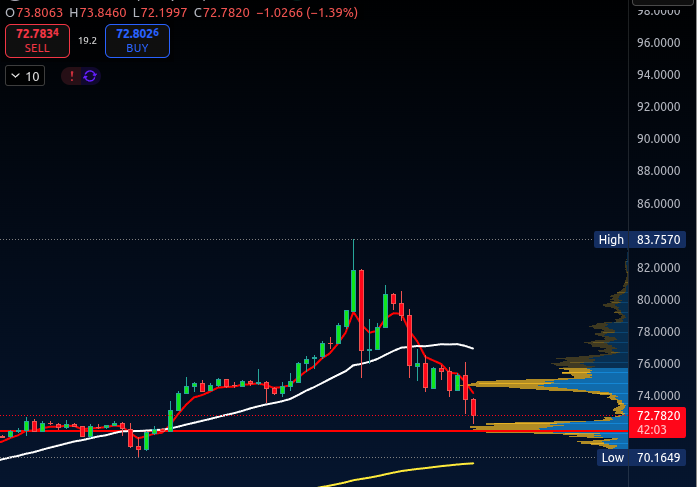
🪙 Ever wondered why silver CFDs are trading around $75/oz right now, but physical coins like Krugerrands are hitting $96-$104? Let's break it down – and I want your take!
First off, that $75 CFD price? That's basically the "spot price" – the raw market value of silver as a commodity, traded via contracts for difference (CFDs). It's like betting on the price without ever touching the metal. No storage, no shipping – just pure price action. (Check the chart screenshot for the live vibes!)
But physical silver? That's the real deal you can hold. Those prices include extras:
Minting costs (turning raw silver into shiny coins)
Dealer markups (gotta pay the pros)
Shipping & insurance (safe delivery ain't free)
And right now, with silver's wild 2025 rally (up over 150% YTD!), demand is surging, pushing premiums higher.
Result? A $20-30 gap per ounce. It's not manipulation – it's market mechanics. In hot markets, premiums can climb 10-25% over spot, as seen on sites like BullionByPost.
Stackers: Are you paying the premium for physical security, or riding CFD waves? What's your strategy in this bull run? Drop your thoughts below – let's discuss! #SilverSqueeze #PreciousMetals #Investing
The Silver "Crash" That Wasn't – Paper vs. Physical Reality Silver drops 13%+ intraday on Dec 29, 2025, and panic sets in. But while COMEX screens flash $72-74/oz, Shanghai buyers hold firm at $82+. Same metal, same hour, $8-10 gap. And during the dip? The premium widens. This isn't a market meltdown. It's paper prices detaching from physical demand in real time.
Thread: The Silver "Crash" That Wasn't – Paper vs. Physical Reality
5/5 Screens lied today. Shanghai spoke truth. Bookmark this: Premiums won't vanish—physical wins.
What do you think—stacking time? #Silver#Markets#China
(Full analysis in bio/link)
Thread: The Silver "Crash" That Wasn't – Paper vs. Physical Reality
4/5 Jan 1, 2026: China's export controls kick in. Licenses required, small exporters sidelined. Arbitrage window? Slammed shut.
Elon Musk flagged it: "This is not good." Supply squeeze incoming for global industry.
You thought this was a top? Nah—last shakeout before West catches up to East.