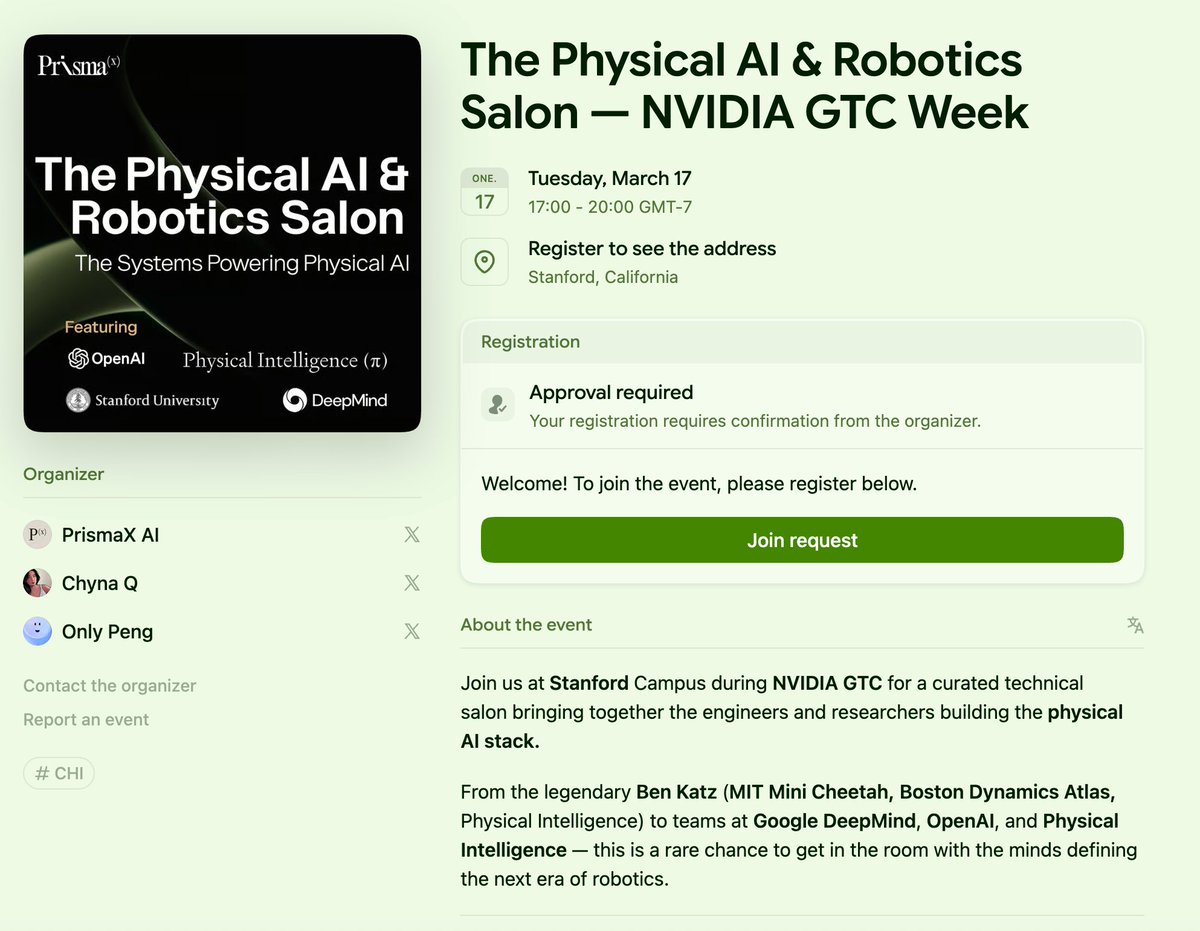
The biggest challenge for humanoid robots isn’t hardware 👀
It’s learning in the physical world.
Dexterity.
Generalization.
Real-world interaction.
These are the problems researchers from
@OpenAI, @GoogleDeepMind and @physical_int
will be discussing at the Physical AI & Robotics Salon hosted by @PrismaXai during @NVIDIAGTC.
📅 March 17
🕔 5:00 – 8:00 PM
📍 Stanford University
If you're interested in Embodied AI, humanoid robotics and real-world learning systems, this conversation will likely be worth your attention.
Personally, I’d be most curious to hear their thoughts on:
• scaling real-world robotics data
• human-in-the-loop learning
• how humanoids generalize beyond controlled environments
Feels like we’re entering the phase where physical AI moves from demos to real capability 🤖🌙
There’s something interesting about teleoperation that most people miss.
It’s not really about controlling a robot.
It’s about learning how to collaborate with one.
Every session teaches you something small:
- How the arm moves.
- Where friction appears.
- How objects behave in the real world.
And slowly you stop thinking in commands.
You start thinking in adjustments.
Tiny corrections.
Better timing.
Cleaner motion.
That’s where the real training happens.
Not just for the model.
For the operator too.
Teleoperation creates a feedback loop:
Human intuition → Robot action → Data → Model improvement.
And the next time you sit down to operate, the robot is slightly smarter.
But so are you.
That’s the part I find fascinating.
It’s not just machines learning from humans.
Humans are learning a new way to work with machines.
And maybe that’s what the future of physical AI really looks like 🌙🤖
@PrismaXai 😊