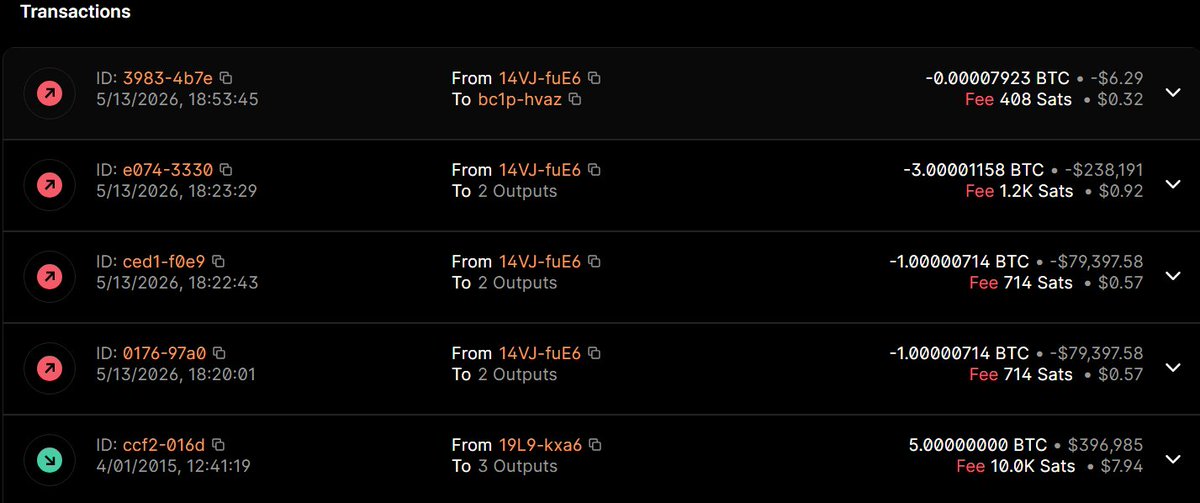
This is real. The 5 BTC received in 2015 just moved yesterday. Blockchain doesn't lie.
wallet received 5.00000000 BTC on 4/01/2015, and the funds moved out on 5/13/2026.
@AnthropicAI@DarioAmodei this one's for the books. 🫡
https://t.co/qncNlvIZil
Smart contract vulnerabilities have cost the industry billions, and most of them were preventable.
Today I'm launching VoltAudit in Beta: an AI-powered security audit tool that gives developers and protocols a fast, rigorous first line of defense before going to mainnet.
What it does:
→ Analyzes any Solidity contract and generates a full security report in minutes
→ Ranks vulnerabilities by severity so you know what to fix first
→ Produces attack proof-of-concepts and property verification to surface real, confirmed bugs, not false positives
The goal is to make high-quality security analysis accessible at the speed of development.
As we are currently in Beta, payments are processed in Sepolia ETH through an on-chain escrow smart contract, keeping the experience fully trustless from day one.
🔗 https://t.co/Tf1CB0MAe9
Feedback from the community is critical at this stage. Every insight helps me improve the AI engine and deliver more accurate, reliable audits. If you work in smart contract security or DeFi, I'd love for you to put it to the test and share what you think.
#SmartContractSecurity #Solidity #DeFi #Ethereum #Web3
Something quietly significant just happened in DeFi.
On April 14, @Morpho officially named its long-in-development fixed-rate protocol: Morpho Midnight. And the CEO @PaulFrambot was deliberate about one thing from the start. Midnight is not a sequel to Morpho Blue. "It is a completely new paradigm for onchain lending, and should not be considered a V2 of Blue," Frambot wrote.
To understand why this matters you need to understand what has been broken in DeFi lending since the beginning.
Every major protocol today, Aave, Compound, even Morpho Blue, runs on variable rates. Your rate changes daily, sometimes hourly. For a retail trader chasing yield that is fine. For a bank, a pension fund, or an institution trying to plan a 12-month credit strategy, it is unusable. You cannot build serious financial infrastructure on a rate that changes while you sleep.
In traditional finance, most loans are built on fixed terms. Long term ambitions simply cannot be funded with capital that can be withdrawn at any time. Variable rates were powerful for bootstrapping onchain liquidity, but they are not enough to sustain where DeFi is going.
Morpho Midnight solves this at the architecture level. Where Morpho Blue offers pool-based, open-term variable-rate markets with externalized risk management, Midnight introduces intent-based, fixed-term, fixed-rate markets with externalized management of both risk and rate. A completely different mechanism for pricing and matching lenders and borrowers.
In plain terms: instead of depositing into a pool and hoping for the best, lenders and borrowers state exactly what they want, the rate, the term, the collateral, and the protocol finds the match. It works more like a bond desk than a liquidity pool.
The timing of this launch is not accidental. Apollo Global Management, overseeing more than $900 billion in assets, has already signed a cooperation agreement with Morpho allowing it to acquire up to 90 million MORPHO tokens over the next four years. That is 9% of total supply from one of Wall Street's most sophisticated credit machines. The Ethereum Foundation has committed nearly $19 million into Morpho Vaults, citing its immutable, open-source architecture.
Morpho currently holds approximately $7.7 billion in total value locked, making it the second largest lending protocol in DeFi behind Aave. And now with Midnight, it is building the product that could bring the next $100 billion in institutional capital onchain.
Security audits are still finalizing. More details are coming soon. But the name has dropped and the direction is clear.
Could Morpho Midnight be the next generation of DeFi?
#Morpho #MorphoMidnight #DeFi #Crypto #OnChainLending #Institutional #Web3 #FixedRate
🚨 Are we witnessing max extraction in real time — and a black swan event that could push crypto to new lows?
Let me explain what just happened with World Liberty Financial in plain terms.
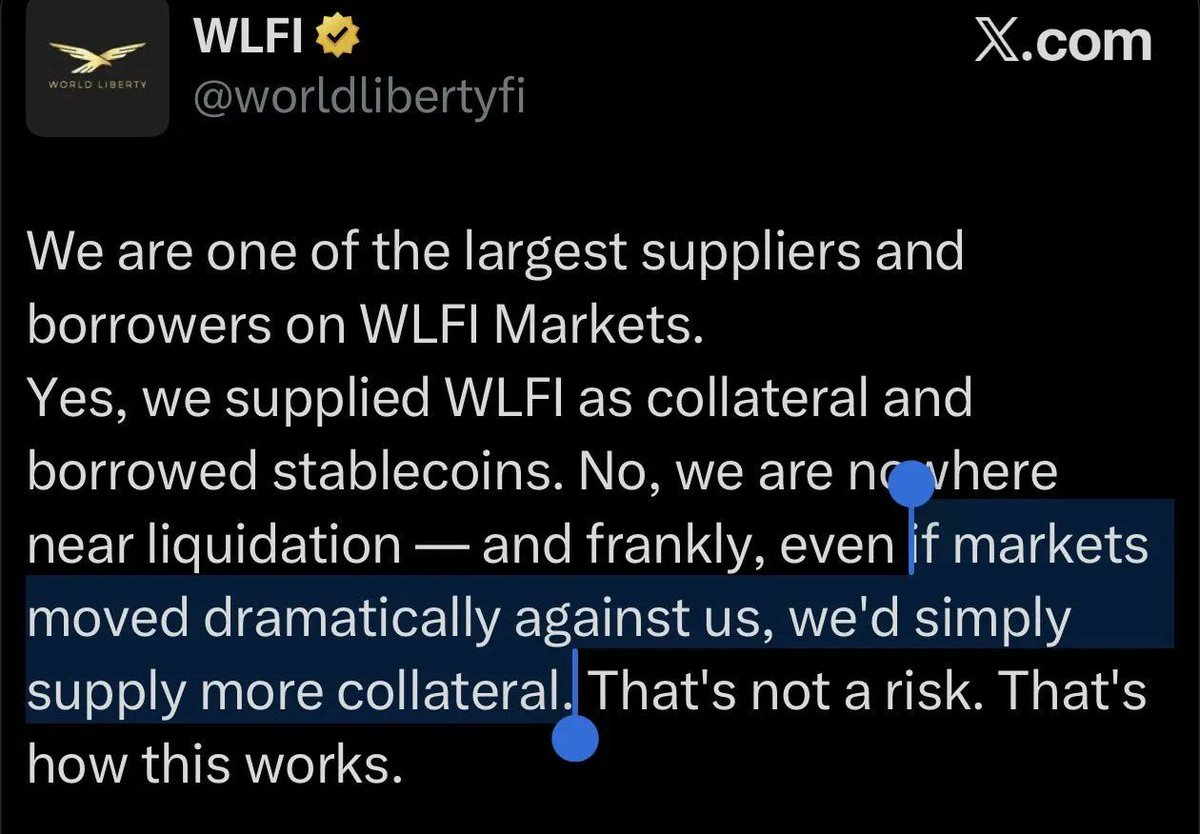
WLFI printed their own token. Then they used that token as collateral. Then they borrowed their own stablecoin, USD1, from a lending platform whose co-founder is their own advisor. Then they sent $40 million of that borrowed money straight to Coinbase Prime.
They created the token. They built the stablecoin. They run the lending platform. They borrowed from themselves and cashed out.
This is not decentralized finance. This is a closed loop dressed up as one.
Their own words when confronted about it: "Even if markets moved dramatically against us, we'd simply supply more collateral. That's not a risk. That's how this works."
That sentence should sound familiar. In 2022, Terra Luna's team said almost the same thing — that they would defend their stablecoin by minting more of their own token. When confidence cracked, the loop imploded. $40 billion was wiped in 72 hours.
WLFI is running an identical structure. The collateral is the token they control. If the token drops, adding more of it does not solve the problem. It accelerates it.
Meanwhile ordinary depositors on Dolomite are sitting at 93% pool utilization, unable to withdraw their own money. The WLFI token just hit its lowest price since trading began. And $40 million has already left the building.
The question is not whether this is a conflict of interest. It plainly is. The question is whether we are watching the early stages of a DeFi collapse that could cascade into broader crypto markets at exactly the wrong time — with macro already fragile, sentiment already broken, and retail already burned.
Max extraction does not announce itself. It just quietly moves $40 million to Coinbase Prime and tells you that's how this works.
Pay attention to this one.
#WLFI #DeFi #Crypto #TerraLuna #WorldLibertyFinancial #BlackSwan #CryptoRisk
Just shipped @DeVOLTfi
Leverage up to 18× on your LST staking yield using Morpho Blue flash loans. Single tx, fully on-chain, unwindable anytime.
Still early. Looking for builders to work with 🤝
https://t.co/ORC7xCecxD
Built for the @contractdotdev hackathon
A fully onchain leverage platform for wstETH positions
Here's what's under the hood:
⚡ Flash loans for atomic leverage — no looping
🔄 @Uniswap for swapping & position execution
📊 Oracle data powered by @Dune
🛡️ Risk-free trade calculation based on historical oracle behavior
One transaction. Target leverage. Done.
🔗 https://t.co/9tbzTrOkAv
Did you know you can earn 38.6% APY on your wstETH?
No vaults. No lock-ups. No extra capital.
Just Morpho Blue flash loans + on-chain swaps — up to 18x leveraged staking yield in a single click.
Built on Base.
Powered by @Morpho and @LidoFinance
Starting a new series: Web3 Dev Onboarding 🧵
Time to share what I wish I knew when I started.
Expect:
Smart contract fundamentals that matter
DeFi protocol integration guides
Account abstraction explained simply
Tools & workflows that actually work
Common mistakes(and how to avoid them)
Just practical tips for devs getting into blockchain.
#Web3Community #Smartcontract #Blockchain