Blockchain scalability is often reduced to one metric: transactions per second.
But TPS only tells us how quickly a network can process transactions It does not explain how efficiently the underlying infrastructure can distribute the data required to keep thousands of nodes synchronized.
That distinction is becoming increasingly important as blockchain networks scale.
Every transaction, block, and blob must propagate across a distributed network. If data propagation becomes the bottleneck, improvements in execution and consensus can eventually reach a point of diminishing returns.
This is where @get_optimum is taking a different approach.
Optimum is focused on the networking layer, exploring how data can be propagated across decentralized systems more efficiently.
Its work with RLNC (Random Linear Network Coding) introduces a fundamentally different way to handle data transmission. Instead of relying solely on traditional packet-by-packet recovery, data can be encoded into combinations that allow nodes to reconstruct information after receiving enough useful data.
The goal is simple in principle, but significant in practice:
Reduce unnecessary retransmissions.
Improve bandwidth efficiency.
Increase resilience to packet loss.
And ultimately, help data move through decentralized networks more effectively.
Optimum's mump2p extends this direction toward blockchain networking, while its broader infrastructure vision includes Flexnodes for permissionless data acceleration and DeRAM for a different approach to decentralized memory and state access.
What makes this interesting is the underlying thesis.
The future of blockchain performance will not be determined by execution alone.
A network can process transactions quickly, but that performance only matters if the information required to process and verify those transactions can move through the network with similar efficiency.
This is why I believe blockchain infrastructure is entering a new phase.
The industry has spent years optimizing execution and consensus.
The next challenge is optimizing the movement of information between them.
And that is the layer @get_optimum is working to improve.
Because in a decentralized network, speed is not only about how fast you can compute.
It is also about how fast the network can communicate.
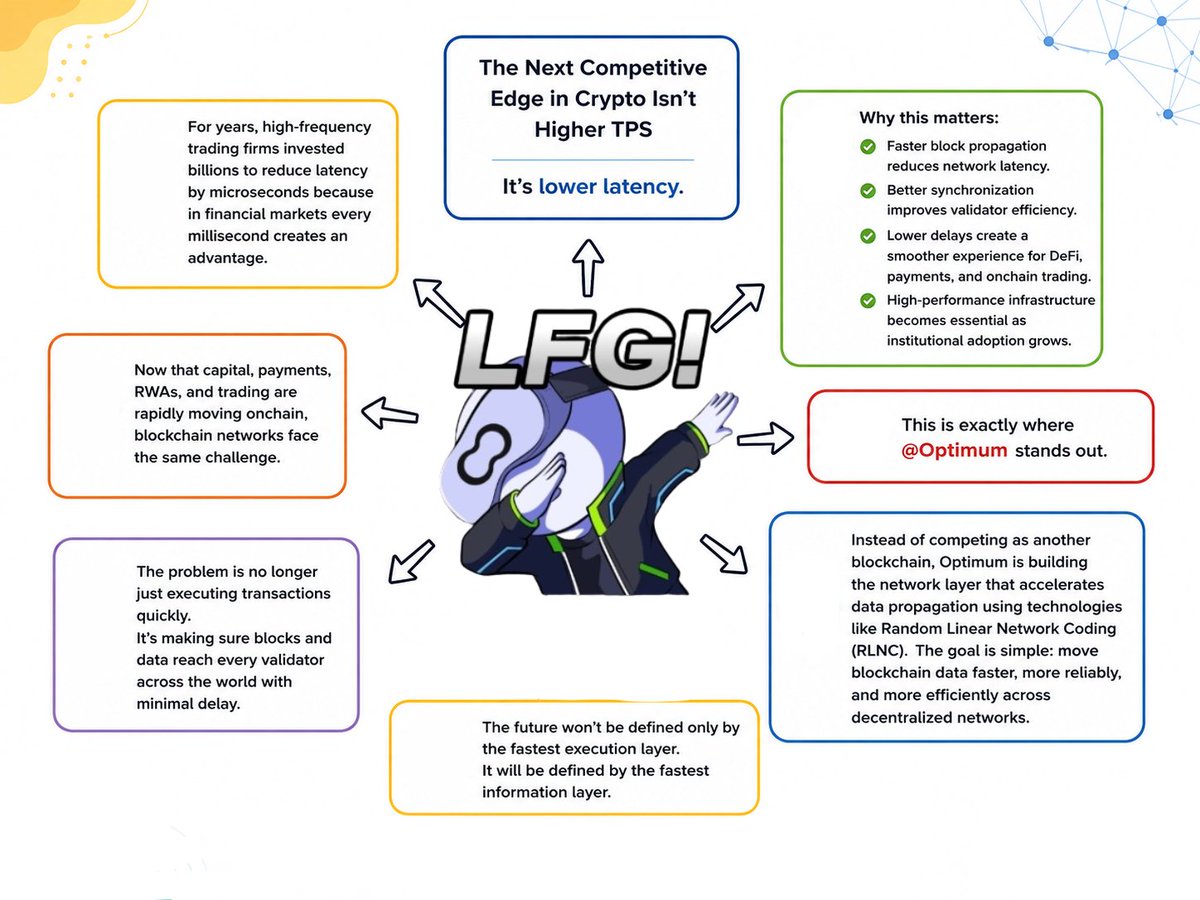
The Next Competitive Edge in Crypto Isn't Higher TPS
It's lower latency.
For years high frequency trading firms invested billions to reduce latency by microseconds because in financial markets every millisecond creates an advantage.
Now that capital, payments, RWAs, and trading are rapidly moving onchain, blockchain networks face the same challenge.
The problem is no longer just executing transactions quickly.
It's making sure blocks and data reach every validator across the world with minimal delay.
Why this matters: • Faster block propagation reduces network latency. • Better synchronization improves validator efficiency. • Lower delays create a smoother experience for DeFi, payments, and onchain trading. • High performance infrastructure becomes essential as institutional adoption grows.
This is exactly where @Optimum stands out.
Instead of competing as another blockchain, Optimum is building the network layer that accelerates data propagation using technologies like Random Linear Network Coding (RLNC). The goal is simple: move blockchain data faster, more reliably and more efficiently across decentralized networks
The future won't be defined only by the fastest execution layer
It will be defined by the fastest information layer
That's the infrastructure race most people still aren't paying attention to
The Future Of Blockchain Speed Is Not Just About TPS
A blockchain can process thousands of transactions...
But if data cannot move fast enough between nodes the network still faces a bottleneck.
The next major innovation is happening at the propagation layer.
Introducing mump2p by @get_optimum
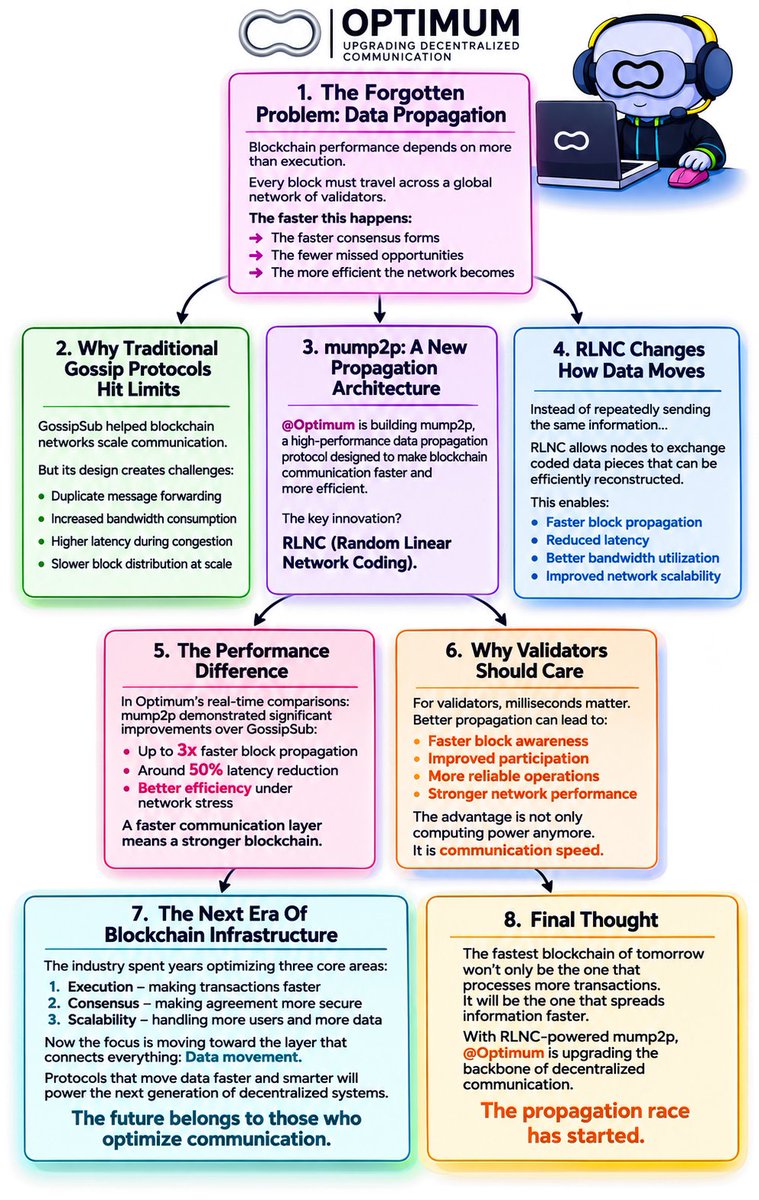
1. The Forgotten Problem: Data Propagation
Blockchain performance depends on more than execution.
Every block must travel across a global network of validators.
The faster this happens:
→ The faster consensus forms
→ The fewer missed opportunities
→ The more efficient the network becomes
2. Why Traditional Gossip Protocols Hit Limits
GossipSub helped blockchain networks scale communication.
But its design creates challenges:
• Duplicate message forwarding
• Increased bandwidth consumption
• Higher latency during congestion
• Slower block distribution at scale
Modern networks need a smarter approach.
3. mump2p: A New Propagation Architecture
Optimum is building mump2p a high-performance data propagation protocol designed to make blockchain communication faster and more efficient.
The key innovation?
RLNC (Random Linear Network Coding).
4. RLNC Changes How Data Moves
Instead of repeatedly sending the same information...
RLNC allows nodes to exchange coded data pieces that can be efficiently reconstructed.
This enables:
Faster block propagation
Reduced latency
Better bandwidth utilization
Improved network scalability
5. The Performance Difference
In Optimum’s real-time comparisons:
mump2p demonstrated significant improvements over GossipSub:
• Up to 3x faster block propagation
• Around 50% latency reduction
• Better efficiency under network stress
A faster communication layer means a stronger blockchain.
6. Why Validators Should Care
For validators, milliseconds matter.
Better propagation can lead to:
→ Faster block awareness
→ Improved participation
→ More reliable operations
→ Stronger network performance
The advantage is not only computing power anymore.
It is communication speed.
7. The Next Era Of Blockchain Infrastructure
The industry spent years optimizing:
Execution
Consensus
Scalability
Now the focus is moving toward the layer that connects everything.
Data movement.
8. Final Thought
The fastest blockchain of tomorrow won't only be the one that processes more transactions.
It will be the one that spreads information faster.
With RLNC powered mump2p @get_optimum is upgrading the backbone of decentralized communication.
The propagation race has started.
The Next Competitive Edge in Crypto Isn't Higher TPS
It's lower latency.
For years high frequency trading firms invested billions to reduce latency by microseconds because in financial markets every millisecond creates an advantage.
Now that capital, payments, RWAs, and trading are rapidly moving onchain, blockchain networks face the same challenge.
The problem is no longer just executing transactions quickly.
It's making sure blocks and data reach every validator across the world with minimal delay.
Why this matters: • Faster block propagation reduces network latency. • Better synchronization improves validator efficiency. • Lower delays create a smoother experience for DeFi, payments, and onchain trading. • High performance infrastructure becomes essential as institutional adoption grows.
This is exactly where @Optimum stands out.
Instead of competing as another blockchain, Optimum is building the network layer that accelerates data propagation using technologies like Random Linear Network Coding (RLNC). The goal is simple: move blockchain data faster, more reliably and more efficiently across decentralized networks
The future won't be defined only by the fastest execution layer
It will be defined by the fastest information layer
That's the infrastructure race most people still aren't paying attention to
Finance Needs an Internet Upgrade
Traditional financial systems were designed for a world where transactions moved slowly and relied on multiple intermediaries Blockchain introduces a different model where value can move instantly across borders with transparency and programmable logic
The vision is not simply to replace banks but to redesign financial infrastructure so that money becomes as easy to move as information on the internet
Key Insight The future of finance is built on open programmable infrastructure rather than isolated institutions
Solana Enables Real Time Financial Applications
Financial products cannot scale if every transaction is expensive or takes several minutes to settle
Solana demonstrates that blockchain can support real time payments trading and financial interactions without sacrificing user experience This makes it possible to build applications that feel comparable to modern internet services
Concept Speed is not only about performance metrics It creates entirely new categories of financial products
CircularFi Focuses on Everyday Financial Utility
The discussion emphasizes that blockchain should become useful in everyday life rather than remaining limited to crypto native users
Financial tools should help people send receive save and manage value in a simple and intuitive way Technology should remove friction instead of creating additional complexity
Vision Crypto becomes successful when users benefit from blockchain without needing to understand how blockchain works
Infrastructure Is More Important Than Marketing
Every successful technology ecosystem depends on strong infrastructure before consumer applications can thrive
Reliable networks secure protocols and efficient developer tools create an environment where innovation can happen continuously Long term value is generated by infrastructure because every future application depends on it
Lesson Sustainable ecosystems are built through engineering rather than short term attention
Trust Is the Foundation of Digital Finance
Financial systems only work when users believe their assets are safe and transactions are reliable
Blockchain strengthens trust through transparency verifiable transactions and decentralized validation However technology alone is not enough Products must also provide consistency security and excellent user experience
Core Principle Trust is created through predictable performance over time
Simplicity Drives Adoption
Many blockchain products struggle because they expose users to unnecessary technical details
The next generation of applications will hide complexity while preserving decentralization in the background Wallet management transaction execution and network interactions should become seamless
Vision The best blockchain application feels effortless because the technology disappears behind a great product
Real Adoption Begins With Solving Problems
The industry is moving away from building products only for crypto enthusiasts
Future success depends on solving practical challenges such as global payments financial inclusion digital commerce and asset management
Projects creating measurable value will continue growing regardless of market cycles
Key Insight Utility creates adoption while speculation creates temporary attention
What I Learned
Blockchain is evolving into financial infrastructure rather than remaining a speculative market
Solana's performance enables applications that require real time execution
CircularFi represents a shift toward practical financial products instead of purely investment focused platforms
User experience determines whether blockchain reaches mainstream audiences
Infrastructure and trust are becoming the strongest competitive advantages in Web3
Closing Insight
The strongest message from this discussion is that the future of Web3 will not be defined by the number of new tokens launched It will be defined by the quality of financial products that solve real problems at internet scale Projects that combine performance usability and trust will shape the next generation of the digital economy
@_offmylawn@widyakrnwn
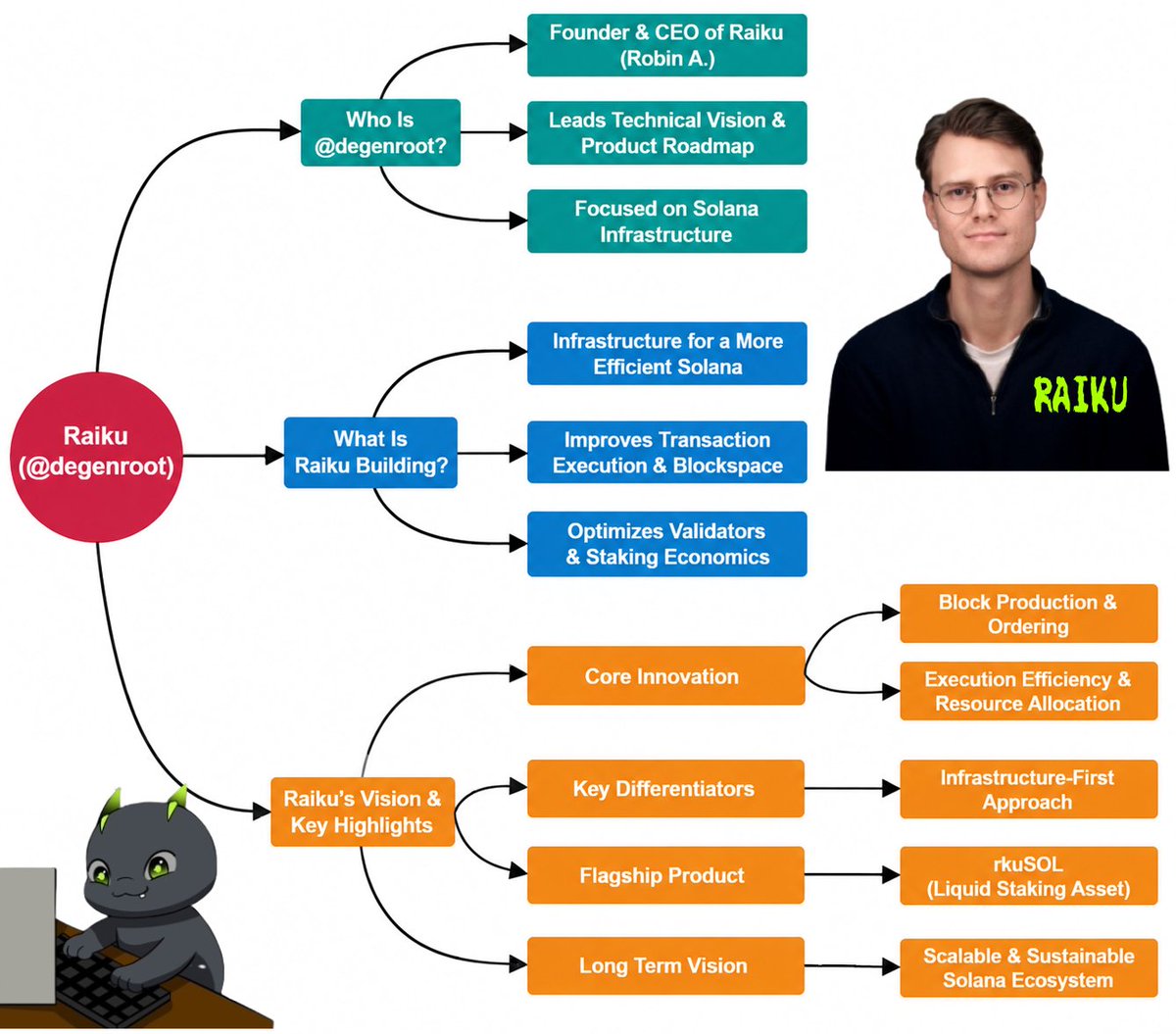
Who Is degenroot?
The Builder Behind Raiku
Degenroot (Robin A.) is the Founder and CEO of Raiku leading the project's technical vision product strategy and long term infrastructure roadmap. Rather than chasing short term trends his focus is on solving fundamental blockchain infrastructure challenges and improving how the Solana network operates at its core.
What Is His Connection to Raiku?
Robin is the driving force behind Raiku he oversees the protocol's architecture validator strategy ecosystem partnerships and product development he regularly shares technical insights roadmap updates and the long term vision for building a more efficient and scalable Solana ecosystem.
What Is Raiku Building?
Raiku is not another DeFi protocol or standard liquid staking platform.
Its mission is to improve how Solana processes transactions and rewards network participants by building infrastructure that makes the network faster more efficient and economically sustainable.
Key Areas
Advanced transaction execution
Efficient blockspace allocation
Validator optimization
MEV aware infrastructure
Sustainable staking economics
Institutional grade blockchain infrastructure
One of its flagship products rkuSOL is designed to provide capital efficient liquid staking while integrating multiple yield sources into a single asset
What Makes Raiku Different?
Unlike many Web3 projects focused on applications NFTs or trading tools Raiku focuses on the infrastructure layer.
Key Differentiators
Infrastructure first approach instead of application-first development
Optimizing transaction execution rather than simply increasing transaction volume
Improving validator incentives to strengthen network security
Building predictable and deterministic execution for institutional users
Creating more efficient blockspace markets that benefit both validators and users
The Core Innovation
Raiku's biggest innovation is its focus on block production transaction ordering and execution efficiency.
Instead of building another consumer facing application the team is redesigning how blockchain resources are allocated enabling
Lower execution inefficiencies
Better validator economics
Improved capital efficiency
More reliable transaction processing
Stronger long term scalability for Solana
This infrastructure centric approach positions Raiku as a foundational protocol rather than just another ecosystem application.
Why Robin (@degenroot) Stands Out
Robin consistently shares technical discussions instead of market hype.
His work focuses on
Blockchain infrastructure
Validator economics
Network efficiency
Long term protocol design
Sustainable ecosystem growth
This builder first mindset has earned him recognition within the Solana developer community.
My Thoughts
Raiku is building the infrastructure that powers a more efficient Solana network rather than simply launching another blockchain application. Under Robin's leadership the project aims to improve transaction execution validator incentives blockspace efficiency and institutional grade reliability.
While many projects build on top of Solana Raiku is focused on improving how Solana itself works making it one of the more technically ambitious infrastructure projects in the ecosystem.
@degenroot@_offmylawn@widyakrnwn@tulenka5
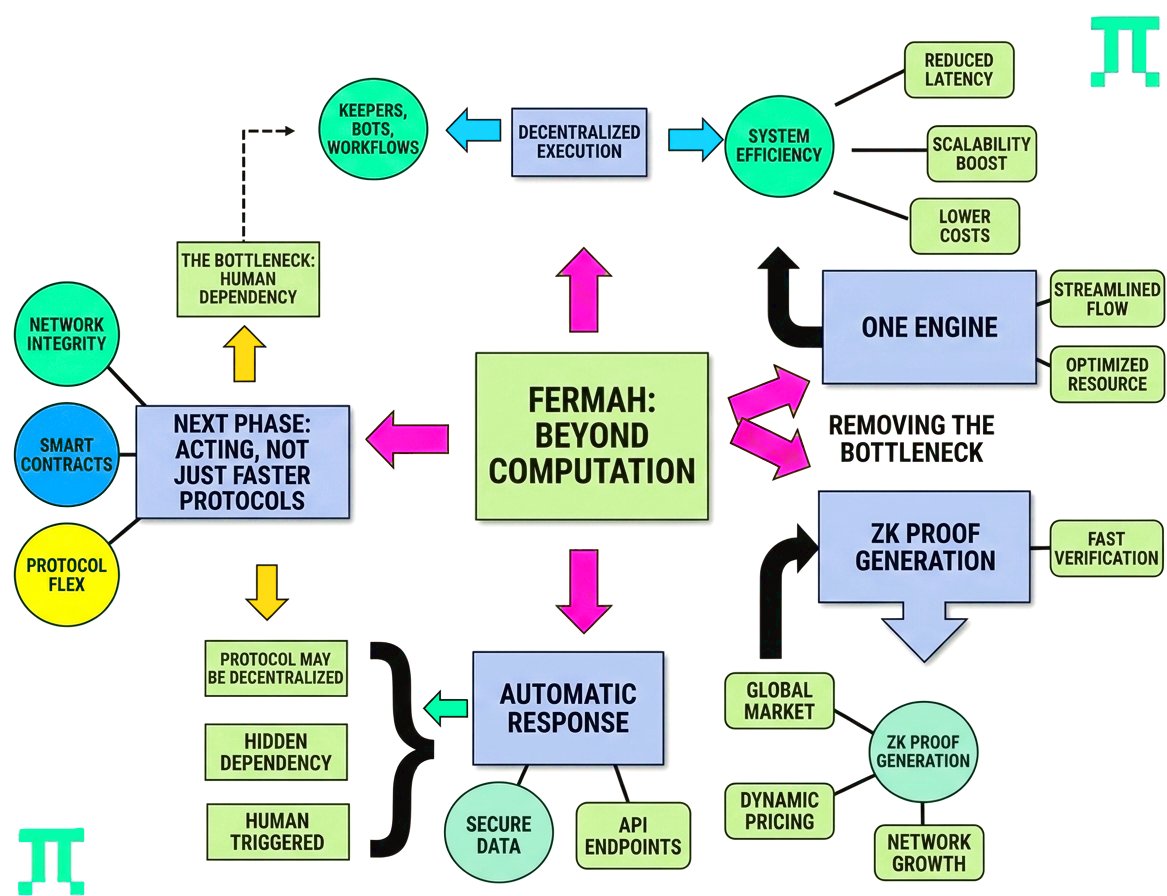
Most people think the next phase of crypto is about making protocols faster.
I think the bigger question is:
Can protocols actually act on their own?
Because underneath the “autonomous” narrative, there is still a hidden dependency everywhere.
Keepers.
Cron jobs.
Bots.
Centralized servers.
Human-triggered workflows.
The protocol may be decentralized.
The execution often isn't.
This is the problem Fermah is quietly attacking.
With Fermah Kernel, the idea is to move beyond protocols that simply wait for someone to trigger an action.
Instead:
→ Observe a condition
→ Execute a workflow
→ Coordinate multiple steps
→ Verify the result
→ Complete the action
Without putting a human in the middle.
And this matters far beyond one use case.
For ZK, Fermah Froben approaches proof generation as a universal marketplace where different proof workloads can be coordinated across available compute.
For autonomous applications, Kernel turns complex workflows into something protocols can actually compose.
For prediction markets, Flashcast Social shows what happens when resolution itself becomes programmable and automated.
The interesting part is the common architecture underneath.
One engine.
Different applications.
ZK proofs.
Prediction markets.
Autonomous workflows.
Cross-protocol execution.
The real bottleneck in crypto may not be consensus.
It may not even be compute.
It may be the gap between:
“Something happened.”
and
“Something acted.”
Fermah is building toward a world where protocols don't just record what happened.
They can respond.
Automatically.
Verifiably.
At machine speed.
That is a much bigger thesis than a proof marketplace
And if crypto is moving toward autonomous systems, the infrastructure that gives protocols the ability to actually act could become one of the most important layers nobody is talking about yet
Fermah isn't just trying to make ZK cheaper
It's trying to remove the human bottleneck from what comes next
@Sipra_ETH@IamitMdt
The Missing Layer in Crypto
Most blockchain discussions focus on scalability consensus and security. These are essential foundations but they do not solve every challenge One critical layer is still missing.
How can protocols operate autonomously without relying on centralized bots scheduled scripts or constant human intervention?
What Is Fermah Building?
@fermah_xyz is introducing Protocol Agency through the Fermah Kernel. Instead of waiting for users to trigger every action protocols can continuously observe onchain conditions evaluate predefined rules and execute verifiable actions automatically.
This transforms smart contracts from passive code into active programmable systems that can operate with greater efficiency and reliability.
Why It Matters
Today's DeFi infrastructure still depends on external keepers private servers and manual execution for many core operations. These dependencies create delays increase operational risk and introduce unnecessary centralization.
Fermah aims to eliminate these bottlenecks by enabling deterministic autonomous execution directly at the protocol layer.
Real World Application
One of the first examples is Flashcast's Universal Prediction Markets. Developers can launch and manage new prediction markets using the same programmable execution engine instead of building custom infrastructure for every new market.
This approach makes decentralized applications more scalable more efficient and easier to expand.
The Bigger Picture
Blockchain innovation is no longer just about faster transactions or lower fees. The next evolution is giving protocols the ability to act intelligently while remaining transparent verifiable and decentralized.
That is the direction Fermah is pushing the ecosystem toward.
The future belongs to protocols that do not just execute code.
They execute decisions.
@Sipra_ETH@mrahsok
Max-guarantee compute doesn't scale. Coordination is the bottleneck.
Remove the operator from the critical path and any protocol can initiate action -- no negotiation, no credential exchange, no prior vetting required.
Composability flows from placement on the guarantee spectrum, not from maximizing guarantees everywhere.
The Next Competitive Edge in Crypto Isn't Higher TPS
It's lower latency.
For years high frequency trading firms invested billions to reduce latency by microseconds because in financial markets every millisecond creates an advantage.
Now that capital, payments, RWAs, and trading are rapidly moving onchain, blockchain networks face the same challenge.
The problem is no longer just executing transactions quickly.
It's making sure blocks and data reach every validator across the world with minimal delay.
Why this matters: • Faster block propagation reduces network latency. • Better synchronization improves validator efficiency. • Lower delays create a smoother experience for DeFi, payments, and onchain trading. • High performance infrastructure becomes essential as institutional adoption grows.
This is exactly where @Optimum stands out.
Instead of competing as another blockchain, Optimum is building the network layer that accelerates data propagation using technologies like Random Linear Network Coding (RLNC). The goal is simple: move blockchain data faster, more reliably and more efficiently across decentralized networks
The future won't be defined only by the fastest execution layer
It will be defined by the fastest information layer
That's the infrastructure race most people still aren't paying attention to
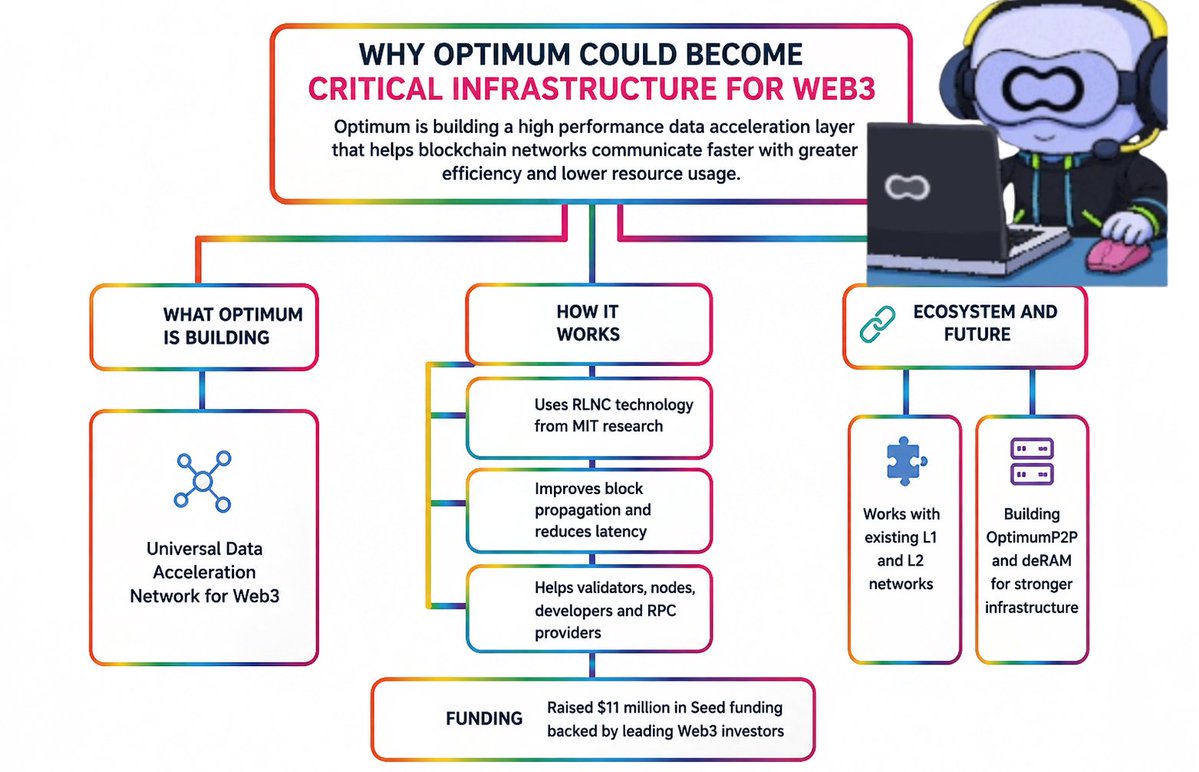
Why Optimum Could Become Critical Infrastructure for Web3
As blockchain networks continue to grow the biggest challenge is no longer only scalability it is also how fast data reaches every validator and every node across the network optimum is focused on solving this hidden infrastructure problem by building a high performance data acceleration layer that helps blockchain networks communicate faster with greater efficiency and lower resource usage
Key Points
• Building a Universal Data Acceleration Network for Web3
• Uses Random Linear Network Coding RLNC developed through years of MIT research
• Improves block propagation and reduces network latency
• Helps validators node operators developers and RPC providers exchange data more efficiently
• Works alongside existing Layer 1 and Layer 2 networks instead of replacing them
• Developing technologies such as OptimumP2P and deRAM to strengthen decentralized infrastructure
• Raised $11 million in Seed funding with support from leading Web3 investors
Why This Matters
Most users only notice transaction speed but behind every blockchain is a networking layer that determines how quickly information spreads across the ecosystem if data moves slowly the entire network becomes less efficient. Optimum is designed to remove this bottleneck by making blockchain communication faster more reliable and more scalable as web3 adoption continues to expand infrastructure projects like Optimum could play an important role in improving the performance of decentralized networks while remaining invisible to the end user
The Missing Layer in Crypto
Most blockchain discussions focus on scalability consensus and security. These are essential foundations but they do not solve every challenge One critical layer is still missing.
How can protocols operate autonomously without relying on centralized bots scheduled scripts or constant human intervention?
What Is Fermah Building?
@fermah_xyz is introducing Protocol Agency through the Fermah Kernel. Instead of waiting for users to trigger every action protocols can continuously observe onchain conditions evaluate predefined rules and execute verifiable actions automatically.
This transforms smart contracts from passive code into active programmable systems that can operate with greater efficiency and reliability.
Why It Matters
Today's DeFi infrastructure still depends on external keepers private servers and manual execution for many core operations. These dependencies create delays increase operational risk and introduce unnecessary centralization.
Fermah aims to eliminate these bottlenecks by enabling deterministic autonomous execution directly at the protocol layer.
Real World Application
One of the first examples is Flashcast's Universal Prediction Markets. Developers can launch and manage new prediction markets using the same programmable execution engine instead of building custom infrastructure for every new market.
This approach makes decentralized applications more scalable more efficient and easier to expand.
The Bigger Picture
Blockchain innovation is no longer just about faster transactions or lower fees. The next evolution is giving protocols the ability to act intelligently while remaining transparent verifiable and decentralized.
That is the direction Fermah is pushing the ecosystem toward.
The future belongs to protocols that do not just execute code.
They execute decisions.
@Sipra_ETH@mrahsok
The Brain Behind Fermah
When people talk about Fermah they often focus on the technology. But behind that vision stands Dr. Vanishree Rao the Founder and CEO
With more than 15 years of experience in Zero Knowledge cryptography and a PhD from UCLA she isn't following the future of Web3 she's helping build it.
At Fermah she leads everything that matters:
• Product vision and long term roadmap
• Research and protocol innovation
• Engineering and ecosystem growth
• Strategic partnerships
• The next generation of programmable compute infrastructure
Fermah started by tackling one of the biggest challenges in Web3 through faster and more efficient ZK proof generation. Today the mission is even bigger building programmable asynchronous compute infrastructure that could power smarter decentralized applications across the ecosystem.
Backed by respected investors including a16z CSX Lemniscap Bankless Ventures and LongHash Ventures Fermah is steadily turning ambitious research into real world infrastructure.
My View
The strongest projects are usually built by founders with deep technical expertise and a long term vision Dr. Vanishree Rao fits that profile
If Fermah continues executing at this pace it has the potential to become one of the key infrastructure layers for the next wave of Zero Knowledge AI and decentralized computing.
This is a project worth watching closely because the biggest stories in crypto often begin with infrastructure
@Sipra_ETH@ahso
Who Is degenroot?
The Builder Behind Raiku
Degenroot (Robin A.) is the Founder and CEO of Raiku leading the project's technical vision product strategy and long term infrastructure roadmap. Rather than chasing short term trends his focus is on solving fundamental blockchain infrastructure challenges and improving how the Solana network operates at its core.
What Is His Connection to Raiku?
Robin is the driving force behind Raiku he oversees the protocol's architecture validator strategy ecosystem partnerships and product development he regularly shares technical insights roadmap updates and the long term vision for building a more efficient and scalable Solana ecosystem.
What Is Raiku Building?
Raiku is not another DeFi protocol or standard liquid staking platform.
Its mission is to improve how Solana processes transactions and rewards network participants by building infrastructure that makes the network faster more efficient and economically sustainable.
Key Areas
Advanced transaction execution
Efficient blockspace allocation
Validator optimization
MEV aware infrastructure
Sustainable staking economics
Institutional grade blockchain infrastructure
One of its flagship products rkuSOL is designed to provide capital efficient liquid staking while integrating multiple yield sources into a single asset
What Makes Raiku Different?
Unlike many Web3 projects focused on applications NFTs or trading tools Raiku focuses on the infrastructure layer.
Key Differentiators
Infrastructure first approach instead of application-first development
Optimizing transaction execution rather than simply increasing transaction volume
Improving validator incentives to strengthen network security
Building predictable and deterministic execution for institutional users
Creating more efficient blockspace markets that benefit both validators and users
The Core Innovation
Raiku's biggest innovation is its focus on block production transaction ordering and execution efficiency.
Instead of building another consumer facing application the team is redesigning how blockchain resources are allocated enabling
Lower execution inefficiencies
Better validator economics
Improved capital efficiency
More reliable transaction processing
Stronger long term scalability for Solana
This infrastructure centric approach positions Raiku as a foundational protocol rather than just another ecosystem application.
Why Robin (@degenroot) Stands Out
Robin consistently shares technical discussions instead of market hype.
His work focuses on
Blockchain infrastructure
Validator economics
Network efficiency
Long term protocol design
Sustainable ecosystem growth
This builder first mindset has earned him recognition within the Solana developer community.
My Thoughts
Raiku is building the infrastructure that powers a more efficient Solana network rather than simply launching another blockchain application. Under Robin's leadership the project aims to improve transaction execution validator incentives blockspace efficiency and institutional grade reliability.
While many projects build on top of Solana Raiku is focused on improving how Solana itself works making it one of the more technically ambitious infrastructure projects in the ecosystem.
@degenroot@_offmylawn@widyakrnwn@tulenka5
Raiku Labs Is Quietly Building for Institutions First
Everyone is focused on the fact that Raiku is limiting access
Very few are asking why
This decision isn't about shutting out the community It's about protecting an infrastructure advantage that only works when it's scarce
Here's why this matters
Institutional infrastructure follows different rules
Retail products are designed to reach millions of users
Institutional technology is different
If a trading engine gives every participant the exact same advantage then the advantage disappears In competitive markets exclusivity is part of the product itself
Raiku appears to understand this better than most Web3 projects
A shift from hype to real market demand
Instead of chasing thousands of users Raiku plans to work with only a handful of enterprise partners capable of generating meaningful activity on Solana
That signals a business model focused on long term value rather than short term attention
Quality over quantity
Execution is becoming the new battleground
As blockchain networks become faster the biggest difference is no longer just transaction speed
It is how efficiently transactions are
• Routed
• Processed
• Executed
• Confirmed under heavy network activity
Infrastructure that improves execution quality can create a measurable edge for professional trading firms
Why institutions care
Large trading firms don't compete with better marketing
They compete with better infrastructure
Saving milliseconds reducing failed transactions and improving execution reliability can have a significant impact when millions of dollars move through the market every day
That is where specialized infrastructure becomes valuable
What does this mean for the community
The interesting part of Robin's announcement wasn't the restricted access
It was the hint that a completely different product is being developed for the broader market
This suggests Raiku is separating two ecosystems
• Private infrastructure for enterprise clients
• Future products designed for wider community participation
That is a much more sustainable strategy than exposing every core technology from day one
A bigger trend is emerging
Crypto infrastructure is entering a new phase
The next generation of winners may not be the loudest projects on social media
They may be the companies building critical infrastructure that financial institutions rely on behind the scenes
That transition is already happening across blockchain
Final thoughts
Raiku's latest move isn't about becoming less open
It's about recognizing that not every innovation should be distributed equally if its value depends on performance and competitive advantage
The real question is no longer whether Raiku is building something valuable
The real question is what they're preparing for the public once their institutional foundation is in place
Sometimes the most important infrastructure isn't the one everyone can access
It's the one quietly powering the future before anyone realizes it
Everyone Wants Faster Blockchains Almost Nobody Is Fixing the Network Beneath Them
1.
The blockchain industry has spent years improving execution.
Higher TPS. Lower fees. Faster finality.
But none of it matters if the network can't distribute data efficiently.
Infrastructure is the real bottleneck.
2.
Every transaction begins with communication.
Blocks must reach validators quickly. Nodes must stay synchronized. Data must move without unnecessary delays.
When networking improves the entire blockchain improves.
3.
This is the problem @get_optimum is solving.
Instead of building another chain Optimum is strengthening the networking layer making decentralized systems faster more reliable and better prepared for large scale adoption.
4.
At the heart of its architecture is Random Linear Network Coding (RLNC).
Rather than relying on traditional packet delivery RLNC optimizes how information is propagated across the network improving bandwidth efficiency while reducing latency and packet loss.
5.
Why does this matter?
Because better networking means:
• Faster block propagation • Lower latency • Better validator synchronization • Stronger network resilience • More efficient infrastructure
These improvements benefit every participant on the network.
6.
As AI DePIN DeFi gaming and other high demand applications continue to grow infrastructure must evolve alongside them.
The next generation of decentralized systems will require networking that scales without compromising performance.
That is exactly the direction Optimum is taking.
7.
The biggest innovations rarely happen where everyone is looking.
While the market debates TPS and transaction fees Optimum is focused on the layer that quietly determines how well every blockchain performs.
The future won't belong to the loudest projects.
It will belong to those building the strongest infrastructure.
@get_optimum is building for that future
@cryptooflashh
Why Optimum Could Become Critical Infrastructure for Web3
As blockchain networks continue to grow the biggest challenge is no longer only scalability it is also how fast data reaches every validator and every node across the network optimum is focused on solving this hidden infrastructure problem by building a high performance data acceleration layer that helps blockchain networks communicate faster with greater efficiency and lower resource usage
Key Points
• Building a Universal Data Acceleration Network for Web3
• Uses Random Linear Network Coding RLNC developed through years of MIT research
• Improves block propagation and reduces network latency
• Helps validators node operators developers and RPC providers exchange data more efficiently
• Works alongside existing Layer 1 and Layer 2 networks instead of replacing them
• Developing technologies such as OptimumP2P and deRAM to strengthen decentralized infrastructure
• Raised $11 million in Seed funding with support from leading Web3 investors
Why This Matters
Most users only notice transaction speed but behind every blockchain is a networking layer that determines how quickly information spreads across the ecosystem if data moves slowly the entire network becomes less efficient. Optimum is designed to remove this bottleneck by making blockchain communication faster more reliable and more scalable as web3 adoption continues to expand infrastructure projects like Optimum could play an important role in improving the performance of decentralized networks while remaining invisible to the end user