Welcome @Curvance to the @cantinaxyz as we kick off the 2nd largest competition of the year!
💰 $375,000 USDC
🗓️ February 26th, 20:00 PM UTC (6 Weeks)
📍 (Competition Link Provided Below)
Loading...
Need an invite? Details Below 💾🪐
Yesterday's complete hack of Wise Lending was far more complex than reported. Very worth examining.
The protocol had added explicit defenses against this style of attack, which the attack then either bypassed or used against the protocol. 🧵 1/21
🪐 Introducing Cantina Competitions 🪐
With @MorphoLabs! 🦋
• $200,000
• 2500 SLOC
• Cantina Code assisted (much bigger than you think)
• Invite Code ONLY
A new era for web3 security begins today.
👇No invite code? Huge opportunity below👇
Hey fam!
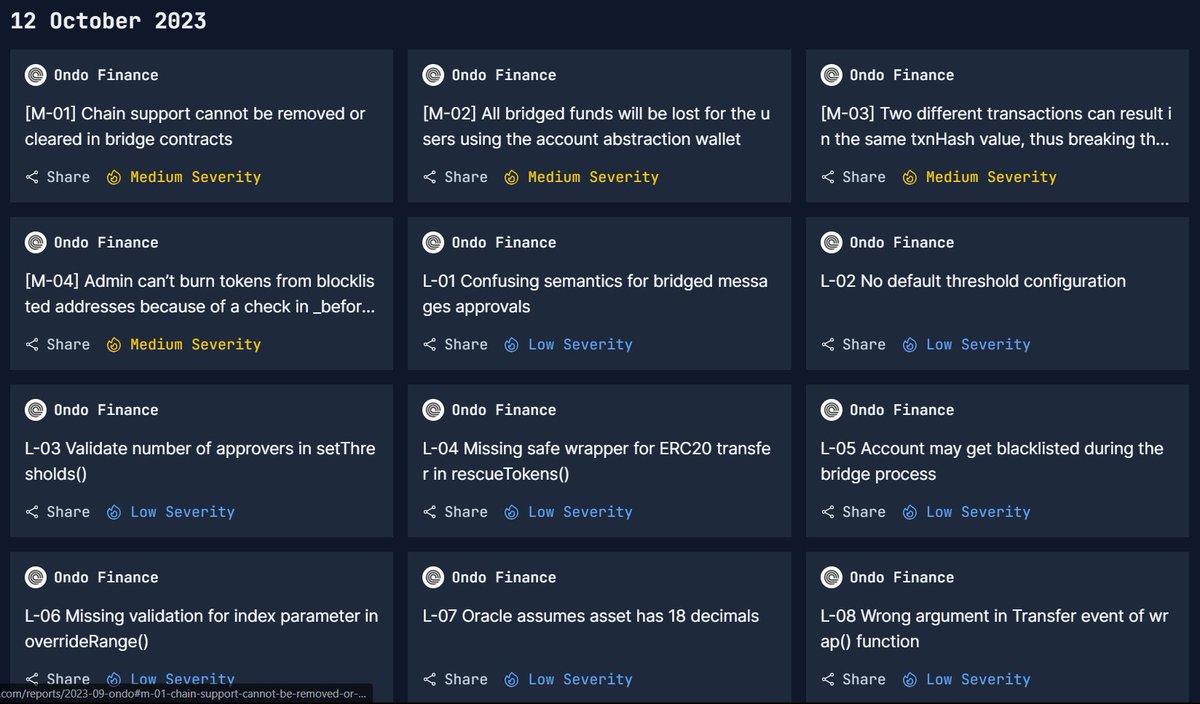
Did you check the latest report of @OndoFinance on @code4rena ⁉️
It's time to learn & take notes from the 15+ findings from this contest with only 0 high 👀🤧
🤔https://t.co/LNPNFcAqgC
#Web3#Security
When you say “I want to make the world a better place,” you add an implicit “I want power and should be trusted with it.”
Increasingly, I think “Copenhagen ethics,” as critically defined in Jai’s influential essay, is basically correct. When you try to solve something, you assert power over it. That matters.
Asserting power is not a neutral act. You tell people: I have identified a problem. I know what will make it better. Trust me—let me step in, let me Do Something—and the world will become a better place.
That’s a good thing, often. Almost every good work comes from an assertion of power. But by interacting with situations, you change them. You make others more or less likely to step in. You direct resources one direction or another. Should you succeed, you tend to acquire more power.
And when your good intent goes wrong, because you have asserted power, it goes wrong on a scale unimaginable for the regular, powerless person—the one who never interacted with the problems at all.
Effective Altruism is a noble concept that draws many well-meaning people. It is also, fundamentally, an assertion of power. The fall of SBF is a good illustration of its failure state: power irresponsibly gained and redirected, with countless left to pay the costs of its failure. When your circle of moral concern—those you feel a responsibility to act on behalf of—is the entire world, you assert power over the entire world.
This is at the front of my mind as I watch the tragedy unfolding in Israel and the commentary on it. Every act of public commentary is an assertion of power: Listen to me. Think and do as I say. My thoughts should impact this setting.
I get a taste of this every time I choose to cover a topic, sometimes intensely so. I learn deeply personal things about people and situations far from me. In my recent article about the backstory behind a beach altercation, I dug through half a decade of ugly and intensely personal drama between people I had never heard of prior to the altercation, and needed to choose what to attach their names to in the public eye. When I assert that power carelessly, I open myself to justifiable blame.
Jai’s post is worth reading. It’s full of compelling examples of people trying to do good in neglected areas and being lambasted for their trouble. But I think in neglecting the role of assertion of power it reflects a common blind spot among altruistically minded people, encouraging a fantasy: that you can Do Good without opening yourself up to the costs of Doing Good Wrong.
Do good. Say things worth saying. Get involved in causes that matter to you. But understand that every time you do so, you enmesh yourself in a web of responsibilities. The assertion of power is neither trivial nor costless.
Little knowledge and high effort can land you in the top 10% of any contest.
Low effort and some more knowledge will land you in the top 50% (if you're lucky).
In the short term, effort is the best leverage you have.
@sekaieth @PopPunkOnChain Because the vulnerabilities they find are the ones typically generated through automated tools - eg code4rena both races type issues
Connie Loizos, Silicon Valley Editor of TechCrunch, asks Sam Altman, CEO of OpenAI (the company behind ChatGPT), in 2019, about OpenAI's business model.
Sam Altman's response would truly blow your mind. I'm not kidding 😁
@0xtowncrier As a dev/founder, you shouldn't be thinking about whether you are getting fair value for $. Thats web2 BS.
You should be thinking about how to distribute VC money as laivshly as possible to airdrop farmers, mercenary yield farmers, and beginner auditors.
@0xtowncrier Bro we auditors are not going to search for complex vulnerabilities unless you pay us more.
I skim the code, ctrl-f "/" for rounding errors, ctrl-f "external" to recommend access control on these functions and collect my paycheck.
Top tier audit firm btw.