If you resist anything in your life, resist the upcoming widespread Age Verification & most importantly, Digital ID's, which they will present as easy solution for you to access almost anything.
Should they succeed to implement Digital ID systems, the next step to CBDCs & cashless society, paired with social score models, isn't that far away anymore.
This is happening, worldwide. Act accordingly!
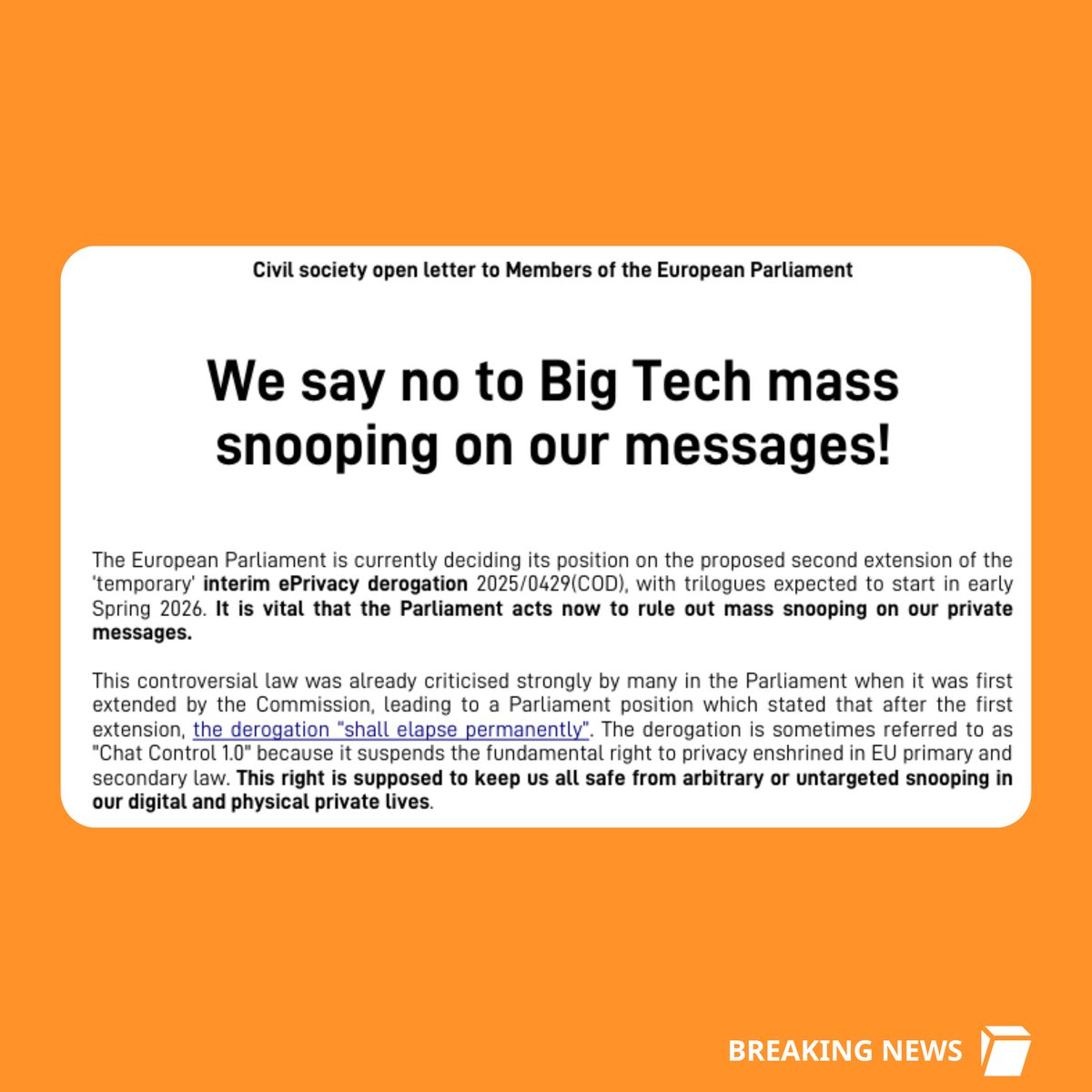
Next Monday, the EU decides on Chat Control 1.0. Will they let the Trojan Horse through the gate and let Google, Microsoft, LinkedIn etc continue to scan all your messages?
We at Tuta say NO.
❌ No scanning
❌ No mass surveillance
❌ No age verification
Instead we fight for:
✅ Encryption
✅ Privacy
✅ Open Source
And so should the EU. Call your local representatives! 🥊
Privacy is not negotiable. Speak up now. ✊ #Privacy
The UK social media ban debate should not be reduced to a simple argument about child safety versus no child safety. The more important question is what kind of internet infrastructure gets built to enforce the policy, and whether that infrastructure remains in place even if the policy fails to achieve its stated goal.
Part 3 of the Children’s Wellbeing and Schools Act 2026 builds on the Online Safety Act by moving the debate beyond content moderation and toward access prevention. That means the issue is not only which apps under-16s can use, but how platforms, app stores, operating systems, and identity providers may be expected to verify who is allowed to access them.
This matters for adults too, because a system designed to block children from certain services can still require adults to prove they are adults. Ordinary online access can become an identity checkpoint, separating the stated safety objective from the verification infrastructure required to enforce it.
A VPN or decentralized VPN can help at the access and network-tracking layer by reducing exposure to IP-based tracking, centralized server infrastructure, and jurisdiction-specific network restrictions. It does not solve identity mandates imposed upstream by governments, app stores, operating systems, or platforms, which is why privacy infrastructure should be explained honestly and not overclaimed.
The internet remains global, while regulation is still national. Centralized platforms can be pressured through companies, employees, app stores, payment rails, and compliance obligations, but global network access does not naturally fit inside one country’s policy framework.
Sentinel becomes relevant here as infrastructure, not as a single application. Users can connect through decentralized VPN applications built on Sentinel, developers can build their own dVPN products, node operators can contribute bandwidth to the network, and businesses can create subscription-based VPN services on top of decentralized infrastructure.
For users, Sentinel provides access to dVPN applications built on an open-source protocol. For builders, Sentinel provides tools such as Sentinel Shield, SDKs, routing infrastructure, and payment integrations to support branded dVPN applications across mobile, desktop, and custom environments.
For node operators, the ecosystem includes Node Deployer, node testing utilities, SentNodes, SuchNode, and P2PScan to help deploy infrastructure, monitor health, track activity, understand coverage, and improve transparency across the network.
For businesses, Plan Manager supports the creation of subscription-based decentralized VPN services, including plan creation, node selection, pricing management, and user access. This turns Sentinel from a consumer-facing dVPN network into a broader framework for launching and operating decentralized VPN products.
The future of internet access will be shaped by infrastructure, and Sentinel is building the network layer, applications, and tooling needed for a more open and resilient internet.
Explore how to use a dVPN, build a dVPN application, host a dVPN node, and build with decentralized bandwidth infrastructure: https://t.co/rQ59JwrAPx
Build your own decentralized VPN business on top of a global peer-to-peer network, with the applications, infrastructure, tooling, and bandwidth layer already built, open source, and ready for developers to use.
Applications across the Sentinel ecosystem now include Independent dVPN, Ryn VPN, Meile dVPN, VALT, Norse dVPN, Sentinel Shield, and multiple additional ecosystem applications developed by independent teams on shared infrastructure.
The wider Sentinel ecosystem now includes:
• Mobile and browser dVPN applications
• Node deployment and hosting tooling
• Subscription plan infrastructure
• Transparent node testing
• SDKs and developer integrations
• AI agent connectivity via x402
• Peer-to-peer bandwidth infrastructure
Developers can customize branding, configure node access, integrate payment systems, and deploy their own decentralized VPN experience on top of the network.
As governments and platforms continue tightening control over internet infrastructure, privacy-preserving peer-to-peer technology is becoming increasingly important.
The Sentinel Network consists of thousands of independently operated nodes spanning 130+ countries, has accumulated over 1M users across the ecosystem, and is built to support aggressive expansion across decentralized VPN applications and programmable bandwidth infrastructure.
Explore and build your own decentralized applications on Sentinel:
https://t.co/yK9zavgjQT
The question is no longer how to build decentralized VPN infrastructure.
It is what you build on top of it.
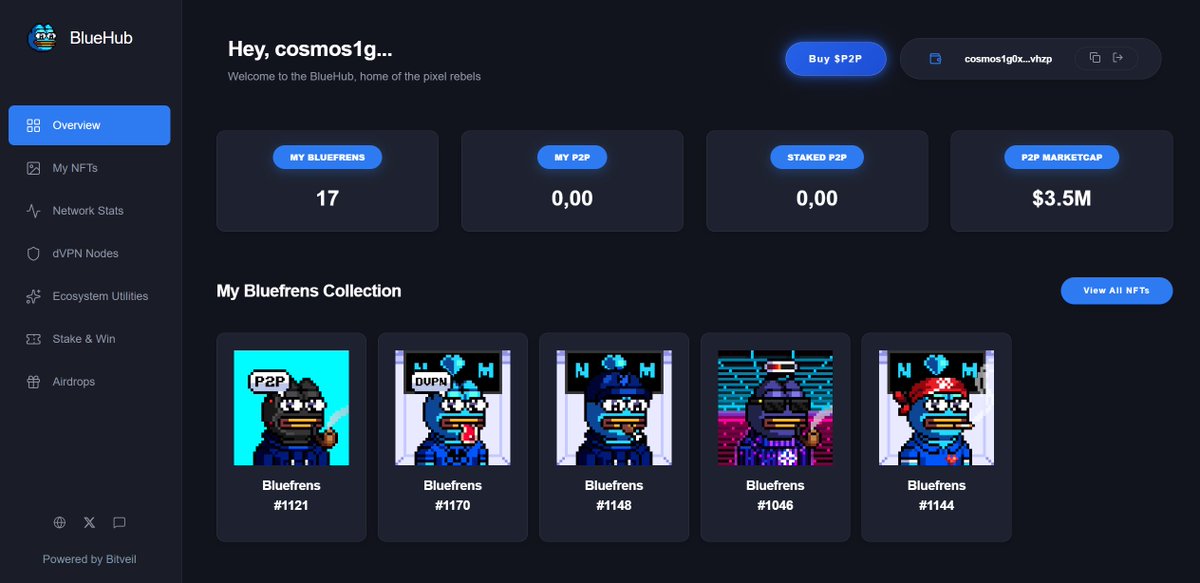
The Bluefrens hub is now live at https://t.co/Oi5ICJhUIt!
Bluefrens is Sentinel's community driven NFT ecosystem created and managed by @Bitveilofficial
Become eligible to enter weekly lottery events at the Bluefrens Hub by holding sentinel:native or Bluefrens NFTs.
Sentinel is an ecosystem focused on utility and real value generation and in order for Sentinel to support a community driven initiative there has to be a strong purpose.
The Bluefrens ecosystem intends for its NFT to have many more usecases than just being a digital JPEG, various dVPN apps and ecosystem utilities built on Sentinel will be offering perks to holders.
Sentinel is one of the first utility focused networks to have a meme culture starting in 2019. The Blue fren was born far before Pepe became famous. Community driven initiatives like Bluefrens drive Sentinel's culture and spirit forward aggressively.
Join the official Bluefrens Discord at:
https://t.co/ou5kzSqbVb
Google’s reCAPTCHA Fails to Stop Bots—But It’s Great at Harvesting Your Data
The controversy surrounding #reCAPTCHA Data. Explore how the system collects user information and its impact on privacy and user tracking
https://t.co/PAHcNB7Fen
VPN detection is improving
Blocking is increasing
Because centralized VPN infrastructure is easy to identify, track, and flag
A decentralized VPN built on Sentinel cannot be as easily identified or tracked
Join 1M+ users and agents accessing an unrestricted internet
It’s never been easier to use a decentralized VPN
Apple TV, Android TV, browser extensions, desktop clients, Multiple apps,
Pay with 300+ cryptocurrencies, including $XMR From $3/month. Some apps are currently free!
Explore Decentralized VPN with https://t.co/LI1IgZ2IEg
We don't have to deal with that kind of nonsense:
Sentinel has over 1,000 servers managed by members of the community.
Our network has over 10 independent dVPN apps, each with its own team.
If you don't want to use other people's apps, build your own! It's now super easy with our SDKs.
What about the code?
It’s completely open-source - check it out for yourself!
https://t.co/ot5PHTxQWQ
The fight for a free internet is every user’s right.
We’ve been doing this for over 8 years and continue to provide tools to bypass blocks to anyone who needs them.
Stay strong and use dVPN!
https://t.co/fQp6E5Gw92
We say NO to Chat Control - & so did the EU Parliament. 💪
But now the Conservative EPP wants the Parliament to vote AGAIN 😡
⚡️Call on your MPs to stay strong & fight for #privacy! https://t.co/FUHuFlfW3m
⚡️ Read the open letter by EDRi that our founders Arne & @matthiaspfau signed: https://t.co/9qiYSkJLtQ
A Self-hosted VPN user discovers the hard way: when your home server goes down, everything goes with it
Privacy shouldn’t rely on a single point of failure
The Sentinel Network runs thousands of independent nodes across 130+ countries
Get a dVPN - https://t.co/fQp6E5Gw92
Protect children online
Protect children onlin
Protect children onli
Protect children onl
Protect children on
Protect children o
Protect children
Protect childre
Protect childr
Protect child
Protect chil
Protect chi
Protect ch
Protect c
Protect
Protec
Prote
Prot
Pro
Pr
P
Pr
Pro
Prof
Profi
Profil
Profile
Profile a
Profile ad
Profile adu
Profile adul
Profile adult
Profile adults
Profile adults o
Profile adults on
Profile adults onl
Profile adults onli
Profile adults onlin
Profile adults online
Privacy isn't some edge case for criminals.
You don't hand your diary to strangers. You don't CC your bank statements to your neighbors. You don't talk about your salary in a crowded room.
But we built a financial system that does all of this automatically and permanently.
Then we told ourselves it was progress.
Cash was anonymous for centuries. It worked. Society didn't collapse. Commerce didn't fail. People transacted freely without broadcasting their lives.
The next generation of crypto needs to remember the lesson that cash knows: privacy isn't a feature you add later. It's the foundation you build on.
Or we can keep pretending it doesn't matter.
War on drugs didn't stop drugs. It built cartels.
Every whistleblower faces the same problem: survival.
Exposing the truth costs you your job, your reputation, often your safety. Support networks want to help-crowdfunding, donations, direct aid. But traceable money is a trail that leads straight to the source.
Bitcoin donations to WikiLeaks are traced and frozen. Canadian trucker bank accounts were locked. The pattern is clear: financial transparency is a weapon against dissent.
DarkFi enables something long overdue: the dark treasury.
Anonymous financial support for high-risk situations. When someone leaks documents exposing corporate fraud or government corruption, they can receive anonymous donations that can't be traced back to them. The donor proves they sent funds. The recipient proves they received them. But the link between identity and transaction is severed mathematically.
This isn't just about whistleblowers. It's also about everyone who funds them. When donations are traceable, donors face retaliation. Their names end up on lists. Their businesses get targeted. Their bank accounts get scrutinized.
True anonymity for sender and recipient. No list. No trail. No retaliation.
The implications extend beyond whistleblowing.
Activists in authoritarian regimes. Journalists in war zones. Human rights defenders in hostile territories. Anyone whose work makes them a target needs financial infrastructure that doesn't betray them. The dark treasury isn't a fringe use case - it's essential infrastructure for any society that values truth over power.
You should be able to decide when the curtains are open.
Privacy technology should be seen as the default state.
Total individual autonomy - you decide when, if and to who you want to un-shadow yourself.
We have been PSYOPed to think that the curtains should be open by default.
Explorers remember everything. That helps audits but also feeds models that profile you.
SilentSwap uses confidential routing to break the direct link between sender and receiver while staying non-custodial and compliant.
You pick the moment to be visible. Everything else stays silent.
https://t.co/7GRzahpLfp