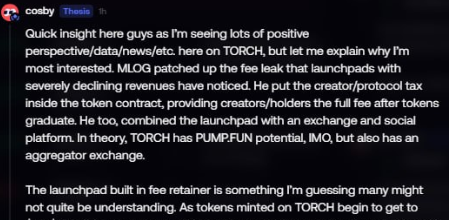
The community brought this screenshot to my attention yesterday, and I must say I’m happy someone took note.
Before we launched, I shared quite a bit of research showing that 9/10 EVM launchpads are actively losing creator fees due to flaws in Uniswap v4 hooks - or well, factually no flaws, just wrong use case (creatorfee).
With Torch, we tried to solve this through contract fees instead of hooks, and so far we’ve been proven right.
What matters here is that all other launchpads and the projects luanching are more or less losing their fees after about a month-ishh. That’s the point when the coins have grown enough for providing LP to become interesting.
It says something to me that this holder, who showed some pretty crazy conviction, is one of the few who actually researched this and understands it. I also know that a lot of this tech talk is yada yada for many people, which is fine. But for the sustainability of the project, these fees are absolutely necessary, if not the most important thing.
I’ll try to explain it in simple words. What is happening on other EVM launchpads is pretty straightforward:
> Creator fees go through a hook that sits on one LP pool.
> 3rd parties create a new LP pool, with no hook or with their own.
> LP and hook fees are generally 1%.
> A 3rd party sets up an LP pool with a 0.9% fee (or anything lower) and adds liquidity. Gets a lot of routes
> The project loses the creator fee, as the third party’s pool doesn’t have the projects hook.
>The launchpad loses its share of the creator fee revenue. Revenue declines, flywheel stops.
So with torch I tried to fix that on a few ways, i'll sum that up below;
We moved the fee out of the pool and into the token itself. The creator fee is enforced in the token contract, not in a hook and not in a specific pool. That changes the whole picture:
> The fee lives in the token, so it applies no matter which pool or router a trade goes through.
> A third party can create as many new LP pools as they want. The fee still applies, because the pool never decides whether it is charged.
> There is no hook for anyone to skip, so there is nothing to route around.
> The fee is only enforced on the buy side, and selling is never taxed by the token.
> Every pool also comes with a default 0.3% trading fee, which goes to liquidity providers. This 0.3% is a uniswap default on most pools, this encourages people to simply add to the canonical pool instead of a seperate one. It keeps the main pool attractive without it being PvP'd (pool v pool lol), so it keeps the most routes.
The torch fees, from both torch and the projects launched will, forever remain and can not be bypassed in the general sense.
Hope this clears up why I did it the way it is. Liquidity is king and that's why I wanted phat liquidity on torch.
All this is enough reason for all builders that are looking for a long term sustainability, to come over to torch and grow alongside it including the community without being afraid of their bread being taken by 3rd parties.
- mlog
Yesterday in London, our CEO @gverdian joined @TheFCA, @Tandem_Bank, @awscloud, @OpenPayd and @HLCGlobal at @InnFin’s FinTech as a Force for Good Forum to discuss operational resilience in an always-on digital economy.
3 takeaways:
➡️ Outsource capability, keep accountability
➡️ 24/7 money changes the risk profile
➡️ Build resilience in from day one
As Gilbert put it: “For the first time in probably 30 years, we’re able to design what we need for the next 30. It’s very encouraging to have so many banks and regulators at the table to do this together.”
#OperationalResilience #TokenisedDeposits #DigitalFinance #AI
A bank account can hold money. It can't follow rules.
PayScript is Quant's language for writing those rules. They live on the account, and the money stays where it is.
I went through the spec, the docs and the first live payments, and animated how it works 🧵👇
$QNT
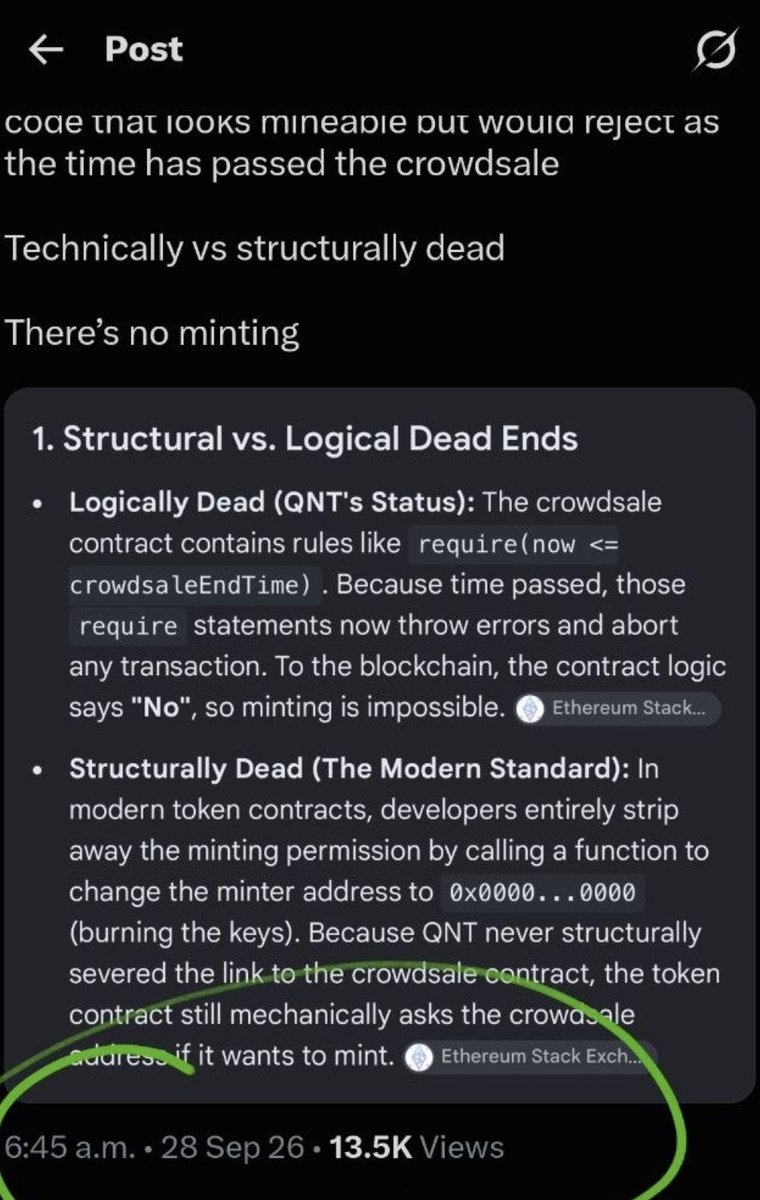
@GregLuntX I don’t need to analyze your engagement farming and crap. I’ve been around QNT since the EtherDelta and IDEX days, and I already know everything I need to know about QNT.
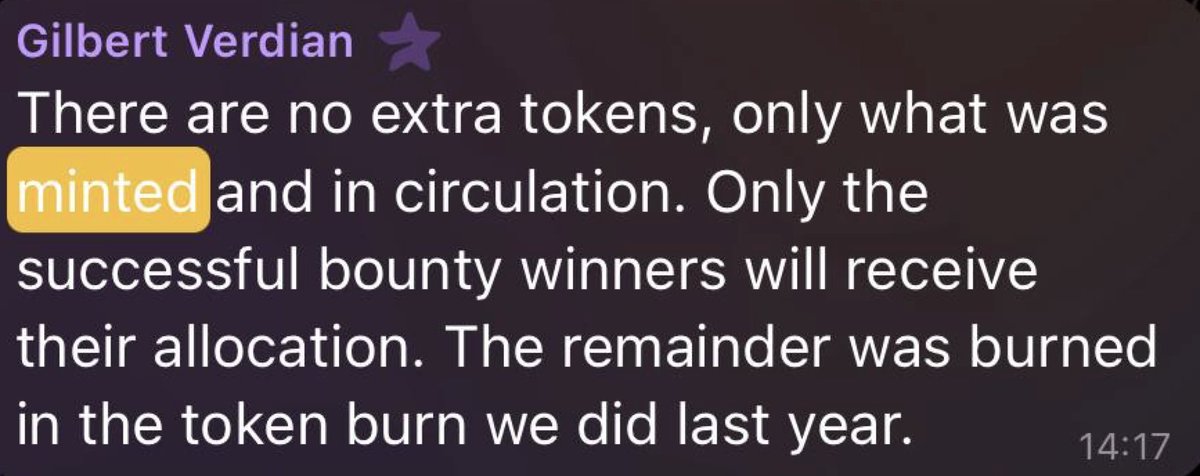
@GregLuntX But the original Quant docs already said no minting after the crowdsale, token creation was permanently closed, and unredeemed tokens were burned. Your own post also says minting is logically impossible now.
So what exactly does this research prove that wasn’t already known?
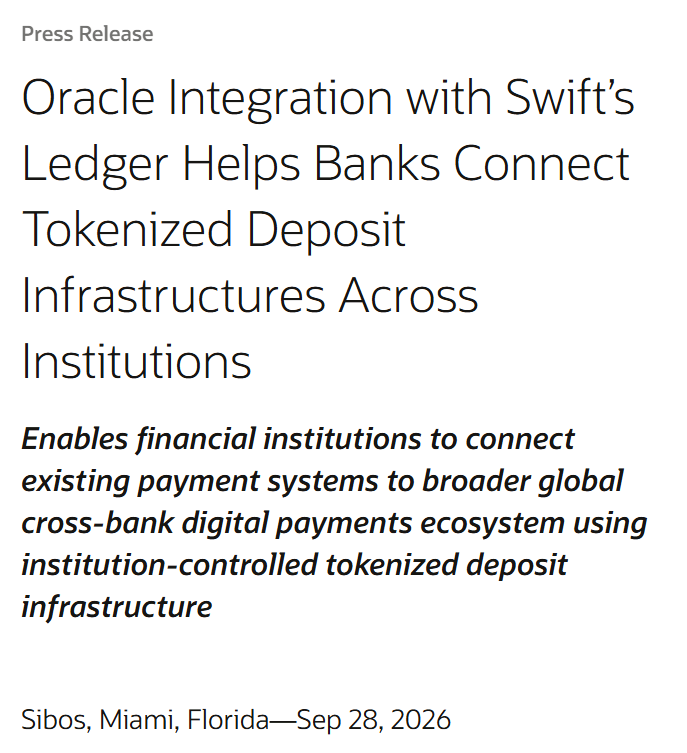
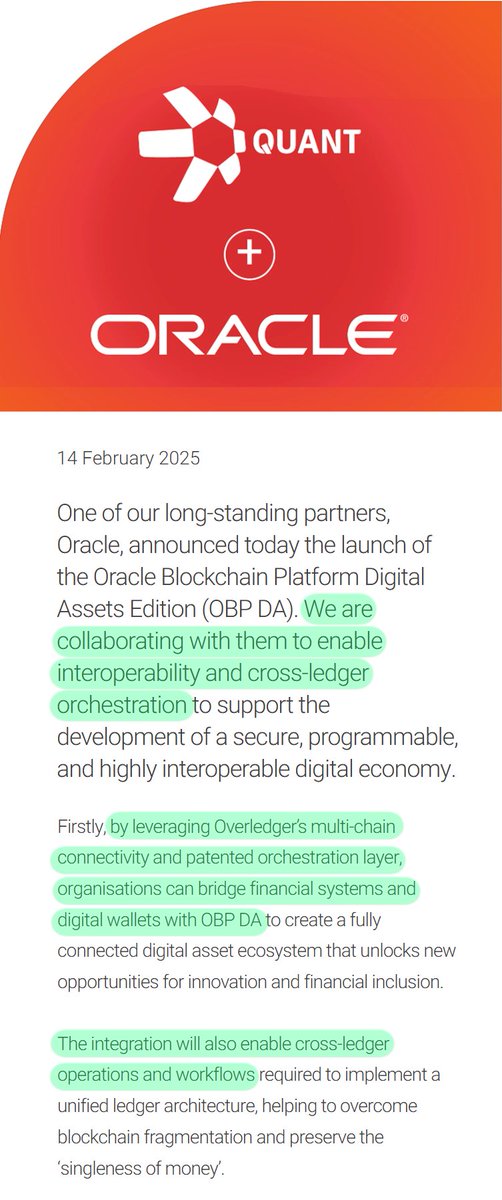
⚔️🔥 BREAKING: Oracle has announced their integration with Swift’s blockchain for cross-bank tokenized deposits.
Hmm, that sounds familiar...
Considering Oracle already has a certified solution for cross-ledger orchestration sitting inside its own stack:
$QNT’s Overledger.
This announcement describes the EXACT kind of problem Overledger was specifically built to solve.
→ Different banks
→ Different ledgers
→ Different deposit systems
All needing to communicate with each other.
This is why deals like The Clearing House matter so much — they don’t just add another customer, they strengthen the network effects around the underlying infrastructure.
Once enough major institutions plug into the same connective layer, everyone around them is more and more incentivized to follow.
You’re watching in real-time how interoperability eats an entire industry.