Nick Cave perdió a su hijo de 15 años, Arthur, en 2015; y a su hijo Jethro, con 31 años, en 2022.
Hace poco respondió así a un fan que le preguntaba por qué seguir creyendo en el mundo, en vez de abismarse en el cinismo.
Elon Musk avait dit un truc qui m'avait marqué sur l'allocation de ressources. En substance : passé un certain niveau de richesse, l'argent n'est plus de la consommation, c'est de l'allocation de capital.
Cette phrase change tout.
L'économie, dans le fond, c'est juste un problème d'allocation. Tu as des ressources finies et des usages infinis. Qui décide où va quoi ?
Imagine une cour de récré. 100 enfants, des paquets de cartes Pokémon distribués au hasard. Tu laisses faire. Très vite, un ordre émerge. Les bons joueurs accumulent les cartes rares, les collectionneurs trient, les négociateurs trouvent des deals. Personne n'a planifié. Et pourtant chaque carte finit dans les mains de celui qui en tire le plus de valeur. Le système maximise le bonheur total de la cour. C'est ça, la main invisible.
Maintenant fais entrer la maîtresse. Elle trouve ça injuste. Léo a 50 cartes, Tom en a 3. Elle confisque, redistribue, impose l'égalité. Trois effets immédiats. Les bons joueurs arrêtent de jouer, à quoi bon. Les mauvais n'ont plus de raison de progresser, ils auront leur part. Les échanges s'effondrent. La cour est égale, et morte. Elle a maximisé l'égalité, elle a détruit le bonheur.
Le problème de la maîtresse, c'est qu'elle ne peut pas avoir l'information que la cour avait collectivement. C'est le problème du calcul économique de Mises, formulé en 1920. L'URSS a essayé de le résoudre pendant 70 ans avec le Gosplan. Résultat : pénuries, queues, effondrement. Pas parce que les Soviétiques étaient bêtes, parce que le problème est mathématiquement insoluble en mode centralisé.
Quand Musk a 200 milliards, il ne les consomme pas, il les alloue. SpaceX, Starlink, Neuralink, xAI. Chaque dollar est un pari sur le futur. Et lui a un track record. PayPal, Tesla, SpaceX. Il a démontré qu'il sait identifier des problèmes immenses et y allouer des ressources avec un rendement spectaculaire.
L'État aussi a un track record. Hôpitaux qui s'effondrent, éducation qui décline, dette qui explose, services publics qui se dégradent malgré des budgets en hausse constante. Le marché identifie les bons allocateurs, la politique identifie les bons communicants.
Le profit n'est pas une finalité, c'est un signal. Il dit : tu as alloué des ressources rares vers un usage que les gens valorisent suffisamment pour payer. Plus le profit est gros, plus la création de valeur est grande. Quand Starlink est rentable, ça veut dire que des millions de gens dans des zones rurales ont enfin internet. Quand un ministère est en déficit, ça veut dire qu'il consomme plus qu'il ne produit. L'un crée, l'autre détruit, et on appelle ça redistribution.
Dans nos sociétés il y a deux catégories d'acteurs. Les entrepreneurs et les bureaucrates. L'entrepreneur prend un risque personnel pour identifier un problème, mobiliser des ressources, créer une solution. S'il se trompe il perd. S'il a raison, ses clients gagnent, ses employés gagnent, ses fournisseurs gagnent, l'État collecte des impôts. Il est la cellule de base du progrès humain.
Le bureaucrate ne prend aucun risque personnel. Son salaire est garanti. Au mieux il maintient une rente existante. Au pire il la détruit par excès de réglementation, mauvaise allocation forcée, incitations perverses qui découragent ceux qui produisent. Mais dans aucun cas il ne crée.
Regarde les 50 dernières années. iPhone, internet civil, SpaceX, Tesla, Google, Amazon, Stripe, mRNA, ChatGPT. Toutes des inventions privées, portées par des entrepreneurs, financées par du capital risque. Pas un seul ministère n'a inventé quoi que ce soit qui ait changé ta vie au quotidien.
La France est devenue le laboratoire mondial de la dérive bureaucratique. 57% du PIB en dépenses publiques, record absolu. Une administration tentaculaire, une fiscalité qui pénalise la création de richesse. Résultat : décrochage face aux États-Unis, à l'Allemagne, à la Suisse. Fuite des cerveaux. Désindustrialisation. Dette qui explose.
Et le pire c'est que la mauvaise allocation s'auto-renforce. Plus l'État prélève, moins les entrepreneurs créent. Moins ils créent, moins il y a de base fiscale. Plus l'État s'endette et taxe. Boucle de rétroaction négative parfaite. La maîtresse pense qu'elle aide, et chaque année la cour produit moins.
Dans nos sociétés, ce sont les entrepreneurs, toujours, qui font avancer la civilisation. Les bureaucrates au mieux maintiennent une rente, au pire la détruisent. Aucune société n'a jamais progressé en taxant ses créateurs pour subventionner ses gestionnaires.
La question n'est jamais qui a combien. C'est qui alloue le mieux la prochaine unité de ressource pour maximiser le futur de l'humanité. La réponse depuis 200 ans n'a jamais changé. Ce ne sont pas les fonctionnaires.
ℹ️La mejor información no se pide. Se encuentra.
En https://t.co/JDvtBfRLZ7 puedes crear tus propios rankings:
✅Las 10 empresas menos endeudadas
✅Las de mayor crecimiento de BPA
✅Las de dividendo más sólido
Todo con filtros simples, sin Excel, sin depender de nadie.
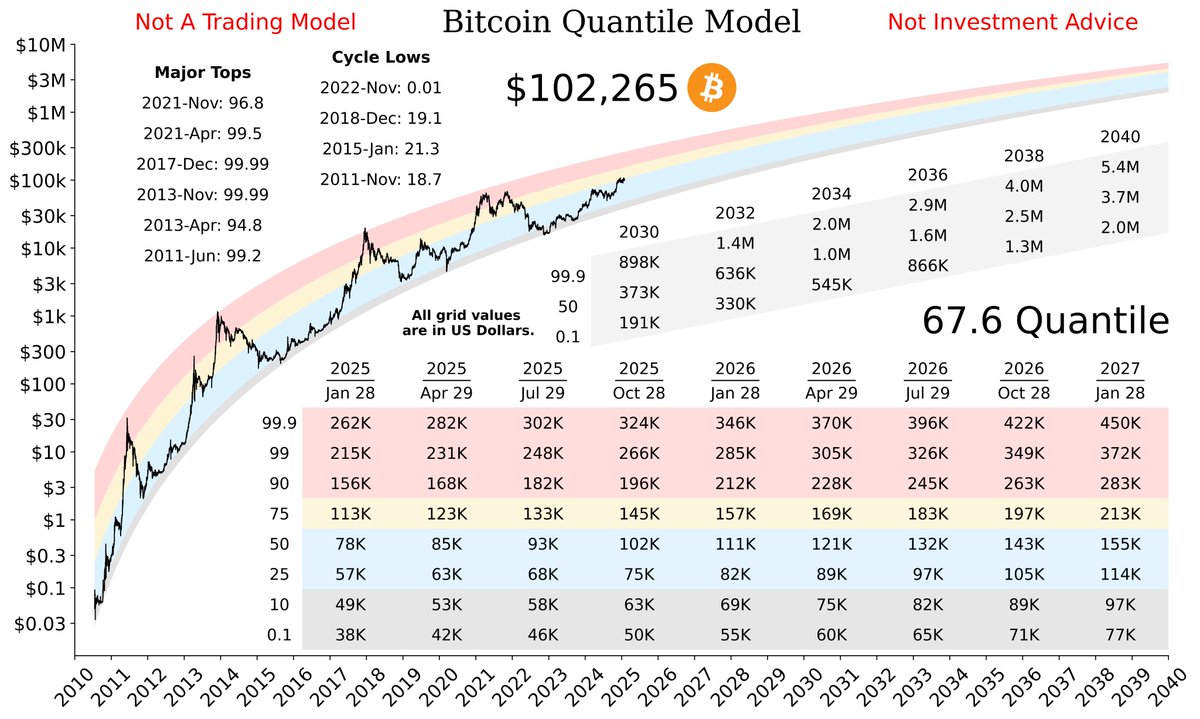
Plan C and have been developing the Quantile Model since mid last year.
A few days ago, we decided to start a research project and publish additional analyses on it.
The amount of work we've been able to do in a few days just amazes me. Let's recap. 🧵 0/
The world's largest capital allocators turning into raging Bitcoin bulls isn't priced in.
The suits are just now starting to allocate - and really just as a small portfolio diversifier because Fink told them to.
But how many of them truly understand BTC?
Very few.
But nothing incentivizes diving head first into the rabbit hole like Number Go Up.
They're getting their first little taste of BTC gains right now.
And guess what?
They fricken love it.
Their inner Gordon Gecko is coming alive.
All these years of steady 8% returns, diversifying with government paper, shooting 95 on the links, dry chicken breast dinners, missionary once a month if they do the dishes...
And now BTC is stirring something inside of them that they didn't even realize had died long ago.
They see Bitcoin steadily crushing everything in their portfolio... And they feel ALIVE.
This is how it starts.
Soon they will reach the same conclusions that many of us came to long ago.
Conclusions based on very simple logic.
Stated simply: There is no second best asset.
Sell the things that are created out of thin air and buy the finite thing that can't be seized or debased.
Every Bitcoiner comes to the same simple conclusions.
And those conclusions have been proven devastatingly correct over the years.
Once you understand Bitcoin, it's all you really want to own long term.
Everything else comes with too many tradeoffs AND likely underperforms.
"Yeah but you should diversify"
For what?
To underperform the best performing asset of the past decade that I can hold for free with zero counterparty or debasement risk?
Choosing to hold Bitcoin instead of everything else is purely logical.
And it's only a matter of time until the majority of global capital is sucked in by the inescapable gravity of the orange hole.
I'm done pretending that Bitcoin is anything less than the best savings technology ever invented.
If it's not going to zero, it's going to millions.
And at this point it's clear it's not going to zero.
Bitcoin is a better investment than Swiss hotels or restaurants or car factories because bitcoin is offering a far more valuable product to the world: a replacement for central banks. Since central banks are the absolute worst, most criminal and most destructive thing on earth, there is an enormous market reward for anyone that can put offer people an alternative. When you buy bitcoin, you are growing the bitcoin pool of liquidity and offering people a money better than central bank slavery. You're making bitcoin better and the market rewards you for your investment. The world needs a central bank replacement a lot more than Switzerland needs another hotel.
But this is a transitory phase that cannot last forever. Bitcoin can't keep replacing central banks forever. Eventually it replaces them all and when they and all their shitcoins are dead, bitcoin won't be making enormous returns anymore. It only makes enormous return by eating other crappy moneys , but when all the crappy moneys die, bitcoin only grows in value as the production of other goods increases. It will only appreciate at 1-5% per year in terms of most goods and services. At that point, Swiss hotels become attractive again.
Deflation is NOT a bad thing, and this is the biggest and most criminal psyop ever perpetuated on humanity, because everything evil is downstream from government inflation, and this is the justification for inflation. Deflation is just another word for economic growth. It is completely normal and good that things become cheaper over time. That's why we work. Work produces things and when things become more abundant they become cheaper. The market chooses the money that is the hardest to make precisely because the limit on supply growth makes it depreicate the least. The natural order is that everything gets cheaper. This does NOT mean that nobody would be consuming or investing. People do not consume just because they expect their money to depreciate. They consume to survive and to enjoy life. It doesn't matter how much cheaper you expect food, clothing, phones,or shelter will be next year. You want these things today and will pay for them today to use them today. Everyone knows their laptop and phone will be significantly cheaper next year and yet they all buy it. It's true that appreciating money will make you less likely to spend money on frivolous bullshit you don't need, and that's a good thing. Debt-fueled mass consumption is a moral disaster for humanity and Bitcoin can't kill it soon enough. The world doesn't need you to waste money on stupid bullshit.
And people don't just invest because they expect money to depreciate. They invest because productive activity produces a surplus over holding money. And the key thing to remember is that money would not appreciate if people weren't investing and producing. So it's impossible to imagine a scenario where nobody invests but money appreciates.
In sum, deflation is great, and it is the absolute best thing about bitcoin. Bitcoin being deflationary makes it the best investment opportunity in the world for as long as central banks exist. You are being perfectly rational to not want to invest in things that aren't as productive, morally imperative, and important as ending central banks. There'll be plenty of time and money for Swiss hotels when central banks are dead.
A trillion dollars of prime Florida real estate needs to be repriced.
How much are coastal properties worth in a world where insurers suddenly refuse to insure, or jack up premiums 10x?
Families that stored the majority of their wealth in their homes are facing massive losses.
Homes are not designed to store wealth long-term. They're designed to be enjoyed and lived in.
And yet homes are one of the most popular savings vehicles in the world.
Bitcoin is designed to store value.
"But Bitcoin isn't tangible!"
You mean it can't be flooded by the ocean or blown apart by a tornado?
And I can just hold it for zero cost without paying property tax or 1% of it's value in insurance each year?
Sounds pretty great to me.
A lot of people seem to have forgotten that cold stored Bitcoin is the king of assets.
But something tells me they'll be reminded soon.
@Juan_Web3 Sí, la entrada oficial de dinero institucional fue en diciembre del 2017, cuando se habilitaron los futuros de CME. En cualquier caso, antes y después de esa fecha los ciclos de BTC respecto a los halvings se han cumplido al dedillo, independientemente del Nasdaq
@Juan_Web3 De 2018 no hace tanto, y para entonces el mercado ya no eran cuatro frikis... el día que vea a Bitcoin romper su ciclo relacionado con los halvings entonces me fijaré en posibles correlaciones con otros activos, hasta entonces mejor no complicarse
The world is converging on #Bitcoin as the ultimate store of value asset.
But the big moves are still ahead of us.
The change in perception of Bitcoin over the past 5 years has been astonishing.
It's gone from an asset that was laughed off at cocktail parties, to an asset that BlackRock is sprinkling into conservative bond portfolios.
And it's happened in a blink of an eye.
Now the US and Hong Kong spot ETFs are hinting at the bigger game that's ahead.
Nation states are entering a battle to get as much Bitcoin as possible under their jurisdiction.
Every country will leverage whatever natural advantage they have to stack finite Bitcoin.
And now that the US and China have made it clear that they're keen on converting overinflated financial asset value into Bitcoin...
We likely aren't far off from major oil and gas producers from publicly stacking Bitcoin.
Converting finite oil profits into finite #Bitcoin makes a lot more sense than converting finite oil profits into infinite fiat assets.
It's a simple idea that will change the investment landscape forever.
And it's the type of move that will send Bitcoin towards $1 million per coin and beyond.
If you think you missed the boat at $66K, you need to realize that we are still at the very beginning of this story.
Most people will still write this off as crazy.
Right now I'm the guy with a dial-up Internet connection explaining how one day we'll be able to stream any movie or song we want from our laptop while cruising at 35,000 feet.
Most people wouldn't have believed it.
But today it's normal.
Those who can extrapolate trends have always had an advantage in investing and life.
And Bitcoin is one of the easiest trends to spot.
If you can see it too, you have one simple job:
Stay solvent, stack Sats, and enjoy life.