I hold real estate forever.
Raise money instead if needed to grow.
The only time you sell
- If the asset is a dog
- If it needs major capex
- If it is in the wrong location
- If it is dramatically underperforming relative to the replacement asset
- Or if selling unlocks a move that multiplies your wealth immediately
But if the asset is solid
Keep it. Raise capital. Scale faster.
Lessons from deal junkie
1. Don’t lose money
2. See rule #1
3. You can’t do a good deal with a bad person
4. Always let it be their idea
5. The property, location and basis doesn’t matter the financing does
6. Things won’t always go your way, how you handle that determines your next paycheck
7. Don’t partner with people who don’t understand integrity and grace
8. When people show you who they are, believe them
9. Greed kills more deals than lawyers
10. The biggest distress in real estate is management
11. Banks are the # 1 cause of bankruptcy
12. In God we trust & all there’s most furnish collateral
13. You can make a deal in any market, but at times it’s hard to find buyers or sellers
14. Never ID in a 1031 exchange until the 45th day
15. DSTs are for suckers who don’t read the fee section
16. Sellers are the cheapest money you’ll ever get
17. Debt is cheaper than equity (hard money loans are much cheaper)
18. A great partner is worth their weight in gold
19. A bad partner should be removed expeditiously
20. Don’t buy…lend, trade, lease or option
21. The velocity of money is everything
22. Your partner’s gonna take half. His name is Uncle Sam
21. Wrapping a loan can make ya 20% faster than you can buy a 20% cap
22. Debt yields > equity yields
23. Saying “You’re right” is how you win a negotiation
24. Safety before yield
25. Walking debt may be the greatest RE move known to man followed closely by options
26. Amortization is a hidden profit center
27. Equity is like sex appeal everyone thinks they have more than they do
28. You dance with the people, not with the properties
29. Always TIC in if with partners
30. The sooner you realize there’s a lifetime value to a partner that’s 10X the current deal the better you’ll be
31. Losing a small amount of money today can compound into millions of dollars in 10 years
32. There’s a deal beyond the deal
33. Share the sugar
I caught up with a friend of mine that helped raise capital for an ex-AWS turned real estate syndicator.
He raised maybe $20M as a "Co-GP". It did not go well.
First, the GP had no real estate background. Just engineering...and access to a lot of capital.
Together, they raised well over $150M from silicon valley engineers.
This hot young syndicator acquired 18 properties in 24 months from mid-2020 to mid-2022.
All of them had variable rate debt. Most did not have rate caps. I repeat: Didn't even buy rate caps. The attorney apparently "forgot". At least, that was the excuse.
So far, the bank has taken 8 properties. Total equity loss on all of them. The other 10 are almost certainly next, but they are in some state of litigation.
The syndicator's website is gone, wiped from existance. Investors are in the dark.
My friend has since been in countless depositions.
He has been named in several lawsuits.
The SEC is also poking around now - justifiably - because they're inquring about mis-representations from the sponsor. Of course, he gets tied into the entire investigation as well.
This is what can happen when you just trust someone implicitly without digging into the details. My friend is a good, honest man...but he got caught up in the euphoria, like many.
And now he is in year 3 of a legal battle. For those of you that have been through anything like that, you know what a cloud it is hanging over your head. Especially when you have young children.
Young (and old) investors, a couple warnings:
• You simply cannot mess around with raising capital. It isn't just ho-hum, "no big deal" stuff. It's a legal tightrope with extremely tight guardrails. You should consult an attorney on everything. Everything.
• Putting your reputation on the line to raise capital for someone else's deal is a MAJOR decision. You better be wildly vigilant before hitching your wagon to someone else.
• You cannot "Co-GP" without having a material responsibility in the deal that reasonably aligns with your compensation/equity. You cannot get paid for raising capital on a sliding scale (unless you're registered as a broker-dealer with the SEC and completely follow FINRA regs).
• You need to seriously assess the sponsor and their underwriting to ensure it is conservative and defensible. If they are cowboys with their numbers and you're even adjacently involved, you WILL get dragged in - complicit or not.
Stay sharp out there.
Physical AI is where the money is going next :
$OUST — Lidar sensors for robots and AVs. Velodyne merger. Profitability unproven.
$QCOM — Smartphone and auto chip designer. Snapdragon. Diversifying beyond mobile.
$ISRG — Robotic surgery monopoly. Da Vinci system. Pay-per-procedure model.
$TSLA — EVs, FSD, Optimus robot. Valued as AI co, not automaker.
$SYM — AI warehouse robotics. Walmart anchor client.
90% of people in real estate wouldn't make it in any other industry as an entrepreneur.
99/100 house flippers aren't going to go start a tech company and crush it. They just aren't.
Most of the people that implode in real estate I find are trying to turn their real estate business into something it's not.
I say this a lot, but there's a reason that your buddy from high school with 3 brain cells is making $1,000,000 / year in real estate...
Your goal needs to be simplicity, limiting brain damage, and a 50%+ net margin.
There is no one coming to buy your prison of complexity that you call a real estate business.
Lean team, lean systems, no office, high profit margin, and maximizing profit per deal.
Get your main thing to $500,000+ / year in take-home income, build a lean team, buy stable assets in stable markets, and don't get distracted.
For most people, that's the ideal path.
Chicago Office Building Sales
401 S. State St ↓94% $4.2M vs $68.1M in 2016
300 W. Adams St ↓92% $4M vs $51M in 2012
55 W. Monroe St ↓90% $25M vs $243.25M in 2014
100 N. Riverside Plaza ↓87% $22M vs $165M in 2005
175 W. Jackson Blvd ↓87% $41M vs $306M in 2018
311 S. Wacker Drive ↓85% $45M vs $302M in 2014
600 W. Chicago Ave ↓83% $89M vs $510M in 2018
111 W. Jackson Blvd ↓81% $25M vs $135M in 2013
70 W. Madison St ↓77% $85M vs $377M in 2014
131 S. Dearborn St ↓76% $137M vs $560M in 2006
250 S. Wacker Drive ↓74% $23.8M vs $90M in 2011
200 S. Wacker Drive ↓68% $68M vs $215M in 2013
161 N. Clark St ↓62% $125M vs $331M in 2013
401 N. Michigan Ave ↓53% $132.5M vs adjusted $281M in 2017.
@julie_kelly2
#commercialrealestate
Successful real estate investing boils down to three things:
1) Acquisitions/Deal Sourcing
2) Capital
3) Operations
We call them the Three Pillars.
Can't build any scale without all 3 fully dialed in.
How to build it out?
• You can partner with others
• You can outsource to third parties
• You can relentlessly recruit
Often, it'll be some combination of the three.
But you need systems and solutions for each pillar if you're going to try to build something stable, scalable, and lasting.
Can you do it all yourself?
Sure, probably early on. But soon enough, you will be your own bottleneck. Plan accordingly.
(Photo of my business partner, Matt, at our quarterly team huddle.)
Bill Ackman says investors are repeating the same mistake from 2000 by chasing hot stocks and ignoring quality.
Here are 10 quality stocks trading at attractive valuations:
1. $META
5-Year Revenue CAGR: 15.2%
Forward P/E: 18
Consensus Price Target: $826
Implied Upside: 39%
I think the most simple, iron clad investing strategy in multifamily is targeting:
• Decent B class apartments
• Around 50% or less of new build cost
• In low crime, stable, affordable submarkets
Buy it with fixed debt. Make it nice. Steward it well.
Let time cook.
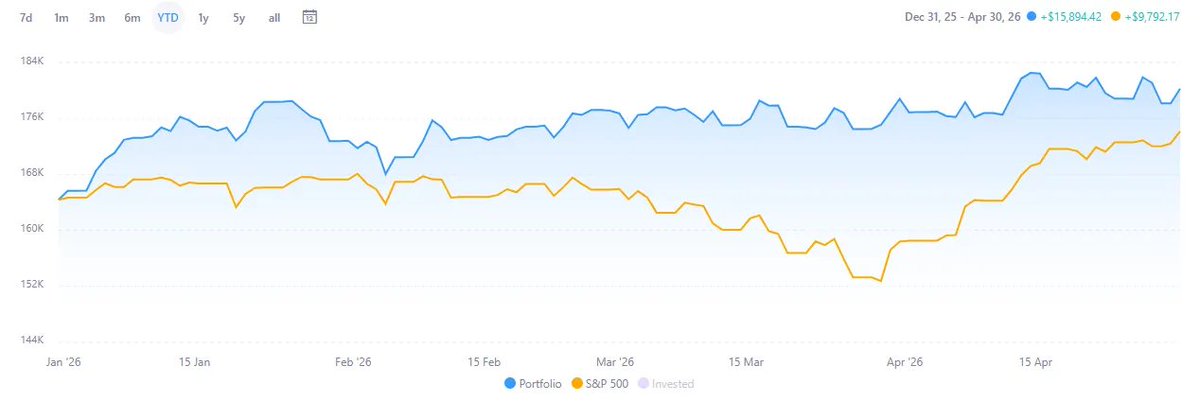
9.49% YTD after returning 64.3% in 2025. April was an incredible ride for the indexes — not so much for us. We didn't suffer much in March because we were defensive, but that also means the recovery wasn't as strong.
Every month I review every position, share management call takeaways, and give an honest read on the macro. No spin, no narrative protection — just what's working and what isn't.
If that sounds interesting, check out Undervalued and Undercovered