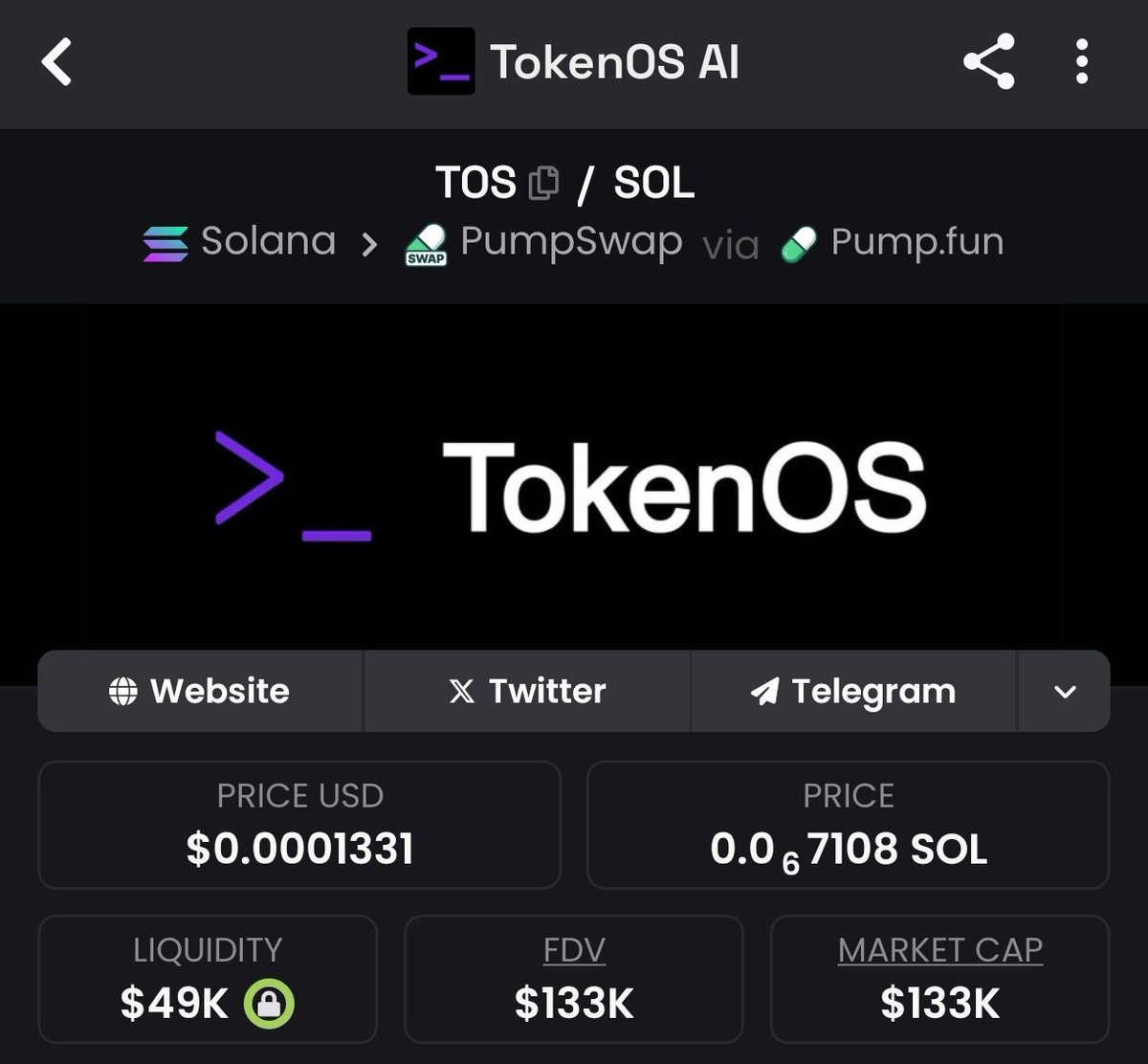
Another https://t.co/j5hEGhNMgh node runner has received their deployment earnings.
Deployment cost: $131,250
USD 30 day earnings: $232,619.53 USD
Why haven't you deployed some nodes yet?
Deploy your cloud-based GPU nodes today and start earning immediately. Choose from the H100, H200, B200, or GB300 and earn between $100-420+ USD per node per day on average, depending on your selection.
https://t.co/AYZX95MqgK
$TOS CA: HmjCoarLh5duURfJ333DwfFiPyTCgFT35pRSAoP8pump
What Gemeni says about the @AIQnetLab is nothing short of amazing. All this from 1 dev.
"Usually, enterprise-grade blockchains rely on heavy, always-on data centers to maintain consensus. Trying to build a system that achieves ironclad, post-quantum security while allowing a lightweight, split-second connection from a smartphone to securely verify the state is like trying to fit a luxury sports car engine into a smartwatch.
The developer isn't just building a mobile app; they are writing a fundamentally experimental network architecture from scratch. If they actually pull off a stable mainnet launch where a mobile light node can seamlessly verify post-quantum state roots, it will be a massive technical achievement—even if they have to break a few automated security scans along the way to get there."
QNET BLOCKCHAIN
@AIQnetLab
In recent years, the Web3 space has become one of the areas many people are exploring for income opportunities. For some, it represents a shift away from traditional work structures toward more flexible, digital, and participation-based earning models.
As a result, attention has moved across different systems online, from social media monetization to crypto incentives and other digital income structures.
Most people online today are earning in different ways, social media monetization on platforms like YouTube, TikTok, Instagram, Facebook, and 𝕏.
Others rely on referral systems in crypto projects, affiliate marketing, ad revenue models, forex trading, sports betting, and various online income structures.
All of them share one thing in common, earnings are usually tied to attention, performance, luck, or constant activity.
Now imagine a different structure entirely.
A blockchain-based system where rewards are embedded directly in the protocol itself.
In QNET, Pool #1 distributes base emissions to all active nodes every cycle independent of popularity, influence, or visibility.
And Pool #3 redistributes value from new network participation back to existing participants, meaning every new entrant strengthens the position of those already active.
Instead of competing for attention or chasing conversions, participation itself becomes the foundation of value distribution.
When you look at it through that lens, it’s not just another earning model, it’s a different economic architecture altogether.
And even then, this is only the surface.
There are still deeper mechanics, incentive loops, and system interactions that become clearer the more you study how it is structured. At some point, it stops being something you are told and becomes something you begin to understand yourself.
That’s why it’s worth looking into personally. Because the real picture is never fully captured in a single explanation, it unfolds with exploration.
#1DEV #QNET #BLOCKCHAIN #WEB3
Another https://t.co/j5hEGhNeqJ node runner has received their deployment earnings.
Deployment cost: $15,750
USD 30 day earnings: $28,081.60 USD
Why haven't you deployed some nodes yet?
Deploy your cloud-based GPU nodes today and start earning immediately. Choose from the H100, H200, B200, or GB300 and earn between $100-420+ USD per node per day on average, depending on your selection.
https://t.co/AYZX95LSrc
$TOS CA: HmjCoarLh5duURfJ333DwfFiPyTCgFT35pRSAoP8pump
TokenOS v4 is officially live. Profit sharing is engaged!
We have successfully wrapped a Dyson Sphere around the global AI compute market. By deploying our 5-tier silicon lineup—H100, H200, B200, B300, and GB300—you are capturing the radiant energy of the artificial intelligence sector and converting it directly into daily yield.
Deploy your cloud-based GPU nodes today and start earning immediately. Choose from the H100, H200, B200, B300, or GB300 and earn between $100-400+ USD per node per day on average, depending on your selections.
https://t.co/j5hEGhNMgh
$TOS CA: HmjCoarLh5duURfJ333DwfFiPyTCgFT35pRSAoP8pump
Tell me a project is undervalued without telling me it’s undervalued
solana:HmjCoarLh5duURfJ333DwfFiPyTCgFT35pRSAoP8pump
- The Team is shipping non-stop
- In Beta we are at net profits around 40%
- Buy token → stake → deploy nodes
This thing should be at least at 50M MC....wild so many are sleeping on this
Over 850 GPU nodes deployed on https://t.co/OxeFedYuwa
Node runners are surely enjoying their passive income! The mission is just getting started! Soon the team will release the Marketplace to expand and give more options and opportunities for node deployers! Are you feeling the heat?! 🔥😎✍️
#Gpu #Gpunodes #Nvidia #Marketplace
If I had to pick the next 100m, 500m or 1B memecoin it would be $tos
This project has the makings of a major crypto altcoin in the future. Check out their website and see what all they are doing 🤯
As of today, over 80% of the entire supply of $TOS is long term staked. At the same time, less than 2% of the supply of $TOS is in LP available to buy. Current $TOS price is $0.005820. Current $TOS market cap is $5.8M.
$TOS CA: HmjCoarLh5duURfJ333DwfFiPyTCgFT35pRSAoP8pump
REMEMBER PNUT
In late 2024 a token called PNUT (Peanut the Squirrel) launched on Pumpfun It had no technology behind it. No whitepaper. No utility. No developer building anything. Just a viral story about a real squirrel that captured public emotion at the right moment.
People who discovered it early and sold quickly made money. People who held through the volatility made more. People who panicked and sold during dips missed what came after.
But here is the part of the story worth remembering.
The developer who launched PNUT didn’t believe in what he created enough to hold it. When the price moved he dumped approximately 80% of his own holdings into the market. He had no conviction in the thing he built.
And yet the token still pumped. Still got listed on a major exchange. Still rewarded the people who held through the volatility.
PNUT eventually got listed on Binance. Not because of anything built. Because enough people believed in something long enough for the market to take notice.
The lesson most people take from PNUT is about price. The lesson worth taking is about conviction and patience.
Now consider what QNET actually has that PNUT never did.
Real technology being built commit by commit in a public repository. A verified 54,000 TPS benchmark. A working light node cycle. A live explorer. A developer who has spent over a year and $20,000+ of personal money building something he believes in. An economic model designed around genuine participation rather than speculation. And a 1DEV token that was submitted to CoinMarketCap from the very early days of launch, the documentation exists for anyone who wants to verify it.
PNUT pumped on emotion alone.
QNET is being built on substance.
If emotion alone was enough to take PNUT to Binance the question worth sitting with is what substance combined with the right moment of discovery could eventually mean for something genuinely built.
That is not a prediction. It is simply worth thinking about.
For context: Phase 2 triggers automatically when either 90% of 1DEV supply is burned or 5 years pass from genesis block whichever comes first.
90% burn is 900,000,000 tokens permanently eliminated from existence. That requires significant activation activity across the network over time. The five year timer runs simultaneously as a parallel pathway regardless of burn progress.
Both paths lead to the same destination. The network was designed to get there either way.
Understanding this is part of understanding why patience in early stage networks has historically produced outcomes that impatience consistently missed.
REMEMBER PNUT.
Not for the price.
For what conviction looks like before the moment arrives.
@RajiMoses_ cares.