Why choose https://t.co/J0elkUhG9w?
◽️Syndicate, VC, Launchpad and Project Fundraising
◽️User and Group Wallet Management
◽️Member and Client Management
◽️Ambassador Referral Program
◽️All-in-One Project Database (GDS): Access detailed project info, socials, documents, vesting, and token data in one place
◽️(Un)Locked (Un)Vested Portfolio & Asset Management
◽️(Co)Investing
◽️OTC Marketplace Trading w/ Broker Support Options
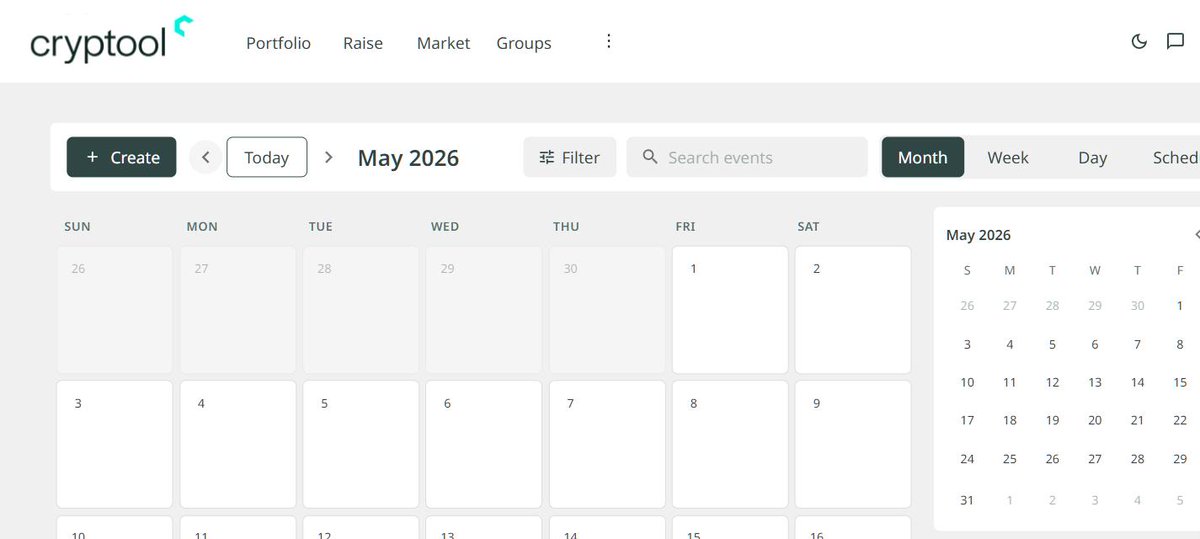
◽️Automated Portfolio, Group, Launchpad Event Calendar
And much more!
Streamline your investments now 👉 https://t.co/XIr3j7NmMp
@ZeynepSlaYldz Mapping the calendar is half of it. The other half is checking it against what the addresses actually did, because a published schedule and on-chain reality drift apart once a team moves early. The calendar tells you the plan, the transfers tell you the outcome.
@RsGrowth The tell underneath it: whether the schedule exists anywhere but the deck. If unlocks are set at deal creation and execute on-chain per participant, the founder answers from memory because the contract enforces it. A spreadsheet version drifts every quarter.
When your holdings are spread across multiple wallets and chains, checking your net worth shouldn't mean opening five browser extensions. Cryptool pulls your entire portfolio into one non-custodial dashboard. https://t.co/oN9HszGIxD
@ETNnigeria Good explainer. One thing most of them skip: a schedule only protects holders if someone reconciles it against actual on-chain transfers. Cliffs and linear unlocks look fine on paper until a team wallet moves early. Track the addresses, not the announcement.
@ilmeaalim@ethena@Tokenomist_ai Rewrites like this are why unlock calendars need tracking at the position level, not from a one-time tokenomics doc. If you hold vested allocations across projects, keep your own schedule and reconcile it against on-chain moves each cycle. Announced dates are not the contract.
Running a crypto syndicate means tracking every member's allocation, setting vesting terms, and distributing tokens when they unlock. Crypto syndicate management software handles all three without custody. https://t.co/CkyrGnv7qI
Locked token allocations vanish in most trackers. Cryptool shows liquid holdings and unvested tokens in one view so your real net worth isn't hidden. https://t.co/DSmDB50H8R
Tracking holdings across multiple wallets shouldn't require opening three different browser extensions. https://t.co/8SWXfrTMoL pulls your portfolio from every chain into one clean non-custodial view. Try Cryptool free: https://t.co/H7EP0twOTI
What's new in cryptool:
• Action and event calendar, live: vesting dates and deal events on one timeline
• Live updates and notifications, in real time
• A faster, refreshed interface
Non-custodial, every wallet and chain. https://t.co/oN9HszGIxD
@pratham_rasp Yes. Project admins set cliff, duration and unlock cadence at deal creation, then https://t.co/mHRTYhep2Y runs the distribution on-chain at each unlock and reminds holders when theirs is due. Investor side sits in the same account, so both directions stay in one view.
@LunchMoneyBro No wallet connect is the right call, a tracker only needs read access. That is how https://t.co/mHRTYhep2Y works: paste as many addresses as you want, every wallet and chain in one view, plus the unvested allocations most trackers ignore. Free tier to try.
Wallet trackers answer one question: what do you hold. Running a syndicate asks harder ones. Who committed to which raise, what has vested, who gets the next distribution.
We wrote up the operations layer that picks up where trackers stop: https://t.co/qqTcylJqyC
the scariest thing in any crypto portfolio is the wallet you forgot you own. old ledger, a metamask from 2021, that one you spun up for an airdrop. tracking only helps if it pulls every wallet into one view, keys still yours. thats basically why cryptool exists
if you manage other peoples money in crypto, the investor update is the worst part. pull positions off 5 chains, screenshot, paste into a deck, pray the numbers still match by the time you hit send. cryptool builds the lp-style view straight from the data so reporting stops being a weekend job
raising a small round in crypto is still weirdly janky. collect from 30 wallets across a few chains, track who actually sent, then sort allocations + vesting after. we built the raise flow into cryptool so its not 4 tools and a spreadsheet. (raises are on bnb chain, eth, multiversx atm)
if you run a syndicate the real pain isnt picking deals, its the admin after. who put in what, each members allocation, vesting per person, then doing distributions without a 3am spreadsheet. we built that whole back office into cryptool so the deal doesnt turn into homework
otc in crypto is still basically telegram dms and a trust-me spreadsheet. agree a price, someone sends first, everyone sweats a little. funny that moving real size still runs on vibes and screenshots. thats part of why we built otc into cryptool, keeps the actual deal record in one place
nobody warns you how messy tracking private allocations gets. you do a round, get a saft, then its cliffs, vesting, unlocks dripping over 2 years across different chains. a spreadsheet gives up around deal 15. thats basically why cryptool exists. free to start if you wanna poke at it