🔥 $STBL DIP IS HEALTHY
I know many are panicking, I even recorded this short explanation this morning at $0.22.
But no need to panic, this @stbl_official dip actually makes me more bullish, if anything.
Watch to see why.
If you have any questions, don’t be afraid to comment.
Our model is built for growth, not extraction.
Every protocol transaction reinforces $STBL’s value through continuous buyback-and-burn mechanics, turning ecosystem expansion into compounding token strength.
🔥 People keep worrying about whether $STBL is actually following its roadmap; let me remind you, they just minted $250,000 worth of USST. $STBL is taking actions that are even exceeding our expectations.
Previously, they announced the buyback and burn plan for $STBL through two methods:
- $1 million per month from the treasury will be used to buy back $STBL.
- 100% of @stbl_official protocol fees will go toward buybacks and burns.
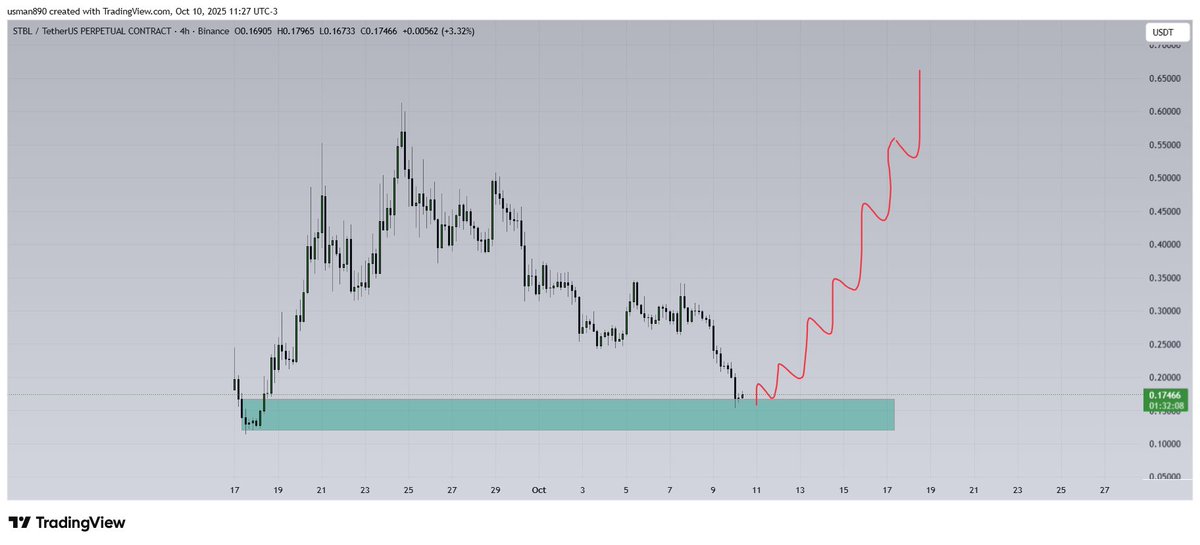
$STBL is currently in the attractive entry zone I mentioned earlier. Now that everything has become clear and even exceeded expectations, $STBL deserves to be valued much higher.
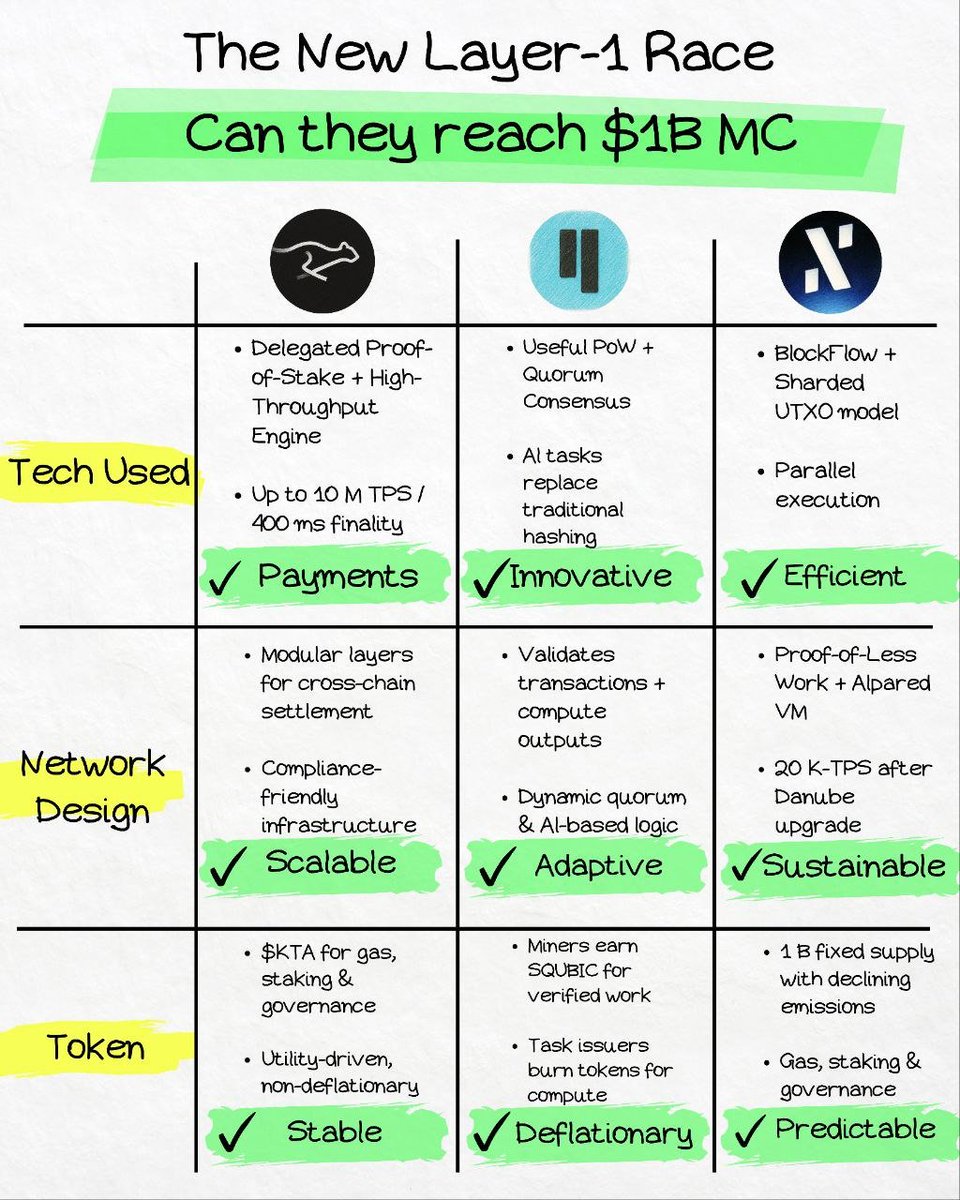
The New Layer-1 Race.
Every cycle, new L1s emerge promising faster speeds, smarter consensus, and real-world adoption.
But could these projects reach $1B market cap?
→ @KeetaNetwork ( $KTA )
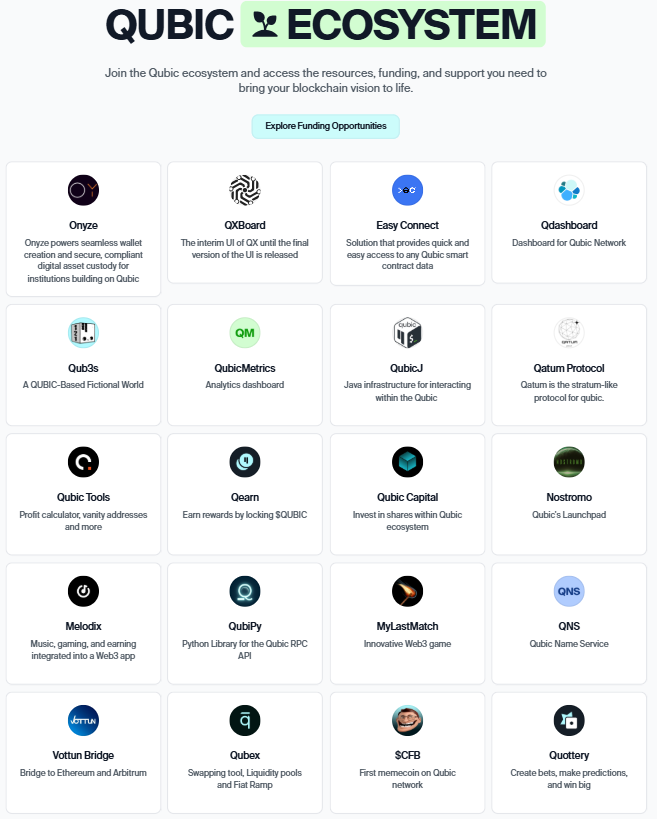
→ @_Qubic_ ( $QUBIC )
→ @alephium ( $ALPH )
Let's dive in👇
⚫ Keeta ( $KTA ): The Scalable Payments Layer
✦ Tech Used → Delegated Proof-of-Stake (dPoS) + High-Throughput Engine
• Custom dPoS consensus achieving up to 10M TPS and 400 ms settlement, verified by audits.
• Focused on cross-chain payments and compliance-friendly transfers, not on yield.
Keeta isn’t chasing DeFi yields it’s building the payment rails that connect TradFi and crypto.
Think of it as a Visa-grade blockchain, enabling seamless routing of BTC, ETH, and USDC with near-instant finality.
Its Base Anchor bridge (activated Sept 2025) links Ethereum and Keeta, pushing it closer to global settlement speed.
✦ Network Design → Permissionless Infrastructure + Modular Scaling
• Base layer handles consensus; upper layers run smart-payment logic and bridges.
• Designed for real-world liquidity, compliance, and banking integration.
Keeta’s goal is clear: become the global transaction backbone for digital assets ultra-fast, compliant, and scalable.
✦ Token / Economy → $KTA Utility & Governance
• $KTA is used for gas, staking, and validator governance.
• Fees secure the network; no burn or deflationary design confirmed.
• Stable long-term emissions focused on throughput and utility.
👉 My take: Keeta is building the self-custodial, high-speed payment layer that institutions could actually use but not a yield platform.
🔵 Qubic ( $QUBIC ): Useful Proof-of-Work for AI & Compute
✦ Tech Used → Useful PoW + Quorum Consensus
• Miners perform verifiable AI / compute tasks instead of random hashing.
• Computations feed into a global AI quorum ledger.
Qubic turns mining into productive work compute power generating real-world AI output.
Recent demos even showed Monero mining via Qubic to highlight its “Useful Work” potential.
✦ Network Design → Quorum Model + Self-Amending Logic
• Nodes validate both transactions and computation results.
• Programmable logic enables AI-dependent smart contracts.
• Dynamic quorum adjustments keep performance stable.
At TOKEN2049, Qubic presented deterministic compute proofs another step toward becoming a decentralized AI mainframe.
✦ Token / Economy → $QUBIC Utility + Compute Rewards
• Miners earn $QUBIC for verified work.
• Task issuers burn $QUBIC to access compute.
• Fee burns compress supply as usage scales.
👉 My take: Qubic is the high-risk, high-reward wildcard blending blockchain security with decentralized AI computation.
⚪ Alephium ( $ALPH ): The Scalable UTXO Chain
✦ Tech Used → BlockFlow + Sharded UTXO
• DAG-style parallel execution with Bitcoin-like security.
• Sharded UTXO increases throughput without losing determinism.
Alephium elegantly scales the UTXO model.
Its BlockFlow architecture processes multiple blocks in parallel, a hybrid of Bitcoin security and modern efficiency.
✦ Network Design → Proof-of-Less-Work + Alphred VM
• Cuts energy use by ≈ 87 % versus standard PoW.
• Alphred VM delivers deterministic smart-contract execution.
• After the Danube upgrade, throughput exceeds 20 K TPS while keeping a single-chain feel.
Alephium is proof that scalability doesn’t have to abandon security, it’s Bitcoin’s logic evolved for DeFi.
✦ Token / Economy → $ALPH (Native Gas + Security)
• Fixed 1 B supply with declining emissions.
• Used for gas, staking, and governance.
• Rewards favor wide validator participation.
👉 My take: Alephium is a developer-first chain energy-efficient, scalable, and grounded in real engineering discipline.
🔚 Conclusion: The L1 Edge
Tech Used:
$QUBIC > $ALPH > $KTA
👉 Qubic’s Useful PoW redefines mining, Alephium’s BlockFlow scales cleanly, Keeta’s dPoS is payments-oriented.
Network Design:
$ALPH > $KTA > $QUBIC
👉 Alephium’s sharded UTXO is mature; Keeta’s modular payments infra is solid; Qubic is ambitious but early.
Token / Economy:
$QUBIC > $ALPH > $KTA
👉 Qubic’s burn mechanics tie value to compute demand; Alephium’s fixed cap gives long-term stability; Keeta’s utility is transactional.
💡 My Takeaway:
If you want high-speed payment infrastructure exposure → Keeta ( $KTA ).
If you want AI + compute speculation → Qubic ( $QUBIC ).
If you want scalable UTXO fundamentals → Alephium ( $ALPH ).