Another Nvidia executive has been romantically linked to a chip buyer at the center of an alleged China smuggling scheme.
Jay Puri, Nvidia’s longtime head of worldwide sales, married Cenly Chen, a senior executive at Super Micro Computer, in March, per the WSJ. Super Micro is one of Nvidia’s biggest customers. Chen reportedly dealt frequently with Puri and pushed Nvidia to supply more GPUs to Super Micro’s customers.
The DOJ indicted three people tied to Super Micro in March over an alleged scheme to divert AI servers with Nvidia chips to China. A shareholder lawsuit alleges Chen managed Super Micro’s purchases of Nvidia GPUs and decided how scarce allocations were distributed.
Neither Puri nor Chen has been charged or accused of wrongdoing. Chen says her personal relationship “had no bearing” on her work.
The Fed is warning about “circular financing” in AI.
Big tech companies are lending to, investing in and guaranteeing smaller, riskier AI firms, which then buy their products, according to the Fed’s latest Financial Stability Report. In a downturn, the Fed says, their exposure “may be substantially larger than suggested by their on-balance-sheet liabilities.”
Nvidia alone has $530 billion in off-balance-sheet commitments, including up to $105 billion backing OpenAI’s Ohio data center.
We survived war, then got hit by inflation.
We survived high inflation; the Fed started hiking rates.
We survived rate hikes, only to see our funds getting hacked.
We somehow recovered our funds; the global markets started selling.
And just when we thought everything was over as Jensen was back, the US is imposing tariffs again.
That's it. I can't handle this anymore.
We are now in one of the worst crypto bear markets in history.
Bitcoin is now heading towards closing its third consecutive 6M candle in red, something that has only happened during the 2014 bear market.
And guess what followed next?
Bitcoin rallied 12,000% and pumped non-stop for 2 years.
Always remember that the most brutal bear markets bring the biggest life-changing pumps, so just survive the current one.
Terence Tao: The Riemann hypothesis needs "something beyond current AI… maybe 2050"
→ Claude solves Riemann 36 days later
Yann LeCun: "GPT-5000… is never going to learn" that an object moves with a pushed table
→ GPT-3.5 solves it within a year
Noam Chomsky: GPT-4 will "achieve exactly nothing"
→ GPT-4 scores 298/400 on the bar 8 months later
Gary Marcus: GPT is "one more fad" with "a short road ahead"
→ ChatGPT launched 26 days later and reached 100m users within 2 months
Bryan Caplan: ChatGPT got a D on his midterm, and AI fandom is "mass hysteria"
→ GPT-4 gets an A two months later
Bill Gates: "I'm not paying attention until it gets a 5" on AP Bio, giving it 3 years
→ It gets a 5 three months later
Yann LeCun: "What works for text doesn't work for video"
→ OpenAI announces Sora 2 days later
François Chollet: LLMs won't hit 80% on ARC within a year
→ o3 scores 80% 6 months later
Subbarao Kambhampati: mocked LLM planning ("GPT-10, 150% accuracy")
→ o1-preview scores 97.8% on his own tests 8 weeks later
Daron Acemoglu: There will be "no qualitative jump" for 5 to 10 years
→ AI handled 16+ hour expert tasks, up from 20 minutes, 19 months later
Jerome Pesenti: Training costs will never reach nine figures, "nobody can afford that"
→ Grok 4 spent $490m 6 years later
Gary Marcus: GPT-5 shows "diminishing returns"
→ GPT-5.2 matched or beat professionals 70.9% of the time, up from 38.8%, 4 months later
Sabine Hossenfelder: LLMs "will not… understand logic"
→ 12 months later she admits they understand logic
Kai-Fu Lee: "AI cannot be creative"
→ Admitted "That prediction was wrong"
Noam Chomsky: ChatGPT is "high-tech plagiarism"
→ OpenAI disproves a 1946 Erdős conjecture 3 years later
Yann LeCun: LLMs can't "invent solutions to new problems"
→ AlphaEvolve beat a 1969 matrix multiplication method 8 weeks later
François Chollet: LLMs are just "a Stack Overflow replacement"
→ Gemini solved 10 of 12 problems at the ICPC world finals 15 months later
Uncle Bob: AI "has no idea what it's doing," so check its code
→ 25 months later he said he doesn't read his agents' code
Arvind Krishna of IBM: AI will write about 30% of code, not 90%
→ 13 to 15 months later Google was at 75% and the industry average at 52%
DHH: "I don't let it drive my code"
→ 13 months later "100% AI pilled" and wrote none of Omarchy Quattro by hand
Andrej Karpathy: Coding agents are "slop"
→ 3 months later he's doing 80% of his coding with agents
Ken Ono: Creative pure math by AI is "decades away"
→ Model solves his PhD-level problem in 10 minutes
Sergei Gukov: Mathematicians are "safe for the next five years"
→ OpenAI proves Riemann
Daniel Litt: 15% chance AI proves the Riemann hypothesis within 10 years
→ AI solves Reimann 10 months later
Andrej Karpathy: an AI understanding the Obama scale photo is "very, very far"
→ GPT-4 solves it
Steven Mnuchin: AI job loss is "50 or 100 years" away
→ Salesforce cut support staff from 9,000 to 5,000
Kai-Fu Lee: AGI is "not within 30 years, possibly never"
→ Calls AGI around 2030 "quite reliable" 6 years later
Michael I. Jordan: Real dialogue with a computer "ain't gonna happen in our lifetime"
→ 2025 study judges picked the AI as the human 73% of the time
We are experiencing the death of thought.
Yesterday, I had to review a hefty contract.
Rather than throw it into Claude & type something like “Review this whole file, break down the key points, and share feedback as if you’re my lawyer,” I did something radical.
I printed the contract, grabbed a mechanical pencil, and spent 90 minutes marking up the document with questions & commentary.
I finished writing down my thoughts in the margins, put down my pencil, and reflected on what just happened.
I felt deeply satisfied & wildly embarrassed all at once.
I couldn’t remember the last time I had used my brain for an end-to-end process without AI. I felt command over the subject matter, I felt clear about what I understood & didn’t understand. And I was left with conviction in my POV. Moreover, I felt the high of “clean” dopamine, a feeling only earned through hard-fought, unadulterated effort.
Then I felt embarrassed. How long had I been depriving myself of thinking? How long had I used an LLM as a crutch, offloading thought for time and understanding for convenience.
And then I got curious.
Why is AI creating the death of thought. And what can I do to make sure I don’t surrender my brain to the machine?
The answer lies in what Daniel Kahneman called System 1 and System 2 thinking.
System 1 is fast, automatic, and gut-driven thought. It’s great for quick reactions and routine tasks, but can be riddled with cognitive bias and misunderstanding.
System 2 is deliberate, analytical, effortful, and conscious. It’s essential for careful reasoning and operates as a “lazy controller,” keeping System 1 in check.
Technology has been hijacking System 2 thinking for longer than you might think.
In 370 BC, Socrates warned that writing “creates forgetfulness” because people would rely on marks on a page instead of memory.
Calculators hijacked mental math as a System 2 exercise.
GPS hijacked navigation as a System 2 exercise.
Google hijacked the fight for knowledge as a System 2 exercise.
But AI is different.
AI doesn’t just take over one effortful thinking job, like calculation or research.
It hijacks all of them at once.
Remembering. Summarizing. Researching. Calculating. Writing. Problem-solving. Weighing Trade-offs. Deciding. Planning. Navigating people. Reflecting. Creating.
These System 2 activities are all at risk all at once & we’re not adequately prepared to defend against it. For 200,000 years, our brains have been trained to embrace shortcuts. Effort was historically rare & expensive, so any “easy out” the brain could take, it was rewarded.
But shortcuts come at a cost, and that’s especially true post-AI.
Cost 1: A summary feels like understanding - when you consume information that’s been compressed by someone else, you’re left with a feeling that you understand the subject, even though you never did the work to truly grok it.
Cost 2: The messy middle is the space for growth - Robert Bjork’s research at UCLA shows that learning that feels harder in the moment, sticks much better than faster review. “Cognitive offloading” (Risko and Gilbert) helps short-term, but you pay the price in memory & understanding.
But there’s a third cost far more existential. The disappearance of judgement.
As we approach AGI/ASI, what will stay uniquely human?
1. Intent
2. Accountability
3. Relationships
4. Judgement
And if we think about what judgement really is, it is compressed System 2 thinking. Every time you slowly pore through a report or marinate on a key decision, you’re locking in a pattern, good or bad, that shifts to future System 1 thinking. Taste is thousands of those patterns firing at once.
So, how do we take back our thinking, while embracing the beauty of such transformative technology?
It resolves down to one key principle: control the space between stimulus & response
One of my favorite quotes is by Viktor Frankl:
“Between stimulus and response there is a space. In that space is our power to choose our response. In our response lies our growth and our freedom.”
AI has collapsed the gap between stimulus (question) and response (answer) to zero. That gap used to be where thinking happened. So, we must rebuild that space intentionally, otherwise it will be taken from us, and with it, our judgement.
How you rebuild it is up to you. Pick your poison:
- Create 30-60 minute no-AI blocks in your day
- Go analog & print out what matters
- Focus your prompts on refining your thinking ( “Where is my logic weakest?”) vs. driving your thinking (“Explain like I’m five.”)
- Write your answer before you ask AI for its answer
- Write your first draft by hand
- Say it out loud: explain the topic to someone without notes before reading a summary
- Read the full source, not the summary
- Set a 10-minute rule: struggle with a problem for 10 minutes before you reach for AI
- Brainstorm ideas & only ask AI for feedback
- Treat AI as an “editor” not a “writer”
AI is like the sun.
It’s a once in a species gift to humanity.
It will cure cancer.
It will put a tutor in every child’s hands.
It will create a world of abundance.
But it’s also powerful beyond measure.
We must remember what the final frontier of being human means and protect it at all costs.
We must fight against the death of thought.
A toothpaste company has quietly killed the entire market research industry and nobody is talking about it.
Colgate published a paper showing you can predict real purchase intent by simply asking LLMs to roleplay customers.
And this is beyond insane.
If you ask an AI, "Rate this product from 1 to 5," it gives safe, middle-of-the-road garbage.
So researchers invented a method called Semantic Similarity Rating (SSR).
Instead of asking the AI for a number, they asked it to roleplay.
They gave the LLM a demographic profile. They showed it a product concept. And they asked it to write down its raw, unfiltered thoughts.
Then, they used a semantic model to translate those written thoughts into a numerical score.
The results are staggering.
Tested against 57 real personal care product surveys and 9,300 human responses, the synthetic consumers hit 90% of human test-retest reliability.
They perfectly mirrored how different age brackets and income levels react to price changes.
And they provided detailed, qualitative feedback that was deeper and more critical than what actual humans wrote.
This destroys the economics of traditional market research.
You don't need to wait a month to see if a product will sell.
You can simulate 1,000 hyper-targeted customer interviews overnight.
You can A/B test pricing across every demographic instantly.
Yann LeCun says when you train an LLM on human-produced knowledge, you're training it to accumulate what's already known
That's not intelligence; that's memory
It's rote learning, not reasoning, invention, creativity or adaptivity. It's not the intelligence we see in animals
Tesla FSD V15 is a banger release!
Completely new architecture that deserves being called “super” intelligence, as it drives better than human intelligence.
There’s some really interesting selling pressure on $BTC.
I’d expected that from 60K there might be at least a small rebound towards 66–67K, but for the moment the market isn’t showing any significant reaction.
In my view, Binance has played a significant role in this selling pressure following the hack, although we cannot prove that it is selling to recoup its losses. Added to this are the heavy outflows from ETFs, which have further weakened the market.
But you know what? It doesn’t really matter.
It’s the price that matters, not finding someone to blame.
Traders still need to be patient. For those investing in spot markets, however, this weakness could create some really interesting opportunities over the next few days.
Other people’s panic can become an opportunity for those with liquidity, patience and a plan.
The elephant in the room:
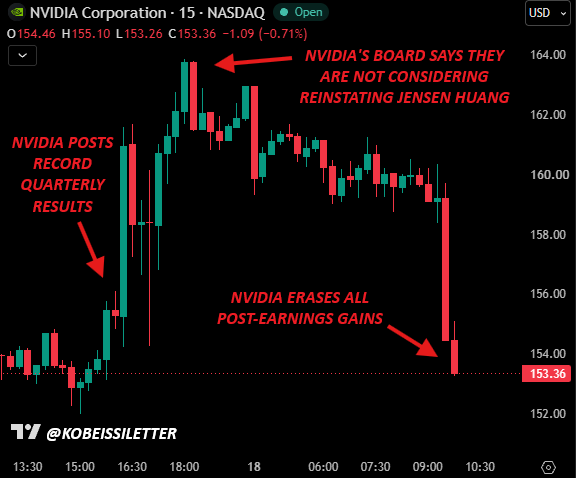
Nvidia's board is completely disregarding the opinions of its shareholders. At this point, shareholder input does not even appear to be a consideration.
Why has the board not directly addressed shareholders?
It raises serious questions about what is happening behind the scenes.
Nvidia's stock, $NVDA, will continue to get crushed until the board acknowledges the shareholders it has a fiduciary duty to serve.
Something does not add up here.
The Guardian says GTA VI’s level of detail is “simply out of reach for any other game developer.”
The liquid inside the bottles sloshes realistically as [Jason] walks, and the racks are stocked with fully illustrated magazines that you can take off the shelf and read through.”
Jason can even eat a donut with one hand and drink a beer with the other.
Rockstar has been researching Miami for GTA VI since 2015, with trips to clubs and Florida Keys bars and ride-alongs with police in South Beach.
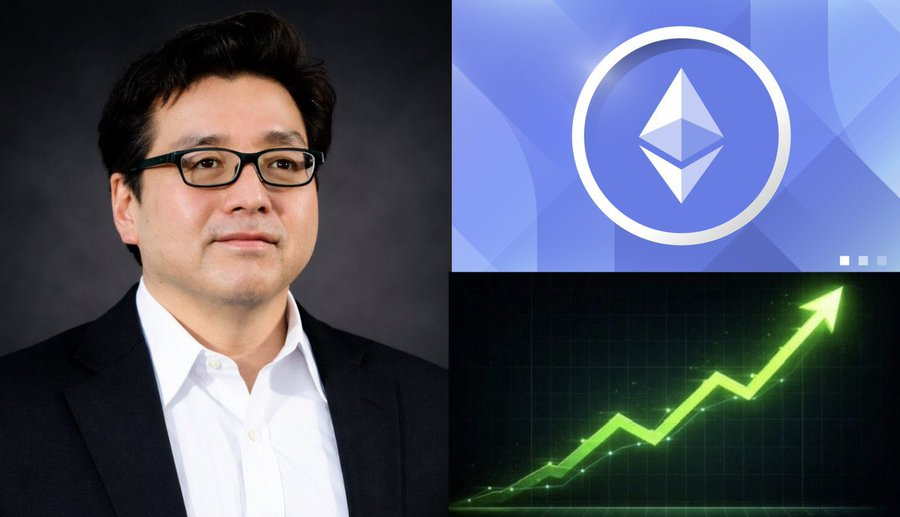
BREAKING: Tom Lee’s BitMine bought $13.8 Million worth of $ETH last week, bringing its total holdings to $10.9 Billion.
They have been buying ETH every week for over 16 months.