stablecoins are dollars.
the only difference between a stablecoin and another dollar held in a bank is the nature of the ledger that the money lives on.
a stablecoin is a dollar who's ownership record is kept in a public shared hard drive that anyone can access and integrate with. anyone can write programs and applications that connect to it and use and move the dollars around. when a stablecoin is moved from one person to another, all that is happening is a record in our shared hard drive is updated.
at its core, the advantage of stablecoins lies in the difference between closed systems (traditional banking) and open systems (blockchains). the banking system today operates with siloed, closed ledgers—each bank maintains its own isolated record of ownership. moving dollars between these ledgers involves complex coordination between intermediaries, clearinghouses, and multiple institutions, introducing latency, fees, and friction.
In effect, a stablecoin is not a different kind of money—it is still a dollar. the magic is in the ledger that keeps track of it. a stablecoin on a public blockchains allows for an always-on, transparent, and interoperable system that is far easier to build on than traditional financial networks. just like how the internet provided an open platform for communication, stablecoins offer an open platform for financial value.
the speakers in this space spent most of the time expressing their confusion about why crypto assets have any value at all. i'd like to offer some clarity.
to create money or conduct finance, economies need trustworthy ledgers and people to maintain them. before bitcoin, we solely relied on institutions—banks, governments, corporations—to provide and manage these ledgers. the trustworthiness of these ledgers are only as strong as the institutions behind them, and they are constrained by social and legal frameworks that form them.
before bitcoin, all ledgers were siloed within nations and companies. and trust between these silos is expensive and fragile.
fundamentally, blockchains are trustworthy ledgers not confined to any one nation or silo. they're trustworthy for two main reasons:
1. open economic incentives
2. cryptography
there's an open economic incentive for truthfully storing, serving, and maintaining the ledger for everyone else: if you do, you get paid for it. cryptography ensures that everyone can be confident you're managing the ledger honestly—anyone can independently run software to verify the work of others. this creates a trustworthy ledger. because it's trustworthy, people value it, which incentivizes more people to participate, further increasing confidence in the system.
blockchains are essentially mass behavioral incentive schemes that pay people to run them, keeping their ledgers alive and trustworthy.
once you have a trustworthy ledger, you can use it to create money and financial instruments. storing things of value—keeping records, moving value around—all requires trust.
so, to help john reed stark finish his sentence: *"you should buy bitcoin because... the ledger that produces it is trustworthy. you can have a high degree of confidence in how it will behave in the future. it's not just the 21 million limit that causes people to value bitcoin, but the high degree of confidence in the system maintaining that limit."*
the rest of the crypto space can also be understood through this lens. programmable blockchains allow people to create and be confident in the behavior of global financial instruments. the blockchains act as neutral and reliable infrastructure to support global economies.
to close out, crypto assets derive their value from the trust we can have in the ledgers that underlie them. they offer a new way to establish trust, incentivize participation, and enable global financial interactions without relying on any single institution or nation.
The US and our allies do not have enough missiles to credibly deter conflict with a near-peer adversary.
Say hello to Barracuda-M.
The most producible cruise missile on the market today. 50% less time to produce, 95% fewer tools, 50% fewer parts — at a fraction of the cost.
Designed to keep pace with the threat. Built to bring mass to the fight.
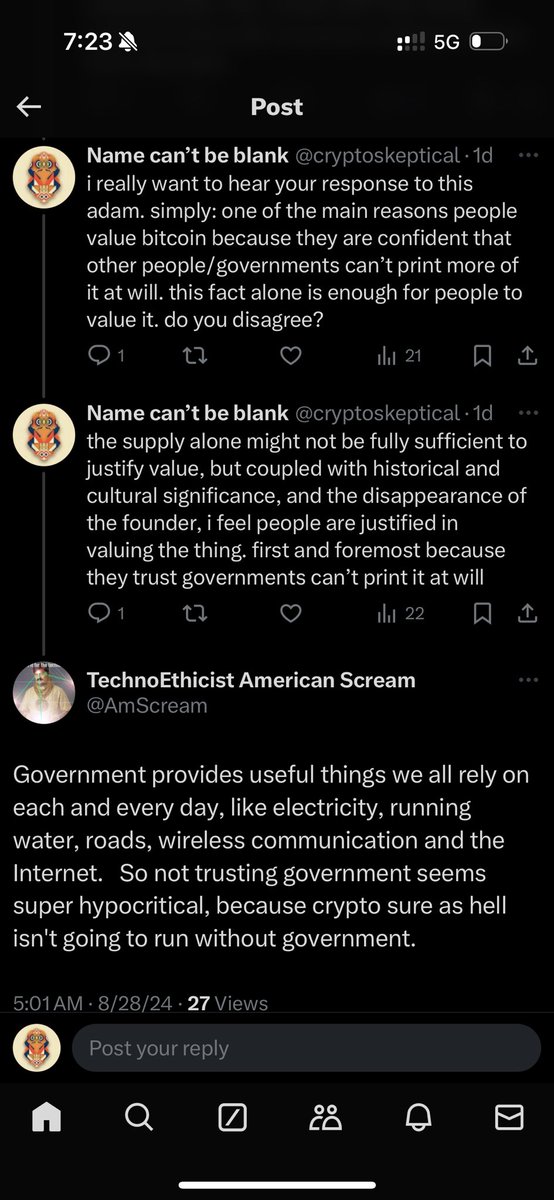
@JDonoghueAuthor@PolitBirojs@AmScream also, i want to point out that satoshi wouldn’t have needed to sell all of his btc for it to serve as evidence for adams initial claim. and we should have expected satoshi to have sold a decade ago, when the value of his coins were a fraction of what they are today
@JDonoghueAuthor@PolitBirojs@AmScream can you acknowledge that adam ignored the counter evidence to his often-made claim, and then made an entirely unrelated point?
@AmScream this is the mod of @r_Buttcoin
people take him seriously
he takes himself seriously
he is bitter. he has spent a decade defending and fighting for a lie. he can’t bring himself to acknowledge the possibility that he might be wrong.
a few interesting examples of @AmScream shifting focus and changing the subject without engaging with arguments. at first i thought it was accidental, like he just wasn’t reading or something. beginning to question that now
1) @AmScream claims selling large amounts of crypto is likely impossible.
2) i provide counter evidence: germany sold
3) he responds saying germany isn’t endorsing bitcoin
4) i explain that he’s not responding to anything i said
5) he says “yuhuh” and blocks me
@AmScream@PolitBirojs bitcoin is like a digital gold in that it shares in the same properties mentioned: it’s rare, difficult to produce, and desirable.
can you address the specific comparison i made? if the properties mentioned are shared, is it not fair to say bitcoin is like a digital gold?
@AmScream@MaryLTrump the link you gave does a poor job of steelmanning the other side, as it does not quote any of the verses that would be quoted by a believer, or any of the verses i referenced above.
@AmScream@PolitBirojs also, a change in a line of code is not enough to change the supply. instead, the network as a whole needs to adopt the change. do you disagree with this?
@AmScream@PolitBirojs what do you mean there’s more than 21m “bitcoin” right now? i assume you are referring to forks? i want to stick with this point as i think it’s important: each chain is distinct. the assets on those chains are distinct and distinguishable. do you disagree?