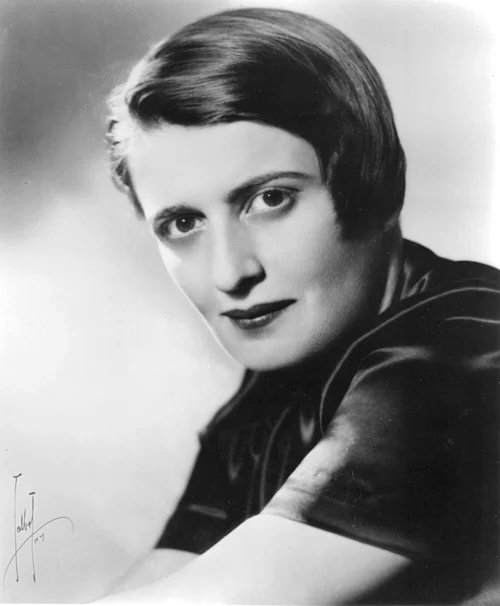
Ayn Rand – The Girl Who Saw It First
She was twelve when the Bolsheviks came into her father’s pharmacy in St. Petersburg and put a red seal on the door. In a single afternoon, a man who had worked all his life owned nothing. She never forgot his face.
Her name then was Alisa Rosenbaum. She watched what followed: the hunger, the informers, the university purged of anyone with the wrong parents. In 1926, she obtained a visa to visit relatives in Chicago. She was twenty-one, and she never went back. She never saw her parents again.
She left the old name behind with the old country. Nobody knows for certain where "Ayn Rand" came from, and she never settled the question. What the name conveys is plain: two strong, hard and clear syllables, with no country, no family and no past in them. It was the first thing she built in America, and she built it herself.
On her second day in Hollywood, a car stopped beside her at a studio gate. The driver was Cecil B. DeMille. He gave her a ride and a job as an extra. On that set, she noticed a tall actor with the face of one of her heroes and deliberately stuck out her foot so that he would trip over it. She married Frank O’Connor, who stood by her for fifty years.
She had one conviction: the West could not defend itself because it was ashamed of its own best men. So she wrote its defence.
Her philosophy starts with three words: A is A. A thing is what it is. Reality does not bend to wishes, votes or slogans. She took this principle from Aristotle, the only philosopher to whom she acknowledged a debt, and saw herself as continuing his work. The three parts of Atlas Shrugged are named after his classical laws of logic. From A is A, everything follows: reason is man’s only means of acquiring knowledge, contradictions do not exist, and whoever asks you to accept one wants something from you and is asking you to abandon reality for something else.
Check your premises.
Her characters are that philosophy made flesh.
Howard Roark, the architect of The Fountainhead, would rather break stone in a quarry than change a single line of a building to please a committee. He is integrity: a man whose work and whose soul are one and the same.
Ellsworth Toohey is his enemy, and her most prophetic creation. He builds nothing. He rules by praising the mediocre, mocking the great and teaching people that they are small. Kill a man’s capacity to admire, and he is yours.
Dagny Taggart runs a railroad better than any man around her. She is competence, and the joy of it.
Hank Rearden invents a new metal and is made to feel guilty for it. Through him, she showed the sanction of the victim: evil is impotent and lives only on what the good produce and agree to hand over.
And John Galt. "Who is John Galt?" is asked on the first page, as a shrug of despair. He is the engineer who invents a motor that could power the world, sees that it will be seized in the name of need, and walks away. Then he persuades the builders, one by one, to do the same. He stops the motor of the world to prove who had been running it.
His oath is her ethics in one sentence: "I swear by my life and my love of it that I will never live for the sake of another man, nor ask another man to live for mine."
The Fountainhead was rejected by twelve publishers before going on to sell millions of copies. When her publisher begged her to cut Galt’s sixty-page speech, she asked whether he would cut the Bible. He did not cut it. In 1991, a survey conducted by the Library of Congress and the Book-of-the-Month Club asked readers which book had most influenced their lives. Atlas Shrugged came second – after the Bible.
Mises reportedly called her the most courageous man in America. She was delighted and asked only whether he had really said "man."
The life was harder than the books. To finish The Fountainhead on deadline, a doctor prescribed her amphetamines; according to her biographers, she took them for some thirty years. She smoked two packs a day and dismissed the evidence linking smoking to cancer, until a surgeon removed part of her lung.
Around her gathered a circle of young admirers who met in her apartment on Saturday nights. They called themselves, jokingly, the Collective. One of them was Alan Greenspan. The joke turned sour. The philosopher of independence came to demand agreement on everything: the right novels, the right music, the right friends. Doubters were put on trial in her living room and expelled.
Then came Nathaniel Branden, her chosen heir, twenty-five years younger. She insisted that both spouses be told and give their consent, because she would not live a lie. They consented. Nobody was the better for it. When she discovered that he had concealed another woman from her, she slapped him, denounced him in print and ordered her followers never to speak to him again. Most obeyed.
She could reason her way to almost anything, including the idea that feelings should obey logic. Hers never did.
In 1973, her youngest sister came from the Soviet Union to visit. Rand showed her New York and offered her freedom. Her sister found America vulgar and went home to Leningrad. The Bolsheviks had taken her father’s shop. Fifty years of the Lie had taken something worse from her sister: the ability to recognise freedom when she saw it. Nothing taught Rand more about what the Lie does to a mind.
She died in New York in 1982. By her coffin stood a six-foot dollar sign made of flowers. For her, it was the symbol of Liberty: free trade between free minds. Her enemies laughed. They had never seen a red seal on their father’s door – she had seen it at twelve, and she knew what the symbol of Liberty costs.
What should we do with her?
Take the builder’s virtues, all seven: rationality, independence, integrity, honesty, justice, productiveness and pride – the kind that is earned. Nobody has stated them better, and no civilization grows without them.
Put them where she refused to: on the foundation she rejected. Charity and hope hold the ground; her virtues build upon it. Galt swore by his life and his love of it. A civilization must swear by more than one life: by the lives that come after it. That is hope – the affirmation of life that plants trees, raises children and builds what it will never see finished.
Together, they make Western Civilization: reason that understands the world, the builder’s pride that shapes it, and an affirmation of life that hands it on. Each alone fails. Reason without a goal turns cold. Pride without hope ends with its owner. Hope without builders remains a wish. Together, they form the widest frame ever found that actually works.
And keep her warning with her teaching. A school of free minds becomes a sect the day agreement matters more than truth. We need her courage, and we need to avoid her living room.
The novel opens with a shrug: Who is John Galt? It was meant as an expression of despair. It is really a question to each of us – and the answer is whoever still builds, and refuses to apologize for it.
Hoje multiplicam-se as promessas do transumanismo e do pós-humanismo: são correntes ideológicas segundo as quais – mais cedo ou mais tarde – a tecnologia eliminará todas as doenças ou dores, bem como o envelhecimento e até a própria morte. Precisamente porque o progresso das ciências é um fruto excelente da inteligência humana, não deve ser confundido com um privilégio para milionários que pretendem a imortalidade, enquanto povos inteiros sofrem miséria e opressão. Vende-se-nos, deste modo, a ilusão de seres humanos otimizados pela cibernética e pela biotecnologia. Perante esta miragem, a antropologia cristã recorda que o limite não é um defeito de fábrica, mas sim a condição da grandeza humana. #ViagemApostólica #Peru #MagnificaHumanitas https://t.co/6HyxDqsDf3
Em 1096, Godofredo de Bulhão renunciou a grande parte de suas posses para atravessar a Europa rumo a Jerusalém na Primeira Cruzada. Não buscava riquezas ou poder. Movia-o o cumprimento de um voto.
Em 15 de julho de 1099, quando as muralhas de Jerusalém finalmente caíram, estava entre os primeiros cristãos a entrar na cidade. Após a vitória, ofereceram-lhe a coroa de Jerusalém. Ele a recusou: não usaria uma coroa de ouro onde Cristo havia usado uma coroa de espinhos.
Preferiu o título de Defensor do Santo Sepulcro, governando Jerusalém sem jamais se proclamar rei. Morreu pouco mais de um ano depois, mas seu nome atravessou os séculos.
Precisamos recordar mais homens assim: homens de fé, coragem e honra, que colocavam seus deveres acima das próprias ambições.
Essa frase do professor Olavo de Carvalho me fez pensar:
"O Brasil não chegou ainda ao estágio de civilização no qual você possa falar que existe conhecimento. É apenas um monte de selvagens perdidos na floresta, dando urros e expressando suas sensações. Estão num nível de comunicação de um cachorro."
O pior é que ele conseguiu definir metade da galera aqui do X...
Amanhã, a entrevista que a Globo teve medo de fazer com o @FlavioBolsonaro vai sair no The New York Times. Spoiler: totalmente red pill. E é só o começo.
With the CORRUPTION going on in this world, you should:
- Follow God!
- GET RICH & FINANCIALLY FREE!
- Take care of your FAMILY!
- HELP those who helped YOU!
- LIVE LIFE on YOUR OWN TERMS!
STOP depending on the SYSTEM that keeps you POOR! Build WEALTH and BREAK FREE! 💰🥂
Here in the UK a quarter of million white girls are raped & abused, & the govt's response is to pass laws preventing you from talking about how & why it happened.
America needs to understand what is coming.
Muita cautela com o alarmismo catastrofista, ninguém deve se desesperar.
O Partido Comunista Chinês anda pelas sombras.
O globalismo satânico habita as trevas.
O medo paralisa.
Mas nós, nós somos a luz.
Repito: NÓS SOMOS A LUZ.
Um vizinho me viu voltando da Santa Missa que fica perto de casa e educadamente me perguntou por que eu sendo instruído era Católico, e que a Igreja Católica não têm a Bíblia como única base da doutrina.
Eu também, educadamente respondi: Quando se estuda a fundo o cristianismo e a história cristã não tem como não ser católico, aproveitei e perguntei de qual denominação evangélica ele era. Ele respondeu com visível orgulho e falsa humildade:
Minha família era Batista, quando cresci fui para Assembléia de Deus, não concordava com algumas coisas doutrinais e decidi frequentar a Igreja Quadrangular, mas tive uma discussão doutrinal com o pastor e fui para a Batista Renovada, lá despertou em mim um chamado que me mostrava que essa denominação não era correta, assim como as outras, resolvi alugar um espaço e instituí minha própria Igreja Evangélica da Verdade Bíblica e você está convidado a ouvir a palavra verdadeira lá.
Eu agradeci e respondi: Pra mim ficou bem clara a verdade!
Me e despedi e na Missa da semana seguinte agradeci a Deus por ser da Igreja Santa e Una, Católica e Apostólica fundada por Nosso Senhor Jesus Cristo.
visão do Purgatório segundo Dom Bosco, conforme narrada nas Memórias Biográficas.
em uma noite, são joão bosco estava deitado, mas não conseguia adormecer. pensava em como a alma poderia existir e se comunicar depois da morte, separada do corpo, e em como seria possível reconhecer os que já haviam partido. acabou adormecendo e se viu em uma estrada, quando uma pessoa o chamou pelo nome e prometeu mostrar o que ele tanto queria compreender. o guia caminhava com tamanha rapidez que os pés de ambos pareciam nem tocar o chão.
depois de atravessarem lugares desconhecidos, chegaram a um magnífico palácio, tão elevado que não havia caminho visível para alcançá-lo. seguindo a ordem do guia, o santo abriu os braços e sentiu-se elevado pelos ares até a entrada. lá dentro, encontrou salões grandiosos e corredores que pareciam não ter fim. por fim, em um salão ainda mais esplêndido, encontrou um bispo que conhecera intimamente e que havia morrido cerca de dois anos antes.
o bispo estava sentado majestosamente, com uma aparência radiante e afetuosa, e à primeira vista não parecia sofrer nada. dom bosco quis saber se aquele amigo havia salvado a própria alma e se já estava no paraíso. o bispo respondeu que se encontrava em lugar de salvação, mas ainda não contemplava a Deus e precisava que rezassem por ele. estava no purgatório. para mostrar quanto tempo ainda lhe restava, apresentou uma folha coberta de traços e desenhos coloridos, que dom bosco não conseguiu decifrar. o bispo explicou que os juízos de Deus são inteiramente diferentes dos juízos humanos.
dom bosco perguntou se ele próprio se salvaria e se seus jovens alcançariam a salvação, mas o bispo não lhe deu respostas definitivas: Deus revela essas coisas a quem deseja e quando deseja. em seguida, pediu que transmitisse aos jovens recomendações muito concretas: que fossem bons e obedientes, conservassem a pureza, rezassem e se confessassem com frequência, fazendo boas confissões. advertiu também contra a neblina das coisas mundanas, que faz as pessoas enxergarem os prazeres e as alegrias passageiras como se fossem a verdadeira felicidade, e que se torna especialmente densa pelos pecados de imodéstia e impureza.
dom bosco saiu apressadamente para transmitir os avisos, mas logo se arrependeu de ter deixado o bispo e voltou ao palácio. encontrou uma cena completamente diferente: o prelado, antes tão radiante, estava deitado sobre um leito, pálido como cera, com lágrimas nos olhos e o corpo tão imóvel que parecia um cadáver. apenas o leve movimento do peito revelava que ainda respirava. quando o santo perguntou o que podia fazer por ele, a resposta foi simples e urgente: “reze por mim.”
o sofrimento do bispo era tão intenso que dom bosco mal conseguia suportar a visão. ele repetia que precisava partir, para onde a mão onipotente de Deus o conduzia. por fim, uma força invisível o arrastou para aposentos mais interiores, até que desapareceu. dom bosco acordou assustado e profundamente comovido, e afirmou que havia aprendido naquele sonho coisas sobre a alma e o purgatório que antes jamais compreendera tão claramente.
a lição mais marcante é que o bispo estava em lugar de salvação, mas ainda precisava ser purificado antes de contemplar a Deus. alguém que amara os jovens e rezara por eles em vida agora pedia que se lembrassem dele em suas orações. por isso, dom bosco não apresenta o purgatório como condenação definitiva, mas como um estado de sofrimento para as almas destinadas ao céu que ainda necessitam de purificação. o relato deixa um apelo silencioso: não devemos esquecer os que morreram. rezar por eles e oferecer sufrágios por suas almas são atitudes que não devem ser adiadas.
I’ve added hundreds of thousands of new followers in the last week.
Most of them are from the beautiful country of Brazil.
I’m going to ask a heartfelt favor to all of those new followers.
Let’s make a deal. I help you guys expose the scam of an election Lula pulled on you to the world outside of Brazil… and you help me expose the destruction of Western Civilization going on in my part of the world.
Europe, USA, etcetera.
Share my content on it, pass it along as help us grow this movement for Remigration.
We’re all on one team against globalist parasites and against communism that is destroying our nations. Free speech is being killed in our nations, too. Let’s ally and defeat and expose the demonic scum ruining us!