Airdrops as we know them are over.
Giving tokens away to build a holder base has mostly created sellers. Across the largest airdrops, between 78% and 94% of recipient wallets had sold off most of their allocation by day 90.
People cite Hyperliquid and Jito as proof airdrops can work, but neither succeeded because of the airdrop. Hyperliquid had over $1B in revenue funding buybacks that soaked up the selling from recipients. Jito’s eligible cohort was small enough to avoid industrial farming.
Token economics are starting to require real protocol performance. MegaETH locked 53% of its supply behind performance targets. Pendle routes roughly 80% of revenue into buybacks for stakers.
Token distribution is moving from handouts to performance.
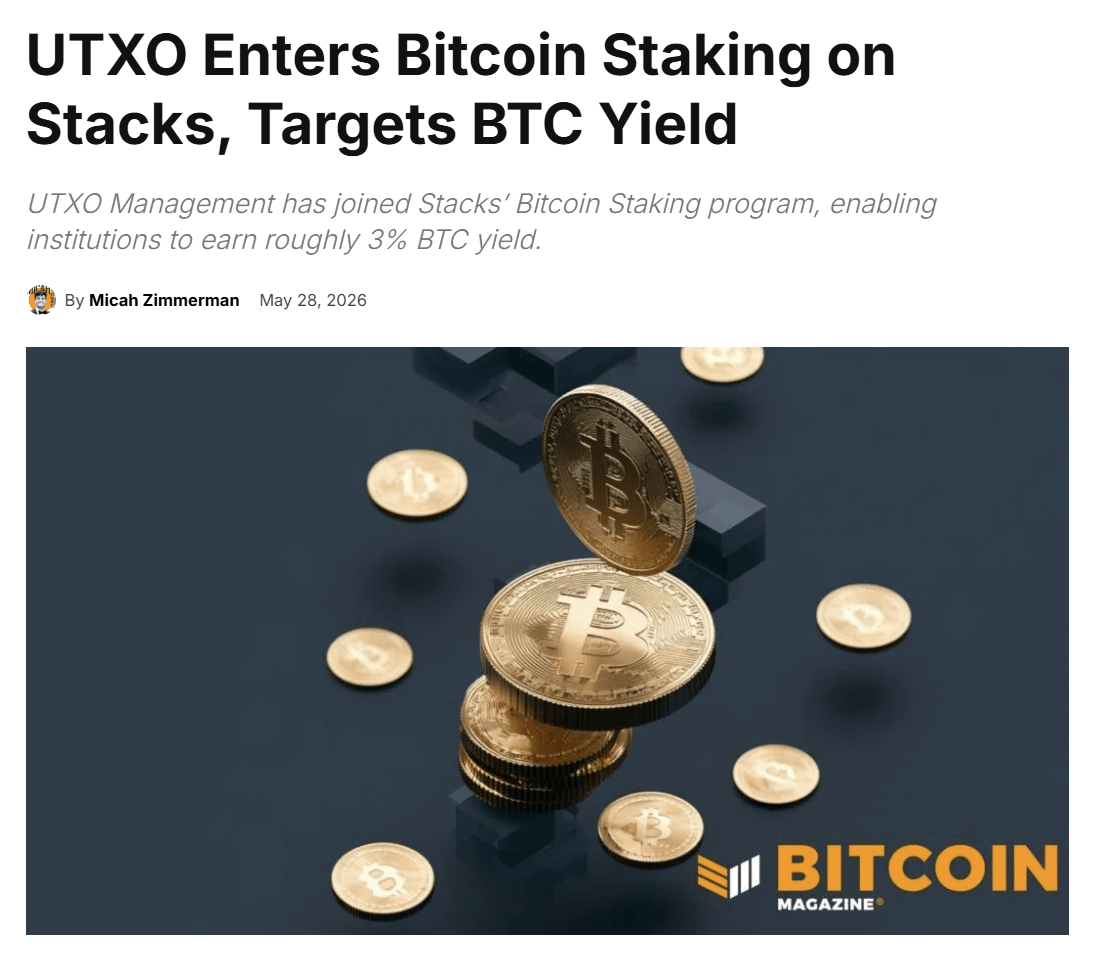
To my great shame, I didn't know much about UTXO when I first saw the announcement, so I looked into what they do and why they partnered with Stacks.
UTXO is the asset management arm of @nakamoto, the same parent company behind @BitcoinMagazine, and the 20th largest Bitcoin
Treasury in the world. It's one of the few companies building Bitcoin investment products for institutions beyond simple BTC exposure.
They're different from companies like Strategy or Metaplanet, which mainly focus on buying and holding BTC.
Instead, UTXO focuses on BTC products for institutions, and institutions are usually cautious about anything that adds extra custody risk to BTC, like wrapping, bridging, or lending it on third-party platforms.
Literally trillions of dollars are sitting idle in Bitcoin held by institutions right now. There's an ongoing race to see who's gonna capture most of it.
Disclosure: I'm a $STX holder and long-time supporter.
Bitcoin Price: Confidence Growing, Risk Shrinking
- - -
The data supporting the power trend in Bitcoin's long-term price is always growing. That's the math that says $1M in ~2033-2034, a 13x from today.
What other asset can you find that presents the prospect of such a future?🤔
Excited to announce @Roxom as my new sponsor! They are building a Bitcoin-denominated capital market, and together with @RoxomTV I’m super grateful for their support of my charts, analysis, and the Bitcoin Strategy newsletter. 🧡 #Bitcoin
$BTC structural support zone — long-term moving averages and where cycle bottoms have historically formed.
MA STACK TODAY (May 19, 2026, price $76,820):
• 200W → $61,148 (P/MA 126%)
• 250W → $57,424 (P/MA 134%)
• 300W → $53,332 (P/MA 144%)
• 350W → $46,956 (P/MA 164%)
HISTORICAL CYCLE BOTTOMS (P/MA at the low):
• 2015-01: 85% of 200W
• 2018-12: 102%/123%/144%/167% ← gentle bear
• 2022-11: 66%/77%/88%/102% ← deep bear, 350W held within 2%
EOY 2026 PROJECTIONS (price flat at $77K):
200W $70K · 250W $61K · 300W $59K · 350W $53K
Implied EOY 2026 floor:
→ 2018-style: $72–89K
→ 2022-style: $46–54K
Both templates converge on the 350W as the absolute structural line. It's been respected within ±2% at every cycle bottom since enough data exists to compute it.
Not a prediction. A map of historically-respected levels.
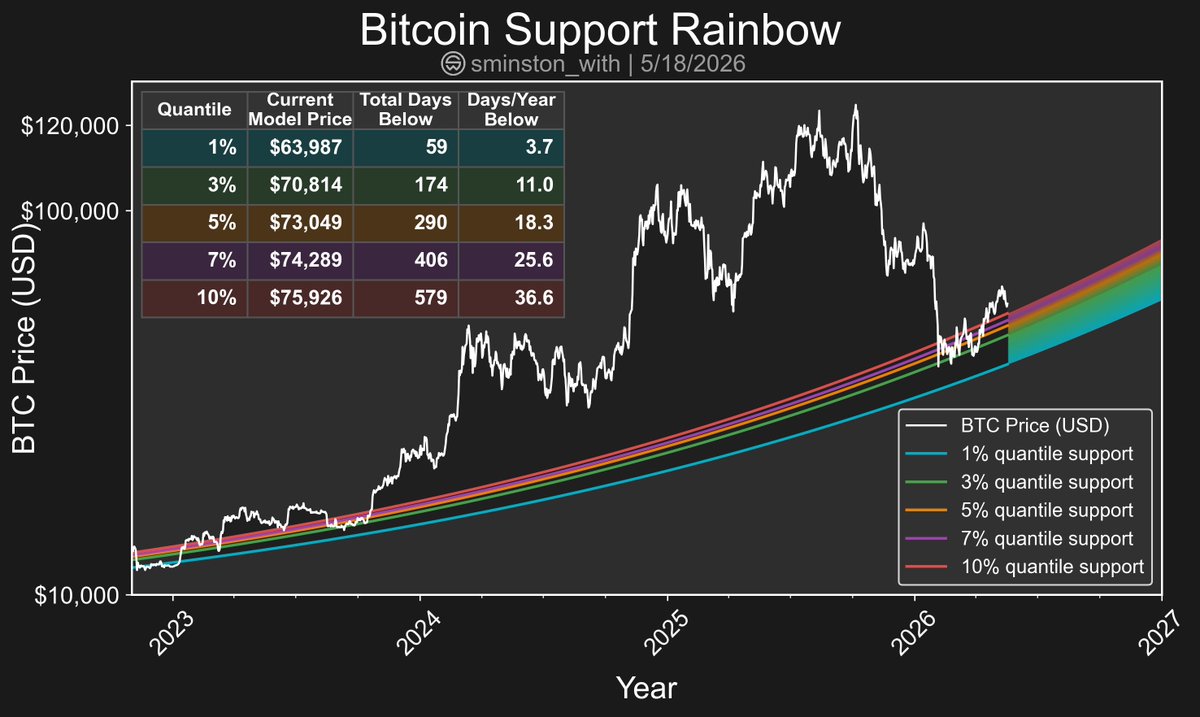
The Bitcoin Support Line (Power-law derived) has been RIDICULOUSLY stable since late 2015.
This is the 5th quantile support model today (orange) superimposed on the model that was PREDICTED by Bitcoin's price only up to late 2015 (dashed blue).
Today the model price is ~$73K.
Will Bitcoin take another crack at the Support Rainbow?
We've historically spent an average of about 18 days/year at or below the 5th quantile power law support model.
So far this year, we've spent 12 below it.
How different will things be this time?
BREAKING: A second Abu Dhabi state-owned sovereign wealth fund bought 4.6K #Bitcoin through ETFs.
Abu Dhabi Investment Council and Mubadala now hold nearly 13K #BTC worth $882,000,000 combined.
🚨 BREAKING
🇺🇸 U.S. SENATE BANKING COMMITTEE JUST APPROVED THE CRYPTO MARKET STRUCTURE BILL!
THE CLARITY ACT HAS OFFICIALLY PASSED THE VOTE AND IS NOW HEADED TO THE FULL SENATE.
THE BILL IS DESIGNED TO INJECT $1,000,000,000 INTO CRYPTO MARKET.
GIGA BULLISH NEWS FOR BITCOIN!!
Bitcoin's bear markets aren't "bear" markets. They're accumulation phases. ISM PMI also happens to indicate economic contraction during these phases.
I forward rate of return for every day from June 2012 (BTC's first PMI<50 day) onward, comparing PMI <50 vs PMI > 50 (contraction vs. expansion).
Buys made during PMI contraction had a 2-year win rate of ~100% vs 81% for expansion buys, AND beat expansion buys on median return at EVERY forward time horizon.
Watch the boxes evolve as 13 years of history unfold ⬇️
Business//Bitcoin cycle FTW