The assumption is that onboarding is a perpetual problem.
It isn't.
People only need to join a network once.
Once businesses, applications, records, payments, contracts and assets are operating inside the same economic system, leaving becomes harder than joining.
The real question isn't how many users are there today.
The question is whether the infrastructure being built gives people a reason to stay tomorrow.
Lots of discussion about sovereignty, elites, war, banks, and politics.
Very little discussion about what BTC actually does.
What goods are exchanged?
What services are provided?
What industries run on it?
What data is processed?
What businesses depend on it?
An economy cannot live forever on a narrative of ownership alone.
By forking PostgreSQL and embedding triple-entry accounting + BSV tokenisation directly into the database engine, the system can:
Ingest real invoices and shipping documents automatically
Record them as cryptographically verifiable triple-entry entries
Tokenise them on BSV
Provide proofs that everything balances and is auditable
Integrate with the rest of the ecosystem (payments, access control, NFTs)
https://t.co/CKELOR6Yju
🤣 The irony is that this argument often undermines Bitcoin's original design more than it supports Lightning.
The post is basically saying:
"The blockchain is a privacy problem, so move activity away from the blockchain."
But Bitcoin's whitepaper wasn't trying to hide transactions from the public ledger. It was trying to replace trusted third parties with a public chain of evidence.
The real question becomes:
If everyone is expected to transact off-chain, what exactly is the blockchain for?
The privacy claim itself is also not as absolute as they make it sound.
If someone knows:
your Lightning node,
your channels,
your counterparties,
your KYC exchange activity,
or your channel open/close transactions,
they can still learn quite a lot.
What they're really saying is:
"Lightning obscures information better than publishing every payment directly on-chain."
That's a much narrower claim than "massively increases privacy."
This is why Lightning is a massive improvement for Bitcoin.
Not only does it help bitcoin scale, it massively increases privacy from future prying eyes.
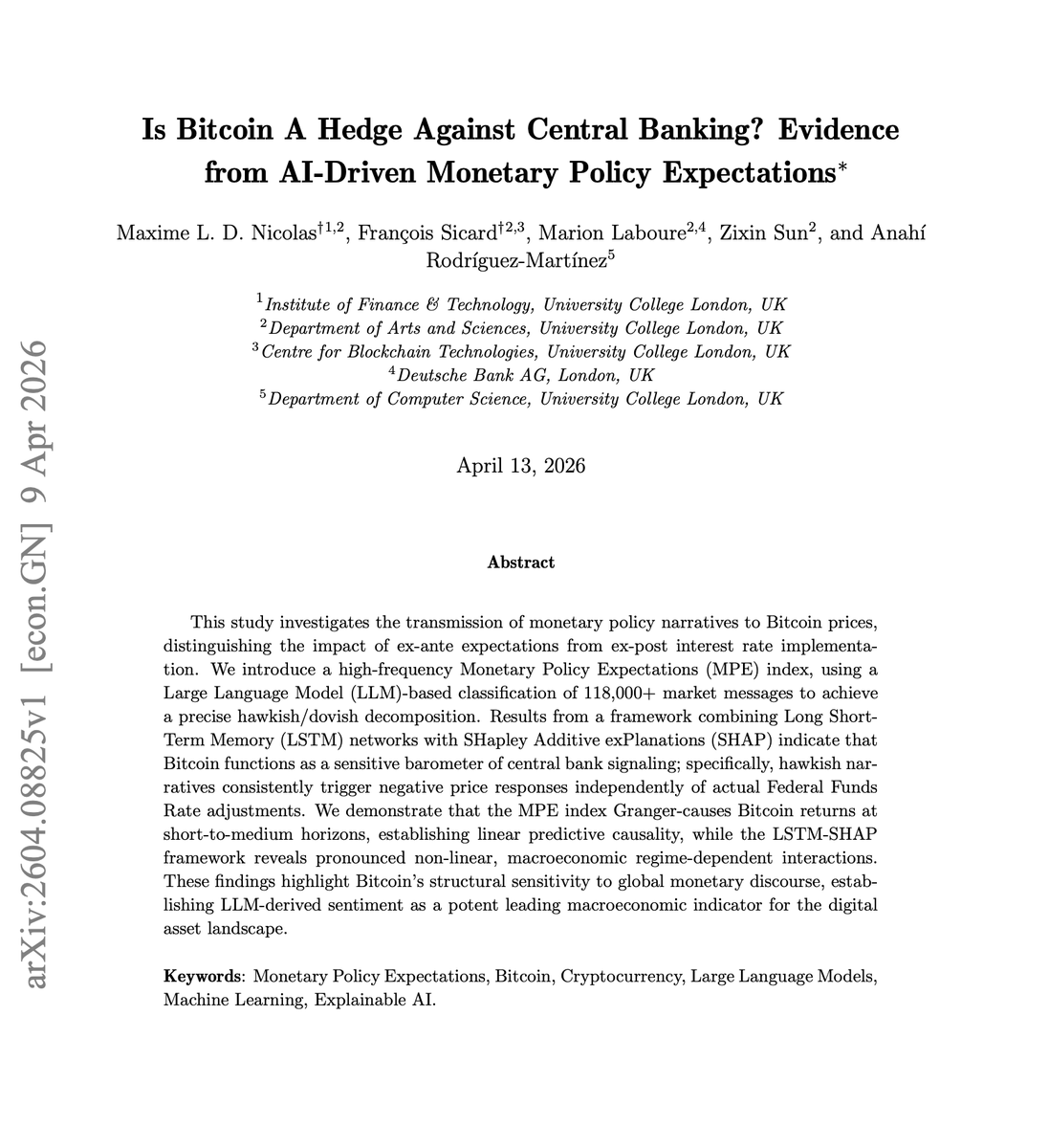
Pierre is presenting this paper as evidence for:
"Bitcoin monetary maximalism empirically vindicated."
But the actual abstract, as shown in his screenshot, is saying something much narrower:
Bitcoin prices are sensitive to central bank narratives and monetary policy expectations.
Those are not the same claim. 🤦
"Bitcoin functions as a sensitive barometer of central bank signaling; specifically, hawkish narratives consistently trigger negative price responses independently of actual Federal Funds Rate adjustments."
Bitcoin monetary maximalism empirically vindicated
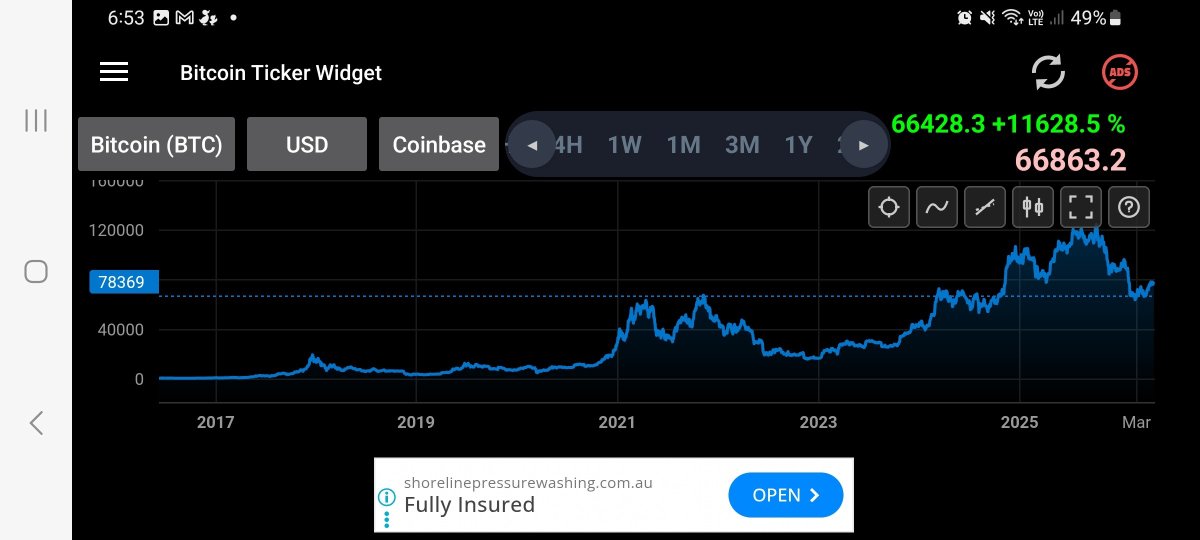
BITCOIN JUST BROKE THE MOST IMPORTANT LEVEL IN ITS ENTIRE HISTORY.
And if we don't reclaim it fast…
We are in serious trouble.
14 years of support. Gone.
That line defined every single bull market.
Never broke without catastrophic consequences.
Never.
Volatility exploding.
Liquidity hunting lower.
Weak hands getting destroyed.
This is not a dip.
This is not a shakeout.
This is structural failure.
Ignoring this isn't conviction.
It's denial.
@SmilaZParadis I wonder how much their insurance claw back for that project.
It seem like the best way of abandoning a project with suffering any financial lost.
@SmilaZParadis Protesters, looks normal, peaceful, boring. News requires excitement coupled with their agenda narrative.
Like fear division, distraction.
Somewhere is the real news someone doesn't want ppl to pay attention to.
Because the real news, has tendency to unite.
The interesting historical angle is that Satoshi actually mentioned poker and micropayments very early on.
Bitcoin wasn't originally presented as merely "digital gold." The early discussions often revolved around:
micropayments,
machine payments,
online services,
gaming,
contracts,
commerce.
So when Craig says:
"When combined with micro-payments (bonded-subsat-channel)..."
he's describing a broader architecture rather than just a poker game.
The poker game may simply be the first demonstration because it's easy to understand:
Can strangers:
- hold money,
- hide information,
- reveal information when required,
- settle fairly,
- prove nobody cheated,
- do it without a house?
If yes,
many other applications become possible.
That extends beyond gaming into auctions, marketplaces, machine-to-machine commerce, supply-chain negotiations, autonomous agents, and other systems where participants need both private information and financial settlement.
Mental Poker appears to be the proving ground. If it works, it demonstrates that Bitcoin can coordinate value transfer, private information, and cryptographic fairness without a trusted intermediary. The poker game is the demo; the underlying infrastructure is the real objective.
Why Mental Poker Matters Today
It is the cryptographic foundation for true trustless multiplayer games on public blockchains.
When combined with micro-payments (bonded-subsat-channel), verifiable accounting, and secure key management (overlay-broadcast), it enables games where real money can be at stake with no house, no trusted operator, and full cryptographic fairness.
Looking at my own work with complete honesty, I can readily admit that my design skills are dreadful. The interfaces are ugly as hell. If aesthetics were the measure of engineering, I would already be convicted.
Fortunately, software is judged by whether it works.
By tomorrow, I expect to have the system loaded and integrated so that the wallet, the game layer, and the supporting infrastructure operate together as a coherent whole. There are still multiple configuration options and some areas where the integration can be refined, but that is largely a matter of presentation and convenience rather than functionality.
The essential point is one that critics seem determined to overlook. The difficult part already works. The mental poker system works. The underlying protocols work. The trustless interactions work. The cryptography works.
One can always hire a designer to improve appearances. It is rather harder to hire someone to invent a functioning trustless mental poker system.
As one as Satoshi might have observed, there are only two kinds of software: software that is beautiful and does not work, and software that works and is eventually made beautiful. I know which category I would rather inhabit.