Consolidation leads to expansion.
I can show you thousands of examples of this. It’s a rare setup that doesn't come around every year, making it the easiest trade you can catch, just buy and hold.
ethereum:native will outperform any asset on earth in the next 3 years.
Congrats @eth_systems on the launch
Institutions want confidential systems using ethereum as the settlement layer
This launch strengthens $ETH is the future of money
👏👏👏👏👏👏
6/
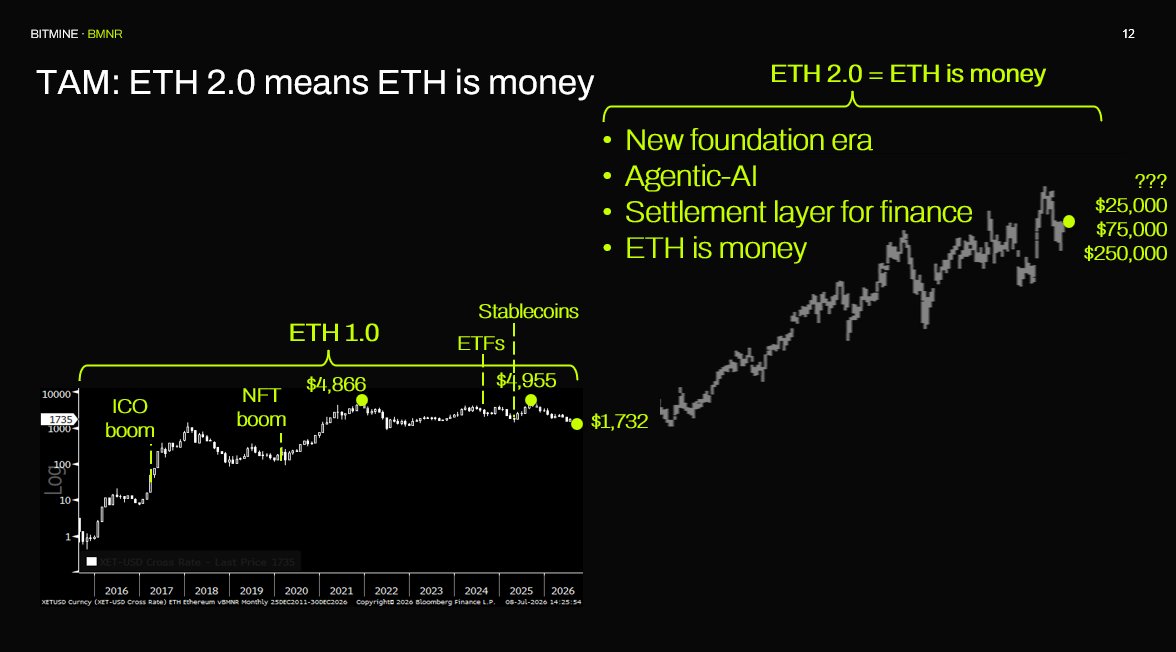
ETH 1.0
- 2015 to 2026
- ICO boom 2017
- NFT boom 2020-2021
- stablecoin boom 2025-now
- ETH peaks $4,866 2021 and $4,955 in 2025
ETH 2.0
- new foundation era
- Glamsterdam
- Enterprise engagement
- financial settlement layer moves to blockchain
- AI era bring agents using crypto
- machine to machine commerce requires blockchains
- ETH becomes the unit of account
- ETH is money
ETH 2.0 = expected massive $ETH demand and price increase
THE $250k $ETH THESIS
"There’s 100x in it."
Vivek of Etherealize says Ethereum is better money than Bitcoin.
Gold-like, but with staking yield.
A call option on money itself.
A monetary asset plus the settlement layer for tokenized finance, stablecoins, DeFi, institutions and trillions in RWAs.
Gold has no yield.
Bitcoin has no native yield.
ETH secures the network and earns staking yield.
Institutions on $ETH vs $SOL:
"To be completely frank, Solana never comes up"
"The next few years will determine the base layer of global finance, institutions will either fragment across competing ecosystems, or converge on a credibly neutral, programmable base layer. Ethereum is already winning that race." - Ethereum Institutional
We're glad to be building alongside this team to accelerate institutional adoption on Ethereum.
ROBINHOOD JUST PICKED ETHEREUM FOR TOKENIZED FINANCE
Robinhood has launched Robinhood Chain, its own Ethereum Layer 2 built with Arbitrum technology.
The goal isn't another crypto chain.
It's bringing stocks, ETFs and real world assets onchain.
🔹 Built on Ethereum
🔹 Tokenized stocks & ETFs
🔹 24/7 trading
🔹 Self-custody
🔹 Direct access to Ethereum DeFi
Robinhood says it chose Ethereum's security, liquidity and ecosystem as the foundation.
That's a major vote of confidence for Ethereum
$HOOD $ETH
1/ Announcing Ethereum Institutional
An independent non-profit dedicated to accelerating the institutional adoption of Ethereum, its L2s, applications and overall ecosystem.
Absolutely insane backing behind Open USD
This is literally the entire US tech private sector deciding to tokenize the US dollar
This is how the US dollar remains the dominant currency of the world for the next 100 years.
Ethereum is the neutral rails that makes this possible.
> This is a "we don't know what we actually want" problem.
The mob wants ETH number to go up. Failing that, someone, anyone, to point fingers at.
This will require greater need for and use of ETH, and therefore more burning of ETH.
Fortunately, we are getting very close to being able to implement near-synchronous and synchronous composability in which tokens will be able to move automagically via ZK proofs that set up shared atomic execution contexts across multiple networks (L1, L2s, Besu private networks, ...) in real-time. This will unify fragmented liquidity pools in real-time. Much ETH will be burned increasingly many complex bridge-less cross-chain TXs are orchestrated. TradFi is coming to do some of this. Agentic will do some of this. And DeFi will make use of this.
📊 INSIGHT: Ethereum hit record usage in Q1 2026, per Token Terminal.
Monthly active users reaching 13.2M +53.5% QoQ and transaction count rising to 200.4M +38% QoQ.
Ethereum's biggest upgrade since the Merge just hit its final dev stage 🔥
Glamsterdam devnets are live with the full EIP bundle — enshrined PBS, block-level access lists, sweeping gas repricings.
The Merge changed consensus. Glamsterdam changes how Ethereum executes. 🔗
https://t.co/iqgYFl5isT
Etherealize Team Commentary on Token Terminal's Ethereum Q1 2026 Report
The headline tension this quarter was Ethereum mainnet hitting record usage levels while transaction fees fell. Ethereum is deliberately scaling the network at the expense of near-term fee capture, betting that cheaper blockspace unlocks far more demand (and eventually network revenue) in the long run.
Token Terminal's Ethereum Q1 2026 Report shows that bet is working. On a year-over-year basis, monthly active users rose 85.9%, transaction count is up 81.5%, and throughput climbed 81.7%.
This is Jevon's paradox at work, and we expect the increase in total network demand to more than make up for lower fees, similar to how the semiconductor industry generates several orders of magnitude more revenue today than it did in 1975, when Intel co-founder Gordon Moore observed that the number of transistors on a microchip doubled roughly every two years.
Furthermore, the scaling payoff is still ahead of us with the Glamsterdam upgrade targeting a more than 3x increase in the gas limit in Q3 and Ethereum's roadmap guiding to 10,000 TPS and a "fast L1" with finality in seconds by 2029.
We agree with BlackRock CEO Larry Fink who wrote in December that "tokenisation today is roughly where the internet was in 1996—when Amazon had sold just $16m worth of books."
The consensus at the time was that Amazon was a money-losing online bookseller propped up by an internet bubble. However, Jeff Bezos saw that the internet was going to transform retail and optimized for network effects and economies of scale, rather than near term profits. Ethereum is making a similar tradeoff to cement its position as the settlement layer for global finance.
The other lesson worth drawing from the Internet is that open, permissionless networks tend to beat closed ones. In 1995, Bill Gates published The Road Ahead predicting digital commerce would run on proprietary corporate networks he called the "Information Superhighway" rather than the open internet. Microsoft was building MSN. AOL, CompuServe, and Prodigy ran walled gardens with millions of paying subscribers. France's Minitel had more users than the entire web until late 1996. They all lost. No serious company would build on top of a network controlled by a competitor, and perhaps more importantly, no corporation could keep pace with permissionless innovation indefinitely.
We have seen this play out again and again: Linux out-built proprietary Unix, the open web displaced corporate walled gardens; Wikipedia displaced Britannica. Each time, the proprietary alternative had the early lead — a more focused product, larger marketing budgets, business development teams — and each time that lead eroded after the open system crossed a threshold of accumulated contribution, tooling, and credible neutrality.
We are now seeing this theme play out in financial infrastructure, and this report's data is evidence that Ethereum has crossed the threshold with dominant market share in every metric that matters.
The institutions building tokenized finance are choosing Ethereum not out of ideology but because the liquidity, composability, and institutional precedent are already there. As this report highlights, Ethereum holds 79.2% of active DeFi loans across the top five chains, 61.8% of stablecoins, 73.0% of tokenized funds, and 84.0% of tokenized commodities.
Every new tokenized asset deepens the liquidity that pulls in the next one, and a neutral substrate is the only equilibrium that holds because large players will never agree to settle on a competitor's infrastructure. Furthermore, institutions are realizing that privacy, permissioning, KYC, and transfer restrictions can all be implemented on Ethereum through privacy-preserving environments and permissioned token standards without surrendering access to public liquidity; the reverse (bolting public liquidity and an open application ecosystem onto a closed chain) is not possible.
The institutional momentum, if anything, has accelerated since quarter-end. In May alone, BlackRock filed for two more tokenized funds, JPMorgan launched JLTXX as its second tokenized money-market fund on Ethereum, and Fidelity International launched FILQ, a Moody's AAA-rated dollar liquidity fund, as an ERC-20. In the world of stablecoins, the Japan Blockchain Foundation's yen stablecoin EJPY will launch on Ethereum, and a twelve-bank European consortium (including BNP Paribas, ING, UniCredit, and BBVA) is preparing a regulated euro stablecoin.
The internet looked impossible in 1990 and inevitable by 2005. If Fink is right about where tokenization sits on that curve, the next few years could be some of the most exciting in Ethereum's history. And as we argued in our Productive Money report, network fees give ETH an intrinsic value floor, while the bull case is ETH absorbing the ~$30+ trillion monetary premium held by gold and Bitcoin given its superior monetary attributes. ETH doesn't need exorbitant fees to win.
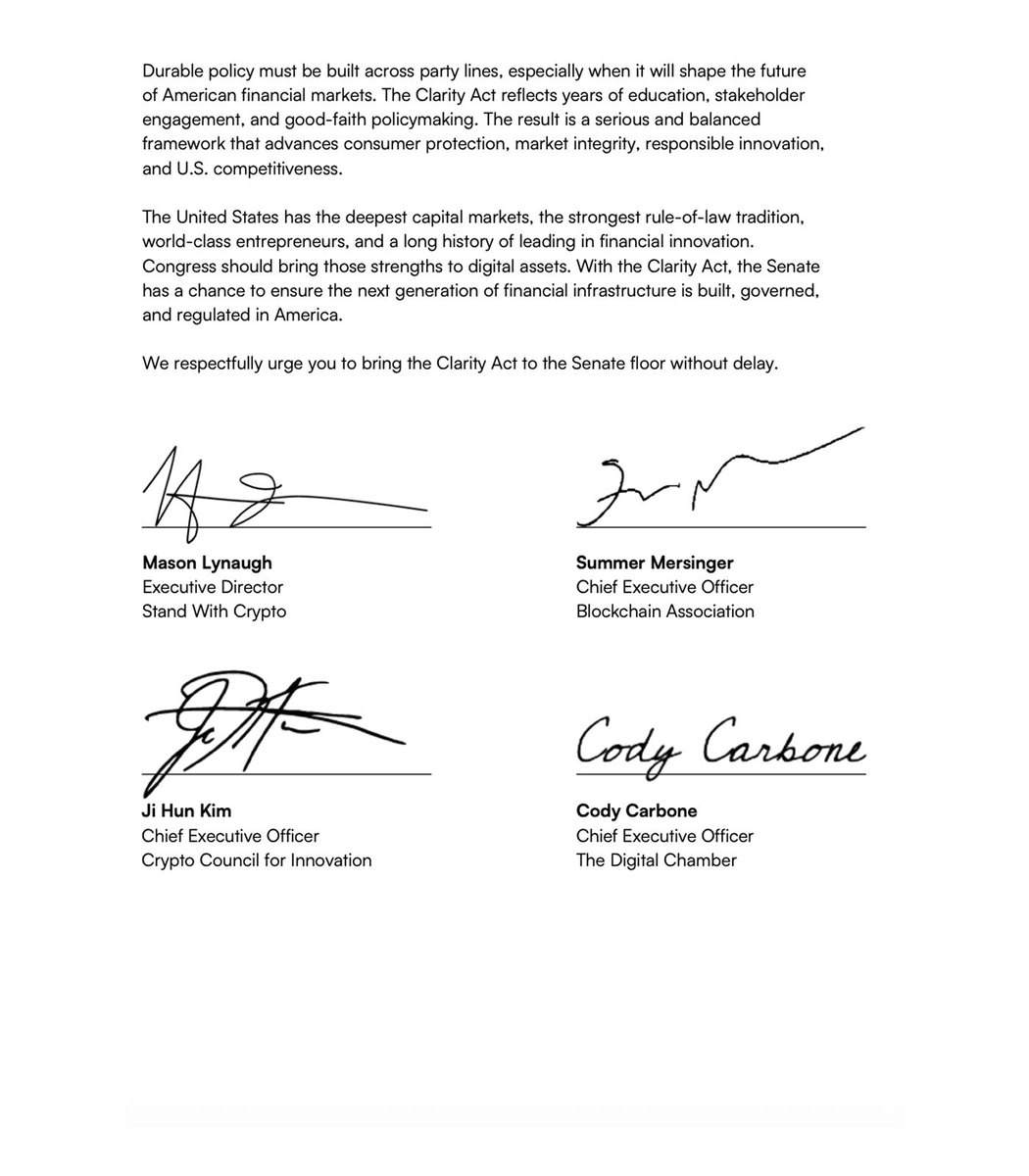
🇺🇸 LATEST: Stand With Crypto and more than 200 companies and organizations have signed a letter urging Senate leaders to bring the Clarity Act to the Senate floor.