1/ There are no other constitutional rights in substance without freedom to transact
Being meaning to write this for 6 months, but the Canadian response to the trucker protests is illustrating this so vividly, that today is the day.
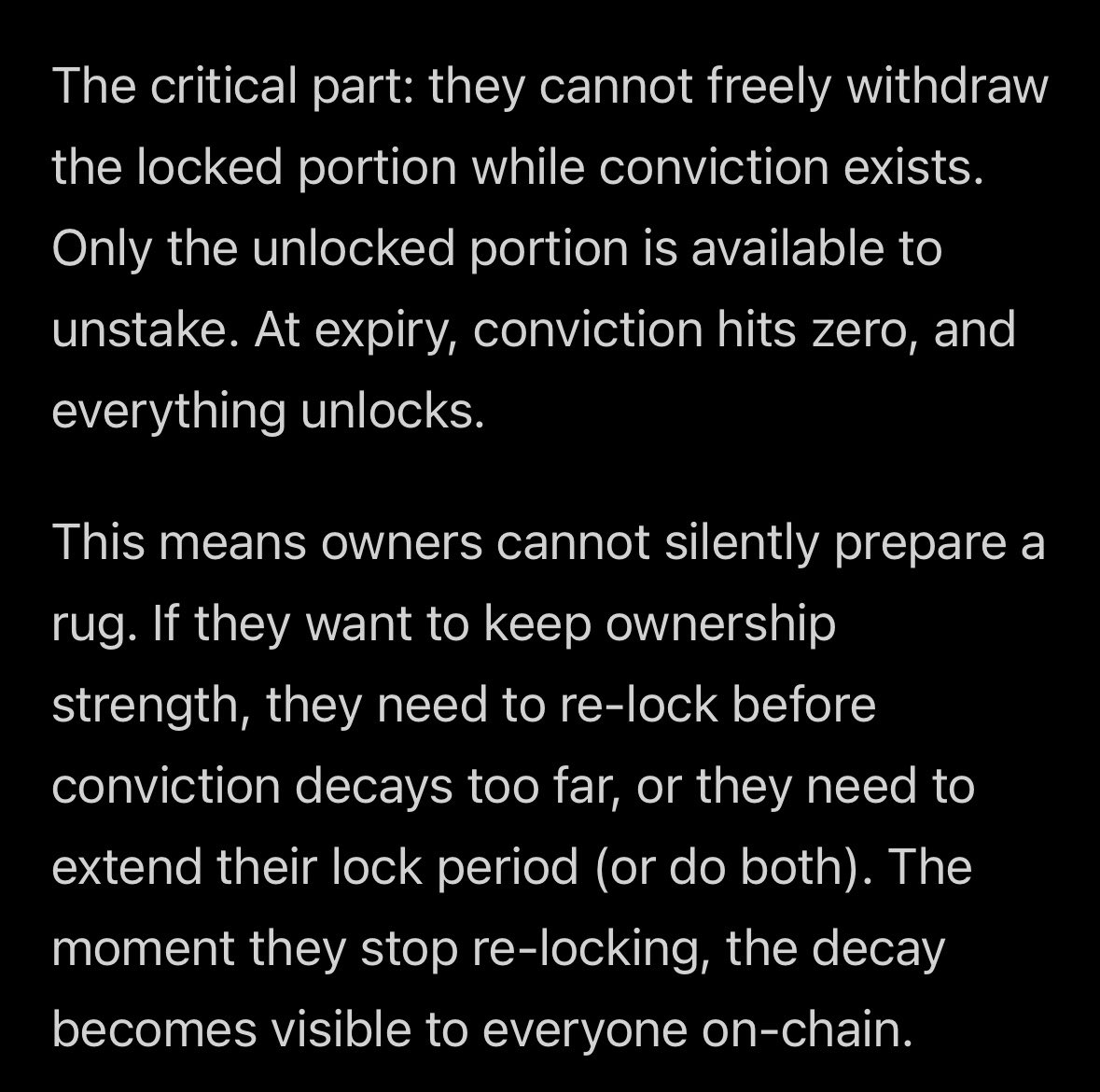
This is basically how the proposed locked stake works.
IMO I think it a win for everybody, alpha holders, investors, well meaning subnet teams, because I mean, if you don’t intend to rug you’d want you community to see your commitment towards your then right?
$TAO
I am not going to sugarcoat this. Last night hurt $TAO & Subnet holders
The founder of Covenant AI decided to cash out of SN3, SN39, and SN81, dumped roughly 37,000 $TAO worth of subnet Alpha on the way out, and cratered prices across the board. $TAO dropped as much as 27%. Nearly $900 million in market cap wiped. $9 million in longs liquidated. Alpha holders on those subnets got absolutely crushed.
I was one of them. I lost a significant amount from this. That is the reality and I am not going to pretend otherwise.
But I am still here. And I am still buying. Let me tell you why.
First, let me be clear about what actually happened. A subnet owner got into a disagreement with Const, got upset, and used it as an excuse to dump his bags on the people who trusted him. That is it. That is the whole story. He dressed it up as a principled stand against centralized governance but the man sold 37,000 $TAO worth of Alpha on his own community while posting a manifesto. That is a rug plain and simple.
Const responded within the hour. Publicly. On chain. With a solution.
Some people are acting like Bittensor died last night. It did not. Let me show you what actually happened in the hours after the dump.
Const proposed lock-based subnet ownership where ownership of a subnet is determined by a team's long-term economic commitment to the project. Not by who registered first. Not by who controls the keys. By who has skin in the game over time. Investors would see in advance if an owner unlocked their tokens. The market could reprice the subnet before the owner dumps. And conviction could be directed to another team or even an agent to manage the system.
If implemented, this would be the most significant governance upgrade since dTAO launched. And it came within hours. Not weeks. Not after a committee meeting. Within hours.
That is what this network does. It finds its weak spots and it fixes them. Fast.
@MacrocosmosAI posted: "Bittensor always emerges stronger from pain. Hacks, exploits, disagreements all fade into the history of this protocol. The flame of distributed training continues to burn brightly. One individual does not make a nation."
@jon_durbin from Chutes: "Chutes is and always will be a Bittensor project. Chutes is Bittensor and Bittensor is Chutes."
@MaxScore from Score: "Score is and always will be a Bittensor project. Score is Bittensor and Bittensor is Score."
Loayei: "Don't care about the drama. Will continue building $TAO."
@TroyQuasar from Quasar called it what it was. He said it was bullshit, that no one is bigger than the network, and that Quasar will take it from here.
The builders did not leave. The builders doubled down within hours. Publicly. On record.
@markjeffrey put it simply: "Bittensor is quite a LOT more than Subnet 3, and $TAO will carry on fine without it. There are 125 other subnets plus three new slots that just freed up."
Three new subnet slots just opened. While people were panic selling, builders were already eyeing the open seats.
@SiamKidd gave the most grounded take. He acknowledged the drama, acknowledged that Sam's governance concerns were not entirely wrong, but made the point that Const's motives have always been genuine. This is growth. This is what permissionless systems look like when they encounter stress. They break in specific places, they get patched, and they come back harder.
This is not the first time something like this has happened on Bittensor. It is not even the second time. Nous Research left the ecosystem before. And what happened? The network adapted, subnets evolved, and the protocol kept building. Every previous inflection point led to upgrades that made the system stronger.
Covenant-72B was real. The training was real.
Fundamentals haven’t changed:
21M hard cap, halving complete, 68% staked, nine institutional products accumulating, Grayscale ETF pending.
$TAO just went on sale at a 27% discount.
Builders keep building.
I’m buying this dip.
$TAO
@MastrXYZ And the crazy thing is that these are the crimes we know about. Imagine how many more there are. Especially in his second term. I think he'll spend the rest of his life at least in court for all the brazen corruption.
⚡️Saylor is right.
Bitcoin is where a massive share of global capital ends up once the world fully understands that every other store-of-value rail is compromised by politics, dilution, leverage, seizure risk, or counterparty fragility. That is the real signal. He is saying it in loud TV language, but the core truth is simple: capital wants a final settlement layer, and Bitcoin is the strongest candidate.
“Hundreds of trillions” sounds absurd only if you still think Bitcoin is mainly a trade. It is not. It is a gravity well for savings. It is competing with sovereign debt, cash balances, gold, second homes, offshore wealth parking, reserve assets, corporate treasuries, and every fake safe haven people use because they do not have a better option. Once you see that, the scale no longer sounds crazy.
The real thing he is naming is capital exile. Money is trying to escape from human institutions that cannot stop debasing, overpromising, and weaponizing the systems they control. Bitcoin is the exit. That is why the case keeps getting stronger every time governments panic, every time central banks improvise, every time debt expands faster than trust, every time the banking layer reveals fragility, and every time people realize their “safe” assets are only safe inside a decaying political order.
Bitcoin does not solve human stupidity. It does not solve war. It does not solve bad culture. It does not solve weak productivity. What it solves is the storage problem underneath civilization. And that matters more than most people understand. When people can store value in something that cannot be diluted or politically bent, the whole structure of capital allocation starts to change. Housing stops carrying as much monetary burden. Bonds lose some of their fake sacredness. Corporate treasury behavior changes. Sovereign reserve logic changes. Personal savings behavior changes. The shell around capital gets harder.
Saylor’s deeper insight is that Bitcoin wins before most people intellectually admit it. It wins through repeated institutional failure. It wins because every other system keeps teaching the same lesson. It wins because the modern world keeps producing reasons to leave. That is why he sounds absolute. He sees the destination clearly.
The part people still do not get is that Bitcoin is not climbing toward legitimacy. It is absorbing it. Every cycle, more of the legitimacy layer leaves the old system and settles into Bitcoin. First retail. Then funds. Then ETFs. Then corporates. Then treasuries. Then sovereign-adjacent behavior. That staircase is already happening.
So the deepest read is this:
Saylor is describing the monetary endgame in oversimplified language.
And the endgame is real.
A huge share of the world’s capital is going to end up in Bitcoin because the world no longer has a trustworthy place to store value at scale.
🎓A Harvard professor just chose a Bittensor $TAO subnet as his research lab SN64 @chutes_ai, and he is no ordinary professor 👇
Professor Juncheng Yang leads the MadSys Lab at Harvard's School of Engineering and Applied Sciences. He's developing a new prefix caching algorithm designed to make AI inference dramatically faster while using less hardware.
He needed real-world production data to test it.
He picked Chutes. Subnet 64. On Bittensor.
This is so important cause:
This man's CV is not normal.
PhD from Carnegie Mellon. Postdoc at AWS. Research Scientist at Snowflake. Internships at Twitter and Cloudflare. Now Assistant Professor at Harvard.
His cache algorithms are already deployed in production at Google, VMware, AWS, Twitter, and Redpanda. His work SIEVE won Best Paper at NSDI'24 and has been implemented in over 60 open-source libraries across 18 programming languages. His S3-FIFO algorithm is running inside Google's infrastructure right now.
He holds the ACM SIGOPS Dennis M. Ritchie Doctoral Dissertation Award. That's the highest honor in operating systems research for a PhD thesis. Named after the creator of Unix and the C programming language.
Meta Fellowship recipient. Google Cloud Research Innovator. Rising Star in Machine Learning and Systems.
Five Best Paper awards across the top systems conferences in the world. NSDI. SOSP. SYSTOR. VALUETOOLS.
This is not a crypto influencer doing a partnership announcement. This is one of the most decorated young systems researchers in the world choosing decentralized infrastructure over centralized alternatives for his next breakthrough.
And here's the part that connects it all.
Chutes processes roughly 300 billion tokens per week across its platform. That's real production-scale inference traffic. Professor Yang's team needs exactly that kind of volume to validate their caching algorithm under real workloads.
Early testing has already shown significant improvements in inference efficiency and cost savings. If the full results hold, this could materially reduce the hardware required to serve AI models at scale which is the entire value proposition of what Chutes is building on Bittensor.
This is what Bittensor was designed to do. Create infrastructure so useful that world-class researchers choose it not because of ideology but because it's the best tool for the job.
When Google's own cache algorithms were written by this man, and he now turns to a Bittensor subnet for his next research frontie, that's not a partnership announcement.
That's a proof point.
The line between academic AI research and decentralized crypto infrastructure just disappeared, folks.
$TAO
Grayscale Bittensor $TAO Trust just hit a major regulatory milestone.
90 days ago, GTAO became an SEC Reporting Company.
That means today its private placement holding period drops from 12 months to 6 months under Rule 144.
So what?
GTAO is now the first publicly quoted investment product in the U.S. designed to provide exposure to $TAO.
It trades on the OTCQX under ticker GTAO. As an SEC reporting entity, the Trust files quarterly 10-Qs, annual 10-Ks, and current 8-K reports with the SEC the same financial transparency required of public companies.
The shorter holding period means accredited investors who buy into the private placement can sell their shares in 6 months instead of 12. That's a liquidity unlock. More liquidity means more institutional participation.
But here's the interesting part most people miss.
Grayscale has already filed an S-1 with the SEC to convert GTAO into the first Bittensor ETF, seeking to list on NYSE Arca.
This is the exact playbook Grayscale used with Bitcoin.
Private placement. SEC reporting. OTC trading. ETF conversion.
GBTC followed this path. It took years. Then it became a spot Bitcoin ETF and unlocked billions in institutional capital.
GTAO is now at step three.
The market already sees it. GTAO shares currently trade at a significant premium to NAV $8.12 market price vs $3.83 NAV per share. Investors are paying over 2x the underlying value just to get regulated exposure to $TAO without touching a wallet.
That premium tells you something about demand.
Right now GTAO holds $7.3M in assets under management. That number is small. But so was GBTC once. The infrastructure is being built. The regulatory pathway is being worked. The filings are public.
Most crypto assets never get a Grayscale trust. Even fewer get an SEC reporting designation. Even fewer get an S-1 filed for ETF conversion. $TAO now has all three.
This is institutional rails being laid in real time.
$TAO
@brian_armstrong Trump has been a disaster for crypto and for the U.S. you kiss ass. You support a wannabe dictator. You're not making the world a better place you bootlicker.
Finished a seven day social media fast. It feels like the most effective longevity therapy I've done.
Everything got better: mood, sleep, energy, presence, judgment, relationships, and optimism.
Evidence shows a seven day fast produces a reduction of anxiety (16%), depression (25%) and insomnia (15%). The effects felt bigger.
Conversely, dipping back in, I can viscerally feel that my body metabolizes social media similarly to a fast food meal, corrosive relationship, hangover, and sleep deprivation. My body hates it.
After the previous fasts (40/hr and 70hr), I wrote that social media is pollution. Not a vice or guilty pleasure. It’s closer to water toxins, air pollution and microplastics.
This time, the major insight was that social media is a form of intoxication.
Alcohol is honest intoxication. It clearly tells you what it's taking from you. Social media on the other hand does not disclose itself as an intoxicant.
It produces the sensation of being informed, engaged, and connected while quietly evacuating your capacity for depth and independent thought.
You don’t feel drunk, you feel current. But evidence shows that it causes your brain to shrink. The impairment is real by you can't feel it. Making it the more dangerous type.
If you haven't tried it, I strongly encourage you to try a social media fast. Even if for one day.
I cannot even with the lies at this point.
“If crypto wants to pay yield, it should become a bank.” That sounds principled until you apply it consistently.
Lot’s of financial institutions already pay yield without being a bank, such as… 🧵
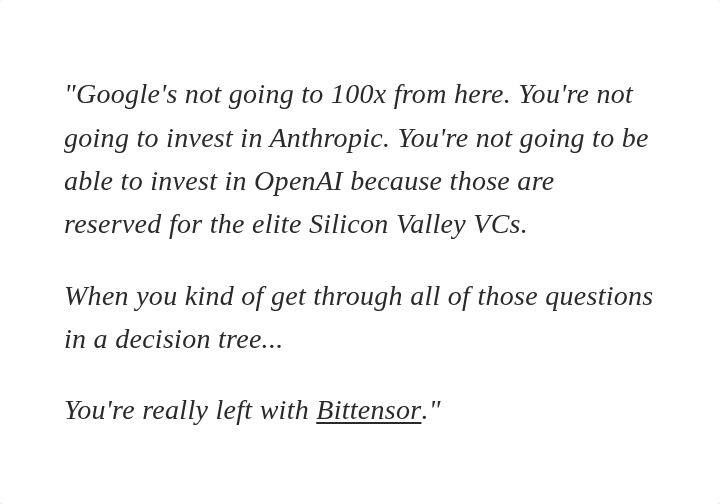
Something clicked for me after reading Stillcore's piece on $TAO
Bitcoin gave us decentralized money.
Ethereum gave us programmable contracts.
Everyone understood those in hindsight. Nobody really got them early.
Bittensor is doing something weirder and more interesting than both.
It took the actual incentive engine behind Bitcoin - the mining, the issuance, the coordination - and made that programmable.
So now instead of mining blocks you can mine intelligence. You can mine drug compounds. You can mine computer vision. You can mine anything that can be measured and rewarded.
That's not an upgrade. That's a completely different game.
And the part that gets me - right now anyone can participate the way only VCs used to.
Early internet? You needed Sand Hill Road connections. Early @bittensor? You just need to understand what you're looking at before most people do.
128 subnets today. Each one an AI company competing in an open market. No boardrooms. No funding rounds. Just output quality and market signals deciding who wins.
I keep thinking about where this sits in the timeline.
Not "early" as a price argument.
Early as in - the people who genuinely understand the architecture could still probably fit in one room.
That window doesn't stay open forever.
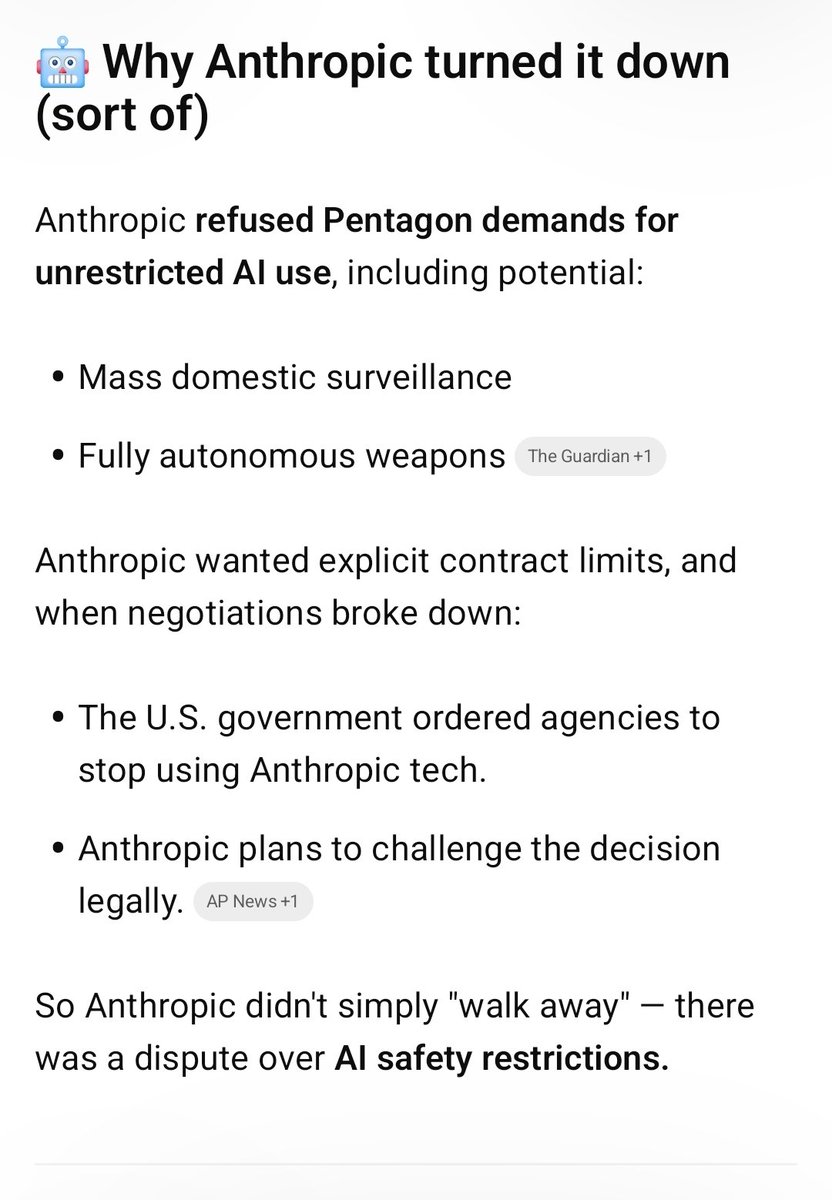
Canceling my ChatGPT subscription after they signed a contract with the government which can use their technology for "any lawful purpose"
Anthropic turned it down because the govt wanted to use them for mass surveillance and autonomous weapons.....
i still can't believe Trump is still the president of the US
like genuinely,
he banned anthropic's AI on thursday. called it a national security threat.
blacklisted it from all government use. the ink wasn't even dry.
and on friday his own military used that same AI to identify targets and bomb Iran.
man does not read his own executive orders. he signs them for the headline and moves on.
this has been the pattern since day one and it's honestly exhausting to watch.
look at just 2026 alone:
> said he'd end all wars. started the biggest military operation since iraq.
> said crypto is the future of america. signed the strategic bitcoin reserve order.
btc is down 50% since and the reserve is still empty. nothing happened.
> said tariffs would make america wealthy. ppi came in at 3.6%. groceries up. gas about to spike. regular people are poorer.
> promised to refill the SPR. it's sitting at 60% empty. nine months in.
banned tiktok. unbanned tiktok.threatened iran. negotiated with iran. bombed iran. all within a few weeks of each other.
and it's not just 2026. this is the whole career,
every single promise. every single order. every single bold statement at a podium.
none of it means anything. it never did.
really, i don't care what side of politics you're on. this is not a man who should be trusted with anything that matters.
not your money. not your data. not the most powerful technology ever built. and definitely not a war.