Foreword
“Are the Ones Being Brainwashed the Believers — or the Japanese People?”
It is not too late even now.
No matter what methods are used, the government and the Supreme Court should seek a path to withdraw the dissolution order against the former Unification Church.
I will continue to state this consistently and sincerely to all readers.
Until recently, I myself had carelessly discarded attitudes such as, “I don’t even want to touch something so dark,” and “It feels creepy.” But I want people to know the truth behind this issue, even if only through a single sentence.
That is why I decided to publish this special feature.
After thorough research, I came to the conclusion that the dissolution order is an extremely destructive act that shakes the foundations of constitutional order, the rule of law, and a free society.
That is why I wrote this.
“Spiritual sales,” “cult,” “mind control,” “excessive donations” — there are many keywords that come to mind.
However, these are not concrete and serious criminal facts. Rather, people have simply been warned not to distribute “dangerous images.”
The other day, I spoke with a certain mother whose daughter is a believer. She said over the phone,
“Honestly, I’m starting to think maybe the truly terrible thing is this dissolution order itself.”
That statement left a strong impression on me.
Perhaps what is truly frightening is not the believers who are supposedly “brainwashed,” but us Japanese citizens who have been influenced by television and media narratives.
In this special issue, we also include materials from the March 26 press conference held by a bipartisan group of lawmakers calling for a “fair and impartial trial.”
The first impression I received from the speakers involved in this case was their continued intelligence and dignity.
Wouldn’t it be worthwhile to directly read their voices and assertions in full?
Perhaps we have not truly listened to them until now.
And we must not simply let this matter pass in silence.
The rule of law, freedom, and democracy are gradually being eroded. Readers should consider not only their own future, but also the freedom and legal rights of their children and future generations — and ask what can still be done now to protect them.
⸻
I am, by nature, someone who values neutrality and fairness.
In the past, I belonged to an association of broadcast critics seeking improvement in broadcasting law, and at one point I even wrote bashing articles against the Sankei Shimbun.
When I later saw media reports attacking the former Unification Church “for the sake of the Communist Party,” I confess I laughed bitterly and fell silent.
I have lived my life placing greater importance on integrity and sincerity than on outward appearances or status.
Through this issue, however, I have been astonished again and again while writing. Why?
Because the people I encountered through this matter — including members of the Family Federation — were all remarkably sincere individuals.
I even found myself thinking they resembled the earnest young people of Japan’s past.
Of course, my arguments in this issue are not emotional defenses of the church.
I am not protecting the organization itself. I am pointing out the irrationality and destructiveness of the dissolution order.
And yet, reflecting on it now, perhaps I came to like these believers because they possessed a spirit and conviction that cannot easily be manipulated by legal coercion.
I am writing this in the hope that it may serve as a record of the times.
— Kotaro Ogawa
South Korea's "Church-State Collusion" task force just raided the Family Federation again.This time, the charge is embezzlement.
Here's what you need to know.The Joint Prosecution-Police Investigation Unit (합수본), created in January 2026 specifically to probe alleged collusion between the Unification Church/Family Federation and politicians, executed search warrants at roughly 10 locations this morning, including the Cheon Jeong Gung headquarters in Gapyeong, the Seoul office, and the HJ Global Unity Foundation.
The warrants name Family Federation leader Dr. Hak Ja Han Moon and other church officials as suspects under the Aggravated Punishment for Specific Economic Crimes Act for embezzlement.
This is the first time the task force has launched a compulsory investigation on embezzlement charges. Previous raids in January targeted alleged "split donations" to politicians.
Here's what's worth paying attention to.The task force spent four months investigating alleged political bribery involving lawmakers from both major parties.
Last month, it cleared every single lawmaker.
All charges dropped. Insufficient evidence. Statute of limitations expired.
The only indictments were four legislative aides charged with destroying evidence.
Dr. Han was also cleared of bribery-giving charges in that same decision.
Now, instead of winding down, the task force is expanding its scope into the church's internal finances, claiming it discovered evidence of systematic embezzlement during the lobbying probe.
This raises a basic question: Was the unit created to investigate political corruption, or to investigate a religious organization?
Meanwhile, Dr. Han, age 83, has been detained since September 2025. She was indicted in October by a separate special counsel on charges that already included embezzlement.
The court has granted her temporary medical release four times due to deteriorating health. She is currently hospitalized under court-ordered conditions until May 30.
She now faces embezzlement investigations from two separate prosecutorial bodies simultaneously.
This is happening 28 days before South Korea's June 3 local elections.
Source: https://t.co/U4S1easILV
+ 100 American second-generation believers have arrived in Tokyo in response to the dissolution of Japan's Family Federation.
They came to stand with Japan in defense of religious freedom.
According to sources, Dr. Hak-ja Han, 83, underwent shoulder surgery under general anesthesia at approximately 1:00 PM KST today, April 14.
The procedure began earlier than scheduled and concluded at around 5:30 PM.
The surgery was completed successfully and she is currently recovering.
The surgery took place during an ongoing medical hospitalization authorized by Seoul Central District Court.
On March 27, the court granted her a temporary suspension of pre-verdict detention, a legal mechanism allowing defendants with serious medical conditions to receive treatment outside custody.
She has been hospitalized continuously since that ruling.
The authorized hospitalization period is set to expire on April 30.
A 83-year-old woman has just undergone major shoulder surgery under general anesthesia.
When that authorization expires, she faces return to the same detention facility her legal team has described as the source of repeated falls and cardiovascular deterioration.
The question is not complicated.
Is sending a post-surgical patient in her condition back into that environment, one that already damaged her health, something any medical standard would permit?
Pastor Son Hyun-bo, leader of a large church in Busan that grew from 20 to over 10,000 members, was arrested in September 2025 under South Korea’s Public Official Election Act for making comments about political candidates during sermons.
He spent 143 days in detention before being sentenced to six months suspended and released on January 30, 2026. The case stands out because similar violations had previously resulted only in fines, not imprisonment.
The incident reflects a noticeable shift in how election-related laws are being enforced against religious leaders in South Korea.
The country’s democracy was built with significant contributions from Christian civil society during the democratization movement, making religious freedom a sensitive and historically important issue. International attention, including statements from former U.S. officials, played a visible role in the outcome.
When enforcement of long-existing laws suddenly leads to prison terms for religious speech, it raises broader questions about the balance between regulating elections and protecting freedom of belief.
Do you believe stricter enforcement of the election law is necessary to maintain fairness, or does it risk limiting legitimate religious expression in a democratic society?
Was Japan's dissolution order against the Family Federation driven by law — or by politics?
The record suggests the latter.
After the assassination of Shinzo Abe, media pressure against the Family Federation exploded overnight.
Prime Minister Kishida responded immediately.
On October 18, 2022, he told parliament that civil lawsuits could not justify dissolving a religious corporation.
The next day, he reversed that position.
The author of the source article calls it "nothing more than an opportunistic move to evade public pressure."
The cases used as legal grounds averaged 32 years old.
Zero illegal donations in the past 11 years.
Proceedings were conducted entirely in secret.
Japan's only prior dissolution was Aum Shinrikyo — responsible for 29 deaths and 6,000 injuries.
The Family Federation had no criminal convictions.
One legal scholar calls the outcome "judicial suicide" — a court that followed public opinion instead of law.
When legal standards can be rewritten in 24 hours under media pressure, dissolution orders stop being judicial decisions.
They become political weapons.
Source: https://t.co/VEryGM4Lvn
Legal scholar Eitaro Ogawa @ogawaeitaro calls the Tokyo High Court's dissolution order against the Family Federation "judicial suicide."
Of all the flaws in the ruling, the most troubling is the inflation of tort claims.
The court confirmed actual tort victims: 4 individuals.
Total damages: 18.68 million yen (approx. $129,000).
That wasn't enough to justify dissolving a legal entity.
So they inflated the tort count.
The court added a new category: cases where the "possibility of constituting a tort cannot be denied."
That category covered 138 individuals and 915 million yen (approx. $6.3 million).
Over 99% of the alleged harm was never proven as unlawful.
Using mere possibility as grounds for a de facto death sentence is a collapse of legal reasoning.
Source:
https://t.co/pTnH6SIEYJ
BREAKING: Korea’s Special Commission DECLINED TO INDICT Dr. Han and others in the “religion–politics collusion” case.
This is not an acquittal from the current trial. It simply means there is no further indictment at this point. Either the evidence wasn’t sufficient, or the statute of limitations had passed. But the investigation is not closed.
What stands out is the timing. One of the central figures, Jeon Jae-soo, is now running for mayor under the Democratic Party. This clearly benefits him ahead of the June elections.
More importantly, it at least appears to show that the narrative around this case has always been stronger than the evidence IMO. But... more inquiry is needed.
#ReleaseTheMotherOfPeace #GodsDreamOneFamily
https://t.co/NRA3CknncZ
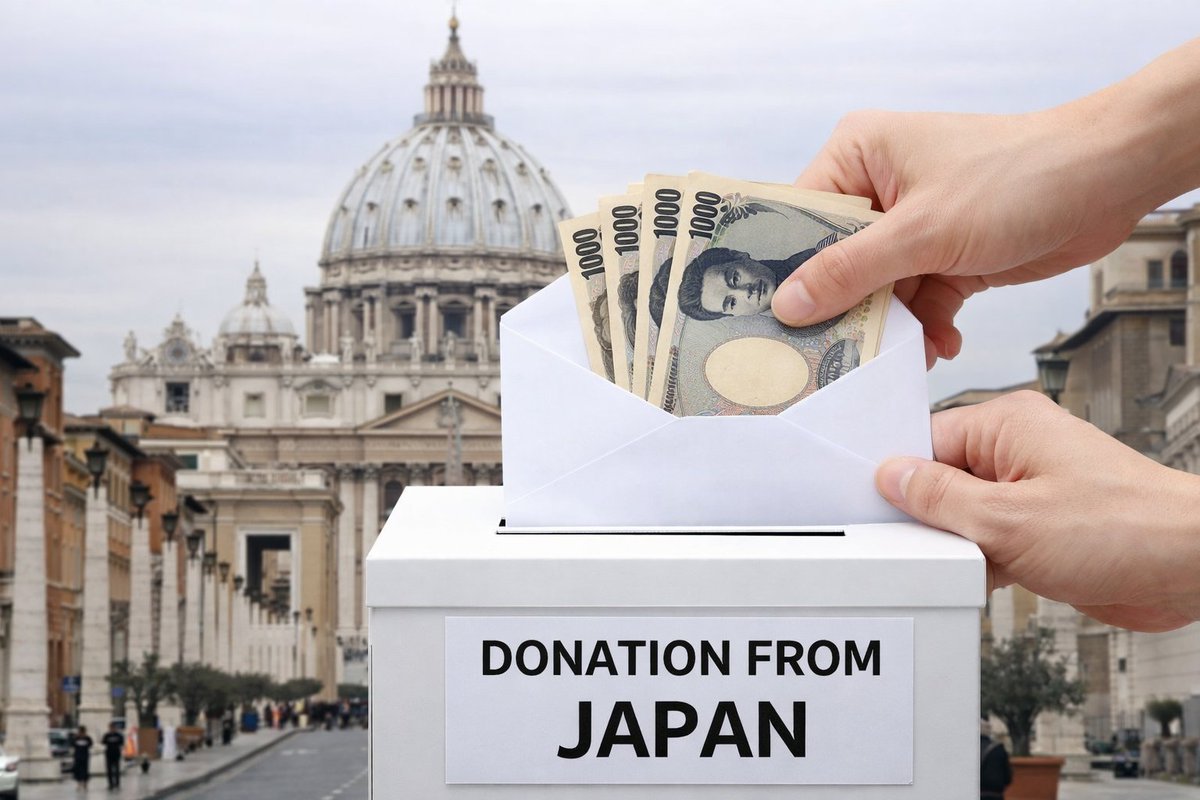
Japanese Catholics send money to Rome every year.
Nobody calls for the dissolution of their church.
Among the criticisms surrounding the March 4, 2026 dissolution of the Family Federation in Japan is one that has drawn recurring attention: donations flowing to Korea.
The question nobody is asking: how is this different from any other international religion operating in Japan?
Other international religions do the same thing, without scrutiny:
- In 2020, Japanese Catholics sent approximately $612,000 (91.77 million yen) to the Vatican following Pope Francis' visit to Japan
- Caritas Japan remitted approximately $1.44 million (216 million yen) internationally in 2024
- The Vatican's "Peter's Pence" collected $64 million (9.6 billion yen) globally in 2024, sent to Rome
- Approximately 81 percent went to Vatican operating costs, not charitable work
- The Japan Bible Society sent approximately $103,000 (15.51 million yen) overseas in 2024 through the United Bible Societies
- The Church of Jesus Christ of Latter-day Saints routes tithing from Japanese members to its world headquarters in Utah
The government has never investigated.
It has never filed for dissolution.
Japan's Ministry of Education's dissolution filing described how the Family Federation used donations, including for overseas missionary work.
The court accepted that filing as the basis for its ruling, and the organization was erased.
No equivalent filing has ever been brought against any other faith for the same practice.
The church was dissolved for violating "social appropriateness," a standard so vague that four UN Special Rapporteurs warned Japan it violated international human rights law.
The Family Federation is a Korean-origin religion.
The Catholic Church answers to Rome.
Protestant bodies remit to headquarters worldwide.
The Family Federation operates peace programs across dozens of countries, including interfaith summits and diplomatic initiatives coordinated from Korea.
These are among the activities that Japan's Ministry of Education cited in its dissolution filing.
The difference is not the behavior.
It is which religion's money is being watched.
SOURCES:
Vatican News
https://t.co/0hRdiu77IX
The Pillar Catholic
https://t.co/4EHNoX1Cnz
Caritas Japan
https://t.co/DjY6btN3vE
Catholic Bishops' Conference of Japan
https://t.co/QdBj9hJT2K
Japan Bible Society
https://t.co/BQGp4lL9Dd
The Church of Jesus Christ of Latter-day Saints https://t.co/60vHbJEYcj
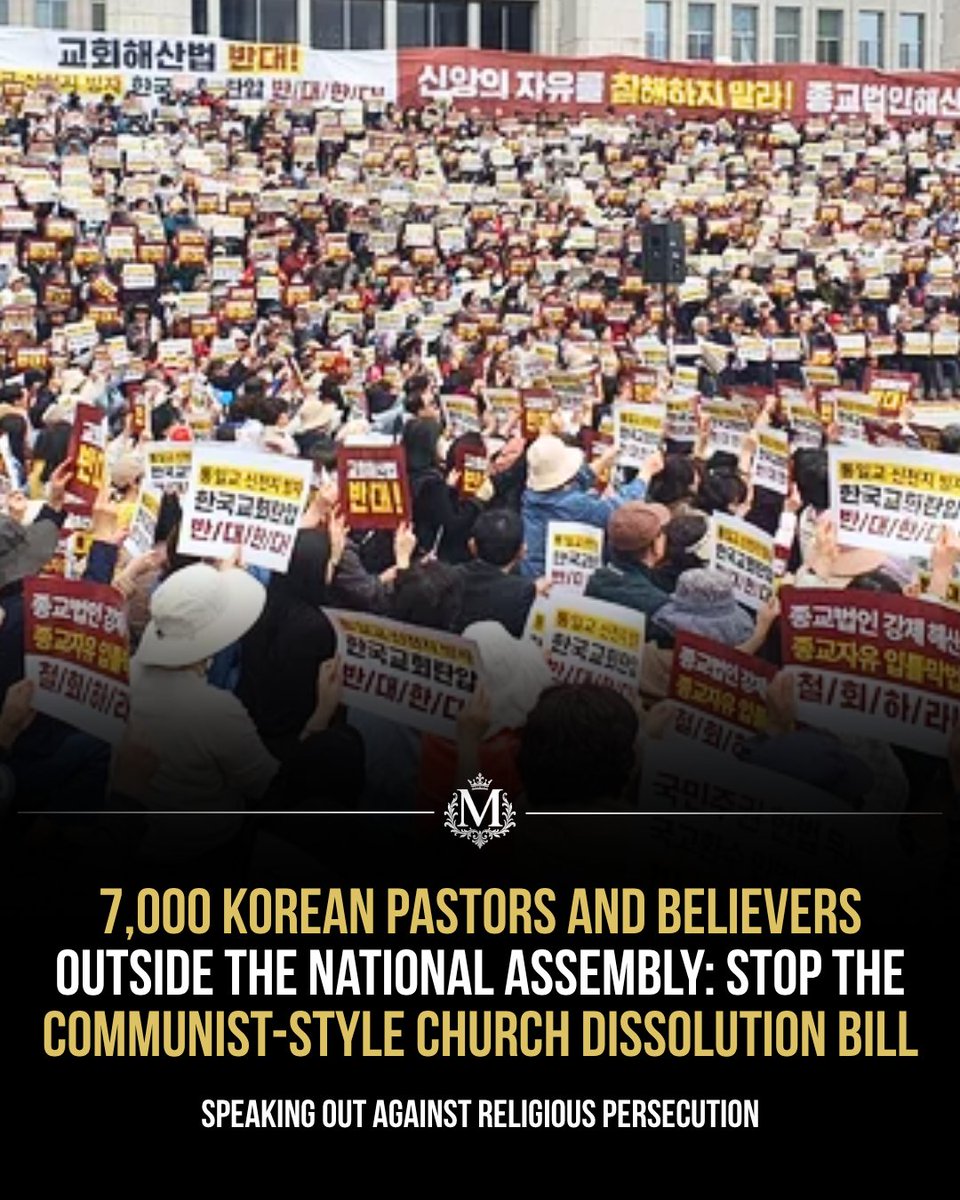
"7,000+ Rally Against Religious Corporation Dissolution Bill as Concerns Over 'Religious Freedom Violations' Spread"
7,000 Protestant clergy and believers gathered outside the National Assembly on April 1.
They came to demand withdrawal of a civil law amendment that would allow the government to dissolve religious organizations and seize their assets.
The bill was framed as targeting groups like the Unification Church and Shincheonji.
Mainstream Protestant leaders rejected that framing.
The rally's closing statement made the case directly:
"It is packaged as a Unification Church and Shincheonji prevention law. In practice, it could apply to all religious organizations."
The specific provisions drawing alarm:
・ Warrantless investigations and oversight of religious bodies
・ Mandatory government seizure of assets upon dissolution
・ Vague, undefined criteria for determining "political interference"
Pastor Kim Un-seong of Youngnak Church called it "a dangerous starting point that could eventually cover all of society."
Pastor Lee Tae-hee pointed to China: "China started with institutional management and developed into a structure that restricts even doctrine and sermons. This law could become the starting line for that kind of control."
Pastor Son Hyun-bo framed it as a constitutional violation: "The principle of separation of church and state means the state must not interfere in religion. This bill reverses that."
PPP lawmaker Cho Bae-suk attended the rally and stated the bill "poses a significant risk of infringing on religious freedom and property rights."
Organizers are calling on Catholic and Buddhist communities to join the opposition.
Protests will continue until the bill is withdrawn.
The bill targets religious groups the government dislikes.
Its critics say it will not stop there.
Source: https://t.co/z42bzgUkZn
BREAKING: Korean Pastors Rally Against Dissolution Bill.
Condensed translation:
Approximately 7,000 Protestant pastors and believers gathered in front of the National Assembly in Yeouido, Seoul, to oppose the proposed Religious Corporation Dissolution Law, calling for its withdrawal over concerns it could infringe on religious freedom and property rights.
Participants held placards and chanted slogans opposing forced dissolution of religious groups, arguing the bill could enable state overreach and apply broadly to all religious organizations, not just specific groups.
Lawmakers, including Representative Cho Bae-sook, attended in support. She stated:
“Laws must not violate the Constitution and must align with universal values. This bill has a high potential to infringe on religious freedom and property rights.”
Religious leaders warned that the law could expand beyond religion into wider societal control.
Kim Woon-sung said:
“This amendment may appear like a small seed now, but it could become a dangerous starting point that eventually covers all of society. Issues related to so-called heretical groups like Shincheonji or the Unification Church are spiritual matters that the church itself should handle—they are not matters for state power to resolve through law.”
He added:
“A law must have not only legality but also legitimacy. A law lacking legitimacy can lead to another historical tragedy.”
Lee Tae-hee warned:
“State control over religion gradually intensifies and eventually extends to controlling the content of faith itself. In China, it began with institutional management but developed into a system that restricts doctrine and sermons.”
He added:
“This Religious Corporation Dissolution Law could become the starting point of such control.”
Speakers cited international examples, noting that religious regulation in countries such as Germany, China, and Russia has been used for political control, causing harm.
Son Hyun-bo stated:
“The principle of separation of church and state means the state should not interfere in religion, yet this law reverses that principle.”
He warned:
“If this law is passed, it could lead to an abuse of state power—dissolving churches and confiscating their assets.”
He emphasized:
“Religious freedom is a fundamental right guaranteed by the Constitution.”
Speakers also referenced the historical role of religious leaders in the March 1st Independence Movement, framing opposition to the bill as a national responsibility.
In a closing statement, Pastor Choi Kang-hee described the bill as:
“An unconstitutional piece of legislation that infringes on the religious freedom guaranteed by the Constitution.”
Key concerns included warrantless investigations, asset confiscation upon dissolution, and vague standards for determining political involvement.
The statement concluded:
“Although this bill is presented as a measure to prevent groups like the Unification Church and Shincheonji, it is in fact a comprehensive regulation that could apply to all religious organizations. It represents an attempt to turn religion into an object of administrative control.”
It warned:
“If the bill is not withdrawn, opposition movements led by Korean churches will spread like wildfire. Other religious communities, including Catholicism and Buddhism, as well as civil society, must also join in solidarity.”
Organizers stated they will continue rallies and coordinated action until the bill is withdrawn.
https://t.co/c4Gj3nEjxP
More than 500 people gathered outside the Japanese embassy in Washington D.C. yesterday, March 19th, to appeal to visiting Prime Minister Sanae Takaichi and the country of Japan.
We made our voices heard through prayers and testimonies, chanting and praise singing.
You can find out more at https://t.co/ajsQ6DGux2.
#Japan #usa #godsdreamonefamily #religiousfreedom #helpourchurch
Today, more than 500 U.S. members gathered in front of the Japanese Embassy in Washington, DC, to stand for religious freedom and raise concern over the Japanese government’s order to dissolve the Family Federation for World Peace and Unification.
Members—especially those with Japanese spouses, parents, and relatives—shared heartfelt testimonies about the sacrifices and devotion of Japanese members for the sake of global peace and unity.
We sincerely hope the Japanese government will recognize these sincere efforts for peace and reconsider its decision.
Former U.S. Representative Dan Burton, speaking at the International Religious Freedom Summit, delivered a direct and impassioned plea for the immediate release of Dr. Hak Ja Han.
Burton framed that the Dr. Han's continued detention as a serious violation of religious freedom, a core value enshrined in the First Amendment of the U.S. Constitution and essential to democratic alliances.
He expressed frustration that South Korea—an official U.S. ally—continues to hold Dr. Han despite international concern, warning that failure to act could force a reevaluation of the bilateral relationship.
The statement comes amid ongoing international attention to religious freedom cases in South Korea, particularly those involving conservative Christian leaders who have faced prosecution or detention over political or social commentary.
Dr. Han's case has become a symbol for critics who argue that legal actions against religious figures reflect broader pressures on free expression under the current administration.
Burton's intervention, from a veteran U.S. lawmaker with a long record on religious liberty issues, adds weight to calls for Seoul to address the matter swiftly.
This message deserves wide attention because religious freedom is a foundational human right and a key pillar of U.S.-South Korea alliance values.
When a respected former congressman publicly links a religious detainee's case to the strength of the bilateral partnership, it elevates the issue from domestic legal dispute to diplomatic priority.
In an alliance built on shared democratic principles, how can South Korea uphold its commitment to religious liberty while addressing legitimate security or legal concerns?
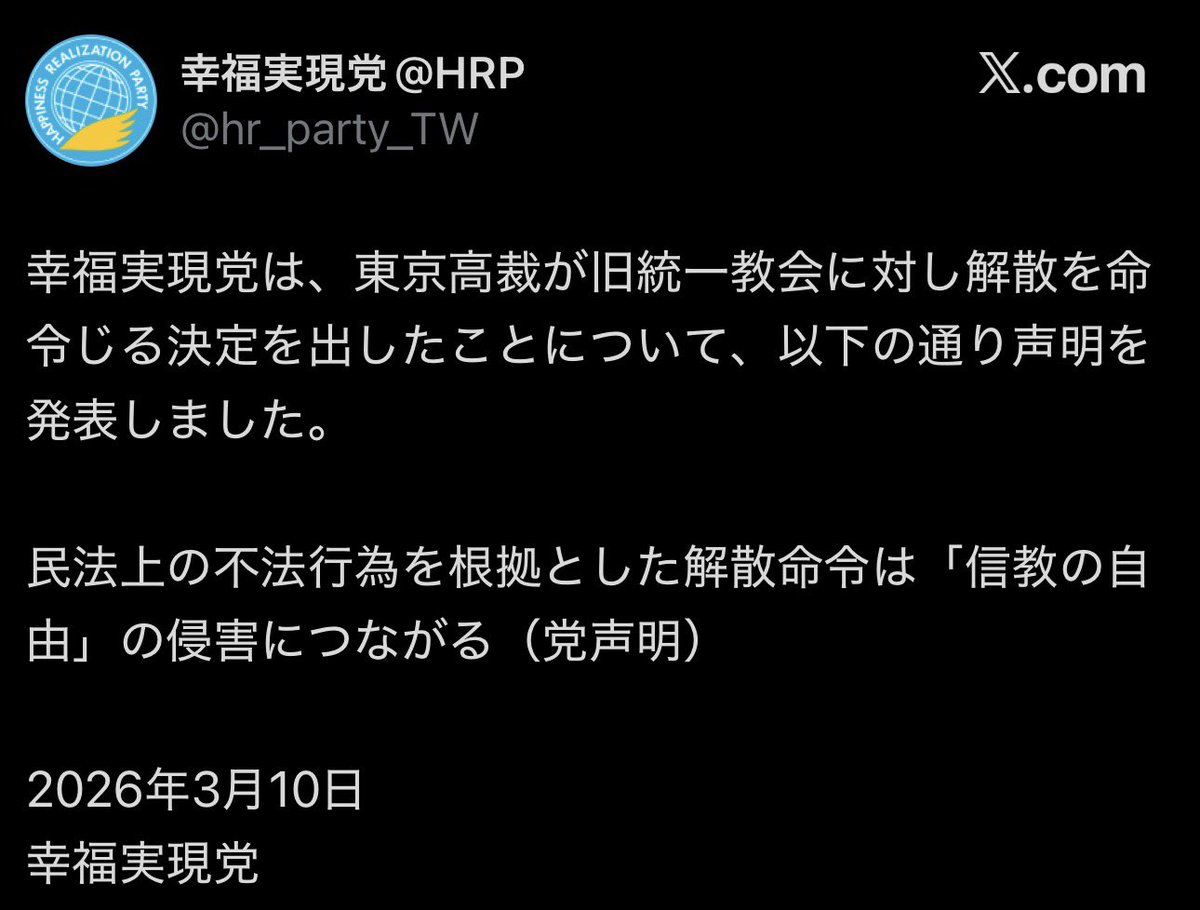
A Japanese political party that has spent years criticizing the Unification Church just came out defending its right to exist.
On March 10, Japan’s Happiness Realization Party (HRP) issued a formal statement on the Tokyo High Court’s March 4 decision ordering the dissolution of the Family Federation for World Peace and Unification.
The statement opens with a pointed disclaimer: HRP has “long pointed out problems” with the Unification Church and is not defending the organization.
Their concern is the legal mechanism.
This is the first dissolution order in Japanese history based on civil tort law, not criminal conduct.
Previous dissolutions targeted organizations like Aum Shinrikyo, which committed mass murder with sarin gas on the Tokyo subway. That was criminal law.
This is something different.
HRP’s argument:
∙Using civil tort as grounds to dissolve a religious body gives the state arbitrary power to decide which religions survive
∙The court claims religious freedom is preserved after dissolution, but liquidating all assets, including houses of worship, makes religious practice effectively impossible
∙The Abe assassination visibly shaped the ruling, meaning one individual’s crime was attributed to an entire religious community
∙That logic is incompatible with rule of law
The party called religious freedom “the human right among human rights,” warning that when a state can dissolve a religion based on civil complaints rather than criminal conviction, no faith community is safe.
This matters because the objection is not coming from an ally. It is coming from a rival.
When your critics say the government crossed a line, that line probably got crossed.
BREAKING: Ex-U.S. Ambassador Randy Evans (Trump admin) strongly condemns Japan’s dissolution order on the Unification Church.
→ 260 church buildings at risk of seizure
→ Thousands of worshippers suddenly locked out
→ “Silence invites the next religious crackdown”
Full op-ed (via Washington Times):
https://t.co/ZQBV5hsghS
#ReligiousFreedom #Japan
A Former U.S. Ambassador Warns Japan
Following the dissolution order against the former Unification Church,
260 churches have been closed.
Chapels, Bibles, and even religious properties
are all subject to liquidation.
And this is not based on criminal convictions.
He warns:
“Silence invites a chain reaction of religious persecution.”
History has shown this many times.
In countries where religion becomes a target,
freedom does not last long.