Cuál es la relación entre las alteraciones formales del pensamiento y los síntomas de primer rango de Schneider?
Una es una experiencia del paciente y la otra un signo clínico?
Las dos hablan de pensamiento desorganizado?
Me cuesta creer en dios pero valoro mucho mi formación jesuita en Caracas, sobre todo como médico, porque los jesuitas te enseñan a servir al otro, o por lo menos a intentarlo, y eso es algo que no es nada fácil de hacer bien
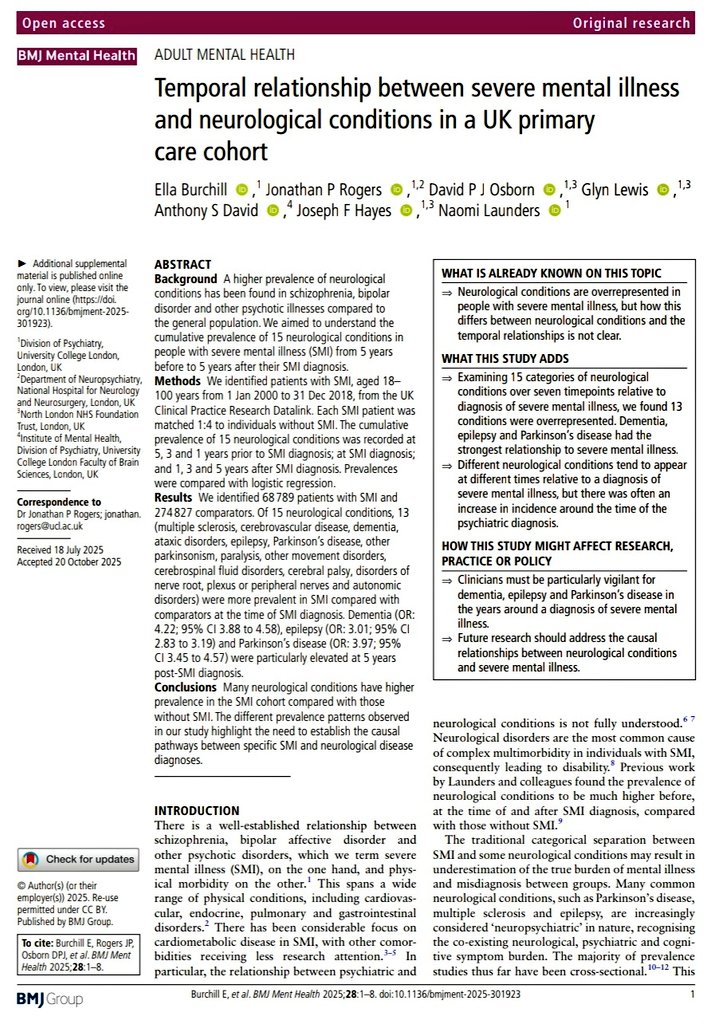
New UK study shows people with severe mental illness have higher rates of many neurological conditions, including dementia, epilepsy & Parkinson’s, from years before diagnosis to years after. Highlights need to understand links between brain & mental health.
Link: https://t.co/XU3vWK9CY5
@ella_burchill@drjprogers@GlynLewis9@ProfTonyDavid@JF_Hayes@NaomiLaunders
#MentalHealth #Neurology @ucl@NIHRresearch @UCLPsychiatry @BMJMentalHealth
Neuropsychiatry is plagued by small sample sizes.
@ella_burchill is changing this with a BIG new paper on the relationship between psychosis and 15 neurological conditions in @BMJMentalHealth.
https://t.co/nLrrrF3Bx9
Here are some highlights...
“your generosity conceals…” is iconic but “you’re petrified by your own fucking standards and your fear of failure” made me feel like i was being stabbed
Is there an impostor in the brain? Is Capgras more common in Alzheimer's, Lewy Body Dementia or Parkinson's? Spoiler alert: Lewy Body is the most common presentation. Capgras can teach us both about identity and neurodegeneration. Capgras syndrome refers to a delusional misidentification in which someone believes a familiar person, often a spouse, has been replaced by an identical impostor. Watanabe and colleagues describe in a new paper in Brain, the largest ever series of Capgras cases studied at the Mayo Clinic. They explored causes, brain imaging patterns and clinical clues revealing that this rare and haunting syndrome is frequently linked to Lewy body disease and to widespread cortical dysfunction. They even show cases associated w/ tumors.
Key Points:
- Capgras syndrome most frequently occurs in neurodegenerative conditions, particularly Lewy body dementia (58%), followed by Alzheimer’s disease (10%) and mixed two hit cases (18%).
- Neuroimaging revealed bilateral cortical involvement, especially right frontal dysfunction, supporting the idea that Capgras arises when both hemispheres and emotional recognition networks are disrupted.
- The syndrome may emerge early in Lewy body disease and late in Alzheimer’s.
- The syndrome can occasionally improve w/ cholinesterase inhibitors, suggesting possible cholinergic mechanisms play a role.
My take: This paper represents a Herculean effort. BRAVO. Capgras is one of the most interesting phenomena in neurology. These 5 points resonated w/ me: 1- Recognizing a familiar face depends on both vision and emotion. When emotional familiarity is disrupted, the brain can possibly create an impostor story to explain the mismatch. 2- Capgras syndrome is more frequent in Lewy body dementia than in Alzheimer’s, and thus may serve as an early clue that a neurodegenerative process is underway. 3- Right frontal brain dysfunction appears to be key, however widespread brain involvement and mood changes likely contribute. 4- Symptoms frequently worsen in the evening and may respond partially to cholinesterase inhibitors or to other supportive therapies. 5-Seeking to understand Capgras, the authors believe is a path to help us to understand that emotion, memory and identity are all intertwined. We need to better appreciate that brain disorders can profoundly alter the way folks perceive loved ones.
https://t.co/1xhjRpfyFN @Brain1878@FixelInstitute@ParkinsonDotOrg@alzassociation@lewybodyny@LBDAssoc