The Comparative Study of Electoral Systems (CSES) includes post-election survey and macro data from 60+ participating nations. Available for free download.
📢 Call for Nominations: 2026 #CSES Awards 📢
Recognizing outstanding scholarship using CSES data:
🏆 GESIS Klingemann Prize
📄 David Howell Award
We welcome nominations across regions, methods, & career stages.
⌛️Learn more & submit by April 22: https://t.co/cwNFu10drC
📢 The deadline for the David Howell Award (CSES) has been extended to April 30, 2026
Recognizing the best 2025 conference paper using CSES data and honoring David Howell’s legacy in building CSES as a global research resource.
Learn more: https://t.co/cwNFu10drC
📢 Call for Nominations: 2026 #CSES Awards 📢
Recognizing outstanding scholarship using CSES data:
🏆 GESIS Klingemann Prize
📄 David Howell Award
We welcome nominations across regions, methods, & career stages.
⌛️Learn more & submit by April 22: https://t.co/cwNFu10drC
📢 New blog from 2025 #CSES Klingemann Prize winners (@LuanaRusso_UM & Paula Schulze Brock)
How do mainstream parties shape attitudes toward populist radical right parties?
🔗Read it here: https://t.co/dDe7m0rGIy
📢 Nominations are now open for the 2026 GESIS Klingemann Prize!
We encourage submissions across regions, methods, and career stages, including early-career scholars.
⏳ Deadline: April 22
Learn more & apply: https://t.co/nBz0Quel2f
🏆 The 2025 GESIS Klingemann Prize goes to:
@LuanaRusso_UM (Maastricht University) & Paula Schulze Brock (European Commission JRC)
Their article examines how cooperation with populist radical right parties shapes public attitudes.
🔗https://t.co/0C2y2lLqqe
Congrats! 👏
🧵
The study sheds light on key issues like affective polarization, negative partisanship, and the normalization of far-right parties in Western democracies.
📢Big news! CGD at @VanderbiltU is now the U.S. home of the Comparative Study of Election Surveys (@csestweets ).
In partnership with @GESIS_org, CGD will manage this flagship international collaboration on open, high-quality election data worldwide.
https://t.co/h7YXdgi2KX
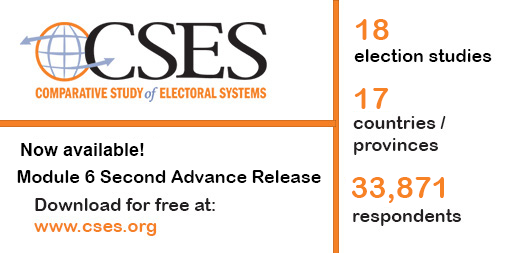
Announcement: The Second Advance Release of the Comparative Study of Electoral Systems (CSES) Module 6 dataset is now available for download! For more information, please see: https://t.co/CGdweCS0Ri
Want to work for CSES, or know someone who does?
GESIS (@gesis_org) is hiring a full-time Senior Researcher, based in Germany, in the area of International Electoral Research.
The application deadline is August 15, 2025.
For more information, see: https://t.co/fRW8HBSFXZ
CSES Announcement - The First Advance Release of CSES Module 6, containing seven election studies, is now available. The dataset and documentation may be downloaded from the CSES website for free.
For more information please visit:
https://t.co/fQiJCbachf
🔔New paper on party surrogation!
What does it mean to feel represented by a party you didn’t vote for?
In Party Politics with @Liron_Lavi we explore the concept of Party Surrogation through a cross-country and individual-level analysis using @csestweets.
https://t.co/bE2DJ3tIoe
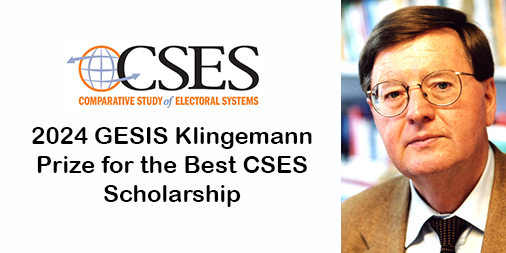
The winner of the 2024 GESIS Klingemann Prize is “Patterns of Affective Polarization toward Parties and Leaders across the Democratic World” by Reiljan, Garzia, Ferreira Da Silva (@Frederico_FS), and Trechsel (@Atrechsel) in @apsrjournal. Congratulations!
https://t.co/JDVjk3x5XH
Thanks to the #EPOP2024 organisers and an inspiring Manchester environment, the @FSW_KULEUVEN@csestweets-Belgium team had a great time presenting our first analyses of the 2024 elections in Belgium
Are you attending #APSA2024?
Join us at a CSES Reception at 7:30 p.m. tonight (Thursday, September 5th) in the PCC, Room 107A. Enjoy finger foods and beverages as we update you about the project and announce the winner of the GESIS Klingemann Prize!
https://t.co/oOYvOUrgQG
Nominations are now being accepted for the 2024 GESIS Klingemann Prize for the Best CSES Scholarship, with a submission deadline of Friday, April 26, 2024: https://t.co/In4Gvk7Ido
The Harrison Prize-winning paper (best 2023 article in @PolStudies) uses @csestweets data: "A crucial advantage of this dataset...[is that it offers] more variance on this question in terms of contexts and, most importantly, in terms of quality of democracy."
Abstract below⬇️
"Citizens who voted for a party that won the election are more satisfied with democracy than those who did not. This winner–loser gap has recently been found to vary with the quality of electoral democracy: the higher the quality of democracy, the smaller the gap. However, we do not know what drives this relationship. Is it driven by losers, winners, or both? And Why? Linking our work to the literature on motivated reasoning and macro salience and benefiting from the Comparative Study of Electoral Systems project—covering 163 elections in 51 countries between 1996 and 2018, our results show that the narrower winner–loser gap in well-established electoral democracies is not only a result of losers being more satisfied with democracy, but also of winners being less satisfied with their victory. Our findings carry important implications since a narrow winner–loser gap appears as a key feature of healthy democratic systems."
https://t.co/fcnNdFTHjI
@Jf_daoust@r_dassonneville Richard Nadeau
CSES Announcement: A significantly updated Integrated Module Dataset (IMD) is now available for download. For more information, please see: https://t.co/SPqqTPxXvY