Could you run an aluminium smelter with wind, solar and batteries? Let's suppose we tried to do it in South Australia. We have thousands of MW of utility scale wind and solar. Could we run a smelter with it? How may batteries would we need?
https://t.co/XiIhiSzY64
@skinthent Solar fails every night and produces nothing. Where are all the solar farms built during the 80s? Dust. Where are the nuclear plants built during the 80s? Still spitting our power. If you choose the most expensive reactor design on the planet ...you will pay top dollar for it.
A 1,000 MW nuclear plant produces 90% of the time (maintenance and fuel reloading 10%); 1,000 x 0.9 x 24 x 365 = 7.8 million MWh of energy annually. A 1,000 MW solar farm produces energy about 25% of the time 1,000 x 0.25 x 24 x 365 = 2.1 million MWh/year & it fails every night
We don’t need to replace 600 EJ of fossil energy. We need to stop wasting it. Fossil systems lose ~2/3 as heat. Electrification delivers energy directly into work, cutting total demand ~40–50%. The transition isn’t bigger than we think. It’s smaller. #SWB
https://t.co/gJOVbP1NE9
@HowToAI_@djspratt Which makes AI thinking a lot like most actual human thinking. We give up or start inventing when stuck. Not all of us all the time, but most of us most of the time. None of us never give up and never invent.
@TerryCorby57986 Australia, like everywhere else, has yet to take notice of 4 decades of work on DNA repair mechanims and the implications for nuclear regulatory processes ... What's the difference between a nuclear meltdown and an Easter Holiday weekend? 15-30 road accident fatalities.
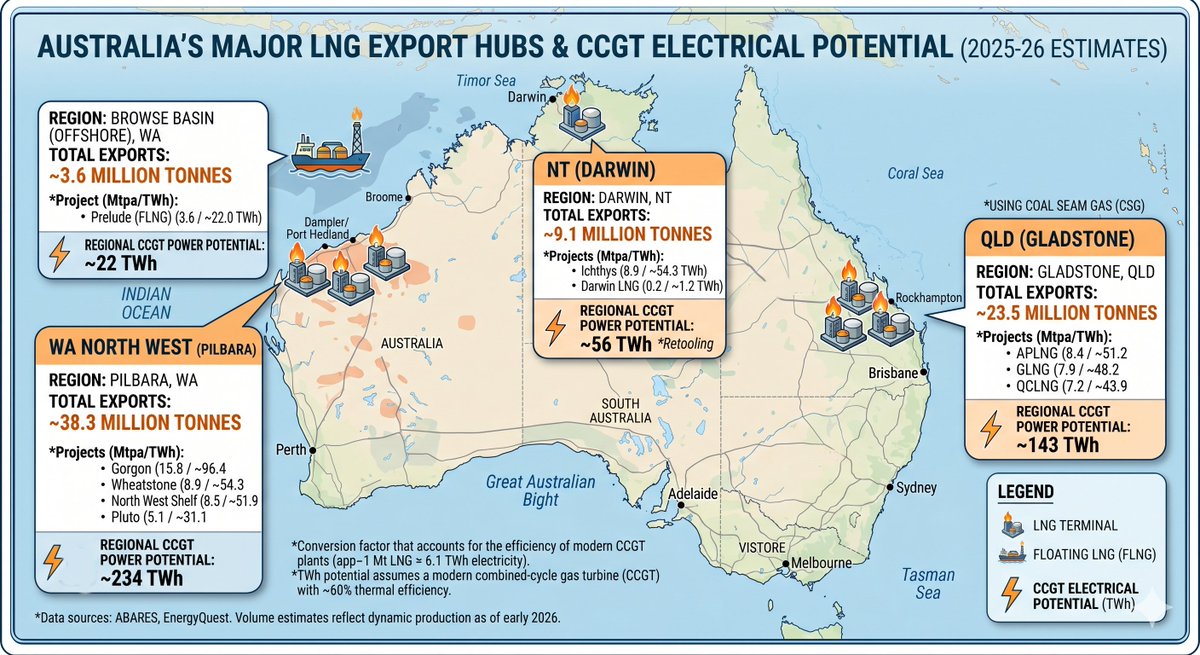
LNG people reckon they've invested $400 billion in Australia since 2010. That could have bought almost 50 nuclear reactors ... which is about 20 more than we'd need for a 100% nuclear electricity system.
https://t.co/xdJv3BAD78
https://t.co/00XUuPvhq4
A great non-technical summary of what my generation got wrong about radiation and nuclear power. We ignored the big discoveries about DNA repair mechanisms and their implications for how to respond rationally to radiation leaks, accidents etc.
https://t.co/l4mPzaOzKn
"Too cheap to meter" frightened most energy market competitors. They effectively worked to ensure it never happened.
If nuclear energy had become "too cheap to meter" and we had completed the 1,000 reactors by 2000 that President Nixon's Project Independence envisioned, here are some consequences that might have happened – or not happened.
1. Coal would have become "too cheap to mine" and would have been pushed off of the US electricity grid.
2. Natural gas would have become "too cheap to drill."
3. George Mitchell would have never been motivated to develop the combination of directional drilling and hydraulic fracturing that enabled the shale revolution.
4. The LNG industry would have never been created.
5. It's unlikely that the wind and solar industries would have expanded beyond certain niche applications and geographies with superior resources.
6. Hydro would have continued producing from existing dams, but would have experienced limited growth.
7. Oil markets would have been more limited than they are today.
The ~100 nuclear plants that did get completed have steadily produced about 1/5 of US electricity for several decades now.
If we had successfully completed 1,000 nuclear plants, would we have just stopped building? Imagine what 10-20 times as many nuclear plants would be powering?
Who might have worked hard to limit nuclear energy's market penetration? Why should their proxies get all of the credit just because they were openly carrying the signs and attending the rallies?
BACKGROUND
This post was inspired by a Wall St. Journal USA250 podcast installment titled "Nuclear Power's Reboot." The host of that podcast is Katherine Sullivan.
Most of the show tells a conventional interpretation of nuclear energy's development history, starting with Truman's announcement about how Hiroshima's military capability had been destroyed by a single bomb, going through Strauss's statement about a future with nuclear providing energy that was "too cheap to meter" and ending with the 25+ year hiatus in nuclear power plant construction.
Victor Gilinsky, an NRC Commissioner during Three Mile Island, shares his certainty that serious accidents were bound to happen in the future. As history has shown, the low-consequence accident that took place on his watch is still the worst nuclear accident in US history.
Sullivan played clips from Ralph Nader's antinuclear rallies and interviewed a woman who was a frighted young mother in Middletown, PA when the core at TMI unit 2 melted and caused a media/political/regulator stoked panic without harming anyone. When she returned from her governor-suggested evacuation to her undamaged home, she became an active member of the antinuclear movement.
Finally, in the last few minutes of a 22 minute podcast, Ms. Sullivan attributed essentially all of the recent interest in nuclear energy to the growth of AI.
That framing is not only wrong, it worries me. Nuclear energy is a clean, capable and potentially affordable replacement for much of the coal, gas and oil that we burn for electricity, industrial heat and ship propulsion. We need nuclear for far more than powering planned AI data centers. But energy system experts like Robert Bryce (@pwrhungry) have been warning that AI data centers are about as popular in rural America as hog farms.
I worry about a near future when protests, finances and grid connection challenges slow AI data center expansion enough to cause the established antinuclear movement and its well-heeled, powerful, motivated friends to more loudly claim that less AI means we don't need new nuclear.
The energy market consequences mentioned at the beginning of this post would be good for most of humanity. But those who are profiting by the enterprises that would lose in the competitive markets for energy fuels are guaranteed to do everything they can think of to ensure that they continue to survive and flourish. I suspect that many of those who would be negatively impacted by a thriving nuclear enterprise both read and advertise in the Wall St. Journal.
@thecourier
Meat and dairy industry telling porkies? Gosh, what a surprise. They fool consumers and even their own farmers with their junk claims.
https://t.co/R0N3R8R9A7
@DavidJSmith3567 Wrong and wrong. Go back to 2024, the "Smart Energy Council" reckoned Dutton wanted about 10 GW (about 9 AP1000s), which they wrongly said would produce 4% of our electricity. If 10 GW was right, then this would produce 10e9*24*365*0.9/1e12/281
= 0.2805694 (ie. 28%).
Here's what we built in Australia as a result of the ban on nuclear power. Each of these big projects is massive. Wheatstone was $30 billion. We could have got 3 reactors for that. The Greens and the nuclear ban have locked in gas.
https://t.co/00XUuPvhq4
The radiation porn is already starting as assorted anti-nuclear media prepare for the Chernobyl accident anniversary. Why are there no such "celebrations" of the Bhopal or Ufa accidents? Both were more deadly and left many with lifelong pain.
https://t.co/tPI08curyr
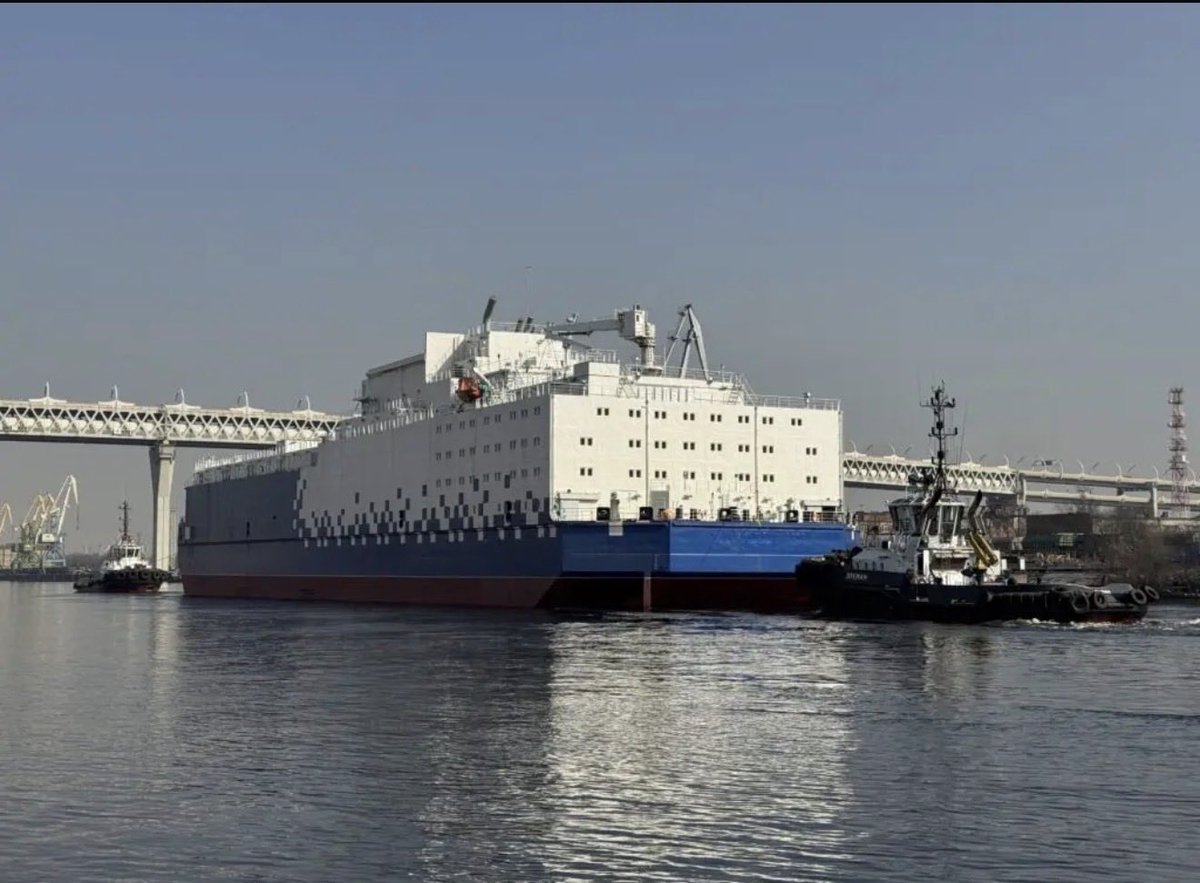
This is what Russia’s floating nuclear power plant dominance looks like.
The 1st of 4 Chinese built hulls has reached St. Petersburg where they will each be equipped with two 53MWe RITM-200S integral PWR reactors.
N-1 contingency for 1 unit at a time refuelling in far away Murmansk will mean 318MW of steady baseload power for the Chukotka Baimsky copper mine in Eastern Siberia a few hundred km inland from where they will be moored in Nagleynyn bay.
Baimsky is the largest undeveloped copper deposit in planet earth. In the harsh and remote arctic environment of eastern Siberia and with Russia’s nuclear energy industrial stack behind it, this is the best way to power it.
With thanks to @realTZV for the picture.
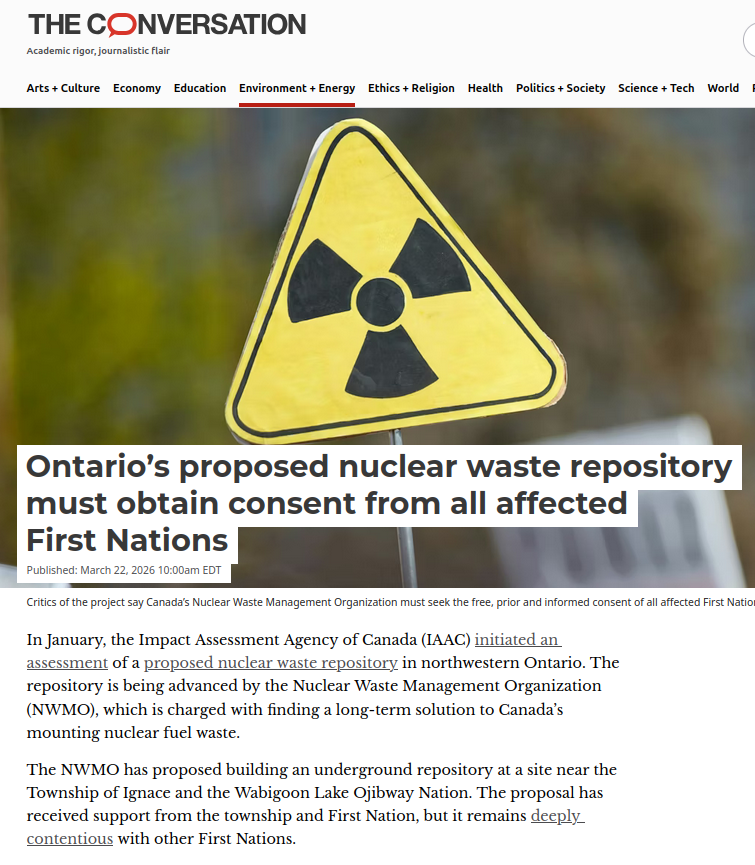
The nuclear waste management org in Canada (@NWMOCanada) has been working diligently for many years to find a host for its nuclear waste. It found a site and got consent from the local community, including the local First Nation. But then people from farther away protested. The crux of the protests seem to be rooted in the fact that nuclear waste remains hazardous for a long time.
I cannot for the life of me understand why it's not harder to dispose of wastes that stay hazardous forever. Why don't we need to spend billions of dollars on intergenerational studies and broad-area consent to dispose of mercury or lead?
I think the new US approach of trying to co-locate long-term waste disposal with high-tech fuel cycle facilities (innovation campus) is probably the better idea at this point.
@AlHendiify It isn't incredibly dangerous after 500 years. After 500 you can handle it without gloves. It would be safer than many things on sale at Bunnings... eg pool acid. It's remarkable how fear declines as knowledge of the facts deepens.
Taiwan’s nuclear phaseout created a vulnerability that now sits directly on top of the Qatar Ras Laffan force majeure.
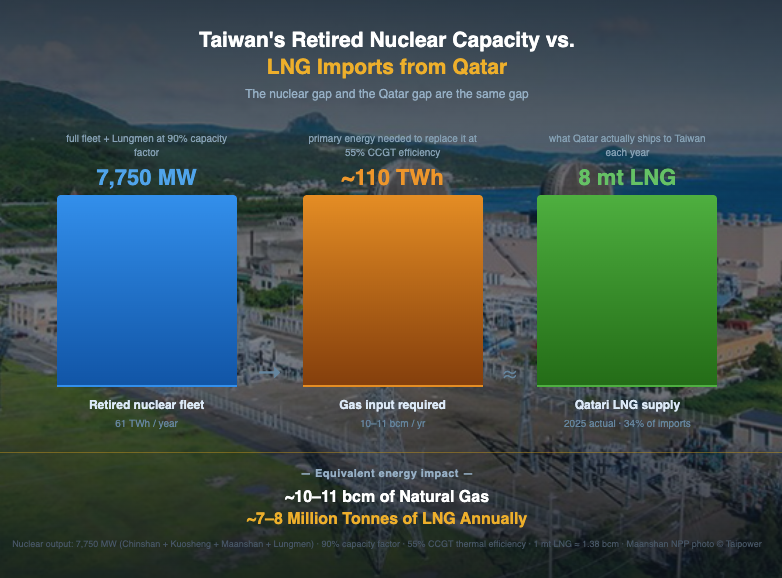
The uncomfortable arithmetic is that the nuclear capacity Taiwan chose to retire is almost exactly equal to the LNG volume it imports from Qatar.
Taiwan imports roughly 35 percent of its LNG from Qatar. LNG now fuels nearly half of Taiwan’s electricity after the political phaseout of nuclear power. The island maintains only about eleven days of LNG storage.
Had Taiwan kept its full nuclear fleet operating and commissioned Lungmen, its completed but never fuelled fourth nuclear plant, the country would today have roughly 7,750 MW of nuclear capacity producing about 61 TWh per year, covering around 21 percent of the grid.
Replacing that output with gas requires far more primary energy because Taiwan’s combined cycle gas turbines operate at roughly 55 percent thermal efficiency. Producing 61 TWh of electricity from gas therefore requires roughly 110 TWh of fuel input, equivalent to about 10 to 11 billion cubic metres of natural gas or roughly 7 to 8 million tonnes of LNG per year.
That volume is almost exactly the amount of LNG Taiwan currently imports from Qatar.
In other words, the nuclear fleet Taiwan shut down would have displaced essentially the entire Qatari supply stream. Every cargo that does not need to cross the Strait of Hormuz is a cargo that cannot be held hostage.
Instead that capacity was retired and mothballed on political grounds and the gap was filled with gas.
On 23 August Taiwan held a referendum on whether to restart the Ma’anshan nuclear plant, the island’s last operating reactor station, which had shut down in May after its forty year operating licence expired.
A clear majority of participating voters supported restarting the plant subject to regulatory approval and safety confirmation.
Taiwan’s referendum law, however, requires affirmative votes from at least one quarter of all eligible voters, roughly five million people. The referendum received about 4.3 million yes votes, leaving it below the legal threshold and keeping the plant offline, effectively confirming the continuation of Taiwan’s nuclear phaseout.
Oil markets built resilience after decades of shocks. Strategic petroleum reserves, spare tanker capacity, and a deep spot market exist precisely because embargoes and supply crises forced the system to develop buffers.
LNG developed very differently. For most of its history it operated as a point to point business, the same ships on the same routes under long term contracts, functioning in conditions stable enough that nobody was forced to build equivalent shock absorption into the system.
Storage compounds this vulnerability and it divides sharply along geographic lines.
Europe benefits from geology. Depleted gas fields and salt caverns can hold months of supply, which is why European utilities spend the summer refilling underground storage ahead of winter demand.
Asia has no equivalent.
Japan, South Korea, and Taiwan depend almost entirely on above ground insulated LNG tanks at their import terminals, essentially the same thermos principle used on LNG ships. South Korea had roughly nine days of LNG supply when Ras Laffan went offline. Taiwan had about eleven days. Japan operates in a similar range.
These are operational buffers designed for a world of uninterrupted deliveries rather than strategic reserves designed to ride out supply shocks.
When a major node in the LNG system fails, there is no large fleet of idle ships ready to reroute, no spare liquefaction capacity waiting to fill the gap, and in Asia no underground storage that can stabilize supply while the market adjusts.
Taiwan’s nuclear shutdown therefore produced a structural vulnerability that is now impossible to ignore. The reactors that were closed would today be offsetting almost the entire volume of LNG Taiwan buys from Qatar.
There's never been a better time to restart Taiwan's nuclear fleet.