The UK’s decision to announce an under-16 social media ban marks a major turning point in the global conversation on children’s online safety.
While the policy aims to protect children from addictive design, harmful content, stranger contact, and unsafe online interactions, it also raises important questions around enforcement, privacy, digital rights, and young people’s access to online communities.
At CSR, we believe that child safety online must be approached with both urgency and nuance. Protecting children cannot rely on bans alone. It requires stronger platform accountability, effective age-appropriate design, digital literacy, parental support, privacy safeguards, and meaningful participation of young people in policy decisions.
As countries across the world rethink how children engage with digital spaces, India too must strengthen its approach to online safety, one that protects children without compromising their rights, agency, and access to safe digital opportunities.
@ranjanakumari
https://t.co/9z5v4axeOB
The Centre for Social Research, Gurugram, recently hosted the certification ceremony for its Office Assistant Training Program, recognizing the accomplishments of 38 students who successfully completed the course and received their certificates.
We extend our heartfelt congratulations to all certificate recipients as they embark on the next stage of their professional journeys.
@ranjanakumari@manasimishra333
We are pleased to share the signing of the second phase project agreement between Centre for Social Research India (CSR) and Hanns Seidel Foundation India (HSS) under the India-Europe Resilience Forum (IERF) initiative.
This partnership reflects our shared commitment to advancing research, capacity building, and social development through collaborative action and knowledge exchange. Together, we look forward to strengthening efforts that create sustainable impact and contribute to more inclusive and equitable communities.
@Asia_HSF@ranjanakumari@manasimishra333
A dead daughter-in-law deserves dignity, not public humiliation by those who failed to protect her. We hear moral policing, psychiatric labels, and character assassination from her in-laws. Not doing puja ,fasting, or watering plants is not evidence of mental illness or moral failure.This is cruelty wrapped in patriarchy.
A dead daughter-in-law deserves dignity, not public humiliation by those who failed to protect her. We hear moral policing, psychiatric labels, and character assassination from her in-laws. Not doing puja ,fasting, or watering plants is not evidence of mental illness or moral failure.This is cruelty wrapped in patriarchy.
Dowry is not a tradition. It is a system of violence that continues to endanger the lives, dignity, and freedom of women across India.
In her latest article, @ranjanakumari examines how dowry has evolved into a deeply entrenched form of domestic abuse, coercion, and psychological violence against women.
The article raises urgent questions about the realities many women face within marriage and the societal structures that continue to normalise this violence.
Link: https://t.co/ImsVRsRJWK
We are pleased to announce a partnership between Centre for Social Research (CSR) and GroSafe to launch the GroSafe School Trials in India.
Led by GroSafe in collaboration with @WeAreTUDublin@ISPCCChildline and @Researchirel this initiative introduces a digital 3D educational game designed to help students recognise and resist online grooming behaviours. The pilot follows a classroom-based, teacher-led model, combining gameplay with structured pre- and post-assessments to build awareness and strengthen digital resilience among young people.
The collaboration brings together expertise in child safety, education, research, and technology to support safer online environments for children and adolescents. By integrating interactive learning with evidence-based evaluation, the initiative aims to contribute to stronger prevention strategies against online grooming and exploitation.
@ranjanakumari@CSR_India
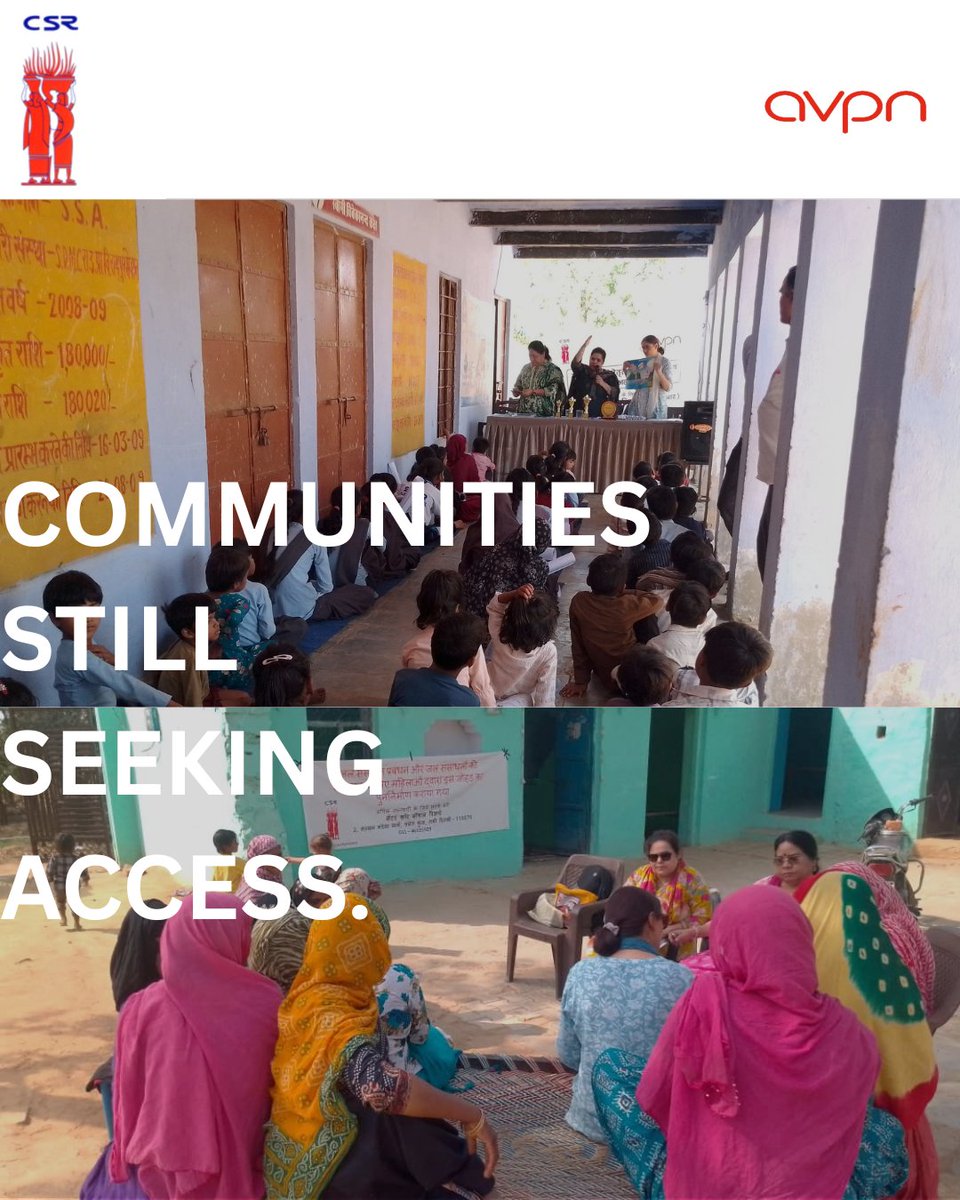
Changing Realities… Shared Humanity Unites Us.
This World Red Cross and Red Crescent Day, the Gender, Water, Climate Change Division celebrates Connections in Adversity. Stay tuned for stories, voices, and moments of shared humanity.
#WorldRedCrossAndRedCrescentDay #UnitedInHumanity #SharedHumanity #ConnectionsInAdversity #HumanitarianAction #CommunitySolidarity #CollectiveCare #CommunityResilience #ClimateAction #GenderEquality #WomenEmpowerment #SocialImpact #ResilientCommunities #HumanConnections #AVPN
AI-generated deepfakes and harmful digital content are creating new challenges for women’s safety, dignity, and mental well-being online. In this important discussion by @BBCHindi Jyoti Vadehra, Lead, Digital Trust and Safety at Centre for Social Research India, highlighted how AI-driven content is reinforcing harmful stereotypes and gender-based discrimination.
“We have been fighting for years against issues like colorism, body image pressures, domestic violence, and violence against women. But now, AI-generated and widely consumed digital content is amplifying these problems again. Young girls are constantly exposed to content that promotes unrealistic beauty standards and harmful sexualized narratives.”
This is not just a technology issue. It is a question of accountability, ethics, and creating safer digital spaces for women and young people.
Watch the full BBC News Hindi discussion on AI-generated fake videos, deepfakes, and the growing impact of online harms against women
Link: https://t.co/a2JLAmSia2
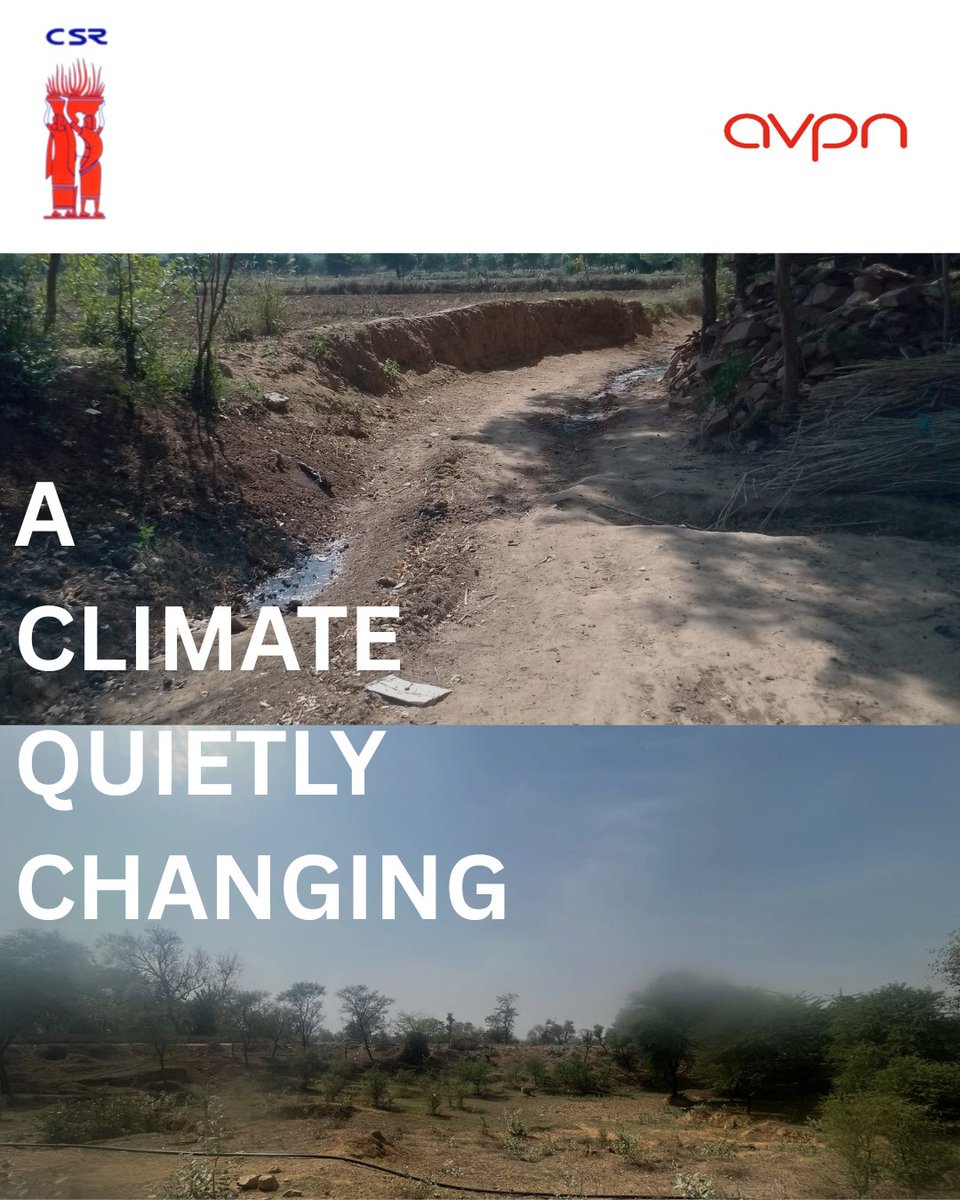
We forget… Water Never Does!
The Gender, Water, Climate Change Division is back with Water Memories. Stay tuned for stories, voices, and conversations on gender, water, and climate change.
@avpn_asia@ranjanakumari@CSR_Environment
Did women lose out again in political crossfire?
Dr. Ranjana points out that reserving 1/3rd seats for women never required delimitation, it could have been done immediately. Instead, the debate shifted, raising a key question: was this about empowerment or political strategy?
Watch the full podcast for the complete perspective.
@ranjanakumari@htTweets@kumkumchadha
🔗 Link: https://t.co/rIfXNQ8njP
Young people are growing up in a digital landscape that's changing faster than ever. We are gathering the experiences of youth across the globe, and what we're hearing is shaping the path ahead.
At @CSR_India we believe real solutions to the challenges of Al start with listening to and learning from those experiencing it firsthand. what it means to them, how it's shaping their lives, and what they think needs to change. Our goal is simple: to co-create solutions with youth, not for them.
If you're a young person who wants to make your voice heard, or want to partner with us, reach out. Let's take this conversation across the country and around the world.
A special thank you to @childnet and Gabrielle for helping us curate these experiences.
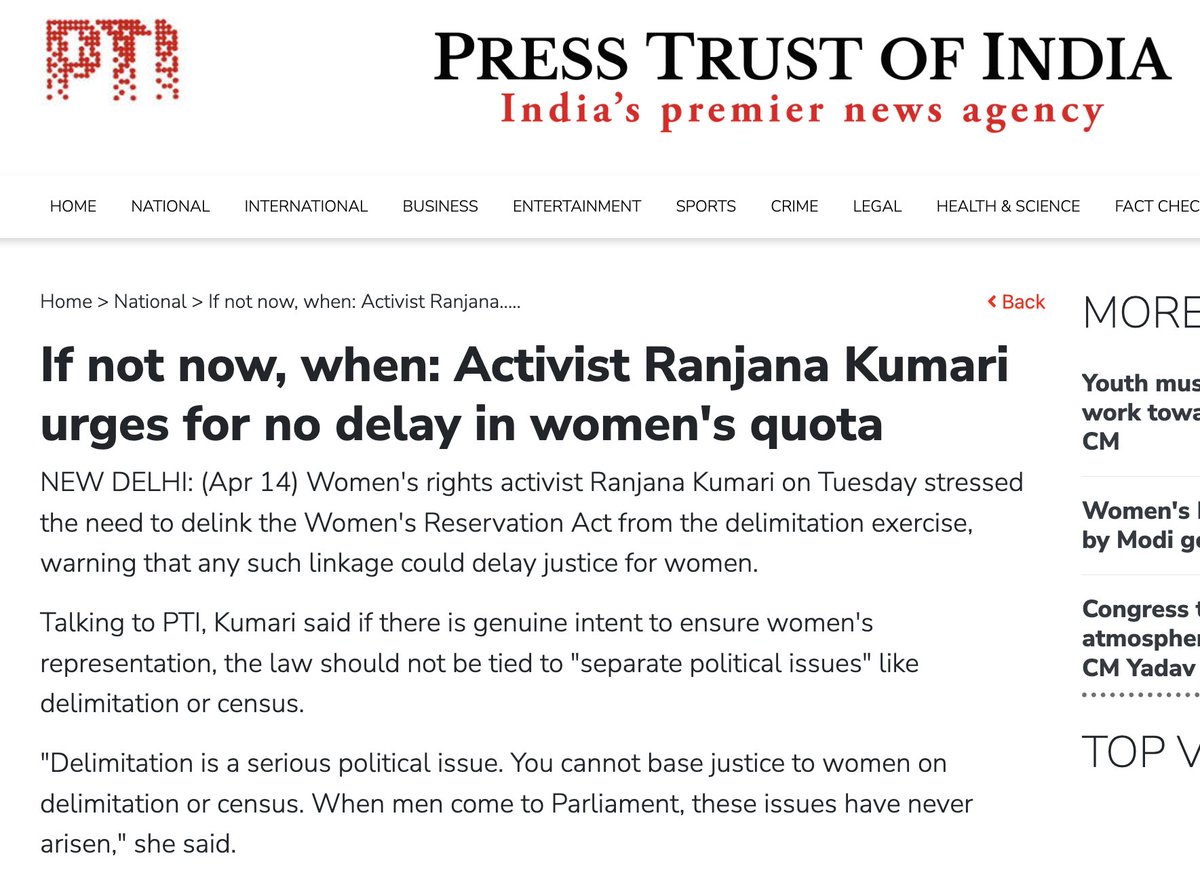
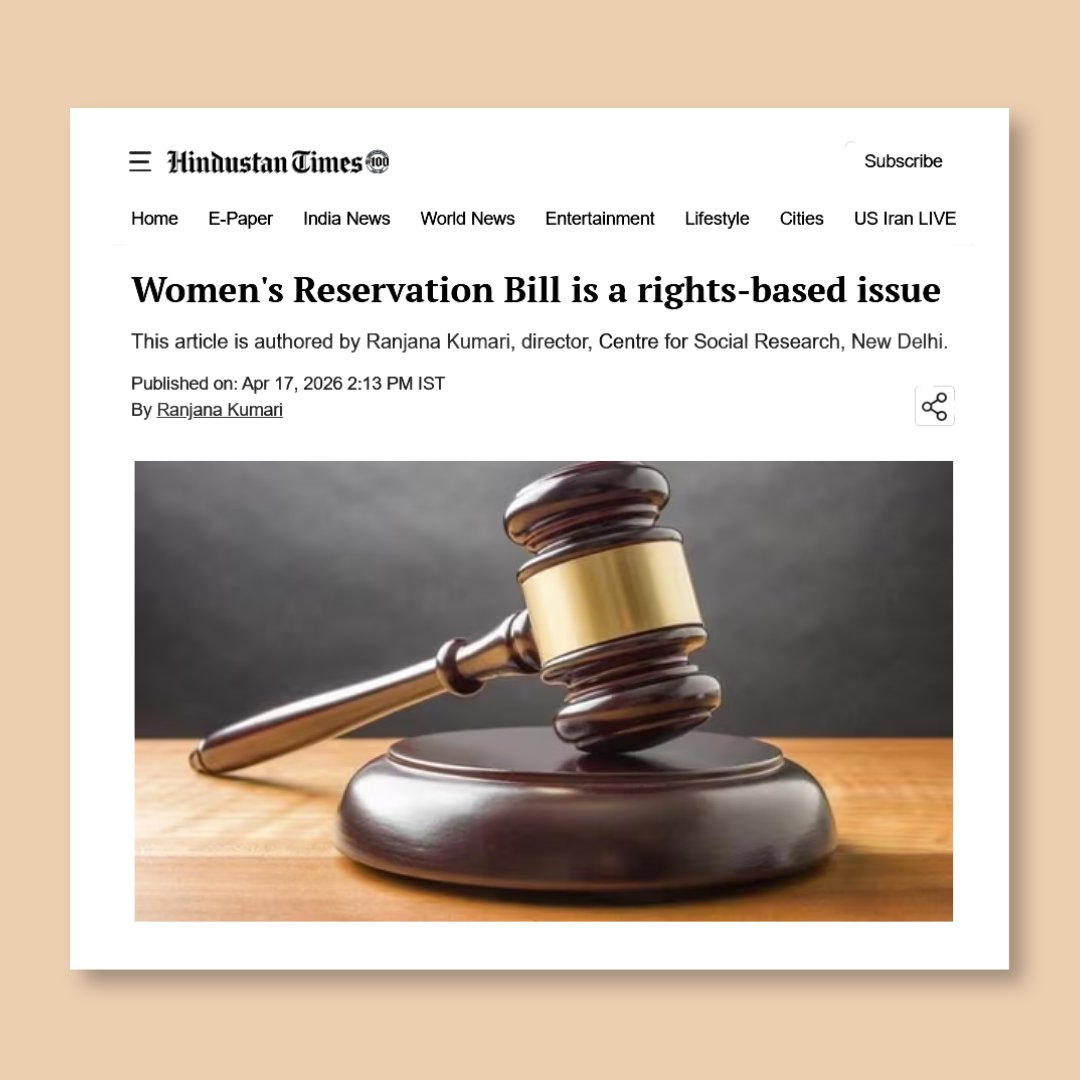
Published today in Hindustan Times, Dr. Ranjana Kumari presents a sharp political analysis of the Women’s Reservation Bill and the debates surrounding it.
The article challenges the intellectual inconsistencies in arguments against expanding seats for women’s representation and highlights how concerns around delimitation, federal balance, and sub-quotas are repeatedly invoked to delay meaningful reform.
It makes a compelling case that the issue is not legislative complexity, but a systemic reluctance across political parties to redistribute power.
When voluntary reform has consistently failed, structural intervention is not just necessary, it is overdue.
An important read for those working at the intersection of gender, governance, and democratic accountability.
Link: https://t.co/zBlsc4tQWB
@ranjanakumari@htTweets@HindustanTimes
Women are no longer waiting, they are shaping India’s democracy.
In this conversation with Abhay Dubey, @ranjanakumari explains why women’s reservation is not a question of “why now,” but a long overdue step. With rising independent voting and strong grassroots leadership, women’s political agency is already transforming the system.
🎥 Watch the full conversation: https://t.co/ZHKg0RhXvh
The Nari Shakti Vandan Adhiniyam is a historic step, but implementation will define its impact.
In conversation with @themojostory and @BDUTT@ranjanakumari outlines what it will take to make women’s political representation truly inclusive.
Watch: https://t.co/5RoLth5gq2
When women are dismissed as “powerless,” they don’t retreat, they rise stronger.
In this compelling episode of the @umashankarsingh Point Podcast, @ranjanakumari unpacks the realities behind the Women’s Reservation Bill and what it truly means for women’s political participation in India.
Watch the full podcast to understand what true political empowerment looks like.
Link: https://t.co/rLJoKo9zjP
As the national conversation intensifies around the implementation of the Nari Shakti Vandan Adhiniyam, it is critical to move beyond headlines and focus on what meaningful political representation will actually require.
While the legislation marks a historic step, its impact will depend on timely implementation, institutional support, and ensuring that representation is truly inclusive. Questions of intersectionality, including the need for a quota within a quota, remain central to this discourse.
Drawing on decades of work in advancing women’s political participation, Dr. Ranjana Kumari shares key insights on the structural and social barriers that must be addressed to translate this reform into real change.
In this conversation with Mojo Story and Barkha Dutt, she reflects on the road ahead for building a more representative democracy.
Watch the full discussion: https://t.co/dwOEIXS8R9
#WomensReservation #NariShaktiVandanAdhiniyam #PoliticalRepresentation #GenderEquality
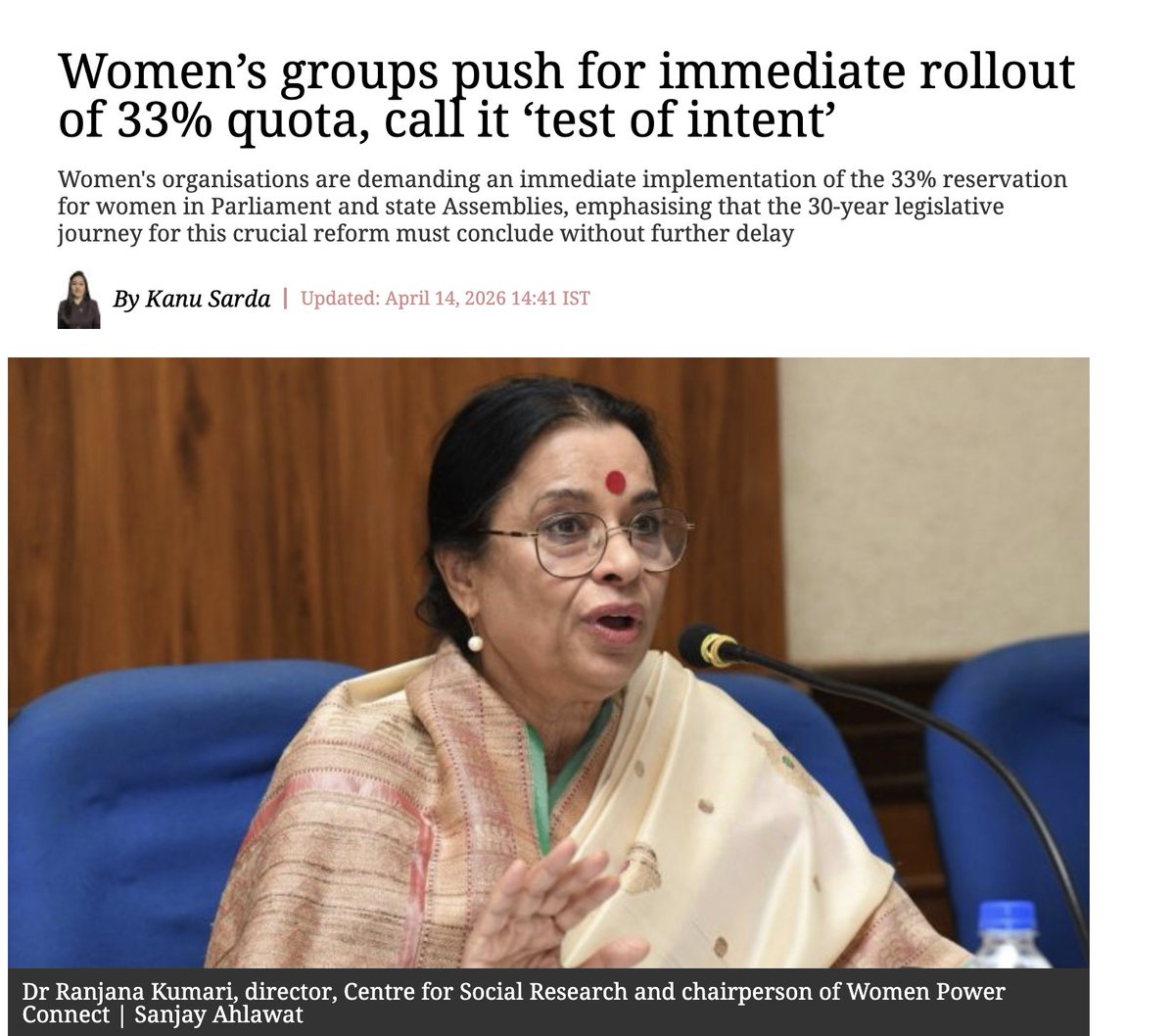
After a three-decade-long journey of sustained advocacy by women’s movements and civil society, the Nari Shakti Vandan Adhiniyam marks a historic step toward ensuring 33% reservation for women in India’s legislatures. This reform goes beyond representation—it signals a structural shift toward a more inclusive, participatory, and representative democracy.
Ahead of the Special Parliamentary Session, a press conference held on April 14 at the Press Club of India brought together key voices from across the women’s movement. Dr. Ranjana Kumari, along with Women Power Connect and the Joint Women Programme—supported by a collective of 1,500+ women’s organisations—highlighted the urgent need to translate this legislative milestone into meaningful and time-bound implementation. The presence of organisations such as CEQUIN and Action India reflected the breadth of support and the continued momentum behind this long-standing demand.
The way forward is clear:
• Build cross-party consensus on implementation in the lead-up to 2029
• Prioritise national interest over partisan positions
• Ensure timely operationalisation of the Act
• Advance the mainstreaming of women’s political participation across party structures and electoral processes
• Strengthen the pipeline of women leaders and equip them with the necessary resources to lead effectively
Women in India have already waited decades for equitable political representation. As the focus shifts from passage to implementation, this moment calls for sustained political will, institutional commitment, and collective action to ensure that the promise of this reform translates into real change on the ground.
#NariShaktiVandanAdhiniyam #WomensReservation #33PercentReservation #WomenInPolitics #GenderEquality #PoliticalReform #IndianDemocracy #WomenLeadership #InclusiveGovernance #CivilSociety #WomenPowerConnect #CSRIndia #JointWomenProgramme #PressConference #NewDelhi