Very much enjoyed moderating last night’s panel discussion on the topic of “Frontiers in Climate-Economics Research: Dynamics, Uncertainty, and Policy Implications,” featuring Charles Taylor (Harvard Kennedy School), James Rising (University of Delaware), and Olivier David Zerbib (CREST, ENSAE, Institut Polytechnique de Paris).
The conversation covered a broad range of important issues and the panelists brought perspectives that were distinct yet complementary, which made for an engaging discussion and no doubt a valuable one for our @MFRProgram Modeling Climate-Economic Dynamics workshop participants and the young scholars in attendance. #EconTwitter #ClimateEconomics #ClimateDynamics #ClimateUncertainty #ClimateChange
But adaptation carries a cost. Where irrigation expands, aquifer levels drop and soils grow saltier — both visible from satellite. Adapting to climate change today can erode the future resource base [https://t.co/UNJEx9JK9q]
I started this paper early in grad school after staring at a map of global irrigation. Irrigated land roughly doubled since 1960 — but unevenly: India and China saw huge gains, while the western US, parts of Europe, and the former USSR lost ground. What explains the variation?
📢 Just accepted in #JAERE! 📢
"Irrigation and Climate Change: Long-run Adaptation and its Externalities" by Charles A. Taylor (@ctaylor463).
📖 Read it here: https://t.co/dKU0ciXQMI
Using soil/sediment thickness as a proxy for groundwater potential, I find drying raises irrigation only where water is reachable below. Recent climate drying explains up to 8% of global irrigation growth since 1960 — a pattern that holds both worldwide and across US counties.
Excited to announce a new funding opportunity for research on "what works" in climate adaptation. We are specifically looking for strong causal designs that tell us what interventions work (or don't) to reduce impacts of a changing climate. Link in next post. Plz share!
Don't miss the next Energy Policy Seminar that tackles the complexities of the clean energy transition and land conservation with #MRCBG's @ctaylor463 🌍 Rubenstein 414ab on 2/24/25, Lunch provided + a Q&A session to discuss renewable infrastructure, decarbonization, and how we can merge these ideas without causing conflicts.
In Person (HUID/RSVP), or attend online via Zoom, everyone is welcome!🎟️ Don't miss out, reserve your spot today: https://t.co/zX6Crdj0s2
With our friends, @HUCEnvironment@HarvardSalata & @BelferCenter
https://t.co/zX6Crdj0s2
Excited for #ASSA2025 New Frontiers in Environmental Economics session!
🌐 Fri 8am (session link below👇)
🗺️ Room: Parc 55, Cyril Magnin 2
🔥 Trade, food, land, clean energy, bunching, air poll., MVPF, etc
w @mattkahn1966@bsprungkeyser@J_C_Suarez et al
Consider applying to this @USDA and @nber post-doc (open new PhDs and junior faculty) to work with other ag/climate/environmental economists here in Cambridge.
https://t.co/ShpdKYINqJ
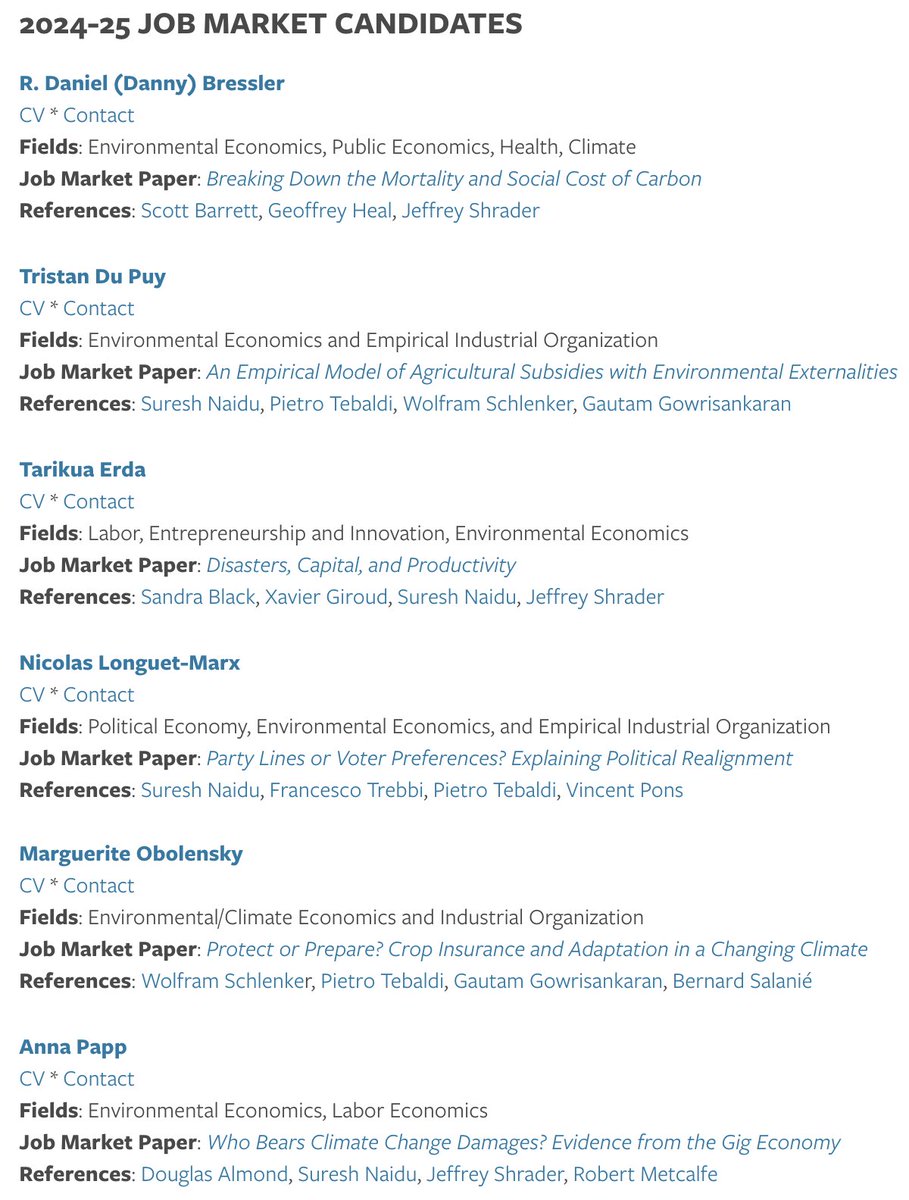
I’m thrilled to introduce six outstanding economics job market candidates from the PhD program in Sustainable Development at @ColumbiaSIPA@SipaSusdev!
Each of them brings a unique perspective and cutting-edge research in environmental economics, empirical IO, labor economics, and political economy.
Follow this thread for details on their Job Market Papers (JMPs) and research. #EconTwitter #EconJMP #EconJMC #EconJobMarket
https://t.co/Db6moQ4R0S
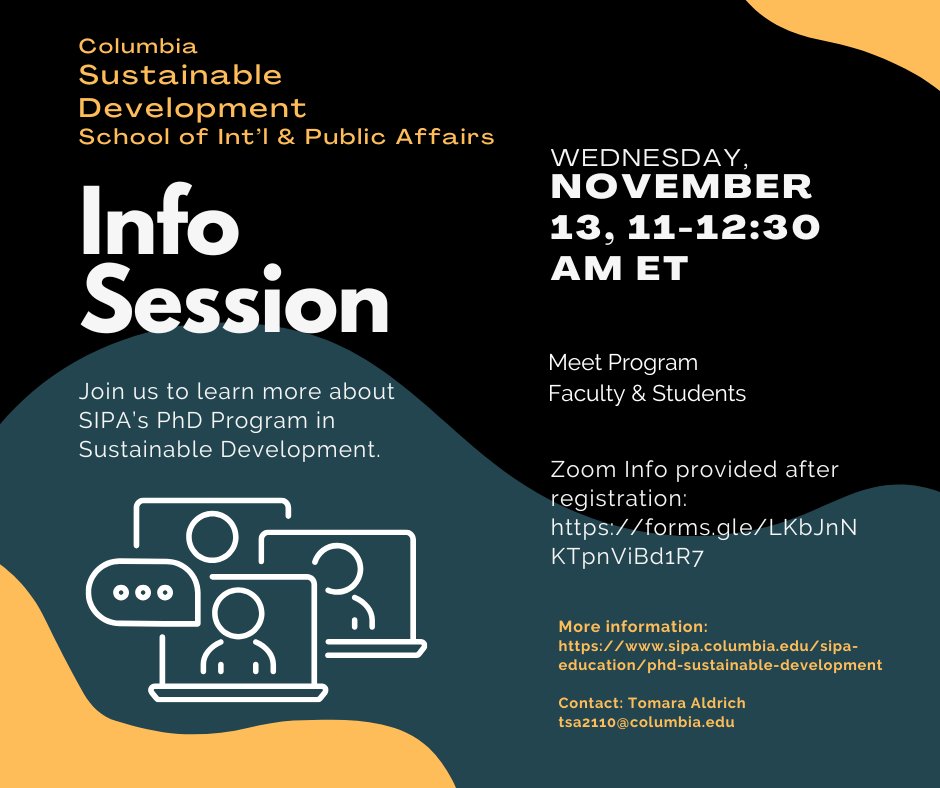
To all economics PhD applicants, we would like to draw your attention to the PhD in Sustainable Development at Columbia University.
The PhD is for economists and scientists interested in issues related to the environment, climate change, energy, development, poverty, health, transport, inequality, labor, political economy, and public policy more generally.
With an inclusion of the natural sciences and/or engineering, the program is designed to provide a deep understanding of the interaction between natural and social systems.
We're hiring pre-docs at @HarvardSalata to work with me and my excellent (and friendly) colleagues on environmental econ topics. Consider applying!
https://t.co/fR93ypAjRZ
Pre-doc job announcement! @HarvardSalata is hiring fellows to work with Anna Russo, Wolfram Schlenker, @ctaylor463, and myself on environmental economics! Application review will begin on 10/31 and continue on a rolling basis. Please apply and share! https://t.co/GJEr8qqfjA
great write up covering two fascinating/related topics:
1) why US crop yields have kept increasing (despite climate change)
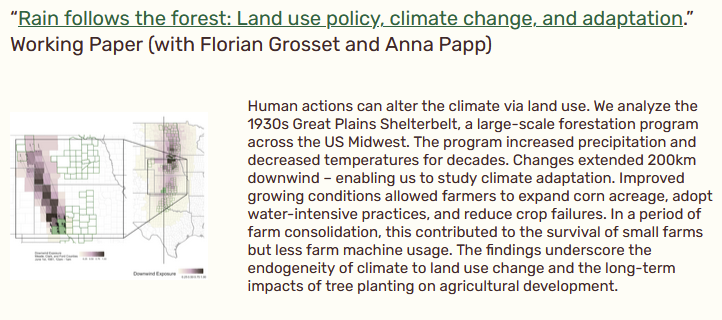
2) why summers in the US Midwest have gotten cooler over time
Revisiting Crop Sensitivity to Extreme Heat.
In my first substantive substack post I revisit the link between extreme heat and crop yields and consider why yield growth hasn't noticeably slowed in the U.S.
https://t.co/uBMXaf4vLb


![ctaylor463's tweet photo. But adaptation carries a cost. Where irrigation expands, aquifer levels drop and soils grow saltier — both visible from satellite. Adapting to climate change today can erode the future resource base [https://t.co/UNJEx9JK9q] https://t.co/D3w2IgSlKJ](https://pbs.twimg.com/media/HJVu8RdWEAIphhW.jpg)





![ctaylor463's tweet photo. But adaptation carries a cost. Where irrigation expands, aquifer levels drop and soils grow saltier — both visible from satellite. Adapting to climate change today can erode the future resource base [https://t.co/UNJEx9JK9q] https://t.co/D3w2IgSlKJ](https://pbs.twimg.com/media/HJVvZ0AWYAMyjnm.jpg)