백명석, Myeongseok Baek, Bike Commuter, Like to listen New Age Piano, Portal Bbs Developer, Cloud Computing, Search Platform Development, OOP, DDD, TDD, Mac
Someone just made Claude instances talk to each other.
Not APIs.
Not agents.
Not orchestrators.
Just multiple Claude Code sessions… messaging each other like coworkers.
It’s called claude-peers — and it turns one Claude into a team.
Here’s what’s happening:
Run 5 Claude Code sessions across different projects
Each one auto-discovers the others
They send messages instantly
Ask questions
Share context
Coordinate work
Your AI tools literally collaborate.
Example:
Claude A (poker-engine):
"what files are you editing?"
Claude B (frontend):
"working on auth.ts + UI state"
Claude A:
"ok I'll avoid touching auth logic"
No conflicts. No manual coordination. Just AI syncing itself.
Under the hood:
• Local broker daemon (localhost)
• SQLite peer registry
• MCP servers per session
• Instant channel push messaging
• Auto peer discovery
• Cross-project communication
Everything runs locally. No cloud. No latency.
What it unlocks:
• Multi-agent coding without frameworks
• One Claude writes backend, another frontend
• One debugs while another refactors
• Research Claude feeds builder Claude
• Large projects split across AI workers
This is basically:
"spawn 5 Claudes and let them coordinate themselves"
Even crazier:
Each instance auto-summarizes what it's doing
Other Claudes can see:
• working directory
• git repo
• current task
• active files
They know what the others are working on.
Commands:
• list_peers → find all Claude sessions
• send_message → talk to another Claude
• set_summary → describe your task
• check_messages → manual fallback
So you can literally say:
"message peer 3: what are you working on?"
…and it responds instantly.
No orchestration layer.
No agent framework.
Just Claudes… talking.
This is the cleanest multi-agent system I've seen.
We're moving from:
1 AI assistant →
to
AI teams that coordinate themselves.
And it's all running on your machine.
Wild.
도메인 전문성은 언제나 진짜 해자였다
- 소프트웨어의 어려움은 코드 입력보다 급여·교통 같은 현실 규칙을 이해해 도메인 모델을 만드는 데 있었고, 코드는 그 이해의 산물이었음
- 에이전트형 AI는 도메인 이해 없이도 소프트웨어 생산을 가능하게 하며 병목을 “만들 …
https://t.co/ek54fGXor4
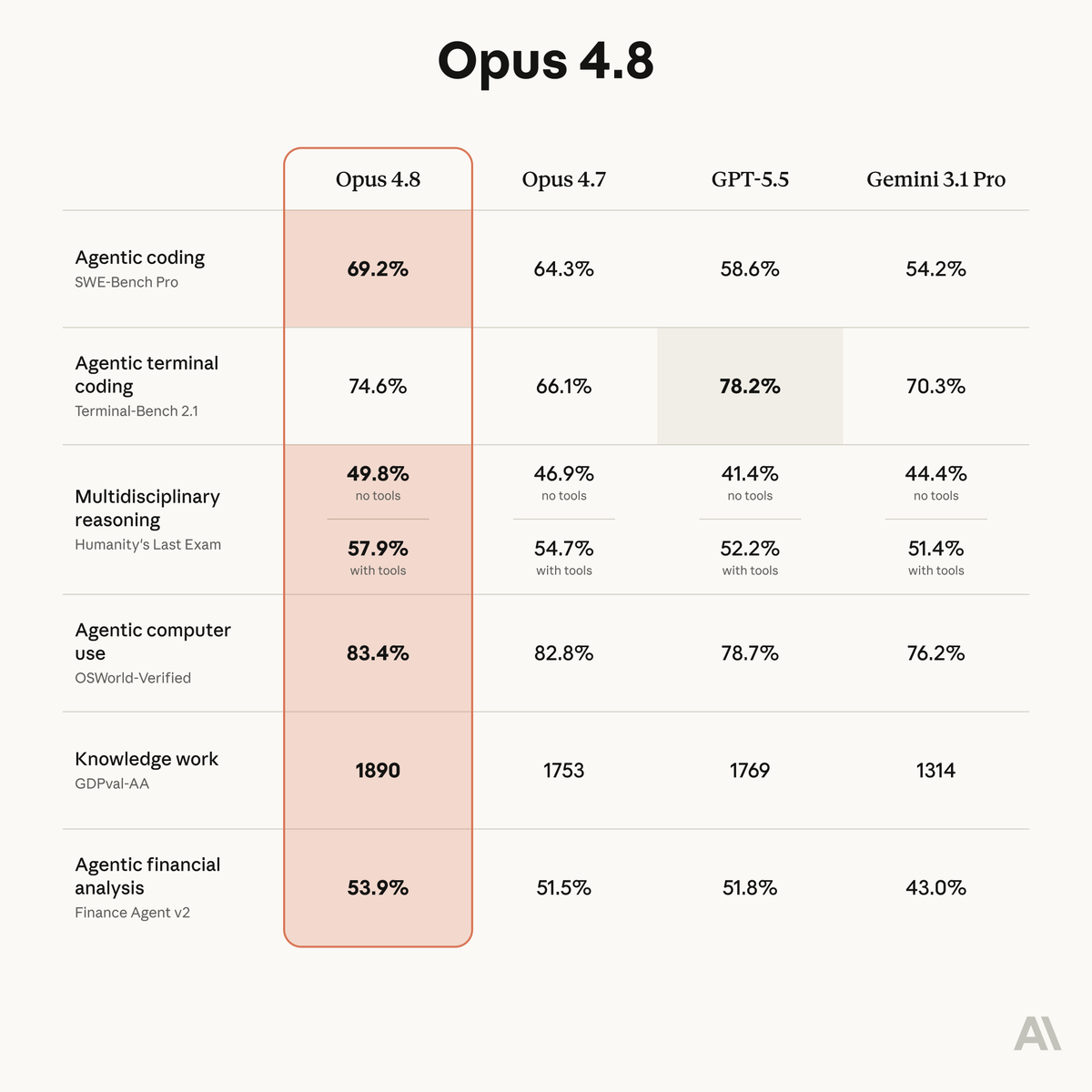
Introducing Claude Opus 4.8: it builds on Opus 4.7 with sharper judgment, more honesty about its own progress, and the ability to work independently for longer than its predecessors.
Available today at the same price.
Introducing Claude Opus 4.8: it builds on Opus 4.7 with sharper judgment, more honesty about its own progress, and the ability to work independently for longer than its predecessors.
Available today at the same price.
클로드 Opus 4.8 출시됐는데 실무에서 긴 호흡의 작업을 자율적으로 처리하는 능력이 대폭 향상됨. 특히 이번에 강조된 Workflows 기능은 단순 프롬프트 연쇄가 아니라 모델이 스스로 진단하며 작업하는 구조라, 복잡한 파이프라인 짤 때 에이전트 뼈대로 바로 검토해볼 만함. 자기 객관화 성능이 좋아졌다니 디버깅 오버헤드 줄이는 용도로도 쏠쏠할 듯.
Claude Opus 4.8 is out today. It's our strongest coding model yet: up on SWE-bench Pro (from 64.3 to 69.2) and noticeably more honest about its own work. It tells you when it's unsure and catches its own bugs instead of declaring victory early. Same price as 4.7.
NVIDIA QUIETLY DROPPED A $249 BOX THAT REPLACES YOUR $200/MONTH OPENAI SUBSCRIPTION WITH $2 IN ELECTRICITY
it's called the jetson orin nano super. smaller than a wallet, runs at 25 watts, does 70 trillion ai operations per second. runs llama 3, mistral, gemma and deepseek locally with no api fees and no data leaving your house
a developer running automations and coding assistants pays $200 a month to openai. the same workload on this box costs $2 a month in electricity and breaks even in 10 weeks
install ollama with one command. change one line in your code. point it at localhost instead of openai. everything else works identically
7 billion parameter models handle 80% of what people use chatgpt for. summarization, drafting, coding, document q&a, automation pipelines. total monthly cost drops from $200 to $22
cloud subscriptions keep getting more expensive and rate limits keep getting tighter. the people who set this up in 2025 are going to look very smart in 2027
bookmark this and read the article below
🚨La IA está costando MÁS que los empleados a los que reemplazó.
Y las grandes empresas ya lo admiten en público:
→ Uber desplegó IA entre sus 5.000 ingenieros. En 4 meses agotaron TODO el presupuesto anual. Su COO reconoce que no puede justificar el gasto.
→ Microsoft ha retirado licencias de IA a sus propios desarrolladores para frenar costes.
→ Starbucks eliminó su sistema de inventario con IA tras 9 meses. Funcionaba peor que un empleado.
→ El vicepresidente de NVIDIA dijo recientemente que “La IA está costando más que los trabajadores humanos”
Nos vendieron que la IA iba a ahorrar millones.
La realidad → los costes se disparan, los resultados no llegan y las empresas están dando marcha atrás.
Estamos ante el principio del fin de la burbuja de la IA?
Microsoft is reportedly reducing internal use of Anthropic’s Claude Code after its AI bills started exploding as employee usage rapidly increased.
Some teams are now being pushed toward GitHub Copilot as the company tries to control AI costs.
Uber reportedly faced a similar problem. Executives said the company had already burned through its entire yearly AI tooling budget by April because engineers were heavily using AI coding daily.
AI coding tools are now being used for everything, and that level of usage creates massive compute and token costs when thousands of employees use these systems at the same time.
Source: TomsHardware
AI enabled everyone to write code 10x faster.
But AI didn’t enable everyone to ship useful products 10x faster.
The engineers getting a real edge from AI are mostly the ones who were already great at their business before AI.
You might believe you should spend less time thinking about code because of AI.
I strongly disagree! We’re watching this play out live where tons of AI generated code becomes a liability.
At the end of the day, an engineer needs to be responsible / on call for code that gets shipped to production. If you don’t understand the system you’re trying to debug, you’re probably going to have a bad time.
Yes, AI can help with all of this, if you set up the proper systems. You can have agents triage prod logs, look at errors, etc. You can speed up parts of the investigation, but an engineer needs to make the call. There might be serious customer or financial implications from that change.
I expect the trend continue for trimming dependencies, vendoring code so you can modify it directly, preferring simpler systems with fewer abstractions, and spending waaaay more time thinking about system design and code maintenance.
I’ve said this before, but it’s a great time to get familiar with CS fundamentals and some of the history behind what great software looks like. Many parts will be different in the coming years as AI progresses, but also a lot more than people realize will stay the same.