@imjonathanacuna Building for your own workflow is a strong way to find the real requirements. The durable test is whether the customer context, owner and next step remain clear as the volume and team grow.
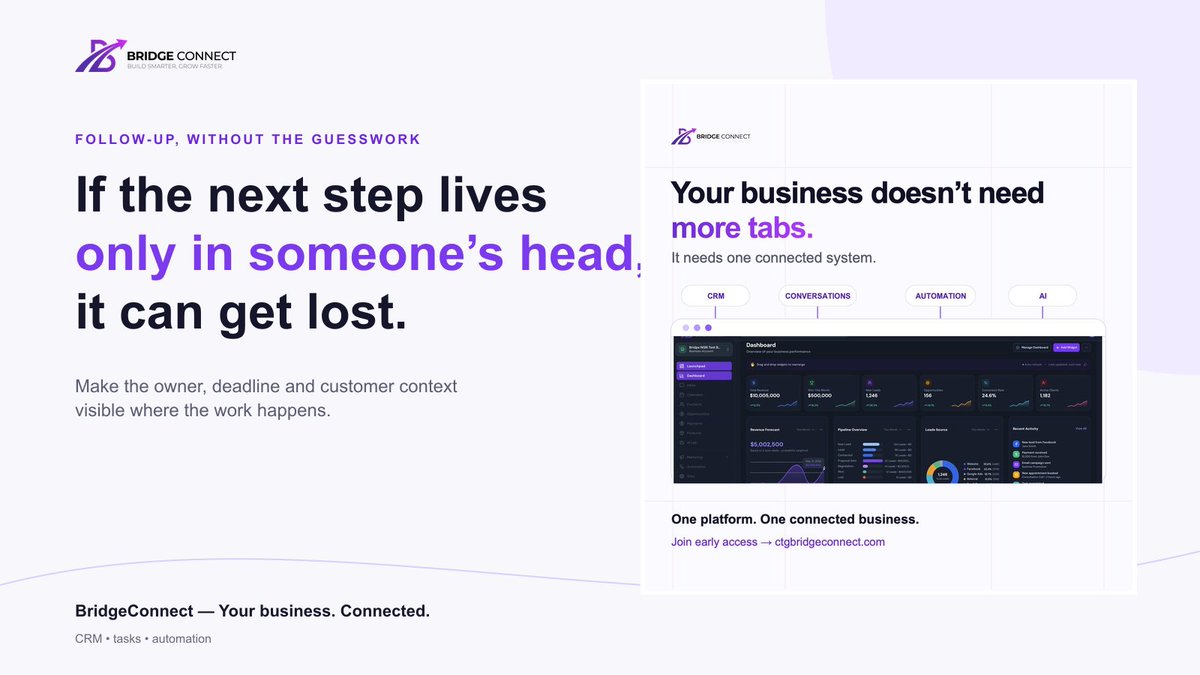
If the next step lives only in someone’s head, it can get lost.
Make the owner, deadline and customer context visible where the work happens.
That is what turns follow-up into a system.
BridgeConnect — Your business. Connected.
@jasonfried The best automation is not a longer sequence. It is a reliable way to preserve context, flag the exception, and make the next human action clear.
@jasonfried Customers may not care about the tool name, but they absolutely feel whether the business remembers them, keeps promises, and follows through without making them repeat themselves.
@jasonfried The business case often appears when relationship work is made visible: fewer dropped handoffs, faster resolution, clearer renewals and fewer customers repeating their story.
@jasonfried Relationship-oriented is the key distinction. A pipeline can tell you a stage; it rarely tells the next person what was promised, why it matters, or how the customer wants to move forward.
@jasonfried For a small team, a lightweight system can be the right system. The test is whether every customer still has an owner, useful context, and a visible next action as the workload grows.
@oliviaakory The leverage is not just drafting messages; it is preserving the reasoning and response signals in the record so the team learns from each interaction instead of starting over.
@BrennanWoodruff@jasonfried Auto-population is valuable when it stays inspectable. Reps need to see what was inferred, from which source, and what changed before the record becomes the team’s shared truth.
@AustinWaltersUK@jasonfried Exactly. A customer-first CRM should make the history, commitments and next action visible—without forcing every relationship through a sales-stage template.
@jasonfried The signal is probably that people want less record-keeping and more continuity: a clear next step, the relevant context, and less re-explaining. Features only help when they make the relationship easier to carry forward.
A CRM should not make customers repeat themselves.
The next owner needs to see:
• what they asked for
• what has already happened
• what should happen next
Context turns follow-up into service.
“We followed up” is not a system.
A real follow-up system makes three things visible:
• who owns the next action
• when it is due
• the customer context they need to act
Which of these is hardest for your team to keep consistent?
@Mamamie82907563 Exactly—speed matters, but only if the reply carries the lead’s intent forward. The best first response captures the request, makes booking simple, and gives the next person enough context to act.
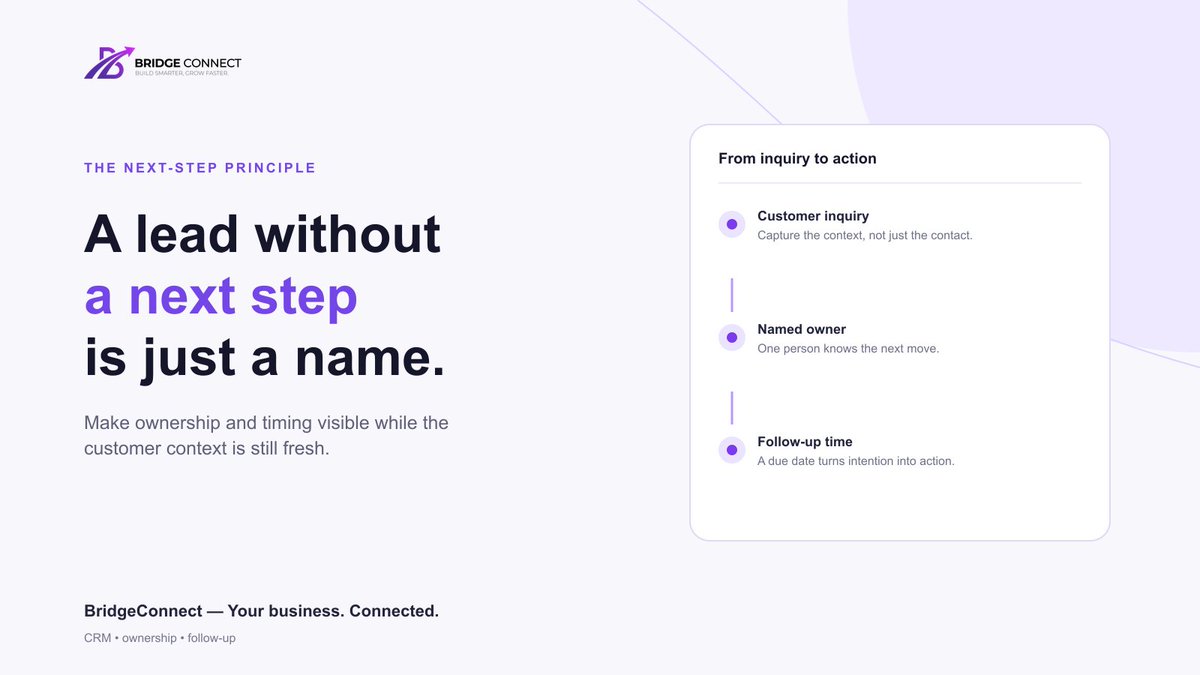
A lead without a next step is just a name.
Every new inquiry needs:
• the customer context
• a named owner
• a clear follow-up time
That is how a CRM becomes a working system—not a list of records.
What gets lost first when your team is busy?
@FavourCommander Good systems need boundaries too. A short intake form or scoped task board can turn “help me with everything” into a visible request, owner and approval step before work starts.
@agbaje_automate A practical fourth step is defining the exception queue before building: what failed, who owns it, and what response time is acceptable. That keeps a helpful workflow from silently accumulating edge cases.
@DamiDefi Audit should also capture the handoff moments: where context gets copied, who waits, and what exception repeats. Those are usually the strongest automation candidates—not simply the most frequent clicks.
@nonoo_techie The human transfer is the part worth testing carefully. Does the rep receive a short summary of what the lead already said? A warm handoff with that context feels very different from being asked the same questions twice.