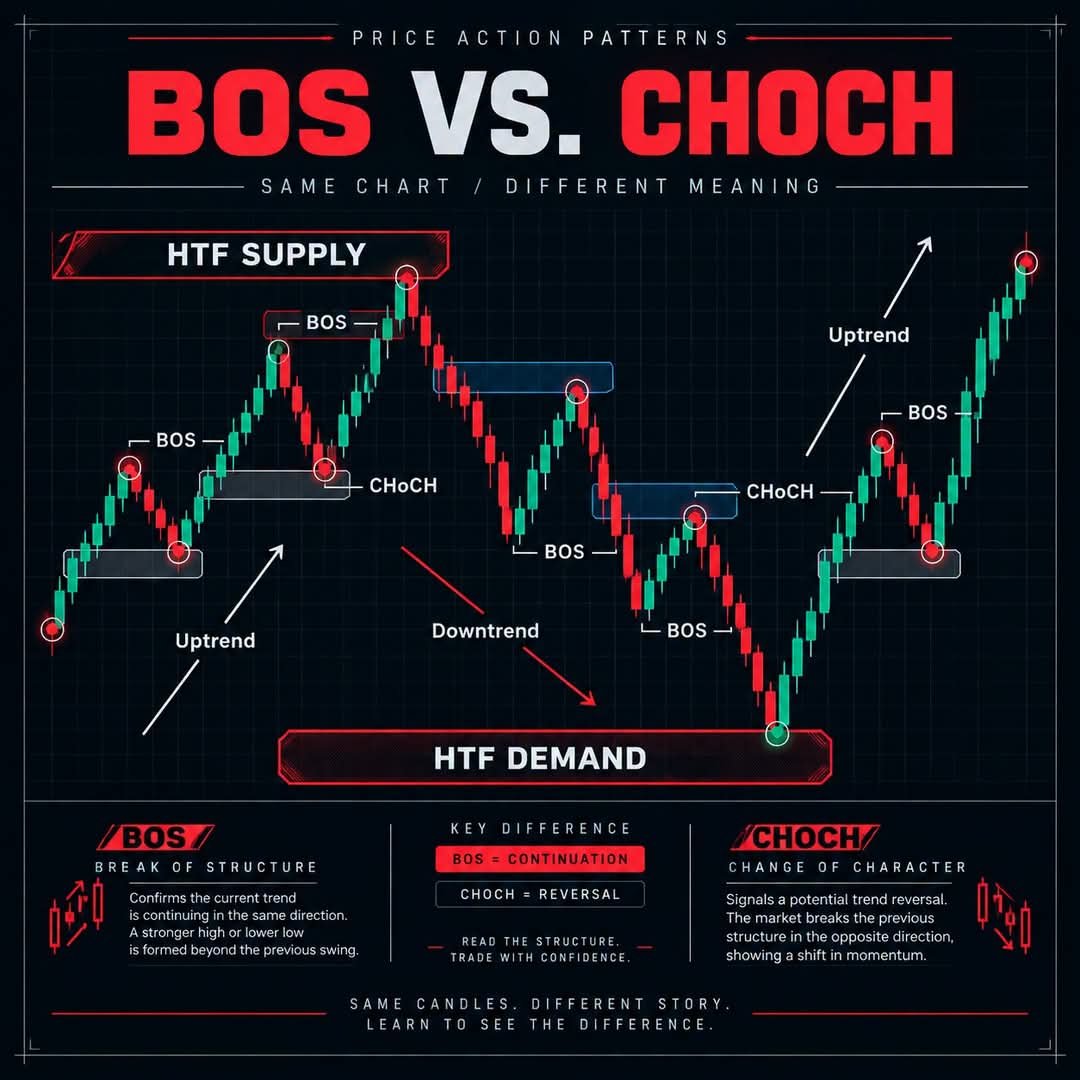
BOS VS CHOCH.
Same candles. Different story. The key is knowing whether the market is continuing or reversing.
Quick breakdown:
✓ Break of Structure (BOS) – confirms trend continuation.
✓ Stronger highs or lower lows extend the move.
✓ Change of Character (CHOCH) – signals reversal.
✓ Momentum shifts as structure breaks in the opposite direction.
✓ HTF Supply & Demand – higher time frame zones define where BOS or CHOCH plays out.
📈 BOS = continuation.
📉 CHOCH = reversal.
READ THE STRUCTURE. TRADE WITH CONFIDENCE.
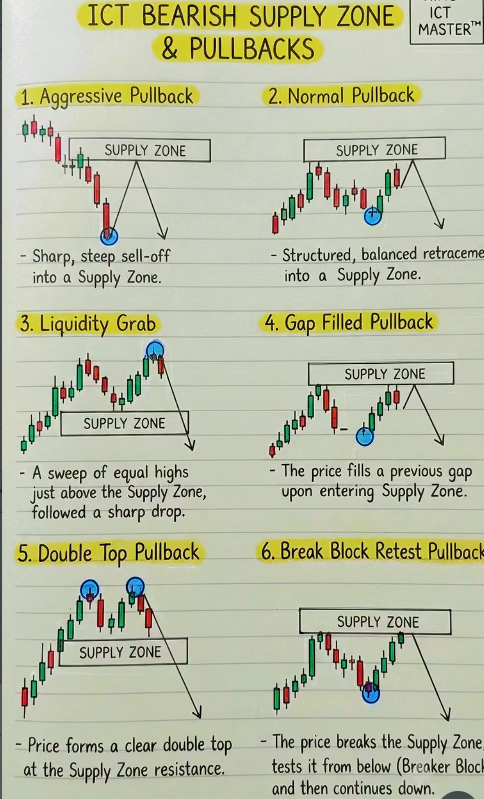
🚨ICT BEARISH SUPPLY ZONE & PULLBACKS 👀👇
✅ 1. AGGRESSIVE PULLBACK – Sharp, steep sell-off straight into the Supply Zone. No hesitation – just pure rejection.
✅ 2. NORMAL PULLBACK – Structured, balanced retracement into the Supply Zone. Clean price action for a high-probability short.
✅ 3. LIQUIDITY GRAB – Sweep of equal highs just above the Supply Zone, then a violent drop. Stop hunt confirmed – sellers step in hard.
✅ 4. GAP FILLED PULLBACK – Price fills a previous gap upon entering the Supply Zone. Gap closure = trap set for breakout buyers.
✅ 5. DOUBLE TOP PULLBACK – Clear double top forms at the Supply Zone resistance. Rejection pattern = textbook bearish confirmation.
✅ 6. BREAK BLOCK RETEST PULLBACK – Price breaks the Supply Zone, then retests it from below (Breaker Block), and continues down. Old resistance becomes new support-turned-resistance.
✍️Master the supply. Wait for the pullback. Short with conviction.
SUPPORT & RESISTANCEVIOLATION.
Uptrends thrive on resistance_breaks and support_acceptance, not blind buys and sells.
Follow strength. Follow structure. Follow liquidity.
CHART ANALYSIS — REVERSAL BUY SETUP 📈
Downtrend → Price is making Lower Highs (LH) and Lower Lows (LL).
Failure to Make a New Low → Price reaches the previous low area but fails to create a new LL. This shows selling pressure is weakening.
Breakout → Price breaks the descending trendline and then breaks the previous high/structure.
Resistance Becomes Support → The previous resistance zone is broken and becomes a new support zone.
Retest → Price pulls back and retests the broken level.
BUY ENTRY 🟢 → After bullish confirmation from the retest, buyers regain control.
Reversal → Price continues strongly upward and establishes a new bullish structure.
MOST TRADERS DON'T NEED MORE TIMEFRAMES.
THEY NEED A BETTER
TIMEFRAME COMBINATION.
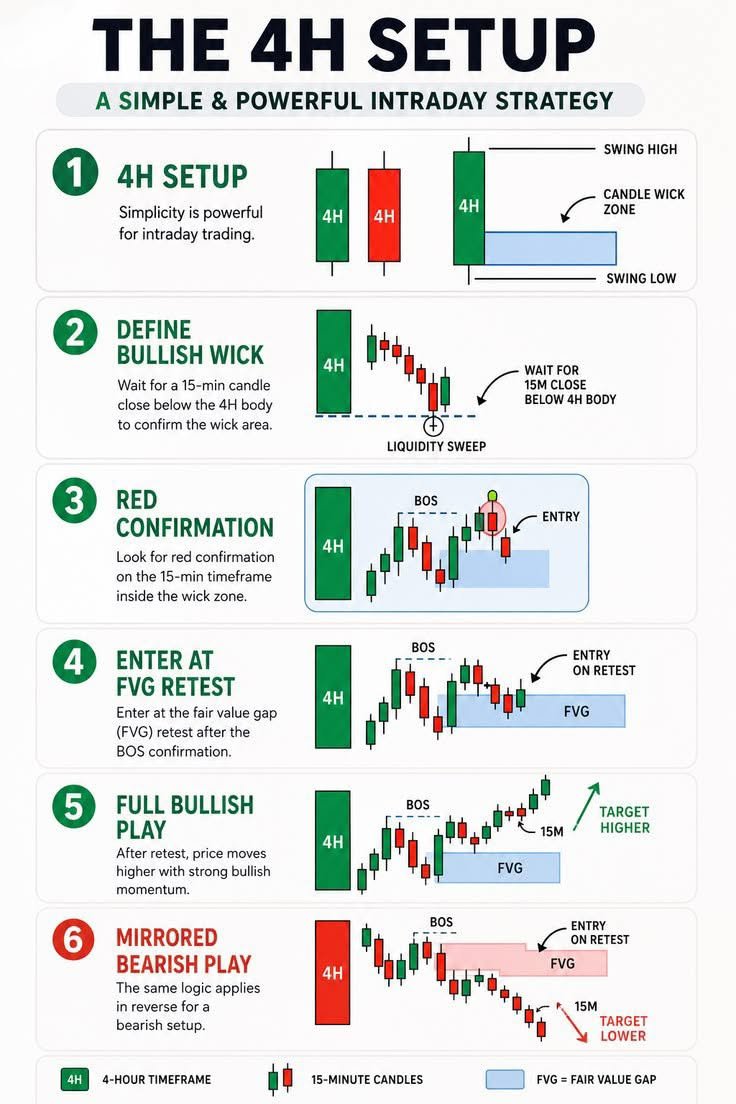
4H → Direction
1H → Liquidity
15M → Structure
5M → Execution
Stop looking at everything.
Start knowing what
each timeframe is for.
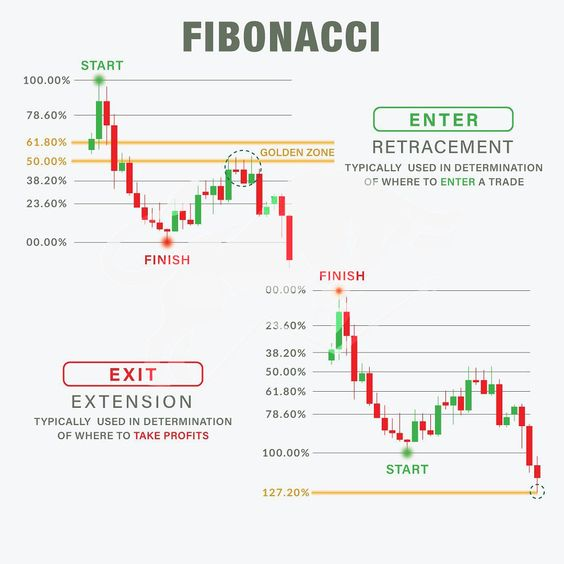
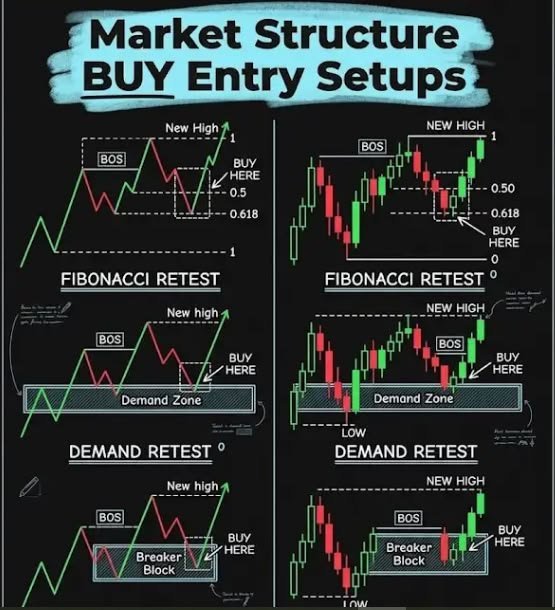
How to Effectively Utilize Fibonacci
Retracement Levels, Demand Zones,
and Breaker Blocks Alongside Break of
Structure (BOS) for Optimal Trading Decisions
5 Things To Look For Before You Enter Any Trade: A Price Action Trading Strategy Explained:
Here are five things to quantify before entering any trades. These areas should be based on the parameters of your own time frame and trading system.
1. Path Of Least Resistance
The first filter for any trade entry is the question: “Is the chart you're trading in an uptrend, a downtrend, a range, or highly volatile?”
“The answer to the question, what is the trend?” is the question, "What is your time frame?” - Richard Weissman
Uptrends are characterized by higher highs and higher lows; this is when long entry signals can occur, whether buying the dip or on a momentum signal.
Downtrends have lower highs and lower lows; this is when short signals can occur, whether shorting rallies or selling weakness.
Trading ranges have the same area of high price resistance and low price support, where selling resistance and buying support should be signaled.
Volatile charts will have very wide trading ranges, little respect for resistance or support, and can move sharply up or down in short periods.
2. Price Area Of Value Or Interest
The next question is: what is the nearest key price area with the highest probability of interest for buyers and sellers? This varies by chart type and technical context.
In an uptrend, the area of interest is buying the dip at the lower 50-day moving average.
An area of interest in a downtrend is selling rallies back into the higher 50-day moving average.
In a trading range, the area of interest could be buyers at the price support level.
In volatile ranges, the area of interest can be deep dips to the 30-RSI or strong rallies to the 70-RSI that can occur within a single day before reversing.
3. Entry Signal
An entry signal is the quantified reason you are going long or short on a chart, based on a backtested technical indicator, price action, or technical analysis. Your entry signal should always create a good risk/reward entry and a high probability of a winning trade.
4 Exit Strategy For Losing Trades
You should have an exit signal for losing trades. A stop-loss is set at a price level that should not be reached if the trade is going to work out in your favor as a winner.
A stop-loss should be determined before you take the entry, and your maximum loss should be quantified based on your position sizing if it is triggered. Keeping losses small is a major key to profitable trading over the long term. The stop-loss should ensure a good risk/reward ratio by limiting downside risk.
5. Exit Strategy For Winning Trades
At entry, you should have a profit target in mind based on technical levels and the historical chart pattern you are trading. The exit signal for a winning trade helps establish the reward part of the risk/reward ratio at entry.
A profit target is where you will lock in gains if your best-case scenario for a trade plays out. This is the price or technical level at which you will take your money off the table, as the future reward potential is not enough to justify remaining
HOW I KNEW THE MARKET WOULD SELL OFF
Save this. You will use this pattern to know what to do forever.
Sunday I said the market could easily roll over this week on $SPY
And the setup was obvious:
• The bounce made retail feel safe again.
• FOMO starts to creep back in.
• Late longs would chase strength.
That’s the exact moment the market loves to flip.
Now we’re selling off overnight… and a lot of traders are stuck long.
Learn to read it this pattern. I will help you BEAT this market.