It's cool to see @GoogleDeepMind's new research to show similar findings as we did back in April.
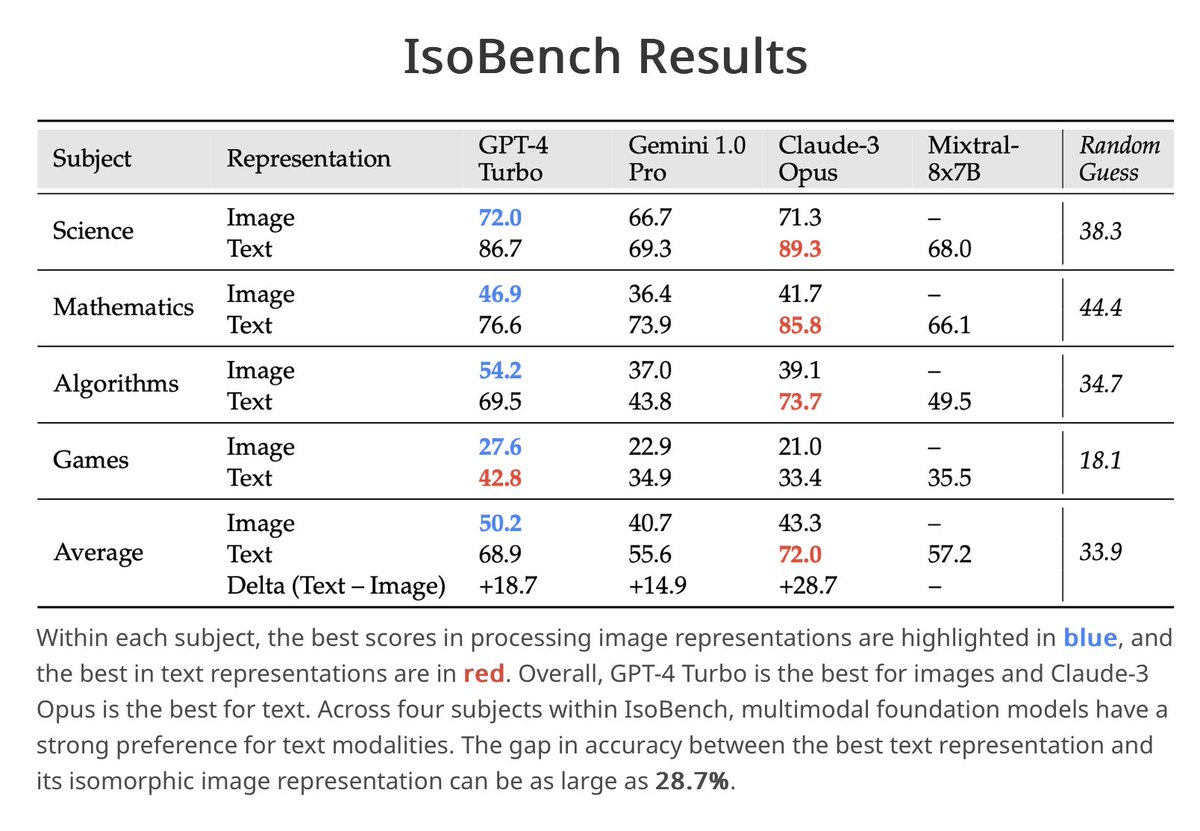
IsoBench (https://t.co/13PpqFziUb, accepted to @COLM_conf 2024) was curated to show the performance gap across modalities and multimodal models' preference over text modality. Interestingly, IsoBench was also designed upon tasks such as algorithms, mathematics, physics, chemistry, and chess puzzles.
It's pretty nice to see people extend the finding to more modalities such as audios and videos. Let's dive deeper into this multimodality issue and fill the gap!
Finally, we propose an alternative to kNN augmentation: We train an MLP layer with the key-value pairs in the datastore for kNN augmentation. Augmenting LMs with this MLP layer effectively reduces LM perplexity, while saving 96% of the disk space compared with kNN augmentation.
“On Retrieval Augmentation and the Limitations of Language Model Training” (https://t.co/HrcV51Z9em) has been accepted to NAACL 2024!
While it is well known that kNN retrieval can decrease LMs’ perplexity, the underlying reason is unclear. We study two hypotheses 👇
We propose a dataset, Macondo, which includes examples following the format
Training set: [villager], who [desc], is the parent of [child].
Test set: [villager], is the parent of [child].
We show that scaling up a model alone does not make it generalize better.
🚀 Excited to announce Reka Flash, our state-of-the-art 21B multimodal model! Try it for free at https://t.co/kSRrreiRaY, and check out our blogpost for more details: https://t.co/vOYNOCXgxn
Do you know 1) if the current CQA data well reflect content understanding and 2) if SOTA models really understand the content of conversations?
Come to the AAAI talk on 2/11 (Tue) 9:50-10:10 at Sutton North and the poster session during 18:30-20:30.
#AAAI20#miulab




![ctinray's tweet photo. We propose a dataset, Macondo, which includes examples following the format
Training set: [villager], who [desc], is the parent of [child].
Test set: [villager], is the parent of [child].
We show that scaling up a model alone does not make it generalize better. https://t.co/cXLQtvJMsN](https://pbs.twimg.com/media/GO7E02QakAE5t5L.png)


