1/
Everyone is stuck on one hack story.
Step back. Crypto still has three old problems — new packaging. 🚨👇
• Safety after the theft, not before the press release
• Dilutive tokenomics after the crash
• Dry powder burned when the next round needs it
The first one is loud this week. The other two decide whether retail still has a shot.
2/
Safety is not “hacks never happen.” Endpoints fail in TradFi too.
The real gap is the morning after.
Most big thefts hit people and custody machines, not the chain. Balances move in minutes. If there is no freeze that works with investigators, no segregated reserves, and no named path back — you did not lose to volatility. You lost to a hole with no floor.
3/
Then the second tax: dilutive tokenomics.
Unlocks and emissions that keep printing after the price already cratered. You pay the market. Then the supply taxes you again.
And dry powder: after shocks, prices look like “entries” while the next round’s strength is already gone.
Three problems. Same question underneath: whose money still counts in the morning?
4/
The fix is not a ban. It is a choice of rails.
One rail stays Wild West: pure DeFi, opaque, high-risk, clearly marked, opt-in. Nobody should mistake it for safety.
The other rail makes the floor the product: auditable reserves, segregated customer property, strict signing, a freeze that cooperates with investigation, and a recoverable loss path.
Hard is not an excuse. Hard is the work.
5/
We have already seen the wedge.
When FTX collapsed, customers of CFTC-registered affiliates kept segregated balances. Much of the offshore book did not.
That is what a floor looks like in one sentence: the money remained — and it had a name on it.
Live rhyme, not the title: the CFTC’s Oct 2026 advance notice (Regulation CAM) sketches a voluntary federal registration rail for crypto exchanges — derivatives-style cyber and customer-property safeguards, opt-in, not a ban on the other rail. A tool for the floor. Not a rename of it.
Prevent the hole. Do not only prosecute after it.
6/
Two risks that rhyme with the same question:
• TradFi takes only the tech — faster settlement, cheaper rails — and leaves the people who funded the experiment without the floor.
• The industry keeps token rules that punish holders after a crash, when a rare deflationary rule would be the royal path.
Floor and supply. Same morning. Same test.
7/
Every money market crashes.
On Oct 10, 2025, crypto saw its largest wipeout on record in dollar terms: more than $19B in leveraged liquidations in 24 hours after a tariff shock (Reuters). It hurt every corner of the market. That part happens.
The second hit did not have to. Dilutive unlocks and emissions kept printing after the price already cratered — a second tax on the same people — while players who could have fixed the rules, or rebuilt with a rare deflationary design, largely did not.
Same day. Two problems stacked: dry powder burned, then supply taxed what was left. Mirror for problems 2 and 3 — not a complaint about one bad Tuesday.
8/
Until irretrievable capital loss (theft / hacking) stops being normal, we are packaging the old hole — not building a money market.
Sources: Reuters (Oct 10–14, 2025); Coinbase/Kraken Oct 10, 2025 closes vs spot ~Oct 31, 2026 (card set). CFTC ANPRM Regulation CAM, Federal Register Oct 13, 2026; CFTC PR 9307-26; Selig Squawk Oct 30, 2026.
No tips. Just context.
Desk take: until money remains and can be recovered, the industry is packaging the old hole, not fixing it.
If TradFi only takes the tech, who builds the floor for the people who funded the experiment?
$BTC $ETH $SOL $XRP $BNB $ADA $DOGE $AVAX $LINK $XLM $HBAR $SUI $LTC $AAVE $INJ $APT $ARB $ICP $ONDO $TAO $RENDER $DOT $OP $TON $PEPE $SHIB $ATOM $FIL $TRX $BCH $SEI
$MOD Modexus just put numbers on the AI cooling story 🧊
New FY29 targets from today's investor day:
Revenue from $2.1B to $5.7-7.7B, a 40-55% yearly pace, no acquisitions
Data center revenue from $1.1B, growing 60-80% a year
Adjusted EBITDA margin from 14.7% to 19-21%
New $500M buyback, FY27 guide unchanged
Bear case from its own slides: first half FY27 margins were hit by component shortages and ramp costs, and data center growth leans on one large customer. These are management targets, not results.
Falsifier: next quarter's data center growth well below the 60% path, or a cut to the FY27 range.
Source: SEC 8-K, Exhibit 99.1
No tips. Just context.
US pre-open: builders broke ground faster in October. Their permits say the next months look slower.
Housing starts ran at a 1.309 million annual pace, above the roughly 1.25 million expected, while building permits fell 7.4% to 1.295 million (US Census Bureau, https://t.co/kyLxtqnX0O consensus).
1. Single family permits dropped 8.7% to 772,000. The 9.9% jump in starts sits inside the survey's error band of 16.8%, so it may not be real.
Why it matters: permits are the forward signal. With the 10-year yield above 5%, builders are pulling back on future projects.
2. 🧠 Nvidia ($NVDA) is up 2.9% premarket at $159.98 (Yahoo Finance, 14:45 CET), lifting the AI chain: Marvell and Sandisk up 3%, Coherent and Bloom Energy up 4.5% (CNBC).
Why it matters: our morning watch line, a close above $160, is exactly where the stock is now.
3. 📉 Lowe's ($LOW) is down 5.2% premarket. Its $3.10 adjusted profit per share included 34 cents of tariff refunds. Target ($TGT) is flat after its best sales growth in five years, 7.1% (CNBC).
Our read: a day after Home Depot slipped on its results, home linked spending looks like the soft spot.
4. Europe is not joining in: STOXX 600 down 0.3%, London's FTSE down 0.6% at 14:29 CET (Yahoo Finance), as falling gold and copper weigh on miners.
Why it matters: this is an AI rebound, not a broad risk on day.
Prices: Nasdaq 100 futures up 0.7%, S&P 500 futures up 0.3% at 14:34 CET. US 10-year 5.12%. Dollar index near 103.8, a 19 month high (Dow Jones). Gold $3,781, down 2.2%, lowest since September 2025 (CNBC). Bitcoin about $63,900, down 1.4% in 24 hours.
Today (ET): stocks open 9:30 (15:30 CET). Pending home sales 10:00 (16:00 CET). Fed minutes from the October meeting 2:00 (20:00 CET). Palo Alto Networks results after the close.
Watch today: the US 10-year yield is near 5.12%. A close at or above 5.15% means markets read the Fed minutes as more hawkish than expected. We lean: it stays below 5.15%.
Sources: US Census Bureau, CNBC, Dow Jones, https://t.co/kyLxtqnX0O, Yahoo Finance.
No tips. Just context.
Desk take: the chips got their answer last night. Housing is still waiting for lower rates.
Which matters more for the next month: AI demand or mortgage costs?
Nvidia beat its own forecast. The market's applause was polite.
Nvidia ($NVDA) guided to $130 billion in sales this quarter, above the roughly $125 billion analysts expected, while assuming zero data center sales to China (Nvidia, Reuters).
1. 📈 Last quarter's revenue was $115.8 billion, up 103% from a year ago. The stock rose 4.8% after hours to $162.94, but it is still down about 25% this month (Reuters).
Why it matters: demand for AI chips looks intact. What the market is still pricing is the leadership vacuum after the CEO's resignation and the new US chip export rules.
2. Asia bounced, unevenly. Korea's Kospi rose 2.0% to 5,067 after giving up a 2.6% opening jump at one point (Yonhap). Japan and Taiwan rose 0.3%, Hong Kong fell 1.1%.
Why it matters: the chip selloff paused, but buyers did not chase.
3. Gold fell 2.3% to about $3,775, its lowest in over a year (CNBC), as the dollar firmed. New York Fed president Williams said more rate hikes are needed, just not a half-point one in December (Reuters).
Why it matters: gold pays no interest, so it loses most when markets expect rates to stay high.
4. 🛢️ Brent oil is down 1.8% to about $91.50 at 08:10 CET. UK inflation rose to 3.6% in October from 3.5% (ONS).
5. Applied Optoelectronics ($AAOI) filed a new $550 million program to sell shares gradually into the market, its fifth this year. At Monday's close that is about 13% more shares (SEC filing, our calc).
Why it matters: funding growth this way spreads the cost across existing holders.
Prices: US 2-year 4.80%, 10-year 5.10% (US Treasury, Tuesday). Nasdaq 100 futures up 0.65% at 08:10 CET. Bitcoin about $64,800, flat since midnight CET (Binance).
Today: euro area final inflation 11:00 CET. Fed minutes from the October meeting 2:00 ET (20:00 CET).
Watch today: Nvidia's regular close vs $160. Above it, the market trusts the numbers over the leadership noise. Below it, most of the after-hours gain is gone. We lean: below $160.
Tuesday's watch: a US 2-year yield back at or above 4.88%. It closed at 4.80% (US Treasury). Held.
Sources: Nvidia, Reuters, Yonhap, CNBC, ONS, SEC, US Treasury, Yahoo Finance, Binance.
No tips. Just context.
Desk take: the numbers answered the demand question. They could not answer the who-runs-it question.
Which one moves the stock more this week?
US shoppers kept spending in October. Two hours into the session, stocks still sold off into Nvidia's report.
At 11:32 ET (17:32 CET) the S&P 500 is down 1.3%, the Nasdaq 100 1.4%, and the Dow 1.6% (CNBC). Nvidia ($NVDA) is down 1.6% at $153.70 after a swing from $157.46 to $150.33.
1. October retail sales rose 0.2%, as forecast, but sales excluding cars rose 0.6%, above the roughly 0.4% expected (US Census Bureau). Car dealers fell 1.6%; without cars and gasoline, sales still rose 0.5%. The headline sits inside the survey's error band, so it could even be zero.
Why it matters: the consumer is not cracking, so the Fed has no reason to back off.
2. 🏦 Fed Governor Waller spoke at 9:10 ET (15:10 CET) on payments and did not discuss rates (Federal Reserve, Reuters). The dollar index (the dollar vs a currency basket) is 103.44, a shade lower on the day. The 2-year yield, a gauge of Fed rate bets, is 4.79%. Markets still expect a December quarter-point hike (Reuters).
3. 🧠 Nvidia reports about 4:20 ET (22:20 CET), its first results since the CEO resigned. CNBC reports it will stop selling to data centers that rent more than half their chips to Chinese companies. Options price a move of about 7.8% after the report (UBS via Reuters).
Why it matters: China exposure is now a sales question, not only a policy one.
4. Home Depot ($HD) is down 2.4% despite sales up 4.9% to $43.4B and a raised full year outlook. Finance chief Richard McPhail becomes CEO on Nov 23. Contractors carried the quarter; households stayed cautious (company, Reuters).
Our read: the strong retail number is not spread evenly.
Prices: 10-year yield 5.10%. Brent $93.28, up 0.9%. Bitcoin about $63,800, down 1.8%.
Watch tonight: Nvidia's after-hours move from today's regular close vs the 7.8% swing options priced in. We lean: it stays inside 7.8%.
Sources: US Census Bureau, Federal Reserve, Reuters, CNBC, Home Depot.
No tips. Just context.
Desk take: Good spending news did not lift stocks. The market is waiting on Nvidia, not on the shopper.
If the report stays inside that 7.8% swing, does the rest of the market calm down?
Asia sold AI stocks again. US futures did not follow.
Korea's Kospi closed at 4,968, its first close below 5,000 since February (AP).
1. 🧠 Washington tightened the chip rules on Monday. Shipping advanced AI chips to Indonesia, Malaysia, Singapore, Thailand and Brazil now needs a US license, and data centers renting large amounts of computing power to China-based companies need one too, with 90 days for existing ones (US Commerce Department rule).
Why it matters: it closes the rent-it-remotely route, and it adds a policy question to Nvidia's results tonight.
2. The selling widened. Taiwan fell 2.3% and Japan 1.3%. In Seoul all 20 of the biggest stocks fell, not just chipmakers, and foreign investors sold a net 1.44 trillion won (Yahoo Finance, MoneyToday).
3. US stock futures are split: Nasdaq 100 futures up 0.1%, S&P 500 futures down 0.2% at 08:20 CET. Nvidia ($NVDA) fell 4.1% Monday to $156.14 ahead of its first report since its CEO resigned.
4. 🛢️ Brent oil is down another 1.1% to about $91.40 after a 3.6% drop Monday (Reuters). The IEA expects more supply than demand this quarter as Middle East exports recover. Cheaper oil takes some heat out of inflation.
Prices: US 10-year 5.12%, 2-year 4.83% (US Treasury, Monday). Bitcoin about $64,600, down 1.0% since midnight CET (Binance). Gold up 0.7%.
Today: German investor sentiment (ZEW) 11:00 CET. US retail sales 8:30 ET (14:30 CET), forecast +0.2%. Nvidia results about 4:20 ET (22:20 CET).
Watch today: the US 2-year yield fell to 4.83% Monday from 4.88% Friday. A close back at or above 4.88% after retail sales means bets on rate hikes are back. We lean: it stays below 4.88%.
Monday's watch: chips trailing the Nasdaq 100 by more than 1 point. They trailed by 2.6 points (Yahoo Finance). Held.
Sources: US Commerce Department, AP, MoneyToday, Reuters, IEA, US Treasury, Yahoo Finance, Binance.
No tips. Just context.
Desk take: Asia is selling the AI chain while US futures wait for one company.
Does tonight's report settle the chain, or just one stock?
US close: the Fed chair walked through an AI bust scenario. The chip market spent the session rehearsing it.
The Nasdaq 100 fell 2.7% and the chip index 5.3%. Nvidia ($NVDA) closed at $156.14, down 4.1%, a day before its results (Yahoo Finance).
🏦 Fed Chair Warsh, speaking at noon ET, laid out three staff scenarios for AI. In one, after heavy investment and stock-market gains, "expected returns could turn down and equity valuations could fall," bringing a slowdown and higher unemployment (Federal Reserve). He called them illustrative, not forecasts, and said nothing about the next rate move.
🧠 Our morning watch held: chips trailed the Nasdaq 100 by 2.6 percentage points, past our 1 point line. That is a supply-chain scare, not just general nerves before Nvidia. Micron ($MU) fell 7.6%, TSMC's US shares 6.3%, Intel ($INTC) 7.0% after a shareholder lawsuit (Yahoo Finance, Reuters).
Selling stayed concentrated. An equal-weight S&P 500 fund, where every stock counts the same, fell 1.0%, versus 1.9% for the regular S&P 500. The US 10-year yield eased only to 5.12% from Friday's 5.15%. Bitcoin was near $65,000, little changed over 24 hours. The fear gauge (VIX) rose to about 23.8, up 23% (Yahoo Finance).
Next: Nvidia results Tuesday after the close, about 4:20 ET (22:20 CET). Fed minutes Wednesday at 2:00 ET (20:00 CET).
Watch Tuesday: Nvidia's regular close, before the results, versus today's $156.14. Close below = sellers kept going into the print. Close above = buyers stepped in first. We lean: close below $156.14.
Sources: Federal Reserve, Reuters, Yahoo Finance.
No tips. Just context.
Desk take: chips priced a version of the disappointment scenario the Fed only sketched. Bonds and the average stock did not.
Does Tuesday's report change the chip tape, or only one stock?
Europe pre-open: Asia sold the whole AI supply chain, not just Nvidia.
Taiwan's market fell 6.03% on Monday, its second biggest point drop on record (CNA). Korea lost 3.6% and Japan 2.4% (Yahoo Finance).
1. 🧠 The selling hit the suppliers: TSMC fell 5.7%, Foxconn 9.3%, and 82 Taiwan stocks closed limit down (Commercial Times). Local press says Nvidia's next chip platform could slip to the first half of 2027 because its HBM4 memory (the fast memory stacked next to AI chips) is in short supply. Single source, unconfirmed.
Why it matters: on Friday the worry was one company. Today markets are pricing demand for the chain behind it.
2. Nvidia ($NVDA) heads into results on Tuesday with two opposite weekend headlines. The FT says Jensen Huang is weighing a return as CEO, while Treasury Secretary Bessent wants an outside CEO, also per the FT. Friday: the chip index fell 3.4%, Nvidia 2.0%, the Nasdaq 100 1.2% (Yahoo Finance).
3. US stock futures point lower: Nasdaq 100 futures down 0.9%, S&P 500 futures down 0.4% at 08:15 CET.
4. 🛢️ Iran launched drones at a US base in Bahrain on Sunday, yet Brent oil slipped 0.6% to about $95.30 (Reuters). The IEA now expects more supply than demand this quarter, by about 1.7M barrels a day.
5. Bitcoin is near $64,560, down 1.0% since midnight CET and about $4,500 lower than Friday morning (Binance). Gold is down 0.8%. No safe haven is getting a bid.
Today: euro area industrial production 11:00 CET. Empire State factory survey 8:30 ET (14:30 CET). Fed Chair Warsh on AI and jobs from 12:00 ET (18:00 CET).
This week: Nvidia results Tue after the close, about 4:20 ET (22:20 CET). Fed minutes Wed 2:00 ET (20:00 CET). Anthropic's Nasdaq debut Thu.
Watch today: the chip index vs the Nasdaq 100 at the close. If chips trail by more than 1 percentage point, this is a supply chain scare. If not, it is general nerves before Nvidia. We lean: chips trail by more than 1 point.
Friday's watch: US 10-year close at or above 5.15%. It closed at 5.15% (US Treasury). Held.
Sources: CNA, Commercial Times, Financial Times, Reuters, IEA, US Treasury, Federal Reserve, Yahoo Finance, Binance.
No tips. Just context.
Desk take: Taiwan did not wait for Nvidia's numbers.
Does Tuesday's report calm the chain, or confirm the fear?
📋 This week's scorecard: 13 dated calls came due. 11 held, 1 partly held, 1 broke.
That is 85% held, counting "partly" as not held. Most were one-day market watches, so read it as a follow-up ledger, not a forecast record.
Five worth a second look:
HELD: USDC on Arc, Nov 9. We said the pile would stay big while lending stayed thin. DefiLlama: $1.298B of USDC on Arc (our line was under $700M), and only about 35% of it in the lending apps Morpho and Aave (our line was above 50%).
HELD: Strategy ($MSTR), Nov 11. On Oct 16 we said index funds may have to sell. MSCI's November review list put Strategy among its US index deletions, effective at the Nov 30 close.
HELD: Binance withdrawals, Nov 10. A stall meant no new reopening round, or an official pause. Binance reopened more networks on Nov 8 and Nov 9 and announced no pause.
PARTLY: the China oil buffer, Nov 13. On Nov 2 we said China's tanks were the buffer being drained. The IEA's November report: stocks on land fell again, to their lowest since at least 2016, but land stocks outside the OECD rose about 13M barrels (our calc from IEA totals). The draw on land continued. The China part did not.
BROKE: Nasdaq 100, Nov 13. We leaned it would close above Thursday's 28,289. It closed at 27,943.74, down 1.2% (Yahoo Finance). The catch: that morning we also leaned the 10-year yield would close at 5.15% or higher. It closed exactly at 5.15% (US Treasury). Two leans on one day pulled against each other, and yields won.
Not scored: on Nov 10 the Nasdaq 100 closed inside our stated no-decision band, down 0.6%. Our lean, a close below 27,629, did not happen.
Carried into next week:
• Strategy ($MSTR): its stock stays worth at least 0.85x its bitcoin through the Nov 30 index exit (our calc from company filings and closing prices).
• OKXICE tokenized stocks: launch is set for Monday, Nov 23. We lean it opens by Nov 30. Later means the date slipped.
Sources: DefiLlama, MSCI, Binance, IEA, US Treasury, Yahoo Finance.
No tips. Just context.
Desk take: a lean only counts if it fits with the other leans we made that day.
Which tells you more: the 11 that held, or the one that broke?
@GavinSBaker Worth reading the fine print too. The same bill carries the Ratepayer Protection Act, so data centers would pay for the grid upgrades built to serve them. It cleared its first Senate hurdle 73-25 on Nov 9 (Senate EPW). The House must then pass the same text before Jan 3.
@anasalhajji Scale check: Starbase's air permit filing covers 35 mobile turbines, about 750 MW. Flat out at EIA's average gas turbine heat rate, that is roughly 0.19 Bcf/d, or 0.2% of the ~92 Bcf/d EIA sees the US using in 2026. A local pipe story, not a national one. Watch the Dec 9 hearing.
Wholesale inflation cooled a notch. Bonds didn't buy it.
US producer prices (PPI) rose 0.3% in October, below the 0.4% economists expected (BLS, Dow Jones consensus via CNBC). The US 10-year yield dipped to 5.12% after the release, then climbed back to 5.145% by 9:11 ET, above where it stood before the data and above Thursday's 5.10% close (Tradeweb via CNBC).
1. 🏦 Core producer prices, which leave out food and energy, rose 0.3%, exactly as expected. From a year earlier, prices are up 6.5%, the highest in nearly four years (BLS, CNBC).
Our read: one calmer month after a jump of more than 1% in September. It takes the edge off this week's hot consumer prices, it does not erase them.
2. 🧠 Cerebras ($CBRS) is up about 13% premarket at 9:11 ET (Yahoo Finance), down from +17% earlier (https://t.co/kyLxtqnX0O). It raised its 2026 revenue outlook to $940M to $960M on its own adjusted measure and named Microsoft as a customer (company release). Nvidia ($NVDA) is higher after Thursday's 4.3% drop.
Fresh demand evidence, one day after Nvidia lost its CEO.
3. Cisco ($CSCO) is down about 3% premarket despite record sales of $18.52B, up 24%. The catch: its adjusted gross margin fell to 65.6% from 68.1% a year ago, on lower-margin AI networking gear and pricier memory chips (company release via https://t.co/kyLxtqnX0O).
AI demand is lifting sales. Somebody still pays for the memory.
4. Modine ($MOD), which makes data center cooling systems, is up about 31% premarket after Bloomberg reported Samsung is in talks to buy it. Samsung said it could not confirm the report (CNBC). The price now rests on a report, not a signed deal.
5. Everything else: S&P 500 futures +0.4% at 9:01 ET, Dow futures up about 200 points (CNBC). Brent oil near $96, bitcoin near $69,000.
Today (ET): stocks open 9:30 (15:30 CET). Fed's Daly speaks 12:00 (18:00 CET). Next week: Nvidia results Tuesday, Nov 17.
Watch today: the Nasdaq 100 close vs Thursday's 28,289. Above it, the AI trade is absorbing a CEO exit and a margin squeeze with the 10-year above 5.1%. Below it, yields are still in charge. We lean: above.
Sources: BLS, CNBC, Dow Jones, Tradeweb, Cerebras, Cisco, Bloomberg, https://t.co/kyLxtqnX0O, Yahoo Finance.
No tips. Just context.
Desk take: stocks got one calmer inflation number. Bonds want more than one month.
Is one cooler print enough to change the Fed's December math?
Follow-up on our check. The IEA's November report: global oil stocks rose 52M barrels in October, the first build since June, but only because oil at sea jumped 86M as Gulf exports recovered. Stocks on land fell again, to their lowest since at least 2016. OECD stocks fell 47M.
Our math from those totals: land stocks outside the OECD were roughly flat to slightly up, about +13M. So the China-led draw we flagged did not continue in October. The China split is not in the public highlights.
Read: the buffer stopped being tapped because supply came back, not because tanks on land refilled. Total draw since the war began: 462M barrels (IEA).
No tips. Just context.
@HFI_Research China looks like the buffer now being tapped. The IEA's October report has non-OECD crude stocks down 76M barrels in September, 78% of it in China. Global observed stocks ended September 509M barrels below end-February. Next check: the IEA's November report, Nov 13, 10:00 CET.
5.13%.
That is the US 10-year Treasury yield at 12:25 CET, above Thursday's 5.10% close (CNBC, US Treasury). Europe has been open since 09:00 CET and has barely reacted.
What moved since the open:
1. 🏦 Bonds kept selling. The 30-year yield is near 5.46% after Thursday's soft auction. The 2-year, the yield most tied to Fed expectations, is flat near 4.86%.
Our read: long rates rising while short rates sit still points to worry about inflation and debt supply, not a new Fed call.
2. 🛢️ The IEA says world oil supply beat demand in October for the first time since the war in Iran began. Global stocks rose 52M barrels, but only because oil at sea jumped 86M. Stocks on land fell again, to their lowest since at least 2016 (IEA). Brent is flat near $95.80 (CNBC).
3. Euro area growth was confirmed at 0.4% for the third quarter. The euro area also ran a €10.3B goods trade deficit in September, after a €13.5B surplus a year earlier (Eurostat).
4. Cisco ($CSCO) gave back its after-hours gain and is down about 2.6% in US premarket despite a beat and a raised outlook. Nvidia ($NVDA) is up about 2.7% after Thursday's 4.3% drop (CNBC).
5. Bitcoin is near $69,400, down about 2.8% since midnight CET (Binance).
What did not move: stocks. The STOXX 600 is up 0.1%, Germany's DAX 0.2%, Nasdaq 100 futures 0.1% (CNBC).
Still ahead (CET): US producer prices (PPI) for October at 14:30, consensus +0.4%. US stocks open 15:30. Fed's Daly speaks 18:00.
Watch today: the US 10-year yield at Friday's close (US Treasury). At or above 5.15%, the bond selloff is still building after PPI. Below 5.10%, it is fading. In between: no decision. We lean: at or above 5.15%.
Sources: US Treasury, CNBC, IEA, Eurostat, Binance.
No tips. Just context.
Desk take: stocks are waiting for 14:30 CET. Bonds are not waiting.
US pre-open: Nvidia is sliding again, and nothing is acting like a safe place to hide.
Nasdaq 100 futures are down 1.3% at 14:35 CET (CME via Yahoo Finance). Bonds, gold and bitcoin are falling with them.
1. 🧠 Nvidia ($NVDA) is down 8.5% premarket at $159.00 (Yahoo Finance, 14:46 CET). Its board met Wednesday night on CEO Jensen Huang's future (Reuters, CNBC). No decision has been announced, and six analysts cut their rating since Wednesday night (CNBC).
At about 6.3% of the S&P 500 at the end of October (Dow Jones), Nvidia alone explains roughly 0.5 points of the 0.65% drop in S&P futures (our calc).
2. 📉 Here's the odd part. In a normal scare, money runs into bonds and gold. Today the US 10-year yield is up to about 5.05% (Cboe via Yahoo Finance, 14:30 CET), from 4.98% at Tuesday's close (US Treasury). Higher yield means bond prices are falling. Gold is down 2.3% near $3,910 and bitcoin is down 1.9% near $72,500.
The money that does move stays inside chips: AMD ($AMD) is up 2.1% after a William Blair upgrade (CNBC), Broadcom up 1.2%.
3. Weekly jobless claims rose to 200,000, above the roughly 195,000 economists expected (AP, Labor Department). Layoffs are still rare. Nothing here gives bonds a reason to rally.
4. Figure ($FIGR), a lending and tokenization platform, beat on third quarter revenue: $287M vs about $247M to $253M expected (company filing, Zacks, Yahoo Finance). The catch: it guides its cut per dollar of loans down to 3.1% to 3.4% in the fourth quarter, from 3.9%. The stock is up 8.9% premarket.
5. 🛢️ Brent oil fell to about $91.60 overnight on a Wall Street Journal report that Vice President Vance may meet Iran's top security official (CNBC). By 14:35 CET it was back near $93.90, above Wednesday's close (Yahoo Finance). The peace premium came out and went back in within hours.
Europe was calm: STOXX 600 flat, DAX +0.2% at 14:30 CET.
Today (ET): open 9:30 (15:30 CET). Oil inventories 12:00, delayed by the holiday. 30-year Treasury auction 13:00 (19:00 CET), a test of demand for long-term US debt. Cisco and Applied Materials after the close. Friday: producer prices (PPI), 8:30.
Watch today: the US 10-year yield at the close. At 5.00% or higher, on a day like this, bonds are saying inflation still outranks the AI scare. Below Tuesday's 4.98%, the scare is finally pulling money into safety. In between: no verdict. We lean: 5.00% or higher.
Sources: CME, Cboe, US Treasury, Reuters, CNBC, Dow Jones, AP, Labor Department, Figure, Zacks, Wall Street Journal, Yahoo Finance.
No tips. Just context.
Desk take: one company's boardroom is shaking the AI trade, but the bond market isn't flinching. Rates are still the bigger story.
Which breaks first: the AI trade or 5% yields?
@staunovo Diesel is the tight leg. EIA's latest weekly report (week ending Oct 30) put US distillate stocks at 99.3M barrels, 11.0% below 111.5M a year earlier, while gasoline stocks sat 1.4% above. Next read: EIA weekly data today, 12:00 ET.
Europe open: chips rallied on demand yesterday. Overnight, the risk moved into one boardroom.
Nasdaq 100 futures (bets on where the index trades next) are down about 0.8% at 10:00 CET, while Dow futures are flat (Yahoo Finance).
1. 🧠 Nvidia's ($NVDA) board is preparing to remove CEO Jensen Huang, according to the Wall Street Journal, citing people familiar with the matter. The stock fell about 8% after hours. No decision had been announced as of 10:00 CET (Reuters, CNBC).
Why it matters: Nvidia was about 6.3% of the S&P 500 at the end of October (Dow Jones). One company's governance problem is now an index problem.
2. Asia took the hit through the supply chain. Taiwan's index closed −2.6%, with TSMC −2.3% and several circuit board makers down the daily limit (CNA). Japan's Nikkei fell 0.7%, Hong Kong about 1.3%.
The twist: Europe opened higher. Germany's DAX is up about 1.1% (Yahoo Finance). And Wednesday's AI demand news was strong: CoreWeave ($CRWV) jumped 24.7% and the chip index rose 5.7%.
3. 🏦 The dollar index is near its highest level since April 2025 (CNBC). The euro is near $1.11 and the yen near 160 per dollar. Futures price about an 87% chance of a Fed hike in December and about 13% for a bigger one (CME FedWatch, market-implied odds, not a forecast).
Why it matters: US bond markets reopen today after Wednesday's holiday, so rates get their first full vote since the hot inflation report.
Prices: Brent oil ~$93, gold ~$3,940, bitcoin ~$73,500 (Yahoo Finance).
Today: US jobless claims 8:30 ET (14:30 CET). Figure ($FIGR) results before the open, call 8:30 ET. 30-year Treasury auction 13:00 ET (19:00 CET). Cisco and Applied Materials after the close.
Watch today: Nvidia vs the chip index at the close. If the chip index falls less than half as much as Nvidia, markets see a company problem. If it falls as much or more, the AI trade itself is being repriced. If Nvidia closes up, no test. We lean: company problem.
Yesterday's watch: Nasdaq 100 above 28,000. It closed at 28,374. Held.
Sources: Wall Street Journal, Reuters, CNBC, Dow Jones, CNA, CME via FXStreet, Yahoo Finance.
No tips. Just context.
Desk take: the demand story did not change overnight. The question is whether markets can price the person and the product separately.
Is this a Nvidia story or an AI story?
Our Oct 27 check is due: OPEC's November report is out.
Saudi Arabia told OPEC it pumped 10.563M barrels a day in October, up from 8.372M in September and 6.238M in August. Its own supply to the market was 9.203M a day, and outside estimates (secondary sources) put output near 9.2M (OPEC report via Reuters, Interfax).
We said: near 9M means new output, flat means storage. Barrels reaching buyers landed right around 9.2M, so the new output read held.
The twist: about 1.36M a day of the reported wellhead output went into storage (10.563M minus 9.203M, our calc). Both happened. More oil reached the market, and Riyadh also built a buffer.
No tips. Just context.
@JavierBlas OPEC's October report has Saudi Arabia telling the group it pumped 8.37 million b/d in September, up from about 6.2 million in August. If October exports above 7 million hold, the November 11 report is the check: near 9 million means new output, flat points to storage.
Circle ($CRCL) is on OKXICE's launch list. Most of the original menu already said no.
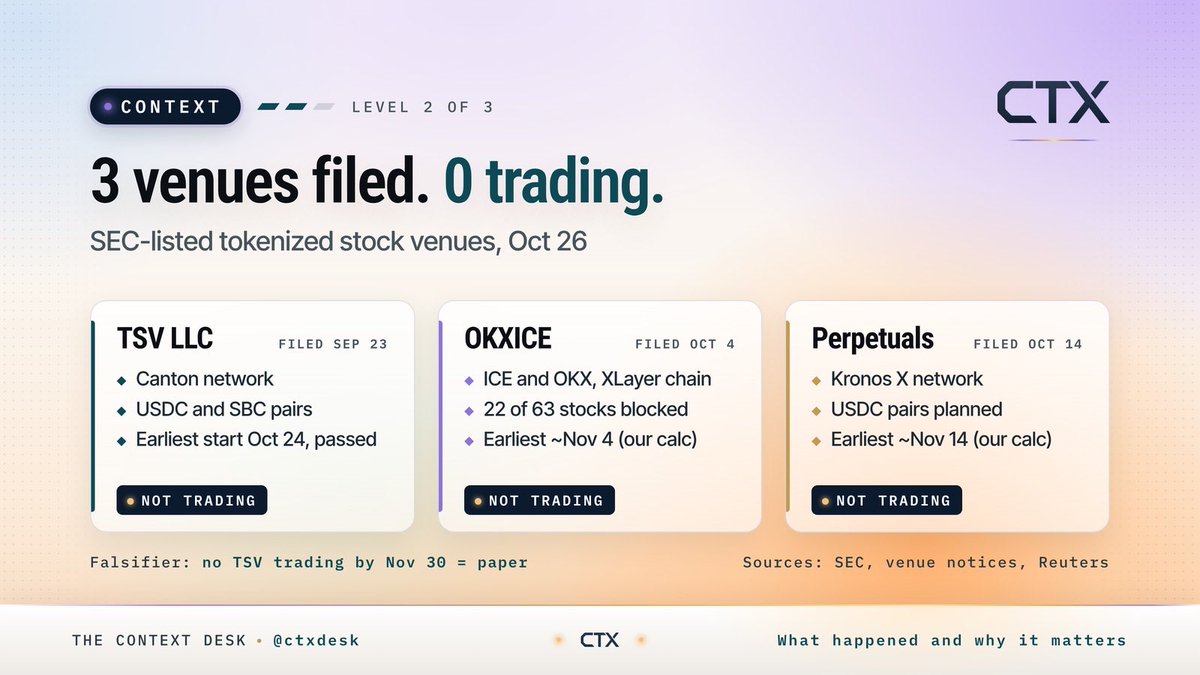
On Oct 26 we asked which would come first under the SEC's tokenized-stock exemption: the first trade at a tokenized securities venue (TSV), or the 32nd company objection at OKXICE, the ICE ($ICE) and OKX venue.
https://t.co/IFamoEz7ef
The 32-of-63 line was crossed in OKXICE's Oct 28 notice: 34 of the 63 named stocks had objected. By the latest notice, dated Nov 5, 57 of those 63 had objected, and the full objector list stands at 67 issuers, including Apple, Nvidia, Microsoft, Amazon and Meta. We found no notice after Nov 5.
Today OKX and ICE said the venue opens Nov 23 for eligible US customers, with more than 70 assets. The named first-mover issuers are Circle, Coinbase ($COIN), Robinhood ($HOOD), Strategy ($MSTR), BitGo, Securitize and https://t.co/XGAPmFQpMm, plus 59 Direxion ETFs. Strategy will also list preferred stock. The six original names that have not objected are exactly Circle, Coinbase, Robinhood, Strategy, Securitize and BitGo.
1. Why issuer participation is different. An objection blocks only this venue, and only a third-party token of that company's stock. A company that lists its own shares is a different legal path: Securitize provides the tokenization, and each token is a security entitlement backed one-for-one by a real US share, with dividends, voting rights and corporate actions. That is not a wrapper the issuer can later wave away.
2. The economic menu changed with it. The launch book is no longer the mega-cap list from October. It is the crypto-native issuers who did not object, plus a large set of Direxion ETFs. No size is given.
3. The cash-leg tell for Circle. Today's launch blog does not name the settlement stablecoin, meaning the cash used to buy the tokens. The still-current Nov 5 notice still says each tokenized stock will be paired with a payment stablecoin such as USDC or USDG. Which coin actually prints on day one is the test of whether Circle captures the cash leg, not only a listing of its own shares.
Watch: if OKXICE is not publicly open by Nov 30, the date slipped. If it opens but no public volume data appears by Dec 31, it is a showcase, not a market. An open venue without volume figures, between those dates, is the no-decision band. We lean: it opens by Nov 30.
Sources: OKX blog Nov 11, OKXICE public notices Oct 4 to Nov 5, Securitize.
No tips. Just context.
Desk take: our 32-of-63 objection watch already hit. Today's launch is the leftover names walking in as issuers, not a reopening of the mega-cap menu.
If the venue opens, will the first public pairs name USDC, or only USDG?
0 of 3. ⏳
That is how many tokenized stock venues on the SEC's list are trading today, two days after the first one could legally have opened.
Quick recap: since Sept 17 an SEC exemption lets "tokenized securities venues" (TSVs) trade blockchain tokens of US stocks 24/7 against stablecoins, without registering as an exchange. Three firms have filed. The SEC says being on its list is not an approval.
Where each one stands, from their own pages today:
1. TSV LLC: earliest legal start was Oct 24. Its site still says "Trading is not yet available" and "Operations have not commenced." Plan: the Canton network, stocks paired with USDC ($CRCL) and Brale's SBC. It only takes shares tokenized by the company's own transfer agent (the firm that keeps the shareholder register), so every listing needs a company to opt in. It names no stocks yet. Its site also says launch depends on meeting the exemption's conditions "or obtaining necessary additional relief."
2. OKXICE, the joint venture of ICE ($ICE, owner of the NYSE) and OKX: earliest start around Nov 4 (our calc, from its Oct 4 notice). Its Oct 23 notice says its main trading contract will be audited before it is deployed. Planned on OKX's XLayer chain, paired with stablecoins such as USDC and USDG.
3. https://t.co/QcFUmWbsLH ($PDC): "coming soon." Filed Oct 14, so around Nov 14 at the earliest (our calc).
What changed since our Oct 19 post: company objections at OKXICE went from 9 to 22 of the 63 stocks it named. Microsoft ($MSFT), Alphabet ($GOOGL), Goldman Sachs and Wells Fargo ($WFC) are now on the list (OKXICE notice, Reuters). An objection blocks only that one venue, and no reasons are given. Nasdaq plans its own tokenized stock platform with Kraken's parent next year (Reuters).
Why it matters: the rule exists and the venues exist on paper, but not one trade has printed. And over a third of the stocks OKXICE planned are already off its menu.
Bear case: objections keep growing, so third-party tokens of big US stocks may never get a real menu. TSV LLC needs companies to opt in, and its site names none yet. Even live venues are capped at 0.25% of a big stock's normal daily volume, so they stay small by design.
The other side: a few weeks of slippage is normal for a brand-new market, and the 30-day notice clocks for OKXICE and Perpetuals have not even run out yet.
Falsifiers:
- No TSV publicly starts trading by Nov 30, 2026: the list is still paper.
- TSV LLC launches off Canton or without USDC pairs: the Canton and USDC angle is wrong.
- OKXICE objections reach 32 of 63 (more than half) by Nov 30: third-party tokens of big stocks are failing.
Desk take: the rulebook arrived before the market. Until one trade prints, tokenized US stocks under this exemption are a filing, not a product. 📄
Which comes first: the first TSV trade, or the 32nd objection?
Sources: SEC, TSV LLC, OKXICE and https://t.co/QcFUmWbsLH notices, Reuters.
No tips. Just context.
A bank downgraded Nvidia this morning over slowing AI spending. Chip stocks are rising into the US open anyway.
Nasdaq 100 futures are up 2.0% at 14:31 CET (CME via Yahoo Finance). The US bond market is closed for Veterans Day and there is no US economic data, so stocks vote alone today.
1. 🧠 Baird cut Nvidia ($NVDA) to neutral. Its analyst sees big tech's AI spending growth slowing to about 40% or less in 2027, and flags possible new China export limits and questions over the CEO's future (CNBC, Reuters). Nvidia is still up 3.9% premarket at $175.46 (Yahoo Finance, 14:41 CET), after losing 9.5% in two days.
The counterweight is a customer. CoreWeave ($CRWV), which rents out Nvidia chips, reported $3.66B in quarterly revenue vs $3.55B expected (LSEG) and $132.5B in signed future orders (company). It is up 15.5% premarket. Micron, Intel and AMD are up 5% to 7%.
2. No live rates today. Tuesday's close is the last word: the 2-year Treasury yield, the rate most tied to Fed expectations, jumped from 4.56% to 4.73%, and the 10-year from 4.88% to 4.98% (US Treasury). Markets price about a 90% chance of a Fed hike on Dec 9 (CME FedWatch via CNBC, market-implied odds, not a forecast).
Here's the catch: mortgage rates fell to 7.21% in the week to Nov 6 (Mortgage Bankers Association), but that survey closed before Tuesday's jump. Bonds get their first vote on Thursday.
3. 🛢️ More oil, higher price. OPEC's monthly report shows the wider OPEC+ group pumped 41.23M barrels a day in October, up 2.04M from September. Saudi Arabia told OPEC it pumped 10.563M a day, its most since February, the last month before the Iran war hit supply (Reuters). OPEC kept its demand growth forecast unchanged.
Brent is still up 1.6% near $93 (ICE via Yahoo Finance). Barrels are coming back. The risk of getting them out of the Gulf is what the price is trading.
4. Talen Energy ($TLN) signed a seven-year deal to sell 750 megawatts of power capacity, meaning it gets paid to keep that power available, for about $100M a year from 2029 (company). The stock is up about 5.8% premarket (Yahoo Finance). The buyer is not named, so we cannot say it is a data center.
5. 🔗 Bitcoin is near $73,700, flat over 24 hours while tech futures rally (Yahoo Finance, 14:41 CET). After the US close, MSCI publishes its final list of companies leaving its global indexes under its new non-operating company rule. Strategy ($MSTR), the biggest corporate bitcoin holder, is on the draft list, effective at the Nov 30 close (MSCI).
Prices: dollar index 102.69 (+0.4%). Gold about $4,046. Europe: STOXX 600 +0.4%, DAX +0.7% at 14:26 CET.
Today (ET): open 9:30 (15:30 CET), bond market closed. MSCI index review after the close. Thursday: Figure ($FIGR) results before the open, call 8:30 ET / 14:30 CET, and bonds reopen.
Watch today: Nvidia's close vs Tuesday's $168.89. Above $172.27, 2% higher, means CoreWeave's demand numbers outweighed the downgrade. Below $168.89 means the downgrade, export and CEO risks still lead. In between: no decision. We lean: above $172.27.
Sources: CME, US Treasury, CNBC, Reuters, LSEG, CoreWeave, Talen Energy, OPEC, Mortgage Bankers Association, MSCI, Yahoo Finance.
No tips. Just context.
Desk take: one analyst says AI spending growth is slowing. One customer just showed $132.5B in orders. This morning the market believes the customer.
Which do you trust more on AI demand: a forecast or an order book?
Chip demand is still leading Europe's midday. The rate problem has not gone away.
Europe has been open since 09:00 CET. Around 11:55 CET, the STOXX 600 is up 0.4% and Germany's DAX is up 0.7%, both off their morning highs (CNBC). Nasdaq 100 futures (bets on where the index trades next) are up about 1.8%, implying about 28,240 on the index (CNBC, our calc). On Tuesday, the US 2-year Treasury yield, the rate most tied to Fed expectations, jumped from 4.56% to 4.73% (US Treasury).
1. 🧠 CoreWeave ($CRWV) sold more than its own forecast and raised its 2026 revenue outlook to $13.0B to $13.3B (company filing). Its shares are still up about 13% in US premarket (CNBC, Nasdaq). In Europe, Siemens Energy is up about 9% and Infineon about 7% (Yahoo Finance). Taiwan's stock index closed +3.6% and Korea's Kospi about +2.6%, led by chipmakers.
Why it matters: AI computing demand still looks real. Nvidia ($NVDA) is up about 4.5% in US premarket after losing 9.5% in two days over the board probe into its CEO. SoftBank closed down 0.4% in Tokyo after falling as much as 11% on a $7.1B quarterly loss, including a $3.7B write-down on US data-center projects (Yahoo Japan, CNBC).
2. 🏦 US consumer prices (CPI) rose 0.4% in October, above the 0.3% expected, and core prices rose 0.3%. Futures now price about a 90% chance of a Fed rate hike on Dec 9 (CME FedWatch via CNBC, market-implied odds, not a forecast).
Here's the catch: US bond markets are closed today for Veterans Day. Stocks trade normally, so equities get the first vote.
3. 🛢️ Brent oil is about $93, up about 1.7% after Tuesday's two-month low (CNBC, Reuters). Reuters counts 37 ship attacks around Hormuz in October.
Why it matters: cheaper oil did not stop core inflation from running hot, so the Fed debate is now about core prices, not fuel.
4. Bitcoin is near $74,000, still roughly flat since midnight CET (Binance).
Today (CET): ECB President Lagarde spoke at 10:45 on capital-markets union, not rates (ANSA). US stocks open 9:30 ET, US bond market closed. Thursday: Figure ($FIGR) results before the US open, call 8:30 ET / 14:30 CET.
Watch today: the Nasdaq 100 close vs Tuesday's 27,741. Futures already imply about 28,240, so the 28,200 line is partly priced in. Above 28,300 means the chip bid held into the US open. Below 27,741 means rates won the day. In between: no decision. We lean: above 28,300.
Sources: BLS, US Treasury, CME via CNBC, CoreWeave filing, Reuters, CNBC, Nasdaq, Yahoo Finance, Binance, Yahoo Japan, ANSA.
No tips. Just context.
Desk take: Europe is still voting for the AI demand story, just less loudly than at the open. US stocks vote at 15:30 CET, bonds on Thursday.
Which one gives way first: chip demand or the Fed?