#hbar technology: fastest, highest ABFT security, leaderless #hashgraph consensus, transaction finality within seconds, fair ordering/timestamping, extremely low gas fees and energy footprint, mature governance model. Enterprise and startup use cases in payments, supply chain, ESG, tokenization, gaming, data integrity, identity, public notary, Iot, and more. #HelloFutur
🚨 NEW TRADES ALERT
Rep. Gil Cisneros just disclosed up to $2,500,000 worth of new trades.
Cisneros sits on House Committee on Armed Services, a Navy veteran and former Under Secretary of Defense.
His latest disclosure includes buying the following military/defense related stocks within 3 weeks (May 4 - 29):
$THLEF - French defense electronics company, major NATO contractor in radars, missiles, naval combat systems, and satellite comms.
$DCO - U.S. aerospace & defense components supplier, sells to Boeing, Lockheed, Raytheon and more.
$SARO - Aerospace engine MRO, including military engine overhauls for the U.S. Air Force and allied air forces.
$CRWD - Major federal cybersecurity contracts including Department of Defense.
$AMD - Semis with growing Department of Defense AI/compute contracts.
$NOVT - Precision photonics including defense laser applications.
$TEL - Connectors widely used in military electronics.
$ST - Sensors with defense/aerospace applications.
$CIEN - Optical networking, has federal/defense customers.
$FN - Optical components manufacturer, defense customer base.
$TOELF - Indirect defense tie via the chip supply chain.
Congresswoman April McClain Delaney just disclosed up to $935k of new trades.
She traded 18 different stocks.
Including, once again, $TDG.
We flagged her last disclosure because she bought $TDG 5 times.
The new disclosure shows that she bought it again in the past month, 6 more times.
11 buys in two months.
$TDG is an aerospace/defense supplier.
Delaney sits on Science, Space and Technology Committee.
We estimate her average cost is $1,227 per share.
The stock is currently trading at $1,211
I believe $NOK is one the most overlooked setups right now, which is why I recently took a position in them.
To me, it has a simular setup as $OUST.
You remember $NOK as the company that made the phone everyone had, then lost it all, then spent a decade stumbling through acquisitions and identity crises while the world moved on without it.
That version is over NOW.
What's happening with Nokia right now is one of the most misunderstood setups I've seen in a long time and I hold it.
Here's the full thesis:
When people hear Nokia, they still think of the brick phone, 3310 or the game snake. Maybe they think of the Ericsson comparison. Maybe they think "slow European telecom equipment vendor."
None of that is the trade.
The trade is this: Nokia is quietly becoming the infrastructure layer for the AI-native wireless era and the market hasn't fully priced it yet.
The unlock happened in October 2025. Jensen Huang flew to Washington D.C. and, at NVIDIA's GTC event, announced a $1 billion equity investment in Nokia, at $6.01 per share, giving NVIDIA a 2.9% stake in the company. The announcement caused Nokia shares to surge 15-25% in a single session. It was Nokia's largest single-day gain in over a decade.
What many missed was NVIDIA's strategically allocate capital and putting a billion dollars behind their conviction that Nokia owns a critical piece of the AI infrastructure stack.
When Jensen bets a billion, I listen.
Let me explain the technology plainly, because this is where most investors glaze over and miss the opportunity.
The RAN — Radio Access Network — is the part of a wireless network that connects your phone, your car, your robot, your drone, to the broader internet. It's the "last mile" of connectivity.
For decades, RAN was hardware-defined: dumb antennas, proprietary chips, fixed performance. You got what you built. That was fine when the network just needed to move voice calls and streaming video.
AI breaks that model completely.
When AI-driven applications start running in the physical world; autonomous vehicles, robotic systems, edge inference, real-time sensing, the network demands become fundamentally different.
Latency isn't just important, it's deterministic. Jitter can't exist. The network has to be adaptive in real time, not just provisioned and left running.
Nokia launched its AI-RAN initiative in October 2025, demonstrated it with T-Mobile, and is now moving into commercial trials in 2026, targeting commercial release in 2027.
The core idea is transforming the RAN from a fixed hardware layer into a software-driven platform, one that uses AI to optimize itself continuously, responds to traffic patterns in real time, and can monetize spare GPU compute by offering AI inference capacity to external customers.
Read that last part again.
The base station becomes a revenue-generating AI compute node. Nokia's demonstrations at MWC26 in Barcelona showed exactly this: spare GPU capacity in the distributed AI-RAN network being offered to external customers as compute. The radio tower becomes a distributed edge data center.
This is the architectural shift. This is why NVIDIA cares.
Let me be precise about what the NVIDIA relationship means structurally.
NVIDIA introduced the Aerial RAN Computer Pro (ARC-Pro) a 6G-ready accelerated computing platform that combines connectivity, computing, and sensing in a single device.
Nokia is building its next-generation AI-RAN product line on top of this platform.
Dell Technologies is providing the PowerEdge servers.
The software stack runs on Red Hat OpenShift.
The ecosystem now includes Quanta and SuperMicro as hardware partners. BT, Elisa, NTT DOCOMO, Vodafone Group, and T-Mobile are all working with Nokia and NVIDIA on AI-RAN integration.
As of Q1 2026, Nokia has 10 publicly committed customers for its AI-RAN platform, including T-Mobile, Deutsche Telekom, Vodafone, SoftBank, and NTT Docomo.
Nokia's CEO Justin Hotard, who came in from Intel's data center division, put it plainly at MWC26:
"AI-RAN transforms RAN into a software-driven platform optimized for AI, and with NVIDIA and a growing ecosystem of partners we are progressing from validation to commercial deployment. This is a foundational step toward AI-native networks and 6G."
Jensen Huang said it even more plainly:
"AI is redefining computing and driving the largest infrastructure buildout in human history and telecommunications is next."
This is the AI infrastructure playbook being applied to the last uncaptured domain: the wireless edge.
Nokia delivered a strong Q1 2026. The company raised its full-year growth expectations for its Network Infrastructure business and reported a €1 billion order intake for the quarter. Net cash on the balance sheet stands at €3.8 billion, up from €3.4 billion at end of Q4 2025.
Remember what I said; simular to the $OUST setup, great cash balance.
For the full year, Nokia is targeting comparable operating profit of €2 to €2.5 billion in 2026, with a longer-term target of €2.7 to €3.2 billion by 2028. That's a meaningful step-up trajectory as AI-RAN revenues begin to compound.
The AI-RAN market itself, according to analyst estimates, is projected to exceed a cumulative $200 billion by 2030.
6G infrastructure spending is expected to reach $30 billion annually by 2033, growing at a 63.5% CAGR.
Nokia, as the lead equipment vendor in an NVIDIA-backed AI-native architecture, is positioned to capture a disproportionate share of that buildout.
The restructuring matters too. Nokia reorganized into two operating segments effective January 2026; Network Infrastructure and Mobile Infrastructure, simplifying the model and sharpening capital allocation.
This is not a company still searching for an identity. The pivot is complete.
The final brick in the puzzle is the detail that made me take a second look before I entered the position, and it matters more than most people give it credit for.
The insider buying at Nokia has been consistent and significant. Multiple Article 19 EU MAR disclosures have been filed; senior managers buying shares on the open market at RECENTLY highs and prices.
This is required public disclosure in the EU, which means we're seeing it unfiltered. When insiders file mandatory transaction disclosures showing open-market purchases at market prices, that's unambiguous directional signal from the people who know the most about where this company is going.
Outsiders react to headlines. Insiders act on conviction. To me, the disclosures are speaking.
It will take time to play out, but I believe Wall Street is about to slowly catch up. Morgan Stanley raised its price target from €11 to €14 in May 2026 and maintained a Buy rating.
SEB Equities upgraded from Hold to Buy.
73% of covering analysts are currently at Buy or equivalent.
The analyst community tends to be lagging indicators.
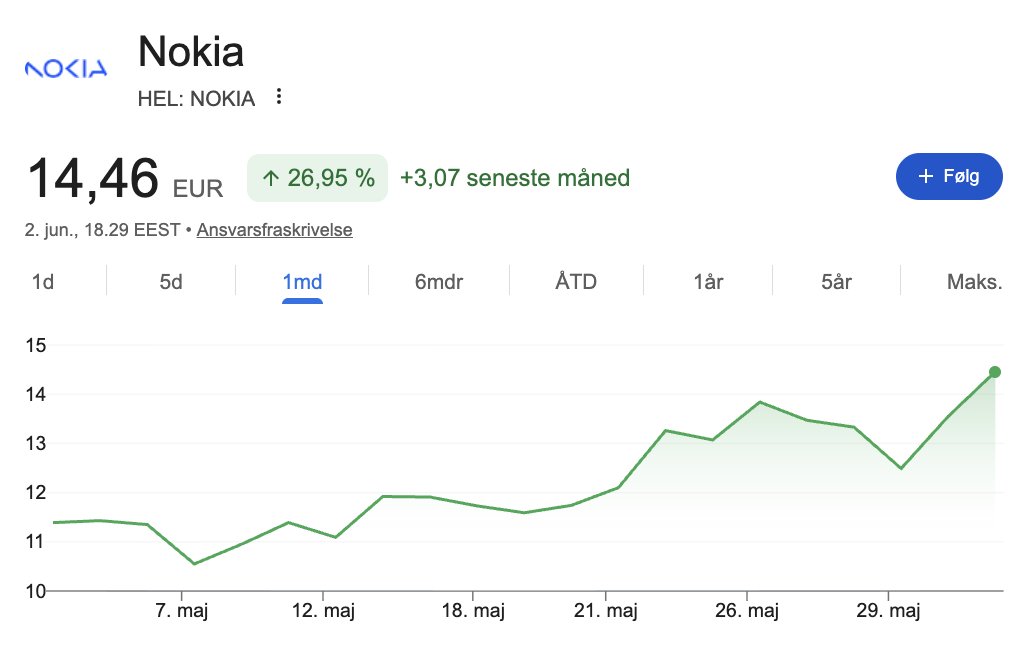
The entry zone has been constructive. The stock is now in the mid-teens. I'm watching the commercial trial results in 2026 and the 2027 commercial launch cadence closely. That's when this goes from a NVIDIA-backed thesis to a revenue story.
Here's what I want you to sit with.
Every AI infrastructure buildout conversation eventually hits a ceiling: where does the intelligence meet the physical world? Data centers get you to the edge of the cloud. Fiber gets you to the building. 5G gets you to the street. AI-RAN gets you to the device, the robot, the vehicle in real time, adaptively, without latency, at scale.
Nokia is building the bridge between the cloud and physical AI. That's not a niche play. That's infrastructure for the next twenty years of computing.
The Robotic AI Radio isn't a product name. It's a description of what every base station eventually becomes.
Nokia was dismissed for a decade because people couldn't see past what it used to be. That's exactly the kind of mispricing where the best returns live.
I hold it. I'm watching it closely. And I think the rest of the market is just starting to understand what NVIDIA understood in October.
Please note: As always this is not financial advice. This reflects my personal analysis and position as part of my portfolio. Do your own research. Know your risk.
—BP
INSANE: 🇺🇸Dell just landed a $9,700,000,000 U.S. government contract as a Hedera governing council member.
Service now is another and Trump is telling you about it
Do you understand what NVIDIA just did?
They didn't announce anything.
Just coordinates: 25.0528, 121.5990
That's Taipei.
Computex starts June 2.
And three words — "A new era of PC."
Here's what I think is coming.
- NVIDIA has been quietly building an ARM-based chip for Windows PCs.
- Developed with MediaTek.
- Designed to run AI natively on your laptop.
- Not a GPU.
- Not a data center chip.
- A processor. For your PC.
And if the leaks are right — it could match RTX 4070 performance
in a thin, efficient laptop. 👀
Intel. AMD. Qualcomm.
They've owned this space for decades.
NVIDIA is walking in.
Jensen Huang also hinted at a "surprise new product nobody knows about yet" for the second half of 2026.
This tweet might be that first signal.
A company that makes the world's most powerful AI chips now wants to power your everyday PC.
That's not an upgrade. That's a new era...
🚨 SPACEX MAY BE THE BIGGEST INSIDER CASHOUT IN MARKET HISTORY!!!
SpaceX is expected to go public on June 12 at a valuation of $1.75-$2 TRILLION.
That would instantly make it larger than Microsoft and second only to Apple and Nvidia in the US market.
Yet the company lost $4.28 BILLION in Q1 2026 alone and has accumulated deficits of $41.3 BILLION since founding.
The real story is what happens after the IPO.
Insiders currently own 95% of all shares.
The public float is only 5%.
And insiders are sitting on $1.66 TRILLION of paper wealth that cannot currently be sold.
Most IPOs lock insiders up for 180 days.
SpaceX isn't doing that.
Just 60 days after listing, 20% of eligible insider shares can unlock.
If the stock rises 30% above the IPO price, another 10% unlocks.
Then five separate 7% unlocks hit between days 70 and 135.
By November 2026, 93% of early-release insider shares could already be free to sell.
This isn't just an IPO.
It's one of the biggest liquidity grab events Wall Street has ever seen.
Space X ipo this June
So many questions
they have the availability to sell on a quick schedule, retail could eat that up or it could pull back and get a better price for the purchase
However, if they wanted to raise money, they could do it through private sale
probably some now and some later 🤷♂️
Its Elon anything can happen
I saw now as an interesting opportunity when it was at his low $.90 a share.
The CEO of Nvidia told you about it. In fact, they are across the street from service now headquarters. Kind of seems like a perfect buyout.
Then Trump spoke about it.
I’m thinking now $$$$ target is a solid 236
target and the time sept 2027
Idk 🤷♂️ at this pace it will be much faster
I think it’s really interesting. That service now is on the governing board of hbar
TRUMP TOLD YOU TO BUY $INTC
people laughed at him.
Then Intel ripped 500%.
Now he’s publicly telling Americans to buy $DELL while AI infrastructure spending is exploding.
This isn’t just about PCs anymore.
$DELL is becoming one of the biggest AI infrastructure plays in the market:
• Massive AI server demand
• $NVDA partnerships
• AI backlog hitting record levels
• Governments racing to build sovereign AI systems
• Enterprise AI capex accelerating
Trump’s entire AI agenda is centered around building American AI dominance, data centers, and compute infrastructure.
$DELL sits directly in the middle of that trade.
Maybe the market shouldn’t ignore these comments twice.
T1 Energy (NYSE: TE) is a high-risk, high-reward stock favored by momentum investors due to its massive price surge and potential exposure to AI data center power demand. However, its unprofitability and reliance on future project execution make it speculative.
🧐