One day in.
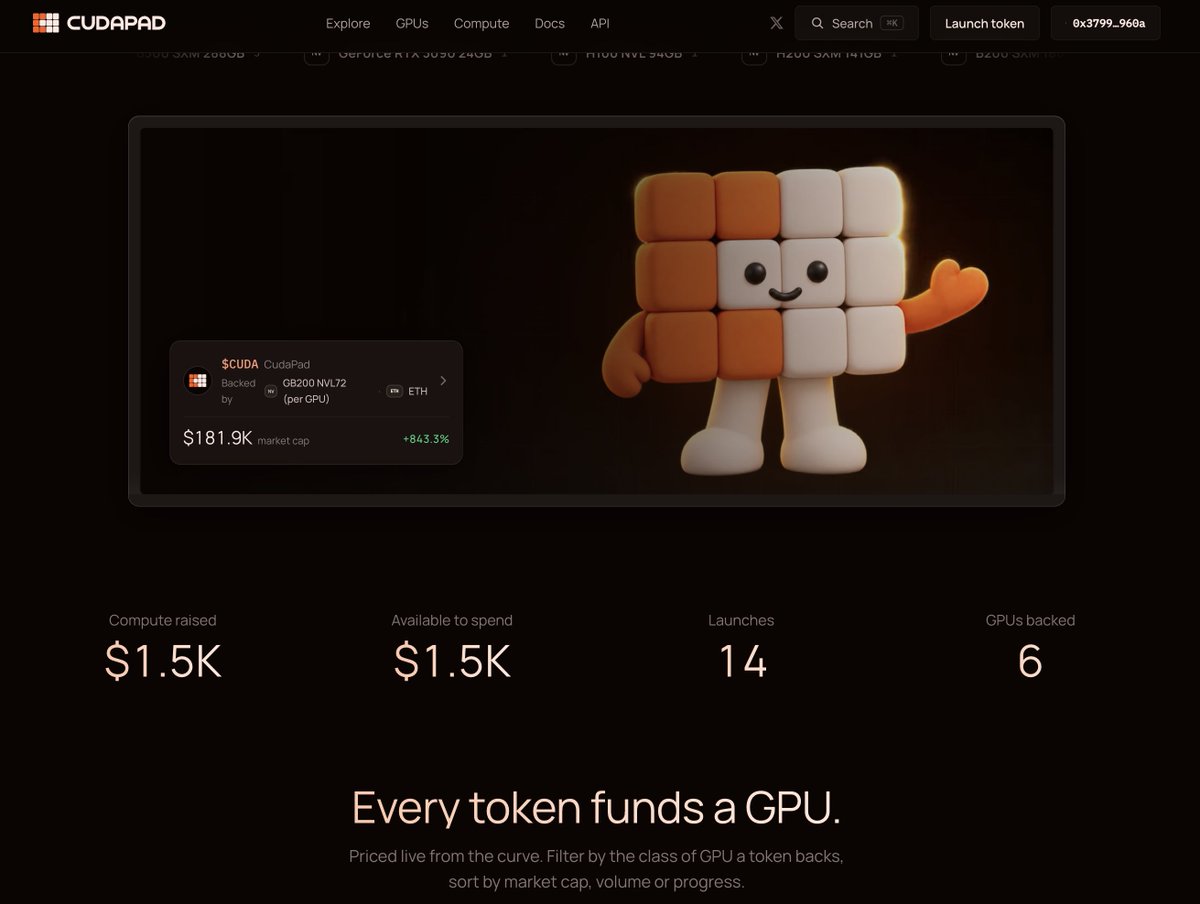
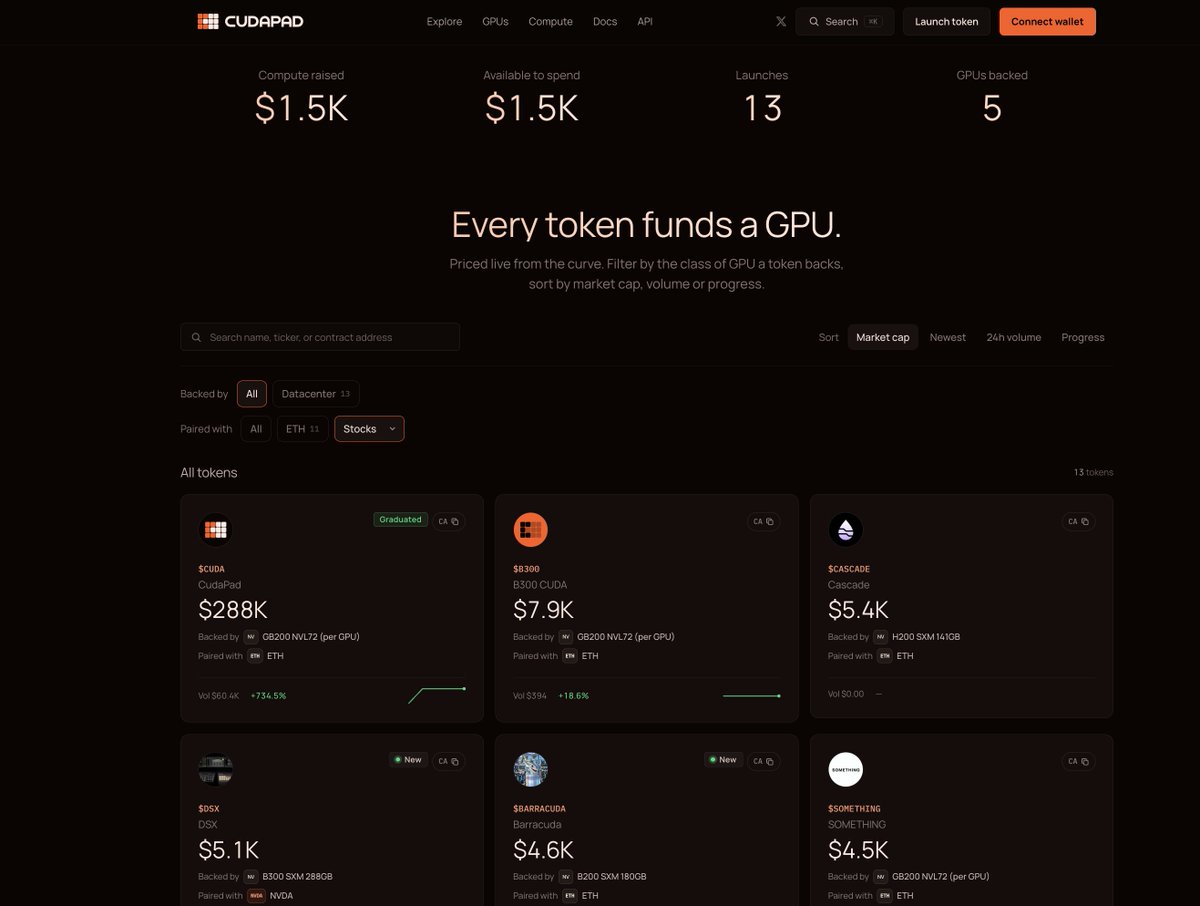
14 tokens launched on CudaPad since yesterday. every one of them is backed by a specific GPU, from a GB200 down to a 3090.
6 different GPUs are now backed. 2 pair assets in use: ETH and $NVDA.
each of those launches pays a 2% creator fee on every trade, and half of that fee buys GPU-hours anyone on the platform can run jobs on.
launch a token. back a GPU. fund the hours.
https://t.co/i1IMBRezMM
Assuming you haven't tried the console yet:
any wallet that has launched a token can run a job on any GPU on the platform, paid by the shared pool.
launch once, then pick a GPU here:
https://t.co/IedeN17olb
We seeded the GPU pool with $1,500 today so day-one launchers can run jobs right away.
14 launches, 6 GPUs backed, $1,500 available to spend.
Fees take over from here.
We pride ourselves on being one of the first building GPU infrastructure on Robinhood Chain.
Very few people are building in this sector here, even though compute is the most capital-hungry part of AI.
The goal is simple: more GPU access, for more people, funded by markets that are already active.
NVIDIA's DSX pitch is that the constraint on AI is no longer chips. it's the megawatts feeding them, and how well a factory adapts when the grid changes.
That's the supply side. the question that gets less attention is who pays for the hours a GPU actually runs.
Today most of it is a cloud bill, or a fund raise.
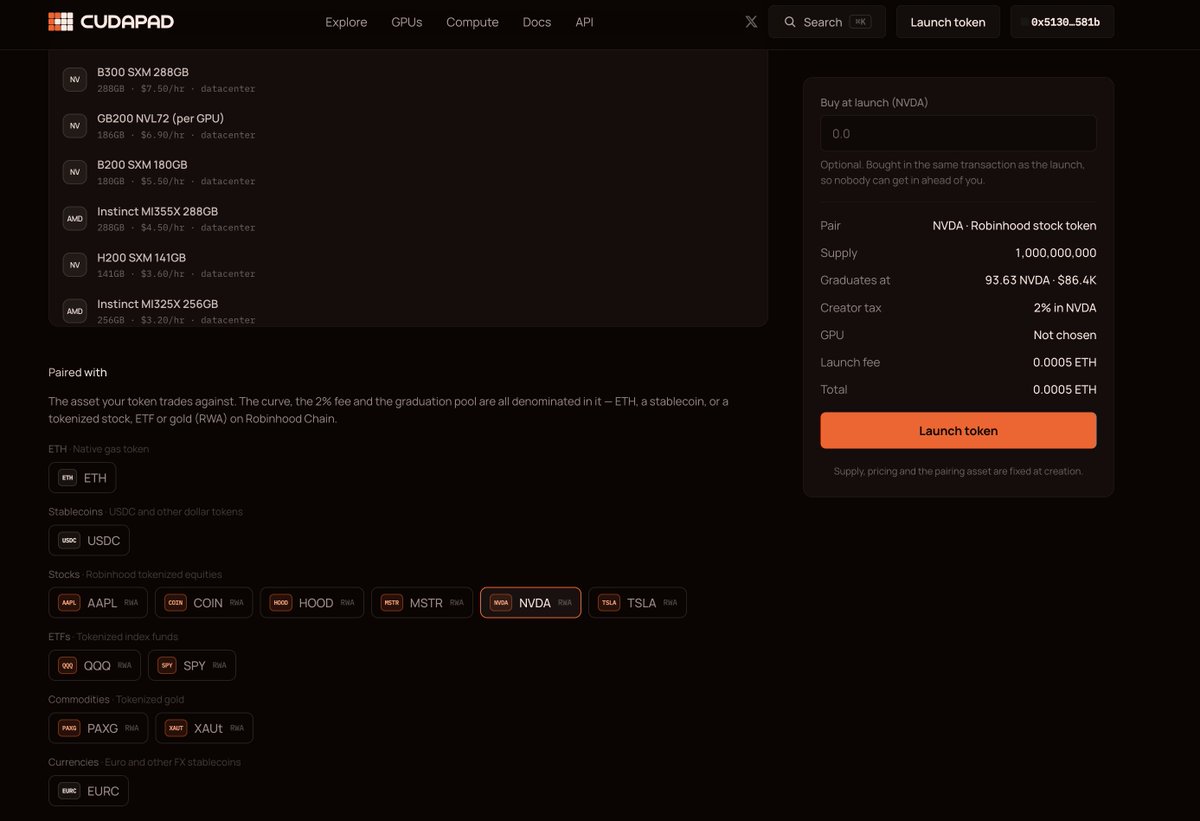
We're testing a third way. $DSX went up on CudaPad this morning: a token backed by a B300 SXM 288GB, paired with $NVDA. its trading fees buy hours on that GPU, and anyone on the platform can run jobs on them.
Every megawatt matters.
The NVIDIA DSX AI Factory Platform helps AI factories maximize AI output, improve energy efficiency, and intelligently adapt to changing grid conditions. #AIInfraSummit
🔗 https://t.co/TVfKujlZr1
CudaPad × Pons.
Every token launched on CudaPad is a @ponsdotfamily token on Robinhood Chain.
Which means every launch shows up on the pons dashboard the second it goes live: curve, holders, graduation, all of it.
One launch, two homes.
Trading → Creator fees → GPU-hours → Jobs
Launch a token. Trade onchain. Fund a GPU.
https://t.co/iUDt510381
if you've been around GPUs for as long as we have, you know how this started.
in 2007 Nvidia shipped CUDA and turned a graphics card into a general-purpose computer. every model you use today runs on that idea.
then DePIN took the next step. Render, Akash, https://t.co/nnksSO2qU6 and the marketplaces that followed proved that spare GPUs could be pooled and rented onchain.
what nobody did is let a token pay the bill.
every GPU marketplace still ends at the same place: someone opens a wallet and pays per hour.
we want to carry that idea forward on Robinhood Chain. a token is launched, it trades, and the fees from that trading buy the GPU-hours themselves.
CUDA made the card programmable. DePIN made it rentable.
we want to make it fundable.
MUST SEE: Amazing moment as President Trump calls Nvidia CEO Jensen Huang while he's on stage at the All-In Summit.
@POTUS on AI Doomerism: “I'm telling you, it's all a hoax… and we're not going to let that happen.”
We have limits in place to prevent anyone from draining the pool.
every job is capped at 8 hours, a wallet can run 2 jobs at a time, and every job is billed on the actual hourly rate of the GPU it ran on.
access is shared without letting a single wallet burn through the balance.
Launch a token backed by an H100 and paired with $NVDA.
Same curve, different pair. The fees come in whatever you paired with, and they still buy GPU-hours.
13 pairs live: ETH, USDC, EURC, TSLA, NVDA, AAPL, MSTR, HOOD, COIN, SPY, QQQ, and two gold tokens.
https://t.co/GrY0xN28uX
We Must Pace the Frontier: I’ve written a new essay on why the AI industry should slow down, with a three-part plan for doing so.
Anthropic is unilaterally committing to the first of these steps. We’ll provide third-party evaluators with permanent, employee-level access to our systems, so that they can verify adherence to our safety measures, report on incidents, and assess models’ alignment during training.
You can read the full post here: https://t.co/OGyPb7yaYt
5/5
the entire loop is funded by trading activity.
tokens generate volume. volume generates creator fees. creator fees become GPU-hours. GPU-hours run jobs.
launch a token. trade onchain. fund a GPU.
https://t.co/tduHdcRC6Y
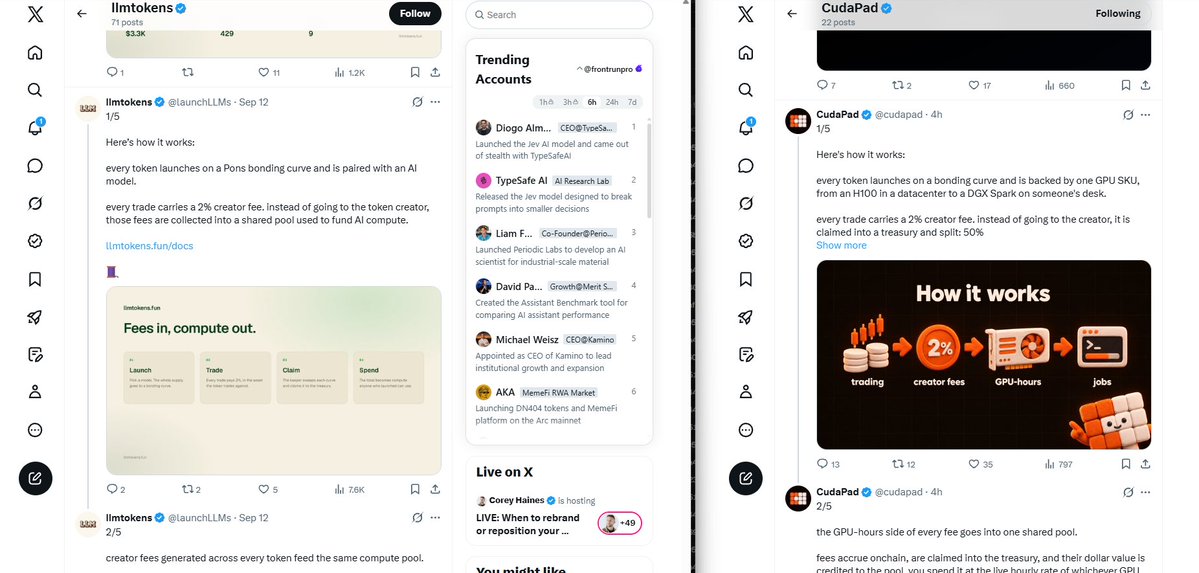
1/5
Here's how it works:
every token launches on a bonding curve and is backed by one GPU SKU, from an H100 in a datacenter to a DGX Spark on someone's desk.
every trade carries a 2% creator fee. instead of going to the creator, it is claimed into a treasury and split: 50% GPU-hours, 30% buyback & burn allocation, 20% protocol.
https://t.co/KW7EDMhLWs
🧵
4/5
every job is billed on actual usage: hours × the hourly rate of the GPU you picked.
jobs are capped at 8 hours and 2 running at a time per wallet, so one wallet can't drain the pool.
the cost comes straight out of the shared pool, connecting onchain trading to a GPU that is actually running.