Lee Kuan Yew:
“Air conditioning was a most important invention for us, perhaps one of the signal inventions of history. It changed the nature of civilization by making development possible in the tropics. Without air conditioning you can work only in the cool early-morning hours or at dusk. The first thing I did upon becoming prime minister was to install air conditioners in buildings where the civil service worked. This was key to public efficiency."
@MrtnzAlvrz@EstablierYago Estimado Martinez, el efecto de inflaccion en earnings growth no se cancela en el ratio PER. Lo que se cancela es los earnings de hoy con el precio de hoy. No el descuento de earnings futuros. Eso lo ves facil en la formula del valor terminal, que es lo que un Per aproxima.
La productividad no es hacer mas cosas. Es eliminar las que no importan. La mayoria de las empresas no fracasan por falta de actividad, fracasan por confundir movimiento con progreso.
Una buena semana tiene pocos objetivos, responsables claros y decisiones rapidas. Todo lo demas es teatro corporativo.
Lo fascinante de esta foto es que no parece Florentino Pérez, sino alguien que quiere convertirse en Florentino Pérez.
El peinado perfectamente controlado, las gafas de tecnócrata, el pasador de corbata y el traje amplio. Puro "Italian Corporate Ambition Core".
Es el lenguaje de la España de finales de los 70 y principios de los 80. Una época en la que la gran aspiración social era convertirse en ingeniero, abogado o banquero.
Algo que siempre me ha fascinado de los hombres poderosos es que casi todos tuvieron una fase previa donde parecían personajes secundarios.
Su peinado transmite aspiración más que poder.
Las gafas grandes transmiten inteligencia, preparación técnica y autoridad profesional.
Todo el look está construido alrededor de una idea:
"Que me tomen en serio".
Es la imagen de alguien que todavía no es poderoso, pero está decidido a serlo.
Jeder in der Blaulichtfamilie weiß: Stichverletzungen sind von außen oft kaum zu erkennen – vor allem bei scharfer Klinge und tiefem Einstich. In diesem Bodycam-Video sagt Henry Nowak klar und deutlich: „I’ve been stabbed“ – ich wurde erstochen.
Man hört seiner Stimme die schwere Sprechdyspnoe an (die extremste Form der Atemnot, bei der schon das Sprechen zur Qual wird). Er fleht unter höchster Anstrengung um Hilfe. Eine Polizistin wiederholt seine Worte und schlägt vor, ihn zu untersuchen.
Es passiert nichts. Alle Beamten haben es gehört, verstanden – und ignoriert.
Statt sofort den gesamten entkleideten Körper ärztlich zu untersuchen, wie es bei lebensbedrohlichen, äußerlich unsichtbaren Verletzungen zwingend vorgeschrieben ist, legen sie ihm Handschellen an, lesen ihm seine Rechte vor und behandeln ihn wie einen Täter. Henry Nowaks Tod ist das Ergebnis eines kompletten, bewussten und unverzeihlichen Versagens dieser Polizisten.
Sie haben entgegen ihrem Wissen und ihrer Pflicht nicht gehandelt. Dass ein sterbender junger Mann in dieser Situation nicht ernst genommen wurde, hat einen bitteren Beigeschmack: Sobald ein weißes Opfer beteiligt ist und die Täter „Rassismus“ rufen, scheint das Opfer sämtliche Rechte zu verlieren und wird seinem Schicksal überlassen.
Ruhe in Frieden Henry Nowak.
Send the video to everyone you know showing how heinously Nowak was treated by the police in his dying moments and how the police cravenly kowtowed to his murderer.
Legacy mainstream media, same ones who wrote about George Floyd millions of times, are dead silent about Nowak.
@Gsnchez Gerard cuando intento reservar en la web me lleva directo al link de pago con apple pay. Pero no pide informacion anterior para mandarme el link de conexion y clave de acceso. Si pago con apple pay como funciona luego recibir eso ?
A British biologist looked at 200,000 years of human history and found that the entire reason humans broke out of poverty was not intelligence, not language, not even agriculture, but one mechanism so simple a 6-year-old could explain it.
His name is Matt Ridley.
He is a zoologist by training, an evolutionary biologist by career, and in 2010 he wrote a book called The Rational Optimist that quietly argued the most important fact about human progress had been hiding in plain sight for the entire history of economics.
Naval Ravikant has been telling people to read everything Ridley has ever written for the last 15 years. The reason is the argument inside this one book.
For 200,000 years, anatomically modern humans walked around with the same brain you have right now. Same skull size. Same neural architecture. Same raw capacity for language, planning, and abstract thought.
For roughly 190,000 of those years, almost nothing happened. Generation after generation lived and died inside the same Stone Age toolkit their great-great-grandparents had used. Then somewhere around 50,000 years ago, the line on the chart of human progress started to tick upward. Then it bent. Then it exploded.
The question Ridley spent years on was the only question that mattered. What changed.
It was not the brain. The brain had been the same for 190,000 years. It was not language, which had existed long before the takeoff. It was not even agriculture, which arrived only 10,000 years ago and was actually preceded by the upward bend, not the cause of it.
What changed was that humans started trading with strangers.
This sounds too small to be the answer. Ridley argues that it is the answer to almost everything. The moment one human exchanged a useful object with another human from a different group, something happened that no other species on earth had ever done.
Two ideas that had developed in isolation came into contact. The flint knapper learned what the spear maker had figured out. The fisherman from the coast learned what the hunter from the forest had figured out. The two pieces of knowledge fused into something neither side could have produced alone.
Ridley calls this ideas having sex. The phrase sounds frivolous and it is meant to. The point is that ideas, like genes, get better when they combine with other ideas from different lineages.
An idea sitting inside one head, no matter how brilliant the head, eventually hits a ceiling. The same idea exposed to ten thousand other ideas does something genes do under sexual reproduction. It mixes. It recombines. It produces offspring nobody planned.
The cleanest proof of this argument is the most uncomfortable case study in the book. Tasmania.
Around 10,000 years ago, rising sea levels cut Tasmania off from mainland Australia. A population of roughly 4,000 humans was now isolated on an island, with no possibility of contact with the rest of humanity. They had the same brains. The same language. The same starting toolkit as their cousins 150 kilometers north. The natural experiment was now running.
What happened next is something no economist or geneticist had ever predicted.
The mainland Australians kept inventing. Boomerangs. Spear-throwers. Fishing nets. Bone needles for sewing fitted clothes. Watercraft with paddles. Their technology compounded slowly across the centuries.
The Tasmanians went the other way. They did not just fail to invent the new tools their cousins were developing. They started losing the tools they already had. Fishing was abandoned within a few thousand years. Bone tools disappeared. Fitted clothing disappeared. They forgot how to make fire from scratch and started carrying lit firebrands from camp to camp instead, relighting their fires from a neighbor's whenever their own went out.
By the time European explorers arrived in the 17th century, the Tasmanians had the simplest toolkit of any human society ever recorded. Their material culture had gone backward for 8,000 years.
The archaeologist Rhys Jones called it a slow strangulation of the mind.
Joseph Henrich at Harvard later proved with formal mathematical models that there was nothing wrong with Tasmanian brains. There was something wrong with their network. A toolkit requires a critical mass of people exchanging skills to maintain itself.
The act of teaching a skill is imperfect. Every generation loses a small percentage of what the last generation knew. If your population is large enough and trading widely enough, those losses get caught and corrected by someone else who still remembers.
If your population shrinks below a certain threshold and stops mixing with outsiders, the small losses compound until entire technologies disappear.
This is the part that should haunt anyone reading this in 2026.
Intelligence is not a property of the individual brain. Intelligence is a property of the network the brain is connected to. A genius in isolation will produce less than a mediocre thinker inside a dense exchange of other mediocre thinkers.
The thing your ancestors needed in order to break out of 190,000 years of stagnation was not better brains. It was better connections between brains they already had.
The implication for any individual is direct and uncomfortable. If you are smart and isolated, you will be outproduced by people half as smart who are connected.
The most successful people in any field are almost never the smartest people in it. They are the ones positioned at the intersection of the most idea flows. They are reading more authors than their competitors. They are talking to more people from more disciplines. They are in the rooms where ideas from different lineages bump into each other.
Ridley ends the book on the line that sounds optimistic but is actually a warning its this "The future will be invented by people who connect ideas, not by people who guard them."
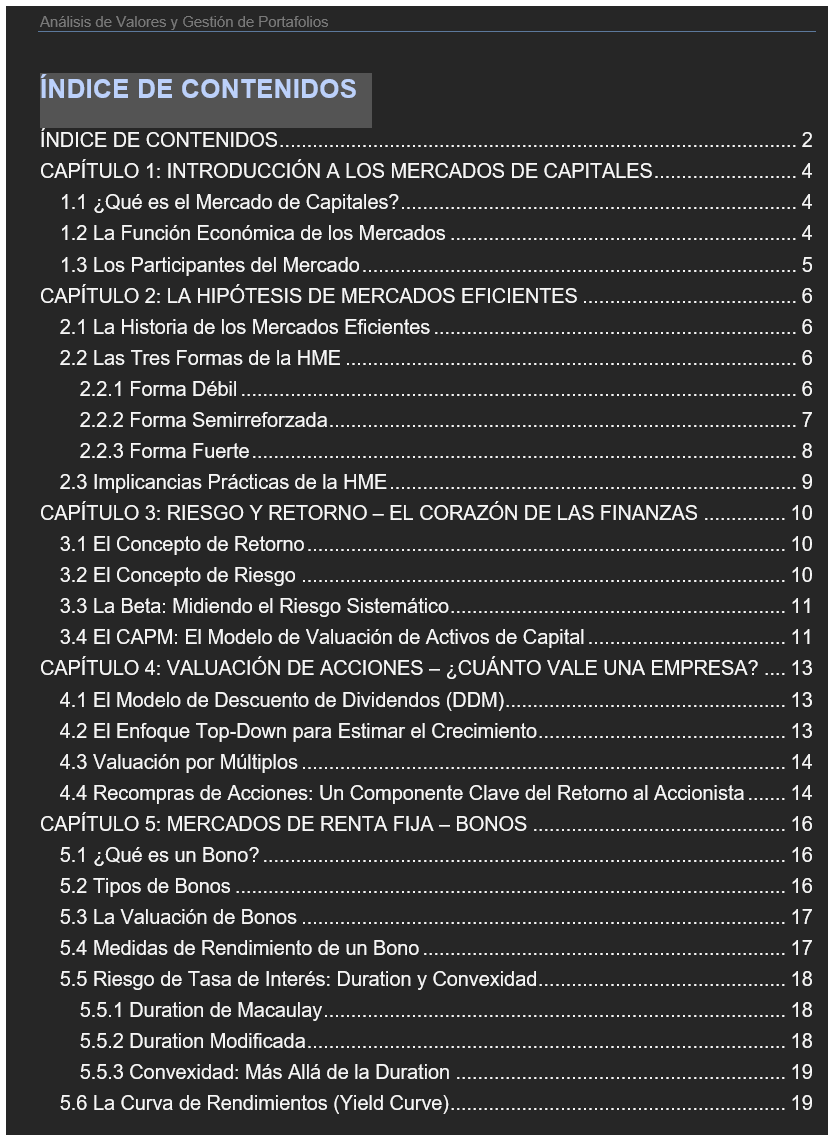
Hace unas semanas se me ocurrio volcar en un Word gran parte de lo que aprendi en un Master que valio 100.000 USD.
Aca, gratis, para que no tengan que gastar guita, que a mi criterio, es innecesaria desde el punto de vista academico.
No les garantiza absolutamente nada, pero si les gusta las finanzas y estan en proceso de aprendizaje, muy probablemente puedan sacarle provecho.
Estoy terminando de corregir partes ortograficas y en breve lo subire a algun lado, mientras les dejo el indice para que vayan viendo de que vamos a hablar.
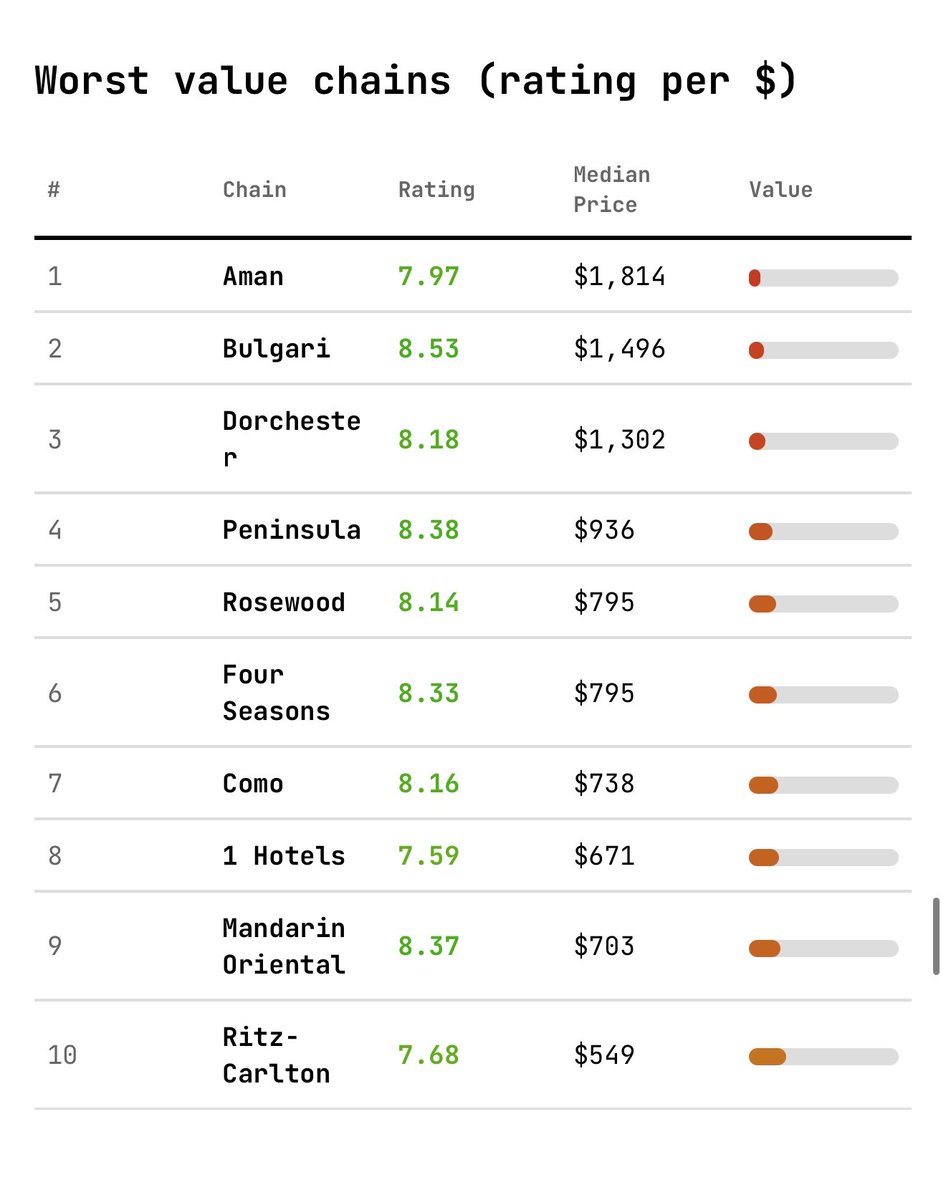
Agreed, and I can prove that luxury hotels are mathematically literally very bad value
For the amount of "more" money you pay for this luxury, you should be getting way way way more than you actually get (as measured by ratings)
Aman should have an average rating of 9.5 but in reality barely hits an 8 on average, so they simply cannot produce the "luxury" experiences they are trying to market and brand themselves for
It's essentially all smoke and mirrors, and reflects my experiences completely, you pay 10x more and get either 0.5x-1.5x more (eg many times 2x worse, sometimes a bit better) not 10x better!
Other luxury chains are slightly better but none of them even get close to a 9 rating with the famous Ritz-Carlton being especially bad: its average rating is a 7.68 for a median price of $549/night, terrible!
Real value can be found with Okura, Minor, Melia and even Marriott. Okura is interesting because well known as luxurious but median only $143/night
So as I always say, luxury is mostly a scam, it doesn't exist and you're best off spending much less for much better value (and often better experiences too)
Source: my new site stats page https://t.co/soyNqf0J7D
@budino_antonio Quien dice que faltan ? Habra gente que diga que sobran. Eso es muy subjetivo ya que asume que hay un gasto militar adecuado para España.
@volatilitysfray Todo esa teoria para explicarse lo listos que son esta fenomenal. Pero en cuanto se les acabo la libra como moneda de reserva y el expolio de la India, ciao. Y a día de hoy UK es una historia de fracaso total desde los 70s. Y eso que las dos guerras mundiales les ayudaron.
LARRY ELLISON: AI IS RAPIDLY COMMODITIZING BECAUSE MOST MODELS ARE TRAINED ON THE SAME PUBLIC INTERNET DATA.
THE REAL COMPETITIVE EDGE ISN’T THE MODEL ANYMORE — IT’S ACCESS TO EXCLUSIVE, PROPRIETARY DATASETS.
THAT MAY BE THE ONLY MOAT LEFT.
This figure by Leandro Prados de la Escosura (@LdelaEscosura), from his new paper “Accounting for the Reversal of Fortune: Spain and Britain, 1501-1800,” is striking.
Something very fundamental broke in Spain around 1560. Having a GDP per capita slightly above Britain's around 1560, Spain fell to less than 50% of it by 1790/99. Part of this was a drop in absolute level: Spanish GDP per capita was around 10% lower in 1790/99. But most of it was due to Britain taking off while Spain did not. Leandro argues that the evidence points to low input efficiency in Spain (plus ça change, plus c’est la même chose).
Spain’s economic performance during the 19th century and the first half of the 20th century was not much better. You cannot understand Spanish history, or even current events, without appreciating its centuries of stagnation and decline.
The figure also shows the growing consensus among economic historians: modern economic growth started in Britain around 1650, much earlier than conventional accounts of the Industrial Revolution suggest.
Link to the paper: https://t.co/gtZPulzVPK
Esta es la lista de todo un país.
ESTA ES LA LISTA DE ESPAÑA.
👥 Estos son los internacionales que representarán a la @SEFutbol y todas nuestras ilusiones en la próxima
#CopaMundialFIFA.
#VamosEspaña