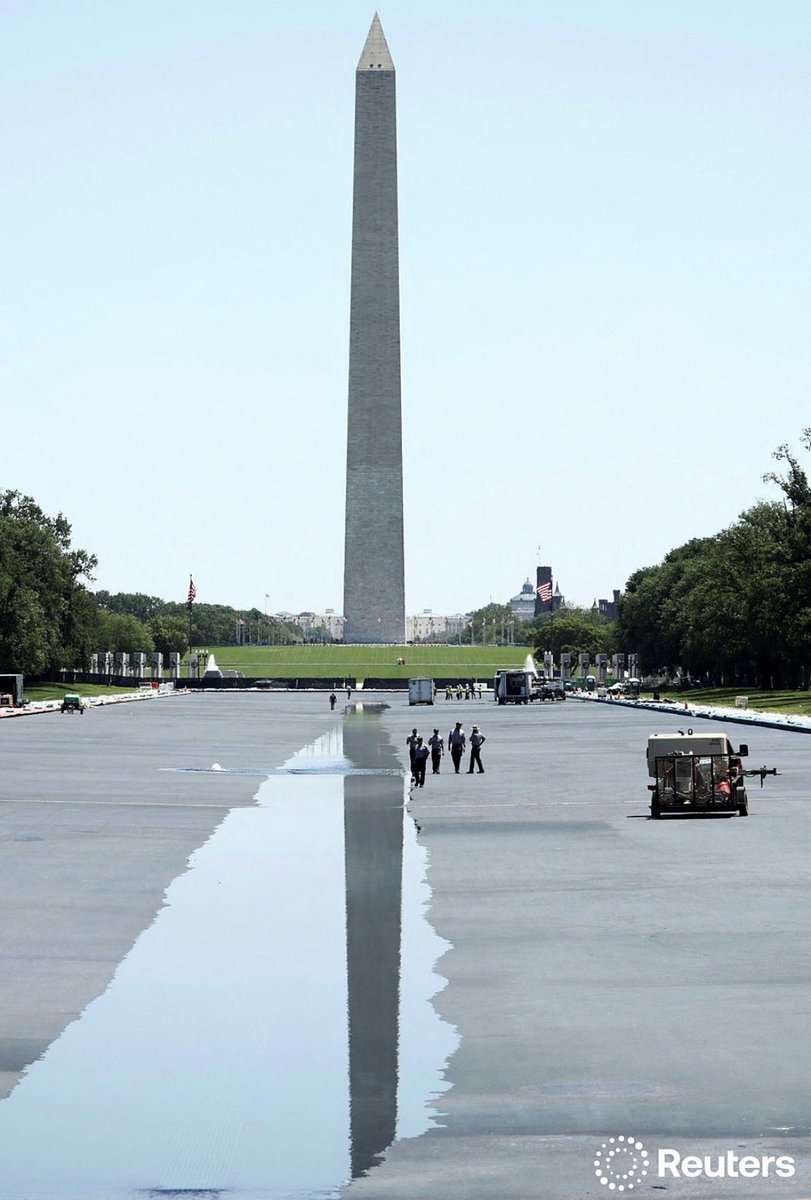
National Park employees walk along the reflecting pool as it is refilled with water after being painted at the directive of U.S. President Donald Trump ahead of America 250, in Washington, D.C., U.S., June 4, 2026. REUTERS/Kevin Lamarque
Meta is building dozens of massive tents at campuses across the US, sticking billions of dollars of chips inside, and powering them with off-grid turbines.
The AI race has officially entered its Mad Max phase.
Over the last month, I reviewed hundreds of documents and satellite images for Cleanview's latest report on behind-the-meter data centers. Meta's data center strategy, which is very visible from space, was one of the weirder approaches I came across.
Mark Zuckerberg recently ditched the data center designs that Meta had perfected over the last decade and told his team to stick tens of thousands of chips in tents outside their data center in New Albany, Ohio. Each of these chips costs about $60,000. Zuckerberg plans to stick billions of dollars worth of them in the tents.
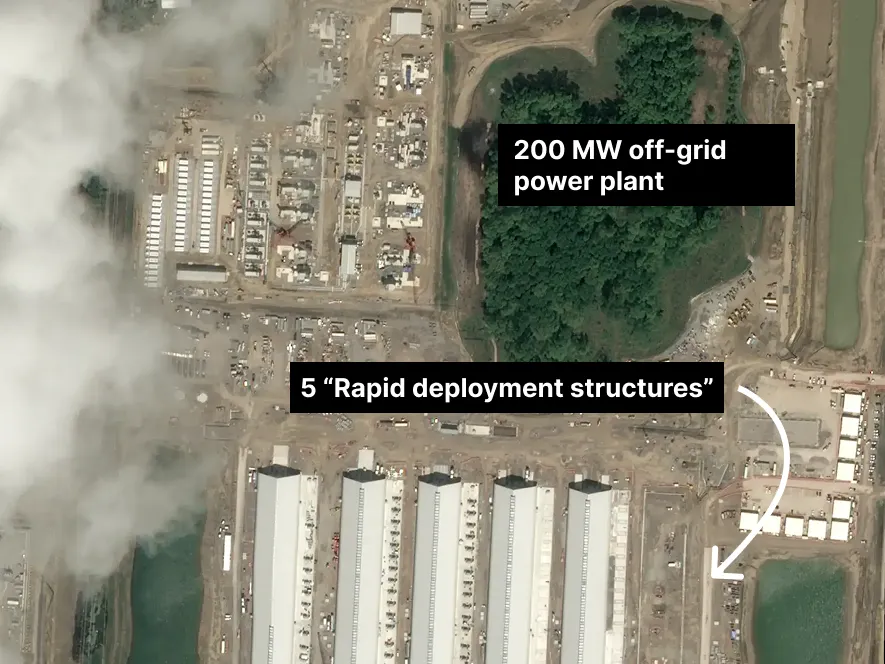
The strategy has helped cut the time to build compute in half. The first five buildings at Meta’s New Albany, Ohio data center took between two and three years to build. Meta started building five ~125,000 square foot tents between April and June of 2026, according to city permits. Satellite images show the structures have all been built.
To power those "rapid deployment structures", as they are officially named, Meta signed a 10-year deal with Williams to build a pair of 200 MW off-grid power plants. Those power plants began construction about a year ago and are nearly complete.
Meta is using the same strategy to build a data center in Tennessee, bringing the total count of tent data centers to three.
Strategies like this are part of the reason behind-the-meter data center capacity is growing so quickly.
In Cleanview's report, I found that there's currently about 2 GW of BTM capacity online today. By the end of the year, it will likely be 3 GW—equivalent to three nuclear power plants. By the end of 2027, it could be as high as 13 GW—more than the power demand of NYC.
I've been talking to a lot of reporters about this research. When I told one reporter about these tents and other companies powering their data centers with jet engines, he said, "It's like a scene out of the movie Mad Max."
Meta is building dozens of massive tents at campuses across the US, sticking billions of dollars of chips inside, and powering them with off-grid turbines.
The AI race has officially entered its Mad Max phase.
Over the last month, I reviewed hundreds of documents and satellite images for Cleanview's latest report on behind-the-meter data centers. Meta's data center strategy, which is very visible from space, was one of the weirder approaches I came across.
Mark Zuckerberg recently ditched the data center designs that Meta had perfected over the last decade and told his team to stick tens of thousands of chips in tents outside their data center in New Albany, Ohio. Each of these chips costs about $60,000. Zuckerberg plans to stick billions of dollars worth of them in the tents.
The strategy has helped cut the time to build compute in half. The first five buildings at Meta’s New Albany, Ohio data center took between two and three years to build. Meta started building five ~125,000 square foot tents between April and June of 2026, according to city permits. Satellite images show the structures have all been built.
To power those "rapid deployment structures", as they are officially named, Meta signed a 10-year deal with Williams to build a pair of 200 MW off-grid power plants. Those power plants began construction about a year ago and are nearly complete.
Meta is using the same strategy to build a data center in Tennessee, bringing the total count of tent data centers to three.
Strategies like this are part of the reason behind-the-meter data center capacity is growing so quickly.
In Cleanview's report, I found that there's currently about 2 GW of BTM capacity online today. By the end of the year, it will likely be 3 GW—equivalent to three nuclear power plants. By the end of 2027, it could be as high as 13 GW—more than the power demand of NYC.
I've been talking to a lot of reporters about this research. When I told one reporter about these tents and other companies powering their data centers with jet engines, he said, "It's like a scene out of the movie Mad Max."
@MattPenny99 How many pieces of software have you built that have been used by over a million people?
Let’s re-evaluate this opinion when you’ve created something from nothing that attracts over a million users, and see how well it holds up
Everytime I catch a glimpse of my Switch 2 im filled with disappointment. It’s going in its second year. Where the hell are all the normal Nintendo games?
President Trump is floating the possibility of keeping the UFC arena on the White House South Lawn — built for a series of fights on his birthday and Flag Day — permanently.
Read more: https://t.co/PdI3ZarEYr
When you search a pharmacy on Google Maps and it has sponsored results … does that actually work?
Has anyone ever looked up their pharmacy then decided to move all their prescriptions to a new pharmacy because CVS paid to pop up first?
@craigaloewen I’m just coming back to Windows within the last 3 weeks after 14 years on Mac - exciting time I suppose? I’m still running in parallels on Mac, which has no nested virtualization/ WSL2. When y’all refer to WSL (like this tweet) are you inferring WSL2 or normal WSL?
Bari Weiss said that many of Scott Pelley's recent stories "typify 60 Minutes, and they're the kind of stories that Nick Bilton is going to put on the air come September in Season 59 with the amazing team that's still there and hopefully from some new people that are going to join us." (The network has not yet said who those new people will be.)
Makes sense why earlier this year they were on a tear of building Claude Code like apps, trying to convert some of their Claude Code base to "app users"