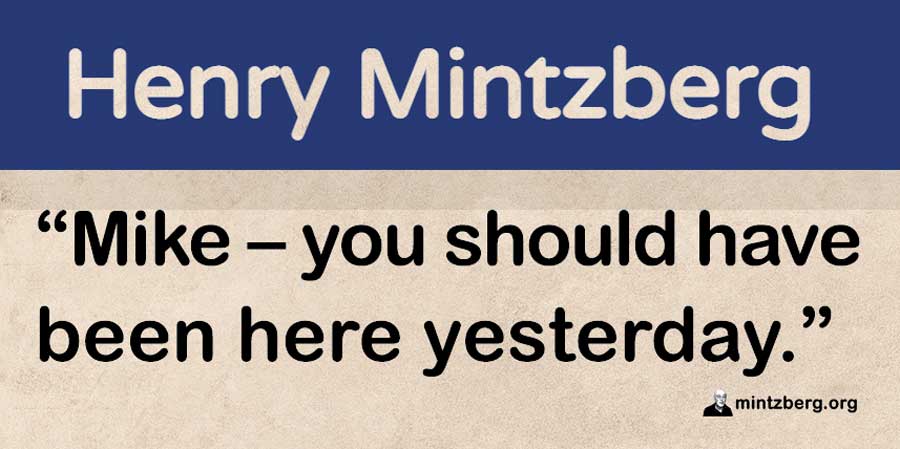
Over the years, I have asked dozens of groups of managers the following questions. “Think back five years to the strategy that your company intended to pursue. How many of you would say that it was successfully realized, more or less?” https://t.co/FWiDhGmKdr
AI struggles to make creative leaps.
Large language models are trained on data from the past. Original thinking involves recognizing novel patterns in the future.
Long live human ingenuity.
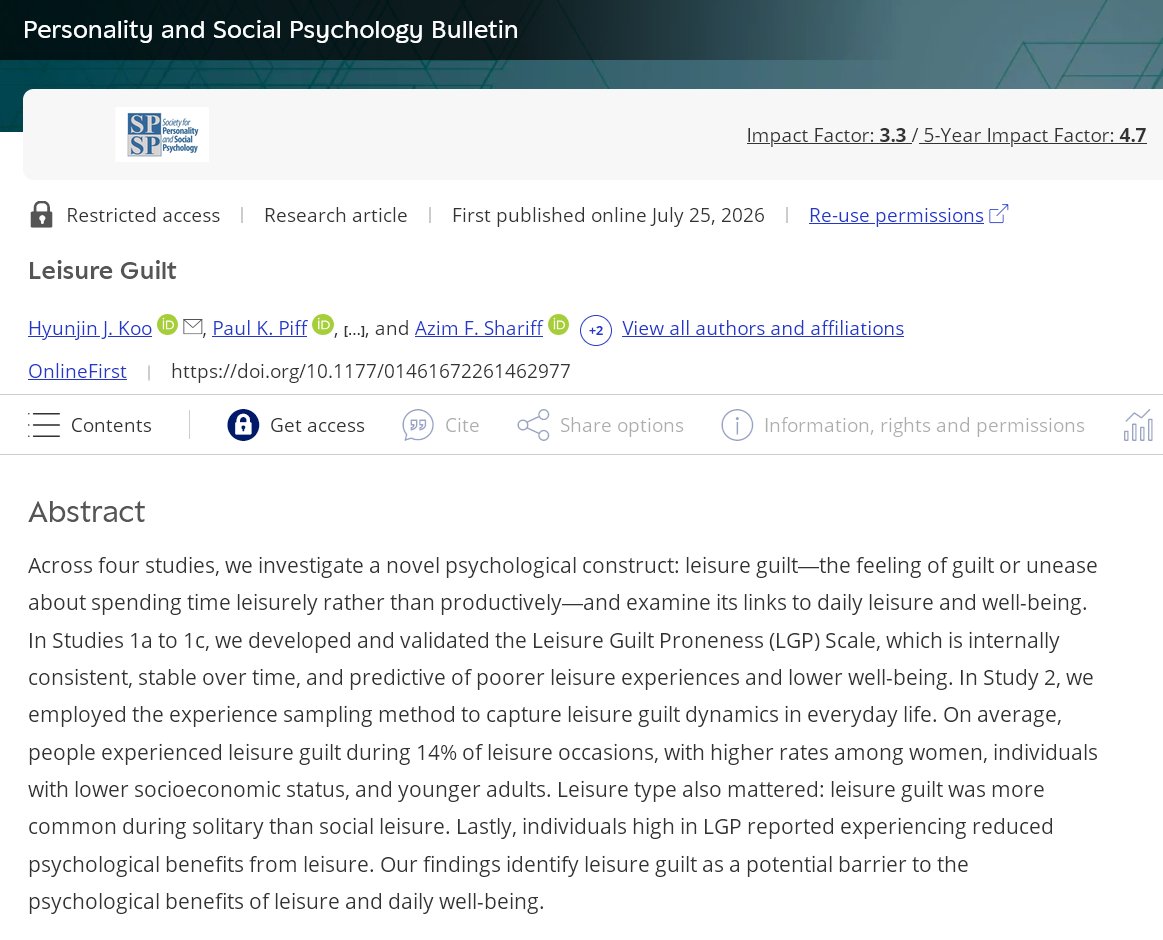
We squander too much of our free time feeling guilty that we’re not working.
In 1 of every 7 moments of fun and relaxation, people feel bad that they're not being “productive”—robbing themselves of joy and rejuvenation.
Leisure is not a bug. It’s a feature of a good life.
In this article, the authors call for a transformative, decolonial shift in #ImpSci that embraces methodological pluralism and centers local knowledge systems to enhance scientific rigor, equity, and contextual relevance.
Read the full article:
https://t.co/MUAOCppuwq
Authenticity is not about saying whatever pops into your head. It's about sharing what reflects who you want to be.
Healthy self-expression doesn't mean no filter. It involves weighing whether your current thoughts and emotions are aligned with your lasting values.
Say organization and we see #leadership. That’s why those charts are so ubiquitous. They show us who sits on top of whom, but not who talks with whom, when, and about what. Why are we so fixated on formal authority?
#communityship
https://t.co/nw9RNt2meY
Paul Graham spent 7 months writing a single essay in 2023.
It started as one paragraph inside another piece he was working on, and the idea kept pulling at him until he cut it out and built it into something that ended up being nearly 12,000 words long.
The essay is called "How to Do Great Work" and I have read it multiple times because it contains more useful thinking about ambition and output than most books I have ever finished.
Here is the framework buried inside it that most people miss:
His opening argument destroyed something I had believed for years. He says the most important decision in doing great work is not how hard you work or how smart you are. It is what you decide to work on.
Originality in choosing problems matters even more than originality in solving them. That is what separates people who make incremental contributions from people who discover entire new fields.
Most ambitious people spend almost no time thinking carefully about this, and then wonder why their hard work feels like it is going nowhere.
The second insight changed how I think about knowledge itself. He says knowledge expands fractally, and from a distance the edges of any field look smooth and complete. But once you learn enough to get genuinely close to those edges, they turn out to be full of gaps.
The problem is that your brain actively wants to ignore those gaps in order to build a simpler model of the world. The people who do great work are the ones who train themselves to notice the gaps instead of smoothing over them, because the gap is exactly where the new work lives.
The third hit me harder than anything else in the essay. He says if you asked an oracle the single secret to doing great work and the oracle answered in one word, his bet would be on "curiosity."
His reasoning is precise: your curiosity never lies, and it knows more than you do about what is actually worth paying attention to. Interest will drive you to work harder than mere diligence ever could, because interest does not require willpower to sustain itself.
The fourth was the one that made me put the essay down and think for a long time. He says people think big ideas are answers, but often the real insight was in the question.
Schools train us to treat questions as temporary placeholders that exist only until they get answered. But a genuinely good question is not a gap waiting to be filled it is itself a partial discovery. Asking the right question means you have already reached territory that almost no one else has reached.
His formula for the factors behind great work is deliberately simple: ability, interest, effort, and luck.
Luck you cannot control, so set it aside. Effort you can assume if you are serious. That leaves ability and interest, and the entire game becomes finding the specific intersection where those two things collide with enough force to generate ideas that compound into something nobody has ever built before.
He took seven months to write the essay. He said it was the best filter he could design, because anyone who actually read the whole thing had already proven something about themselves.
The people willing to do the reading are already closer than they think.
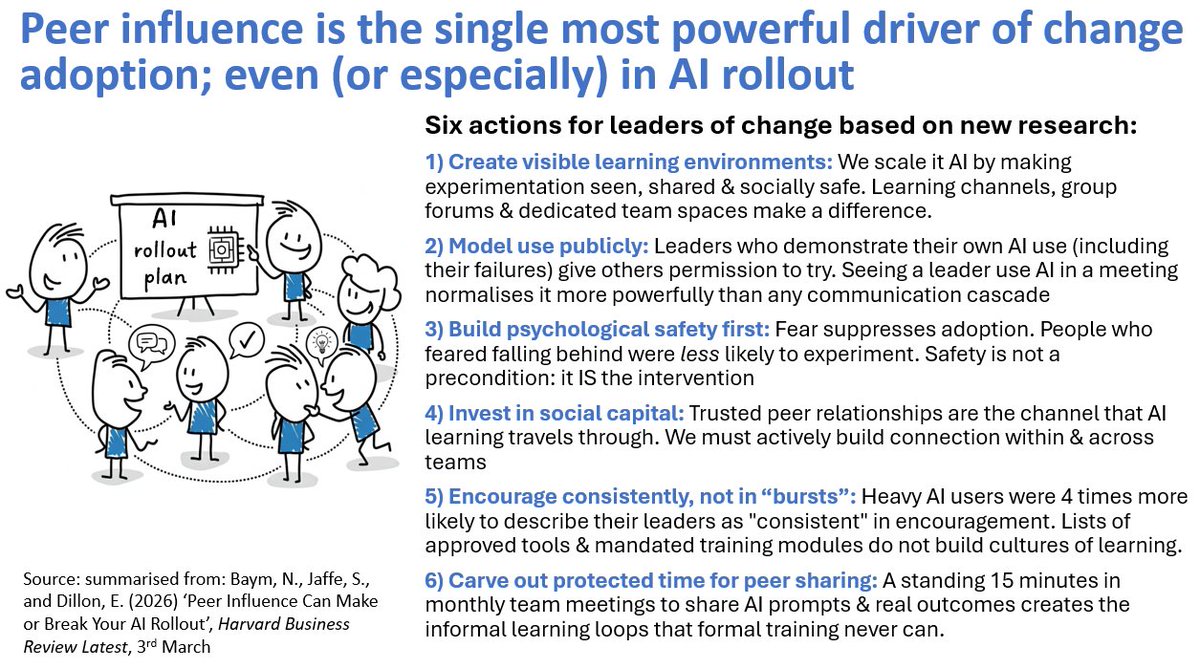
Peer influence is the single most powerful driver of change adoption.
It’s something those of us working in change practice have long known: the trusted colleague who says "this worked for us"; the visible shift in practice from someone others respect; the informal chat that carries more weight than the top-down directive. Peer influence is change experienced through relationships, not instruction. And guess what? New research from @Microsoft (Nancy Bahm & colleagues) confirms that peer influence is also the most important enabling factor in AI rollout.
AI adoption is stalling. Uncertainty makes people choose caution over experimentation, so learning goes underground. When they see trusted colleagues use AI, adapt it to real work & share learning, they’re far more likely to regularly use it themselves. Without social proof, even the best infrastructure & training can’t drive progress.
The research data shows the importance of peer influence in AI rollout. A one standard deviation increase in positive peer influence raises the likelihood of being a heavy AI user by 8.9 % points, & increases the probability of using AI agents by 10.4 points. Leadership mandates have no direct effect on usage once peer influence is accounted for.
The conditions for change are clearer than ever. Culture, psychological safety & trusting relationships aren't "soft" enablers - they’re the powerful mechanisms through which change spreads. In their absence, even the best technology investments fail to scale.
Six actions for leaders of change:
1. Create visible learning environments: We can’t scale AI by urging adoption. We scale it by making experimentation seen, shared & socially safe. Learning channels, group forums & dedicated team spaces can make a big difference.
2. Model use publicly: Leaders who demonstrate their own AI use (including their failures) give others permission to try. Seeing a leader use AI in a meeting normalises it more powerfully than any communication cascade.
3. Build psychological safety first: Fear suppresses adoption. People who feared falling behind were less likely to experiment. Safety is not a precondition: it IS the intervention.
4. Invest in social capital: Trusted peer relationships are the channels that AI learning travels through. We must actively build connection within & across teams.
5. Encourage consistently, not in “bursts”. Heavy AI users were 4 times more likely to describe their leaders as "consistent" in encouragement. Lists of approved tools & mandated training modules do not build cultures of learning.
6. Carve out protected time for peer sharing: A standing 15 minutes in monthly team meetings to share AI prompts & real outcomes creates the informal learning loops that formal training never can.
The research confirms what change practice has long taught us: people change through their relationships, not through policy. AI rollout is just the latest, most visible proof.
https://t.co/C24IDaCaaJ
Many situations in life are similar to going on a hike: the view changes once you start walking.
You don't need all the answers right now. New paths will reveal themselves if you have the courage to get started.
Most change initiatives don’t fail in the plan - they fail in what leaders don’t notice.
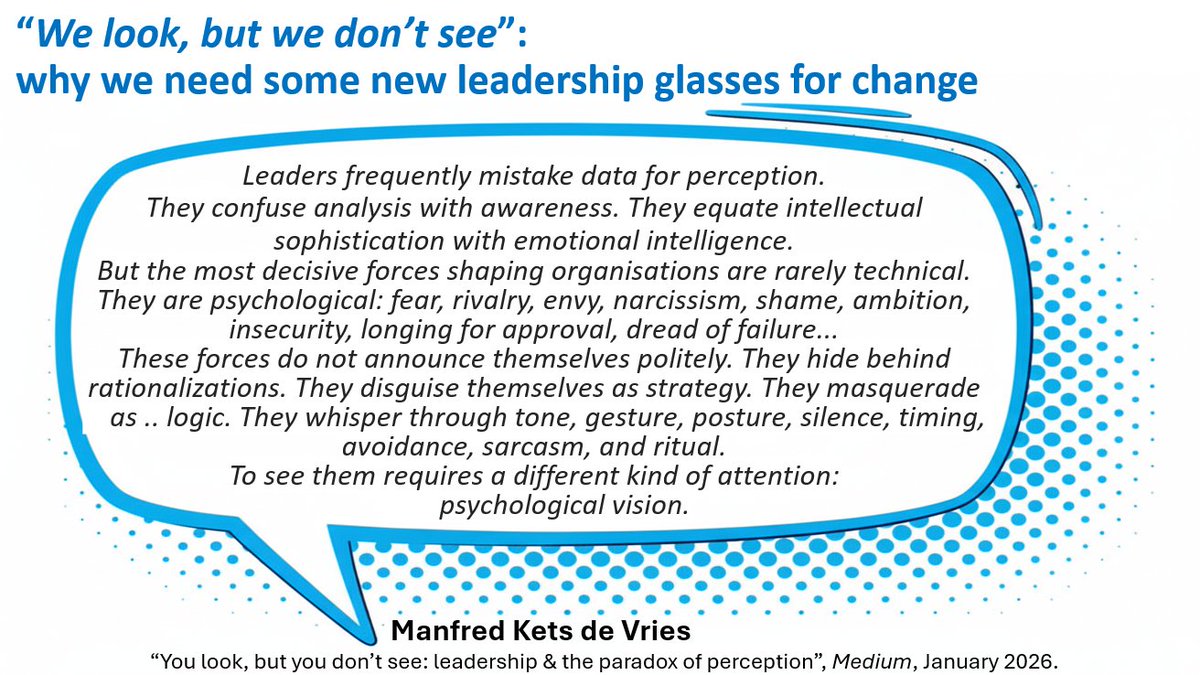
I want to reflect on a new Manfred Kets de Vries article: “You look, but you don’t see: leadership & the paradox of perception,” for leaders of change.
It reinforces that change initiatives are rarely governed by the “visible layer” (methods, metrics, milestones, RAG, governance, etc). These may appear “under control” while the most decisive forces remain under the surface: anxiety, fear, grief, resentment, rivalry, shame. What is labelled “resistance” may be self-protection; “alignment” may be passive compliance; “clarity” may be premature closure. Leading change is not only about implementing the plan but reading the emotional system the plan is landing in.
The article’s core idea is that “seeing” is an active leadership discipline, needing patience & humility. Change is less likely to be derailed by technical error than by psychological blindness: familiarity is mistaken for understanding, data for perception & analysis for awareness.
Curiosity must override certainty. Certainty is seductive, signalling competence, control & momentum. It also shuts down sense-making, especially if people are anxious. Curiosity keeps leaders open to contradiction & surprise. It reframes “what’s going wrong?” into “what’s being protected here?” & slows premature action.
We should use ourselves as instruments of "seeing": noticing what others evoke in us & treating it as data rather than noise. Feeling bored, confused, irritated or anxious in a meeting can be data about what’s happening relationally (avoidance, unspoken conflict, dependency, power etc).
How can leaders of change put on leadership glasses & see more clearly?
1) Build regular reflection time into change efforts (e.g., before key decisions & after difficult meetings) so we can notice patterns rather than just react.
2) Ask, “What emotion is driving this?” & “What might people be protecting?” to look beyond stated positions.
3) Use our own reactions as data: treat our feelings as signals to explore what’s happening in the relationship or group before pushing ahead.
4) Replace certainty with curiosity by framing early conclusions as “working theories,” then test them with questions like “What doesn’t fit?” & “What else could be true?”
5) Practise humility out loud: admit what we don’t know yet, invite challenge & revise our view openly so the system learns that learning is safe during change.
Too often, we look but we don’t see. “Seeing” means practising an enhanced kind of leadership: paying attention to human dynamics beneath surface data; making space for what doesn’t fit; holding tensions, contradictions & uncertainties & staying open to the unexpected. What becomes visible to those who practise “seeing” often determines whether change becomes movement rather than just motion.
The article in @Medium: https://t.co/wCOs0WcoKX.
After analyzing 20 years of data, McKinsey discovered their hiring process favored “perfect” resumes over what really predicts success: resilience, real-world experience, and the ability to learn.
Listen to the full IdeaCast episode here: https://t.co/3Co8qB3leF
We are obsessed with leadership, yet that is what has taken us into the current crisis, and seems incapable of getting us out of it. What if we entertain the unspeakable thought that leadership is the problem more than the solution?
https://t.co/RzJHiwwYrw
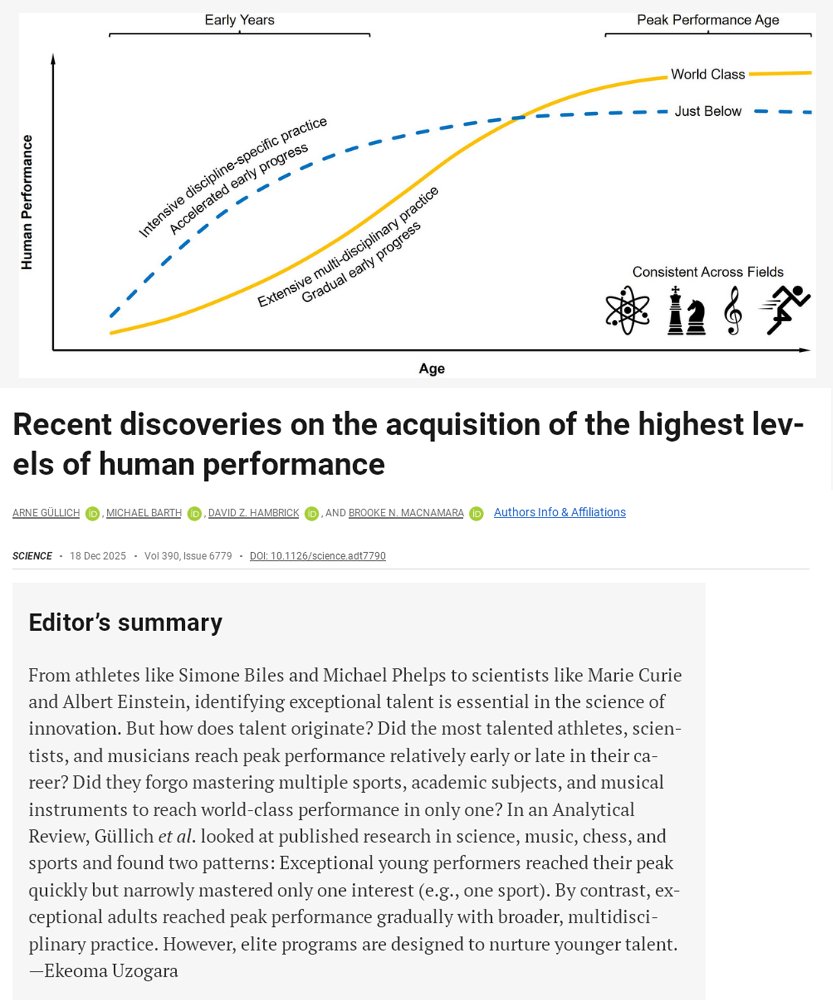
Early specialization is overrated. Generalists excel over time.
Data on >34k stars in sports, music, science, and chess: Focusing on a single field predicts a faster rise, but cross-training foreshadows a higher peak.
The most successful adults start off as well-rounded kids.
“Experts” & “expertise” can be very dangerous to change interventions.
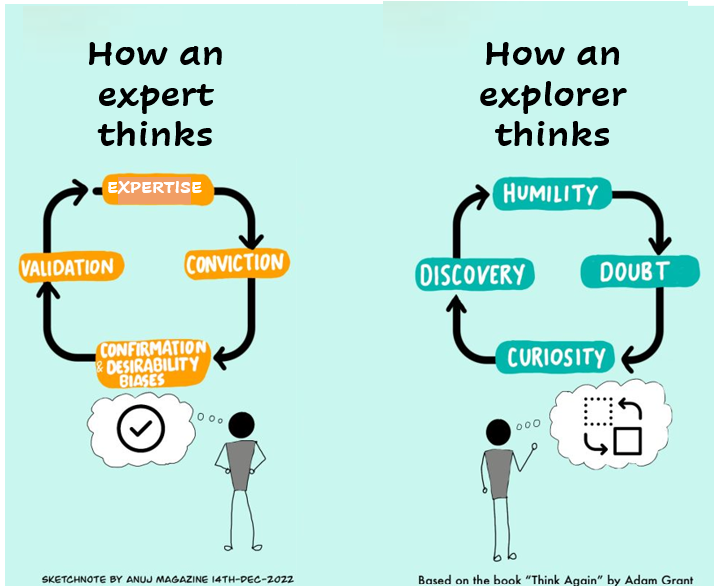
In leading change, it’s better to think like an explorer than an expert. See the graphic below.
An “expert” way of thinking can become a loop where knowing a lot turns into strong certainty. That leads us to mainly look for information that backs up what we already know, which then makes us feel confirmed. Experts can become oriented toward being right & getting affirmed, which can make their thinking narrower & more self-sealing over time.
An “explorer” way of thinking is a loop focused on learning. It starts with being humble enough to admit we might not have the full picture, then asking questions, staying curious & trying to find out more - so new information keeps shaping our views & change practice over time.
One of the greatest dangers in change experts (especially prevalent in external change experts coming into an organisation) is bias. Common biases are:
- Confirmation bias: we search for information/evidence that supports what we already think & overlook anything that contradicts this.
- “Solutioneering”: We jump quickly to a preferred intervention (new structure, operating model, digital tool etc) before fully understanding the local context & constraints.
- Authority bias: we can give extra weight to the opinion of the most senior person (or the loudest “expert”) & discount what others (especially people closer to the work) are seeing or can contribute.
- Overconfidence effect: we can be too sure we’ve got this under control, so we plan as if the future is predictable & leave too little room for learning & adaptation.
- One-size-fits-all / template bias: we over-apply what worked elsewhere (reusing change models, templates & assumptions) even when culture, incentives, capability or demand patterns differ.
- Case-study trap: We lean too heavily on successful past engagements & familiar sectors (“this looks just like Y”) & under-sample what is unique about this organisation.
In a relatively stable world, expert-led change can deliver results. But as AI accelerates the pace of disruption, the edge shifts from having the answers to staying open to better ones. The most effective change leaders will be those who keep their curiosity switched on, run experiments, learn quickly & humbly adapt when the evidence changes. In other words, the future belongs to explorers - because in an AI-shaped world, agility is likely to beat expert ability when it comes to change.
For experts/explorers see Joey Davis: https://t.co/Ya2L36fAPO
For more on biases, see the review by @grahamkmann of the work of Rolf Dobelli: https://t.co/54H7jtZBPs
Graphic adapted from one by @anujmagazine.
Happy to share our publication exploring the real-world barriers and enablers pediatric anesthetists face when implementing interventions in sub-Saharan Africa. https://t.co/sRfakdMAQr