The reason it holds up is that most of it isn't CGI. In a 127-minute movie, the dinosaurs are on screen for about 15 minutes total, and only 6 of those minutes are computer generated. The other 9 are a machine.
Stan Winston Studios built the physical dinosaurs; Industrial Light & Magic handled the digital ones, and Spielberg leaned on the digital as little as he could. He originally wanted no CGI at all. The animal that anchors the whole film, the Tyrannosaurus in the paddock attack, was a full-scale hydraulic puppet, roughly 18 feet tall and around 12,000 pounds, sitting on a floor they had to reinforce because the stage couldn't take the weight.
In every close shot of the T. rex, the actors were reacting to a real object in the room, lit by the real lights on set, casting real shadows. When ILM built the digital version for the running wide shots, they had the puppet's own footage to match against, down to where the light landed on the skin. The CGI looks right because it was copying something physical that was already right. The shots that show their age are the bright, fully digital ones, like the daytime reveal where Grant grabs Ellie's head and turns it toward the field.
That's the trade the sequels forgot. Jurassic World runs on full CGI, and the seams Spielberg spent nine minutes hiding behind foam and hydraulics came back. The dinosaur you remember being scared of in 1993 was, more often than not, a real thing standing a few feet from the cast.
Real enough to cause a problem nobody planned for. The puppet was never waterproofed, and the T. rex's big scene takes place in a downpour. The foam skin drank the rain, the weight calculations slipped, and 12,000 pounds of Tyrannosaurus started shuddering and moving between takes. The crew would be eating lunch when the thing came alive a few feet away. They ran a night shift with towels and blow dryers just to keep a dinosaur dry.
The most convincing effect in the movie was never rendered. It was a machine built so well that, the moment it rained, it started moving on its own.
A prairie dog can look at you and, in about a tenth of a second, tell its whole colony that a tall human in a blue shirt is walking in slowly. It has been doing this for as long as anyone has bothered to record it. The talking-to-animals part isn't the breakthrough. The listening already happened.
Con Slobodchikoff spent more than thirty years recording Gunnison's prairie dogs in Arizona. Their alarm calls encode a predator's size, shape, color, speed, even its direction, and the animals can combine those pieces to describe something they have never seen before. Different colonies speak in their own dialects. All of this was known decades before anyone promised you a translator.
The machines came later, and they keep finding the same thing: the animals were never the quiet ones. A team at Colorado State ran machine learning across 469 elephant rumbles recorded between 1986 and 2022 and found that elephants call each other by name. Not by imitating a friend's sound, the way dolphins do, but with an arbitrary label, a made-up noise that means you, the same way yours does. In 2024 MIT and Project CETI pushed roughly 9,000 sperm whale codas through algorithms and pulled out a combinatorial "phonetic alphabet," clicks that recombine into a vast range of possible messages.
But all of that is structure, not meaning. Finding that whales have an alphabet is not the same as reading it, and nobody has translated a single animal sentence into English. The Coller-Dolittle Prize dangles up to $10 million for whoever achieves genuine two-way communication; the 2025 winners only managed to show that dolphin whistles carry language-like features. The grand prize sits unclaimed. We have the transcript and none of the dictionary.
The next year or two won't hand us a channel to speak to animals. What it hands us is stranger and more humbling: proof that they have been fluent the whole time, naming each other and describing us across the savanna, while the one species holding the recording equipment couldn't make out a word.
Play a savanna elephant its own name and it lifts its trunk and moves toward the sound; play a stranger's and it ignores you. They knew theirs all along. We're the ones just finding out.
Gold didn't climb its way past U.S. Treasuries. Treasuries fell, because the world's central banks stopped believing a government bond is something you actually own.
For the first time since 1996, foreign central banks hold more gold than U.S. government debt. Per the European Central Bank's June report, their gold is worth close to $4 trillion and their Treasuries just under $3.9. Part of that gap is arithmetic, since gold nearly doubled in two years and the metal already sitting in vaults got repriced past the bonds. But the buying underneath is real, and it roughly doubled after a single decision in 2022.
The decision was to freeze about $300 billion of Russia's reserves. Every non-aligned central bank drew the same conclusion in the same week. A bond held in someone else's jurisdiction is a promise, and promises can be revoked. Gold in your own vault cannot be frozen, cannot be sanctioned, cannot be defaulted on, and answers to no foreign parliament. So they bought it. Purchases went from around 500 tonnes a year to more than 1,000, three years running, the longest streak in modern history.
The proof was Russia itself. The dollars and euros it parked abroad went dark overnight, while the gold it kept at home stayed untouchable and the rally left it worth more than the day the sanctions landed. The dollar's single greatest power, the ability to switch off anyone who holds it, is the exact thing that taught the rest of the planet to route around it. Its share of global reserves has slid from 71% in 1999 to about 57%. The dollar is still the biggest reserve currency on earth. Gold has simply overtaken the safest single thing it issues.
The largest gold buyer of last year wasn't a country. It was Tether, the company whose entire product is a digital dollar.
The most American thing on the Fourth of July table was invented in Mexico, by an Italian, to feed Americans who had driven across the border to get a drink their own country had banned.
Caesar Cardini wasn't named after the emperor, and neither was his salad. He was an Italian immigrant living in San Diego who ran a restaurant called Caesar's across the line in Tijuana, for one reason: Prohibition. Liquor was legal there and dry in the States, so Americans streamed south by the carload to drink. On July 4, 1924, per an account his daughter Rosa gave decades later, they arrived in numbers Cardini simply wasn't prepared for, and by dinner service the kitchen had been picked clean.
What was left was pantry scraps: romaine, olive oil, eggs, garlic, Parmesan, Worcestershire, and enough stale bread for croutons. Cardini wheeled a cart into the middle of the dining room and turned the shortage into a show, tossing everything tableside in a big wooden bowl. The leaves went in whole. Then they were laid out stem-out around the plate, so a guest could pick each one up by the base and eat it with their fingers. No fork. It was designed to be watched.
There were no anchovies in it, either. Cardini disliked the fishiness and left them out on purpose; the salty, savory depth people now credit to anchovy came entirely from the Worcestershire, which happens to contain a little anchovy already. The one ingredient most diners now insist makes a Caesar a Caesar is the ingredient its inventor specifically refused. The fish arrived later, added by his brother Alex, a former World War I fighter pilot who worked the same kitchen and briefly marketed his anchovy version as the Aviator's Salad.
None of it exists without the drinking. Cardini opened in Tijuana precisely to catch Americans slipping their own government, and his accident happened on the single busiest cross-border party night of the year: a Mexican restaurant overrun by Americans celebrating American independence because America wouldn't let them toast it with a beer. When Prohibition was repealed in 1933 and Mexico moved to ban casino gambling soon after, the tourists thinned out. Cardini gave up his Mexican businesses in 1936 and moved back to San Diego. The salad stayed on the menu he abandoned; the original Caesar's is still open on Avenida Revolución, still making it tableside.
It has a Fourth of July birthday because the Fourth of July was the day Americans most needed somewhere that wasn't America.
The surprise is that there's no surprise. "Morning Dew (Donk)" isn't a new Beyoncé song. It's a 13-year-old outtake her fans have been dancing to for years, and she just sold it back to them with a prettier name.
The track was cut in 2013, during the sessions for her self-titled album, and registered under her name at ASCAP. It never made the record. For a decade it lived in the vault, one of those rumored ghosts every big pop star has, once whispered to be a Nicki Minaj feature for a 2014 surprise album that never arrived. Then it got out.
A snippet leaked in 2021. The full version leaked in 2023. And instead of dying quietly the way leaks usually do, it caught. TikTok built a dance to it. One version of the audio ended up on more than 96,000 posts. Kids in Jersey and Philly were filming choreography to an unreleased Beyoncé song two years before Beyoncé released it. The comments filled with the same demand for months: put it out.
The fans did the A&R. They tested the hook, built the trend, proved the demand, and generated the streams on a bootleg nobody got paid for. All Parkwood had to do was press the button. During the 2024 standoff between TikTok and Universal, versions of the song kept vanishing off the app, and the only way to hear it was a leak that kept getting muted. So the audience wanted it more, not less. A song is never more valuable than when people can't legally have it.
Then look at what got bolted onto it. Fans knew it as "Donk," because the hook is a chant of the word, slang for a backside, over a beat griping that girls only want to twerk now. The official version keeps "(Donk)" in parentheses, the name the internet gave it, and staples "Morning Dew" to the front. The raunch stays. The title gets a garden.
And the timing is a countdown, not a gift. "Morning Dew (Donk)" is the lead single for the 20th-anniversary reissue of B'Day, an album from 2006, which means a 2013 self-titled outtake is now doing promotional duty for a record it has nothing to do with. It starts a 60-day clock to September 4, her birthday and the reissue date. The surprise is a marketing bell, rung on the Fourth of July, for a purchase two months out.
None of which changes what the song is, or who found it first. She can call it Morning Dew all she wants. The 96,000 videos already named it.
The birds are the part that lived. Every one of them is a dinosaur, the last surviving branch of the theropods, the same lineage that produced Tyrannosaurus and the raptors, and the asteroid that closed the Cretaceous is the reason they're the only dinosaurs left standing at all.
Sixty-six million years ago the Chicxulub impactor hit the Yucatán with a force paleontologists estimate at roughly a million times the largest atomic bomb. It wiped out every land animal over about 5 kilograms. It also killed most of the birds. At the end of the Cretaceous the skies held a whole array of birds and bird-like dinosaurs, many of them with teeth, and almost none of them made it across the boundary.
The ones that did share two traits. First, they lived on the ground. The impact set off global wildfires and buried the planet in soot, and forests collapsed and stayed collapsed for something like 1,000 years. Tree-dwelling birds had nowhere left to live and died with the canopy. The survivors had long, sturdy legs built for the dirt, the same build you see now in ostriches, emus, and kiwis, which sit at the base of the modern bird family tree. Second, they had beaks instead of teeth. Archaeopteryx, the first bird, had teeth, and so did most of its Cretaceous relatives, and the toothed ones were hunters that starved when the animals they hunted vanished. The beaked birds ate seeds, and seeds sit in the ground, dormant, indifferent to the dark. A seed does not need sunlight to still be food.
So the toothless seed-eaters cracked their way through the worst decades in the history of backboned life, waiting out the winter on the leftovers of dead forests. A handful of those lineages made it. Every bird now alive, nearly 11,000 species, descends from that handful.
The pigeon on your windowsill is a dinosaur that survived by eating seeds off a burned planet while everything with teeth starved in the dark.
The man about to headline his own DC show already played a superhero once. That character had exactly one power: he could not die. They killed him off halfway through the movie and never brought him back.
Edi Gathegi is 46. In 2011 he played Darwin in X-Men: First Class, a mutant whose body rewrites itself to survive anything it meets. Underwater he grows gills. In fire his skin turns fireproof. In the comics the power runs closer to immortality, and Darwin has come back from deep space, a fight with the Hulk, and the touch of an actual death goddess. Then Sebastian Shaw force-feeds him a ball of energy and he dies. He was the only Black man among the young mutants, the first to go, and the studio told Gathegi they would bring him back the way the comics always do. Sequel after sequel came out. Darwin was never mentioned again.
It was already a pattern. His breakout was Laurent, the vampire in Twilight, torn apart in the sequel. He spent the next decade playing the man who exits early, at one point asking to be written off Justified himself. More than a decade of being first out the door.
In 2025 he walked into Superman as Mister Terrific and quietly stole it, a floating-orb genius in a T-shaped mask that half the theater left googling. Now The Hollywood Reporter says DC has a solo Mister Terrific series in active development with Allan Heinberg writing the pilot, and Gathegi is back again in next year's Man of Tomorrow. The actor who couldn't survive a single franchise is being handed his own.
The character makes it sharper. In the comics Michael Holt is written to be the third-smartest man on Earth. Not the smartest. Third, permanently, behind Batman and Lex Luthor. It is his defining trait, the rank he never climbs out of.
Except Holt has decided the rank is a lie. He believes he is the smartest man alive and has only been playing third all along, and even Lex Luthor admits Holt is convinced of it.
The actor who kept getting killed off first just landed the one hero written to be done coming in third.
The seven saves against Spain were real. The 18 million followers came later, handed to him in real time by a streamer who stopped mid-broadcast and told his audience to go find the account.
Vozinha, born Josimar José Évora Dias, is 40 and keeps goal for Chaves in Portugal's second division, where he has spent two seasons drifting in and out of the squad. On June 15 in Atlanta he faced 27 Spanish shots, saved seven, and took the man-of-the-match award from a 0-0 draw nobody expected. Cape Verde is a nation of about half a million, the third-smallest ever to reach a World Cup. Vozinha began that morning with roughly 50,000 Instagram followers.
The jump did not come from his highlights. CazéTV is the only channel in Brazil carrying all 104 World Cup matches, run by the streamer Casimiro Miguel and backed by more than 31 million YouTube subscribers. Somewhere in the first half, watching a 40-year-old goalkeeper smother one of the tournament favorites, Casimiro noticed the keeper barely had a following and pointed his audience straight at it.
His ask was small. The channel normally begs viewers to subscribe, he told them; today it was asking them to follow, for Vozinha, because he was stopping Spain and shocking the world. The count moved by a few hundred thousand almost at once. It passed a million by the final whistle, cleared five within hours, and by the night Cape Verde's run ended against Argentina it sat near 19 million.
None of that made the goalkeeping fake. He shut out Saudi Arabia in the group stage too, becoming the third-oldest goalkeeper ever to keep a World Cup clean sheet, behind only Peter Shilton and Dino Zoff. Then in the round of 32 he made eight saves against Argentina, including a full-stretch stop on a Messi free kick, before going out 3-2 in extra time. The saves were the best of his life. The number climbing beside them had almost nothing to do with them.
Sort out what that number means and the feel-good stat curdles. Climbing to it, per Forbes, he passed Patrick Mahomes, Victor Wembanyama and Travis Kelce and closed on Tom Brady. A goalkeeper who cannot reliably make the bench for a second-division club now outdraws some of the biggest names in American sport. He did not build that across a career. He was handed it in an afternoon.
And it was given on purpose. FIFA built this World Cup to live online, cutting a record run of digital deals and feeding live match clips to TikTok and YouTube, and it had already trialed Casimiro back in 2022, when he streamed 22 games out of Qatar. The saves earned the attention. The apparatus turned that attention into a following at a speed no playing career can match, on the say-so of one man reading the room.
The formula was not even new. A month before Vozinha, a New Zealand defender named Tim Payne went from 4,700 followers to nearly six million after a different streamer picked him out as the tournament's least-known player. Same machine. Vozinha just made better saves.
The charges against the Empire State Building couple are the reason they walked free, not the reason they're in trouble. In New York, whether you sleep in your own bed before trial has almost nothing to do with what you did and almost everything to do with which box the charge falls into.
Angela Nikolau, 33, and Ivan Kuznetsov, 32, are Russian rooftop climbers with a Netflix documentary and 1.2 million Instagram followers between them. On July 1 they entered the Empire State Building as paying tourists, hid inside after closing, and at dawn broke a lock to reach the broadcast antenna. They climbed to about 1,450 feet, unfurled a peace banner, and got engaged at the top. The Manhattan DA charged them with burglary, first-degree reckless endangerment, second-degree criminal mischief, and several lesser counts. A judge then sent them home on supervised check-ins. They were photographed the next morning kissing on the subway steps, still in the black clothes they had climbed in.
To see why, you have to know what bail is actually for, because it isn't what most people think. Bail is not a punishment and not a price tag on how bad the act was. It is a refundable deposit with one purpose, making sure you come back for trial. And in New York, a judge setting it is legally forbidden from asking whether you're dangerous. The only question the law allows is whether you'll return to court.
New York's 2019 bail reform sorted every crime into two bins. In one bin, mostly violent felonies, a judge can set bail or order jail. In the other, most misdemeanors and non-violent felonies, the judge is barred from setting bail and release is mandatory. The bin is fixed by how the charge is classified in the statute, not by how dangerous the act looked on video. The judge doesn't get a vote.
Every count against the couple sits in that second bin. Burglary of a commercial building, reckless endangerment, criminal mischief: none is a violent felony under the statute, so none of them lets a judge reach for bail. This is what "not bail-eligible" means, and the phrase runs backwards from intuition. It sounds like the crime was too minor to bother jailing. What it describes is a judge legally prohibited from jailing, no matter how many counts the DA stacked on top. The most the court could do was attach conditions like check-ins, which is exactly what it did.
So the two kinds of danger here point in opposite directions. Climbing up was the hazardous part. To reach the pair, the NYPD had to power down an antenna that emits radio waves strong enough to injure a body, wait about 30 minutes for it to cool, then send officers 1,250 feet into the air in harnesses. The legal danger, by contrast, evaporated at arraignment. NYPD Chief Michael LiPetri promised "there's going to be consequences," and the couple rode the train home that same afternoon, and both things were true, because the statute had already settled the part the chief was talking about.
Which leaves one lever the criminal court doesn't hold. Nikolau and Kuznetsov aren't American, and their lawyer has already flagged the real threat, which is deportation. That case lives in the immigration system, a separate machine that plays by none of New York's bail rules. A conviction the state can't jail them for is precisely the kind of conviction that system can build a removal case on.
The court that couldn't set a single dollar of bail on the climb can still use that same climb to put them on a plane out of the country.
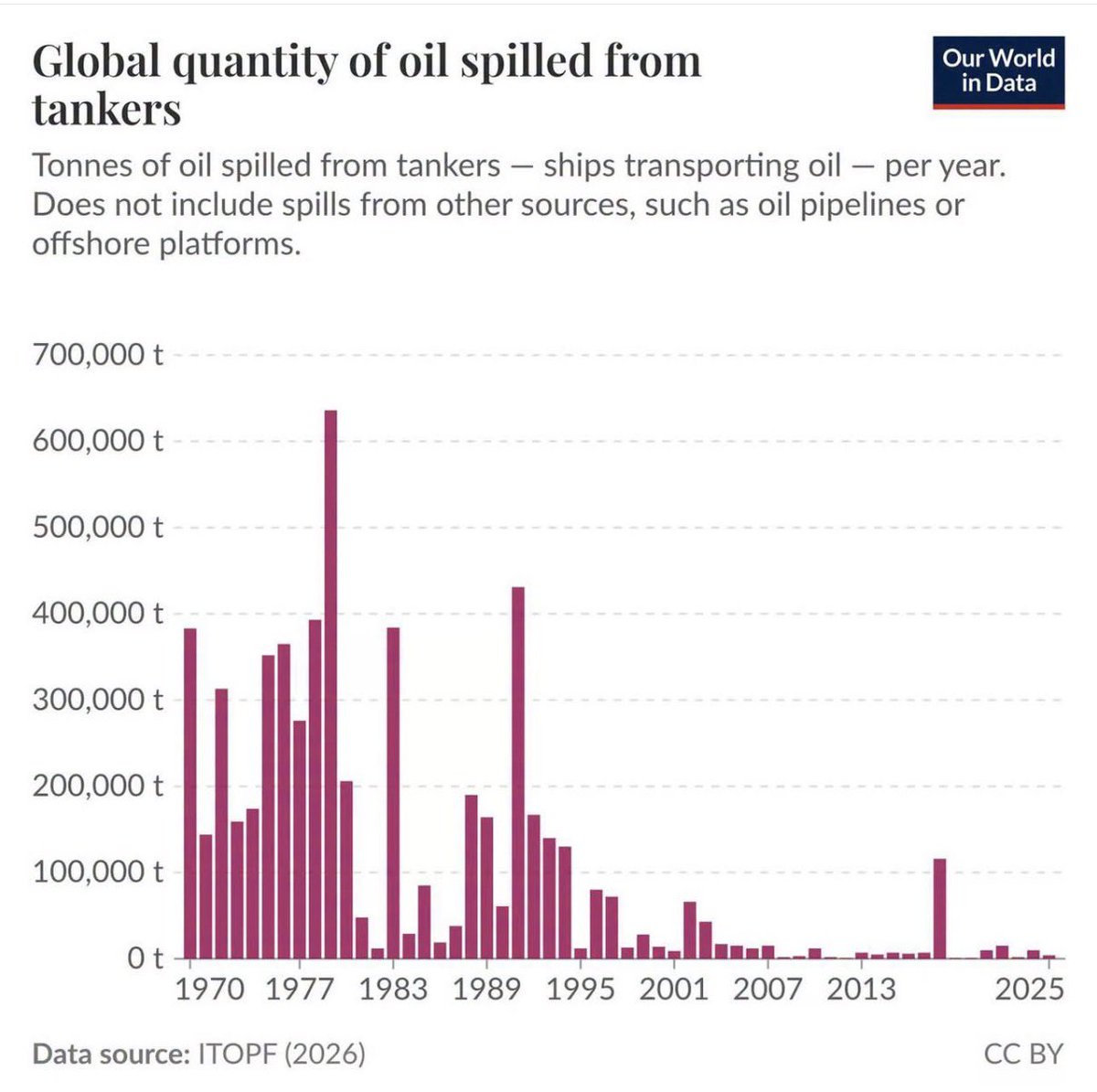
The spill that ended the era of giant oil spills was one of the smaller ones. Exxon Valdez ranked 54th on the list of the world's largest spills the year it happened. A decade earlier a tanker off Tobago put roughly eight times as much crude in the water, and almost nobody remembers its name.
That ship was the Atlantic Empress, which collided with another tanker in 1979 and lost about 287,000 tonnes, still the largest tanker spill ever recorded. The Exxon Valdez lost 37,000. What it had instead of size was location. It ran onto Bligh Reef in Prince William Sound on March 24, 1989, in clear water, close to shore, in front of the cameras, and the oil reached otters and eagles instead of open ocean. Roughly 1,300 miles of Alaskan coastline went dark. A mid-sized spill in the wrong place did what the record-holders out in the open Atlantic never did. It rewrote the law.
The law was the Oil Pollution Act of 1990, and its central demand was a second skin. Every tanker in American waters would need a double hull, an inner shell of steel set back from the outer one, so a reef or a bow punching through the outside stops at a ballast gap instead of splitting a cargo tank open to the sea. A Coast Guard study later estimated that a double hull would not have kept the Valdez off the reef but would have cut its spill by around 60 percent. Here is the part that made it global. The United States was too big a market for any oil company to walk away from, and nobody wanted to run one fleet for America and another for the rest of the world, so the single-hull tanker was condemned everywhere at once. The International Maritime Organization wrote the same rule into its global treaty within two years. Today effectively every one of the world's 12,000-plus oil tankers is built with two hulls.
The Exxon Valdez never got one. It was patched, renamed more than once, converted into an ore carrier, and finally beached for scrap in India, single skin intact to the end.
What the double hull actually changed is narrower than the chart looks, and stranger. The line does not fall because thousands of small leaks slowly dried up. The oil was always concentrated in a few catastrophes. Across the 1990s, 73 percent of all the oil spilled came from just ten incidents; in the 2000s, 75 percent from ten; in the 2010s, 91 percent from ten. The danger of a tanker was never the drip. It was the total loss of a full ship, and the double hull's real job is to keep a grounded or rammed tanker from becoming that. Take the monster wrecks out of the record and the whole line drops to the floor, which is what happened, even as the volume of oil crossing the oceans kept climbing. More oil moving, over 90 percent less of it spilled.
So the claim holds. This really is a problem we mostly solved. But look again at what solved looks like on that chart. It is not a line resting at zero. It is a flat stretch broken every few years by a single ship.
Look at the small spike near 2018. That is one vessel. The Sanchi, an Iranian tanker, caught fire after a collision off the coast of China in January 2018, burned for over a week, and went down with all 32 crew aboard and 113,000 tonnes of cargo, more than every other spill of the decade combined.