Views not my own.
My books, on Amazon, include: Three Duets, The Deep Blue Sea (novels); Meta Verse, Plague Time (poetry); Sylvan Scene (short stories)
"I have been impressed with the urgency of doing. Knowing is not enough; we must apply. Being willing is not enough; we must do."
Leonardo da Vinci
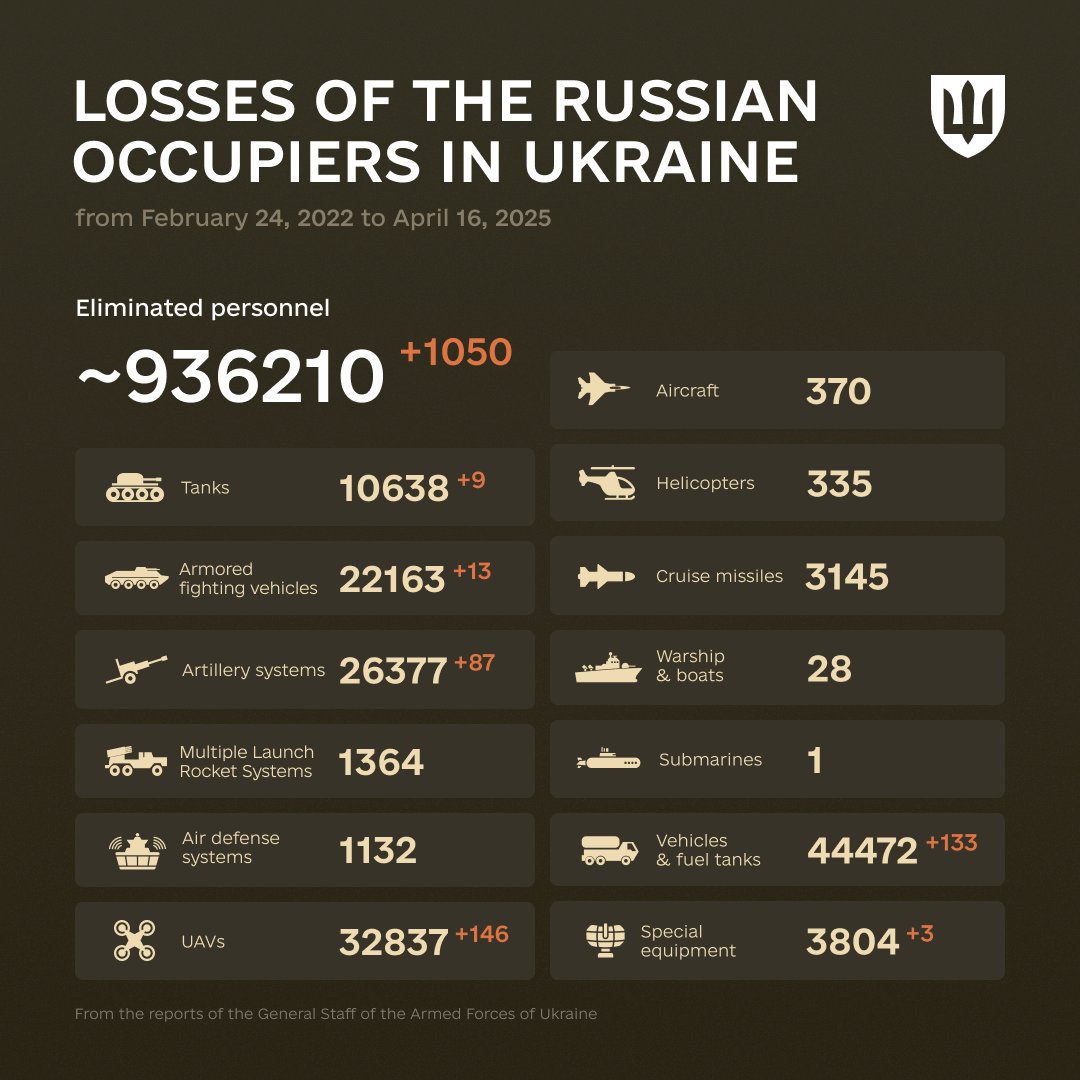
The combat losses of the enemy from February 24, 2022 to April 16, 2025.
https://t.co/A6SkYugPXS
More importantly, Ukraine’s defense industry is increasingly reaping the benefits of European investment, and is on track to quadruple total production in 2025, with new-build Ukrainian equipment already supplying 30% to 40% of front-line demand.
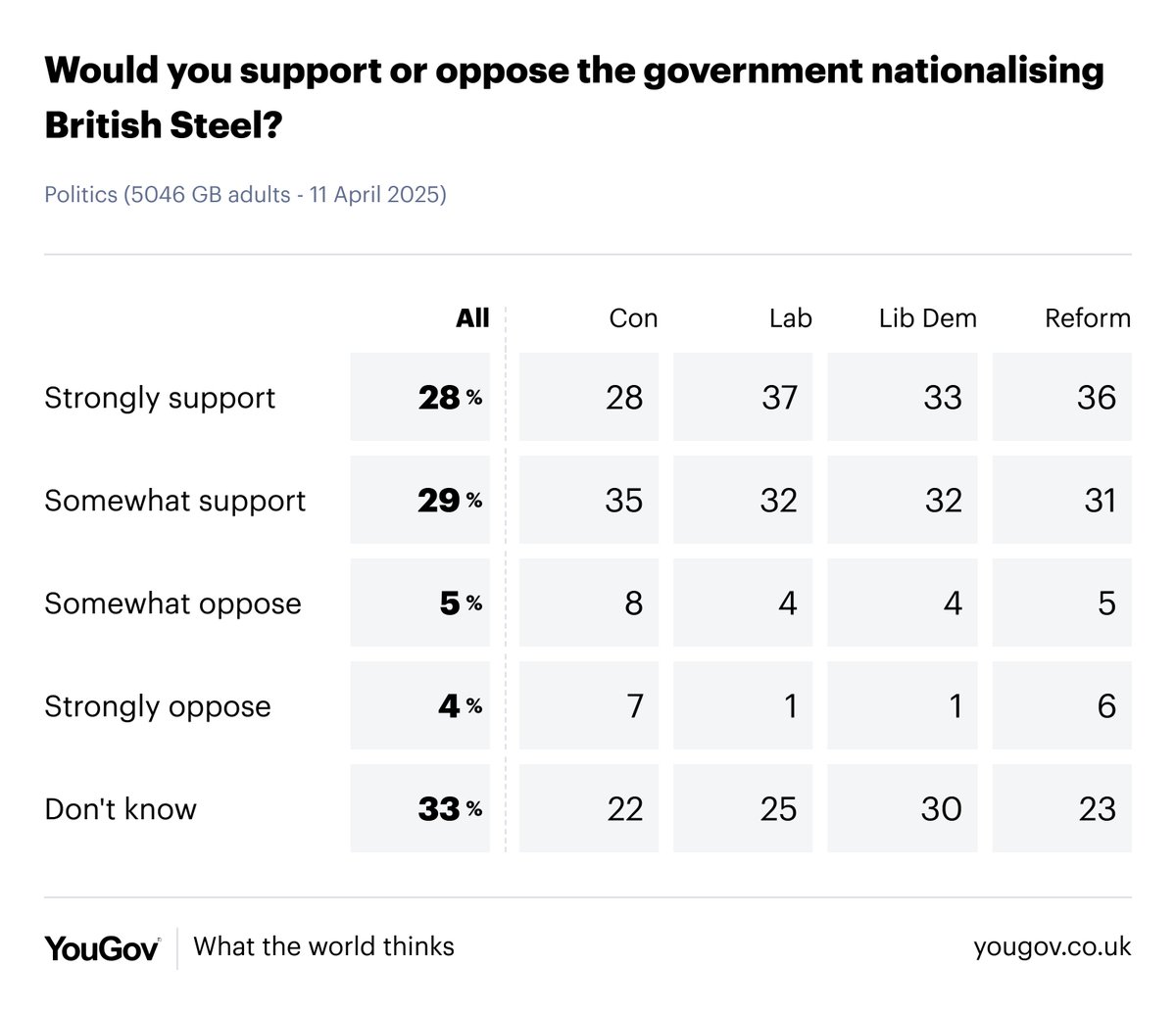
Scunthorpe Crisis Is Not A One-Off - the UK needs urgently to create institutions that can manage and preserve our critical industrial infrastructure.... https://t.co/vwTc4E8TxS
"True friends are like stars; you can only recognize them when it's dark around you."
Bob Marley
The combat losses of the enemy from February 24, 2022 to April 14, 2025.
U.S. President Donald Trump has extended the national emergency and the associated sanctions against the Russian government for a further year, according to a document from the U.S. Federal Register.
https://t.co/imizvYfWz5
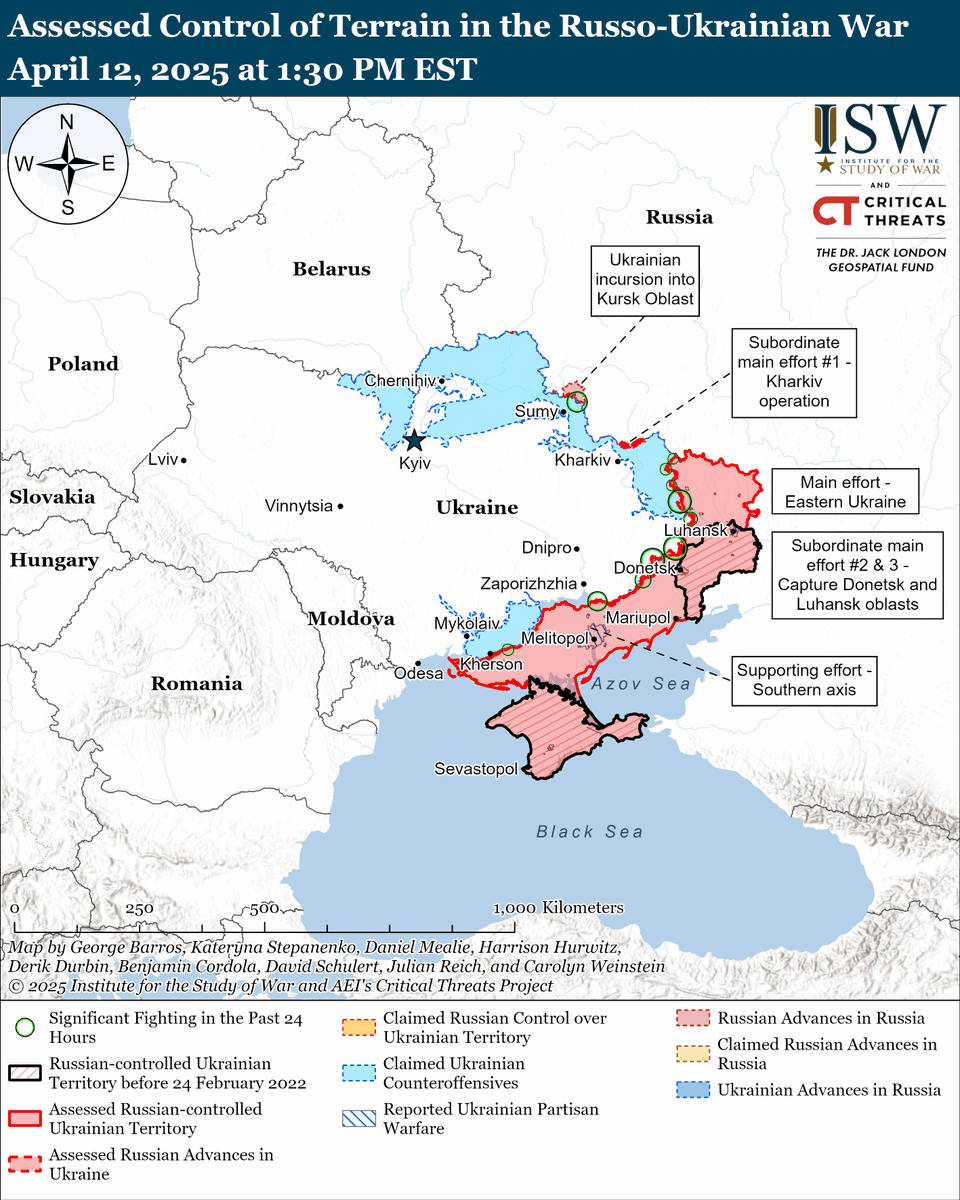
NEW: US Special Envoy to Ukraine General Keith Kellogg expressed support on April 11 for the deployment of an allied "reassurance force" in rear areas of western Ukraine after a possible future ceasefire between Ukraine and Russia. (1/2)
Russian state-owned and pro-Kremlin media amplified a Russian official's blanket rejection of any peacekeeping force in Ukraine on April 12.
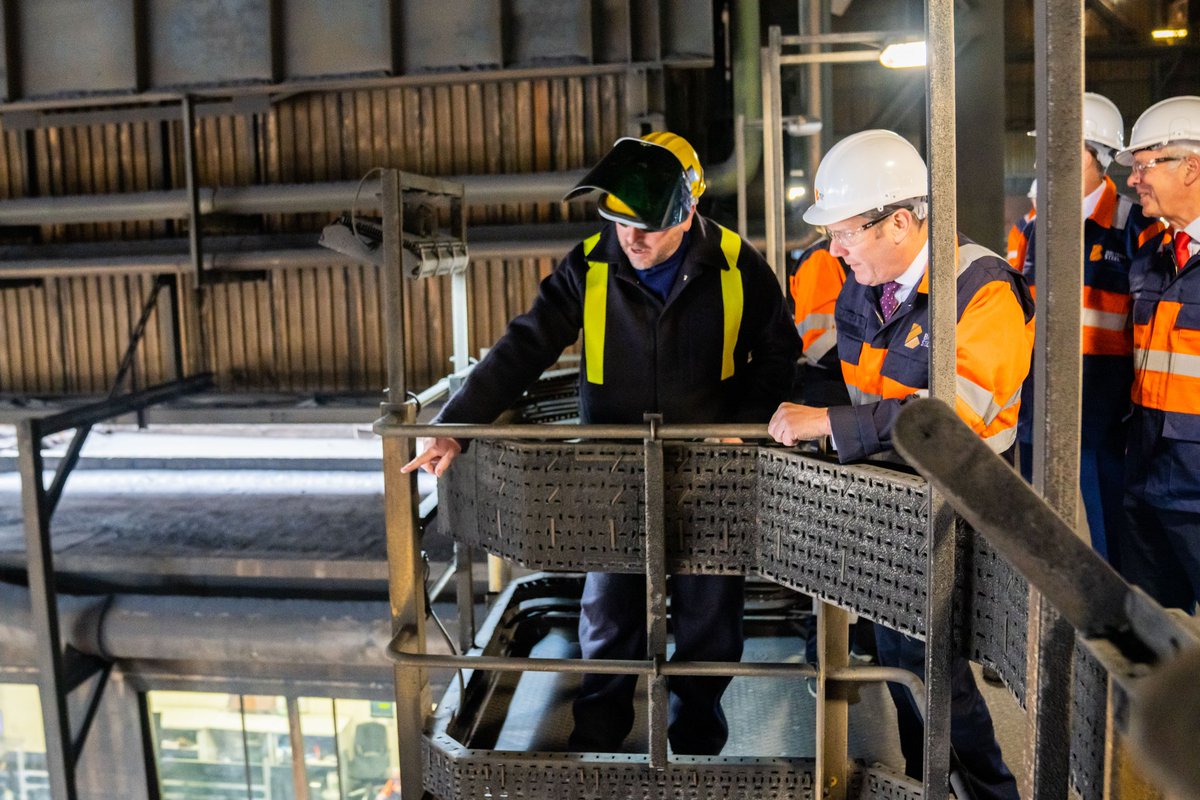
This Labour Government will always act in the national interest.
We are taking action to save British steel production and protect British jobs.
We are securing Britain's future.
I've been to Scunthorpe.
I've met the steel workers.
I know how important steel is to the whole country.
We will act to secure Britain's future.
With British steel: made in Britain, in the national interest.
On the economics & the economic history behind Trump’s tariff war. In conversation with Oli Dugmore, I propose a type of critical analysis of the Trump Shock that the Left should adopt, in contrast to the Project Fear tactics of the Radical Centre.
https://t.co/DB8nZNkP6X
While waiting for the EU's response to the Trump Shock (don't hold your breath for evidence of intelligent life from Brussels...), those of you who really want to worry about something big, turn your attentions to perhaps the largest threat for the status quo - greater than tariffs, equities, bond prices etc. What is that?
The Fed's swap lines!
What saved capitalism (at least for a little while) after the Crash of 2008? Besides China (yes, China saved the capitalist world’s bacon by boosting magnificently its aggregate investment to take up the massive slack developing in the North Atlantic), the answer is: The Fed’s swap lines (i.e., the fact that, without second thought, the Fed lent the central banks of Europe and Japan something like $600 billion).
Something similar happened in 2020, as the pandemic spread panic and chaos through the West’s financial circuits (on that occasion, the Fed’s swap lines funnelled around $450 billion to a world dependent on the mighty dollar).
In this context, hotheads who think that Europe and Japan can afford to play tough with Washington seem unable to fathom the extent of their dependency. For the time being, Trump does not control the Fed. Or so it seems. But is it not possible that the Fed will not want to antagonise him? Is it, therefore, not possible that the Fed may not be as quick to ‘lubricate’ its swap lines at the drop of a hat (as it did in 2008 and 2020) when they are most needed?
Just the thought that, come the next crunch, a certain reluctance may prevail at the Fed over its use of the swap lines that keep the financial markets liquid is enough to make the tumult of the past week look like a serene walk in the park.
The moral of the story for European, British and Japanese decision-makers, both in the public and in the private sector, is: There is a price to pay for your total dependence on a fickle hegemon. Only now you are beginning to get a whiff of how steep that price is…
Have a good day!
https://t.co/q45B0gWt4G
"A person often meets his destiny on the road he took to avoid it."
Jean de La Fontaine
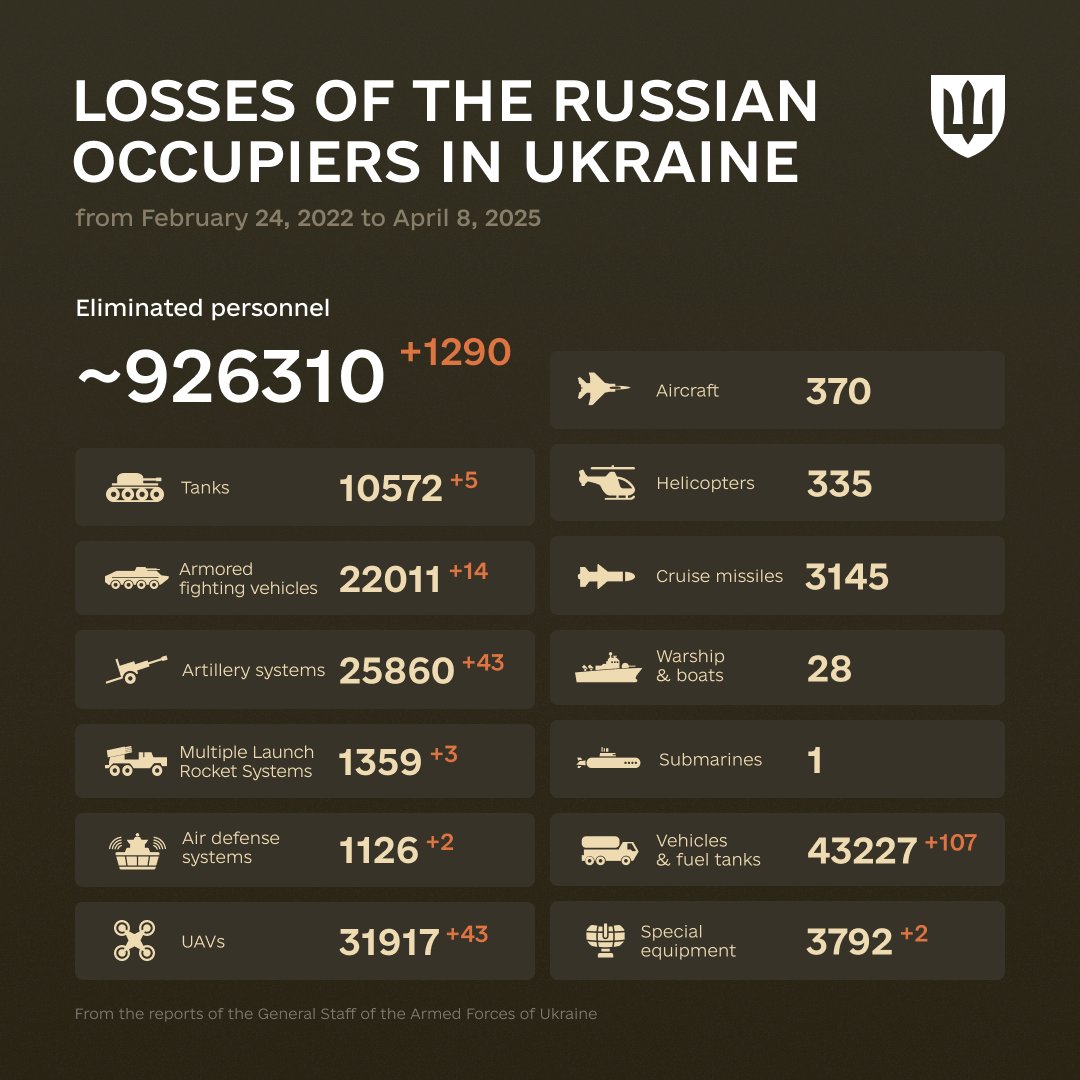
The combat losses of the enemy from February 24, 2022 to April 8, 2025.
To those worried about the share markets’ collapse and their impact on trade, and who wonder how Europe should respond, here are my thoughts this morning:
How will the fall in share prices affect the global economy? Share prices have little to do with actual trade. Their precipitous fall reflects more the terror of margin calls on traders (who used overpriced shares to borrow for the purposes of gambling) than the real effects on trade. If falling shares become self-perpetuating, they may, of course, bring about the loss of confidence that cripples investment and slows down production. My view is that the negative effects will be real but nothing as dramatic as the recent falls in share prices might suggest. It is also important to keep in mind that Trump’s shotgun has two barrels. One barrel fired indiscriminate tariffs. The second will, at some point, fire exorbitant tax cuts for fat cats. When it does, I won’t be surprised if the fickle share markets go through the roof again in a spectacular show of mass relief.
Will Trump’s tariffs stop global trade functioning as it should? This question is founded on an error: that trade was functioning as it should before Trump whacked it on 2nd April. It wasn’t! Since 1971 we lived in a grossly imbalanced system that relied, for its stability, of an unsustainably expanding American trade and gvt budget deficit. That Trump’s Shock may have been rude, uncouth, indeed shocking and wrong-headed means neither that things were fine before 2nd April nor that Trump’s way of upending a problematic status quo was the right way to do it.
How should Europe respond? The early bravado from Brussels was inane and self-harming. When you are running a $240 billion surplus with America annually, you cannot win a trade war. Full stop. The only thing you can and you MUST do is blow up your own mercantilist model before you stagnate into irrelevance. Europe must rebalance its own economy so that it stops relying on ridiculous surpluses that go hand in hand with low investment and low demand domestically. For that Europe needs an additional domestic investment of at least 700 billion euros annually – something that, however, requires Europe to do the one thing Berlin steadfastly refused to do when it was politically possible with the result that it is now no longer politically possible: a fiscal and a political union.
Though obviously I disagree about the urgent need for Europe to re-arm - a decision forced on Europe by the actions of Putin, not one that we Europeans wanted.