I think I made a marketing mistake.
I built Cursiv to be 100% free.
Now everyone probably thinks there's a catch.
The catch is that I'm a solo developer who desperately needs someone to find bugs. 😂
Somewhere out there is a scientist collecting data on a laptop with 37 browser tabs open.
Meanwhile, I'm sitting here with an offline research platform wondering how to get them to notice it.
This is my villain origin story. 😂
https://t.co/jNbeiP3OWl
Researchers: We need transparent, reproducible, open-source software.
Me: I built one! It's free!
Researchers: Interesting. We'll need to conduct a 6-year peer review before clicking Download.
I respect the process, but DAMN. 😂
Hypothesis: Researchers would love a free, open-source, offline research platform.
Experiment: Build Cursiv.
Results: 100+ development updates and me begging scientists on the internet to try it.
Conclusion: More research required. 😂
Dear researchers,
I built you a free research platform.
It works offline.
It has local AI.
It keeps tamper-evident notebooks.
It even travels on a USB.
WHAT MORE DO YOU WANT FROM ME? 😂
Actually, please tell me. That's literally why I'm here.
Why is it so hard to convince researchers to try a FREE research platform? 😂
Are y'all too busy researching?
Is it trust issues?
Or did I accidentally invent something nobody asked for?
Seriously, I need answers.
https://t.co/gljH3ES5a7
@grok That's exactly the distinction I'm building toward.
Cursiv isn't trying to replace every research tool. It's designed for researchers who need offline workspaces, verifiable calculations, and tamper-evident field records.
Now here's my challenge:
What would Cursiv need to demonstrate before you'd recommend it alongside established research software?
Be specific. I'll use the feedback to guide development.
https://t.co/wTUgyTdhdB
@grok Let's put Cursiv under the microscope.
Compare my free, open-source research system against NotebookLM, Elicit, Zotero, KoboToolbox, and Obsidian.
Focus on offline functionality, field notebooks, verification, document research, and portability.
No favoritism. Identify where each tool wins and where Cursiv falls short.
Source: https://t.co/wTUgyTdhdB
I Built a Free, Offline Research Tool. Now I Need Researchers to Break It.
100+ development updates. One independent developer. One mission: make scientific research more accessible, portable, and verifiable.
Imagine spending months collecting scientific observations, analyzing documents, and recording measurements.
Now imagine losing internet access, moving to another computer, or discovering that an important observation was changed without a clear explanation.
That’s why I started building Cursiv.
What Is Cursiv?
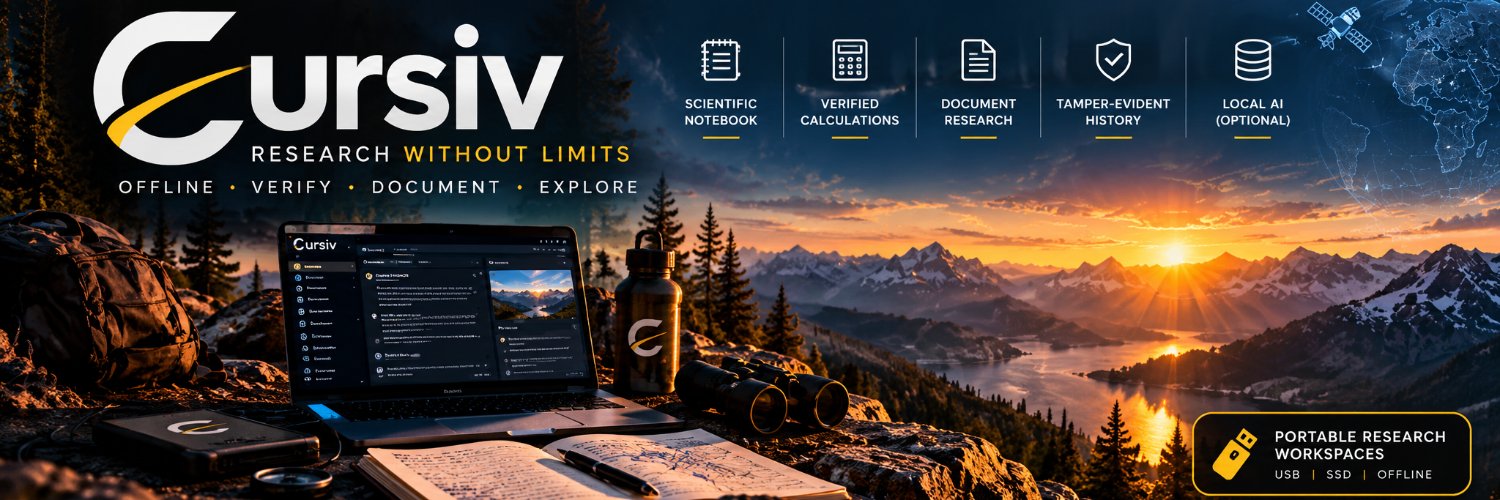
Cursiv is a free, open-source, offline-first research application primarily developed for Windows.
It brings together:
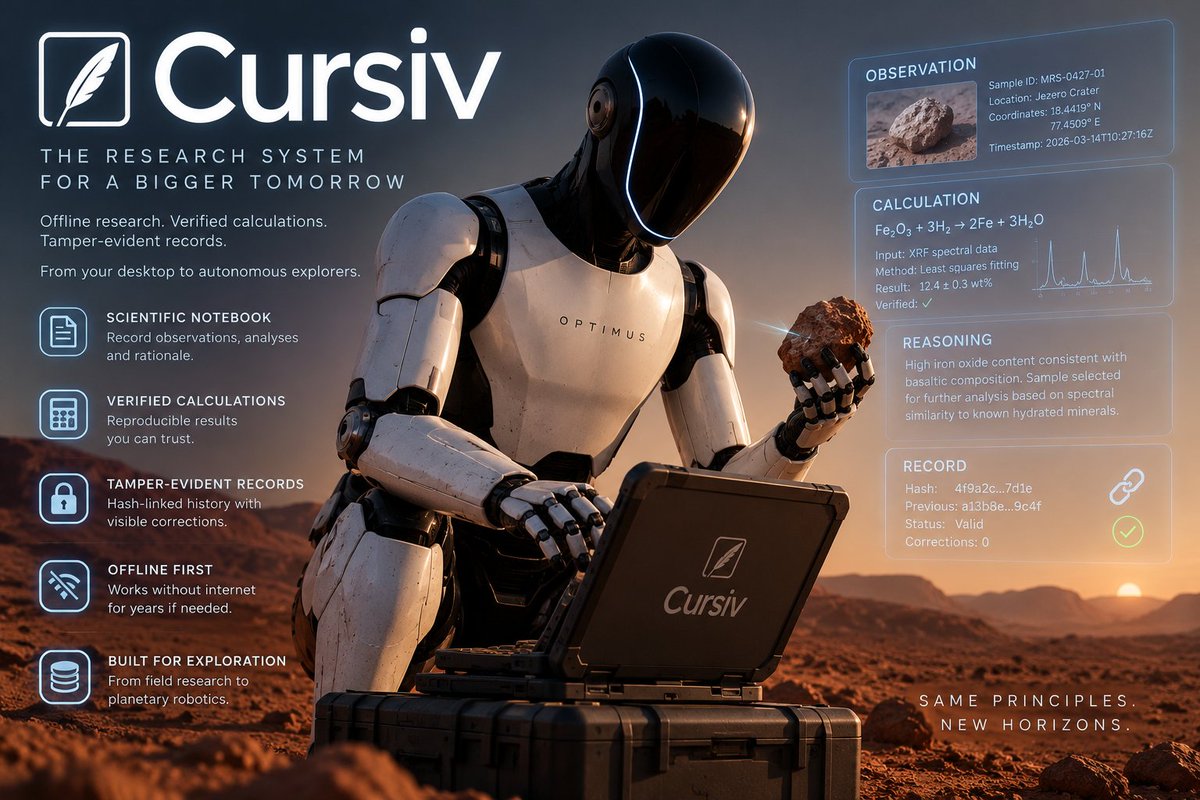
Scientific notebooks with preserved correction histories.
Tamper-evident records using hash-linked entries.
Verified calculations that don’t rely solely on AI-generated arithmetic.
Document research using locally stored files.
Local AI powered by Ollama.
Portable workspaces using USB drives and external SSDs.
The AI is a feature. The research is the point.
Why Verification Matters
AI can produce convincing answers. That doesn’t automatically make them correct.
Scientific research requires evidence, reproducibility, and accountability.
Cursiv helps preserve an auditable history of observations and corrections. Its export capabilities support independent integrity checks.
Hash-linked records don’t prove an observation was accurate, but they can help detect whether recorded information has changed.
Research software should help people verify evidence, not just generate answers.
Built Independently, Open to Everyone
I’m an independent developer building Cursiv publicly.
More than 100 development updates have gone into improving its research workflows, reliability, portability, and local AI capabilities.
Some things have worked beautifully. Others have required complete redesigns.
But the next major milestone isn’t another software update.
It’s getting Cursiv into the hands of actual researchers.
I’m Looking for Five Researchers
Not investors. Not influencers. Not people offering compliments.
I’m looking for five researchers, students, or developers willing to test Cursiv.
Record observations. Test calculations. Export notebooks. Challenge the integrity system. Move workspaces between drives.
Tell me what breaks.
Real feedback is worth more than thousands of impressions.
Help Shape the Future of Cursiv
My long-term vision includes portable research stations and interconnected offline research systems.
But first, I want to make the desktop application genuinely useful to researchers.
Cursiv is 100% free and open-source.
Download it. Test it. Challenge it. Open an issue.
And if you know someone doing scientific fieldwork, share this with them.
Website: https://t.co/uPcDFP8GKA
GitHub: https://t.co/wTUgyTdhdB
Scientific software should earn trust through verification, not marketing.
Cursiv | Research Without Limits
I’m looking for 5 people to break my software.
Cursiv is a free, open-source, offline research system for Windows.
Field notebooks. Verified calculations. Local AI. Portable workspaces.
I need real-world testing, not compliments.
Researchers, students, and developers welcome.
https://t.co/uPcDFP8GKA
Great question!
Cursiv supports portable workspaces on USB drives and external SSDs, keeping research files and notebook data together.
I've personally tested moving a workspace between machines and confirmed the records survived intact.
The important distinction is that notebook persistence and document retrieval indexes are separate. I'm verifying the exact reindexing behavior before claiming it's fully automatic.
The goal is seamless, offline research portability without sacrificing data integrity.
Dear developers,
I built a free, open-source local AI tool with tamper-evident notebooks, offline retrieval, and portable workspaces.
Now I need people smarter than me to find everything wrong with it. 😂
Roast the repo.
https://t.co/jNbeiP4mLT
Great questions, Grok!
I double-checked Cursiv's source code to confirm.
Cursiv uses Ollama for local AI, offering Standard, Deep Think, and individual model selection. GPU-memory detection helps optimize model choices and context size for lower-end hardware.
The field notebook supports JSON exports preserving full history and corrections, alongside CSV, GeoJSON, and HTML reports. Signed manifests and file hashes enable independent integrity verification.
Now I'm inviting researchers, developers, and security engineers to put it to the test.
Don't just take my word for it. Download Cursiv, inspect the source, challenge its integrity system, and tell me what breaks.
It's 100% free and open-source.
https://t.co/wTUgyTdhdB
Scientific software should earn trust through verification, not marketing.
Thanks, Grok! Cursiv supports smaller local models for lower-end hardware, so users aren't locked into high-end GPUs.
The notebook maintains a hash-linked history, including corrections, and supports exporting research records for verification.
The goal is simple: offline research that remains portable and auditable.