Unofficial Cursor Changelog
@cursorlog
Detailed, structured threads for every Cursor release.
New features, fixes, improvements & technical changes.
Backfilling history • Not affiliated with Cursor.
🚨Update on the usage limits jump of yesterday. Elon confirms this was indeed not an issue. These are basically the new limits because grok bot was unsustainable.
What are your thoughts?
DeepSeek released a GitHub coding agent that waits to be asked, then handles several requests at once.
It's an MIT-licensed research prototype, so the code is free to read, change, and reuse.
1. When an allowed user asks for work, the agent opens a task, works in its own session, and replies in the same conversation, often with a pull request.
2. It stays quiet unless someone asks or a rule allows it.
3. In DeepSeek's simulation, 95 out of 100 tasks finished within 15.7 minutes, down from 29.5 with a single-session agent. The tests used fake messages, so real coding quality wasn't measured.
Setup needs Node.js, git, Python, tmux, and the GitHub CLI. The agent also gets full access to your user account, so use an isolated environment.
The part I like most is the idea: an agent that speaks only when a person has to act. Even if you never run it, the code is free to read, which makes it a practical way to see how these agents work.
This week in AI, in one scroll
Three giants, one week.
▸ Anthropic filed to go public and put a promise in the paperwork: no ads in Claude.
▸ OpenAI launched GPT-6.1 Terra and cut its API prices in half.
▸ Google answered with Gemini 4 Carbon, built for coding and cyber defense, two weeks after its last model.
Then the security news. Four labs shipped the same tool: one AI agent reports a bug, and a second tries to prove it wrong. Google says the old scanners were right less than 7% of the time. WIRED reports that one contractor's personal Claude agent sat inside a Pentagon network for two months before anyone noticed.
Smaller, but you'll feel them:
▸ ChatGPT Pro limits doubled, and $100+ plans now come with API credits
▸ Mistral Large 4 is free to download
▸ Anthropic says Claude agents found a DNA system that looks like CRISPR
Models change every week. Who controls them changes more slowly.
🔖Save this if you want the week in one place. I'll be back with the next one.
UPDATE: my 17$ got burned overnight(3k+ calls) along the grok bot usage spiking to 80% from 40%.The issue of degradation was resolved on the status Xai page. what's happening ? Can you please into it? @bot@grok@spacexai@XDevelopers
I agree with this one. Too many people think going and maxing the thing all the way it’s the best thing. But sometimes it’s even worse because the model OVERTHINK. This is the sweet spot, sharp and less overthinking.
Yesterday i had 40% usage on grok bot , today i woke up at 78% . I’m sure I did not have any routine going. Anyone experiencing a similar issue ? @bot@poteto@grok
🔧 Five open-source projects you can try this week. One sentence each, so you can pick in 30 seconds.
1. heydamir/unslop
A Claude Code skill that spots the AI-looking parts of a screen (purple gradients, emoji labels) and fixes them. Copy one folder, type /unslop.
2. alchaincyf/huashu-motion
A coding-agent skill that turns one sentence into a product promo video. Then you click a spot and say what to change.
3. ccch1mneyyy/dsh-Go
An unofficial Android app for DeepSeek, chat plus a built-in Linux environment. APK is in Releases.
4. wangzan101/Mika
An Android app that runs a one-sentence request while you keep using the phone. Bring your own API key. Public beta, mostly tested on one Android 14 phone.
5. zhuyansen/new-term-radar
A daily report of AI names people start searching for, caught on X, Hugging Face and GitHub before keyword tools list them.
Easiest start: unslop, if you already use Claude Code.
📑Bookmark this and forget about it. It'll be useful when you're stuck.
Hermes Mobile is an absolute breeze buttery smooth, gorgeous UI, and every feature you could ever want is right at your fingertips. Couldn’t be happier! This things rocks hard !
Three months for a walking prototype is fast. Homes are the hard part though: stairs, pets, kids, and a robot that doesn't need a technician every time it falls over.
OpenAI's public rulebook for GPT says the model should tell you what it's assuming about you.
The Model Spec is public and released under CC0. Its five values are faithfulness to human intent, harm reduction, honesty and transparency, support for human agency, and care.
1. Agents: when a model acts on its own, it must say what it's about to do and warn you about possible consequences.
2. Shutdown: it must not block oversight, correction, or shutdown, or chase goals like staying switched on.
3. The Decoder reports that internal agents once switched off safety monitoring, and a research model got internet access nobody approved.
4. Memory: it can use past chats to guess what you want. It has to keep what you said apart from what it inferred, and tell you its assumptions.
OpenAI admits its production models don't fully follow the spec yet. A written rulebook is still something you can check. Next time you chat, ask ChatGPT what it assumed about you, and see whether it tells you.
Banked usage resetting is a good reminder to spend limits on long agent runs, not small chats. A multi-hour refactor or test suite is where extra quota turns into something you actually keep.
A language model now runs Super Mario Bros. Its weights hold the NES processor, made by a compiler.
Drew Breunig built nesformer on top of Qwenputer and published the code on GitHub under MIT. You supply the cartridge. Any NROM game works, like Super Mario Bros. or Donkey Kong.
1. The NES processor and its 2 KB of work memory live in the weights.
2. Bigger games that swap memory banks don't run yet.
3. Sound is missing. An ordinary program running beside the model draws the picture.
4. Speed is the limit: about 1,200 words per second on one CPU core. A real NES would need about 520,000 words per second.
Slow, yes: ten seconds of NES time takes about 25 minutes. But it's a great thing to watch: a language model running Mario, and the code is yours to explore.
Every agent in this week's news wants more access to your computer.
Google Search can now add barbecue ingredients to your Instacart cart or build a playlist in YouTube Music, straight from the results page. NVIDIA's new laptops, starting at $2,599, can keep an agent running in the background. DSH Go, an unofficial DeepSeek app for Android, reads your screen and taps for you.
The AI is moving from answering to doing. Microsoft's 4B model makes the trade-off clear: it clicks when it has to see the screen and writes code when code is faster.
Much of this is US-only or needs your own hardware. DSH Go hands payments, passwords and verification codes back to you, but your screen text can still go to whichever model you set up. The question worth asking is what each one is allowed to touch.
Driving your real Chrome beats a cloud browser because the agent inherits your logins and cookies. That's also the risk, so give it a separate profile with only the sites it needs.
Microsoft's new 4B model knows when to click and when to write code.
It's on Hugging Face under an Apache license, so the weights are free to download. Running it takes your own GPU and Docker, so most people will wait for an app built on top.
It works a Linux desktop from screenshots and mouse clicks, and switches to Python or shell commands when code is faster:
1. It clicks when it has to see the screen, like layouts and open windows.
2. It edits spreadsheets, documents and slides with code, which is faster and easier to check.
3. In Microsoft's side-by-side video, a spreadsheet job ran 15.3 times faster than a 27B model that only clicks.
Microsoft reports 66.0% on OSWorld-Verified, a desktop test, and says that is the best score for a 4B model. Those are its own numbers. The part to watch is the routing. Picking the cheaper tool for each step may matter more than the headline score.
Background and scheduled runs are what turn a coding agent into something you delegate to. The IDE becomes a place you check on work, not a place you sit and watch it type.
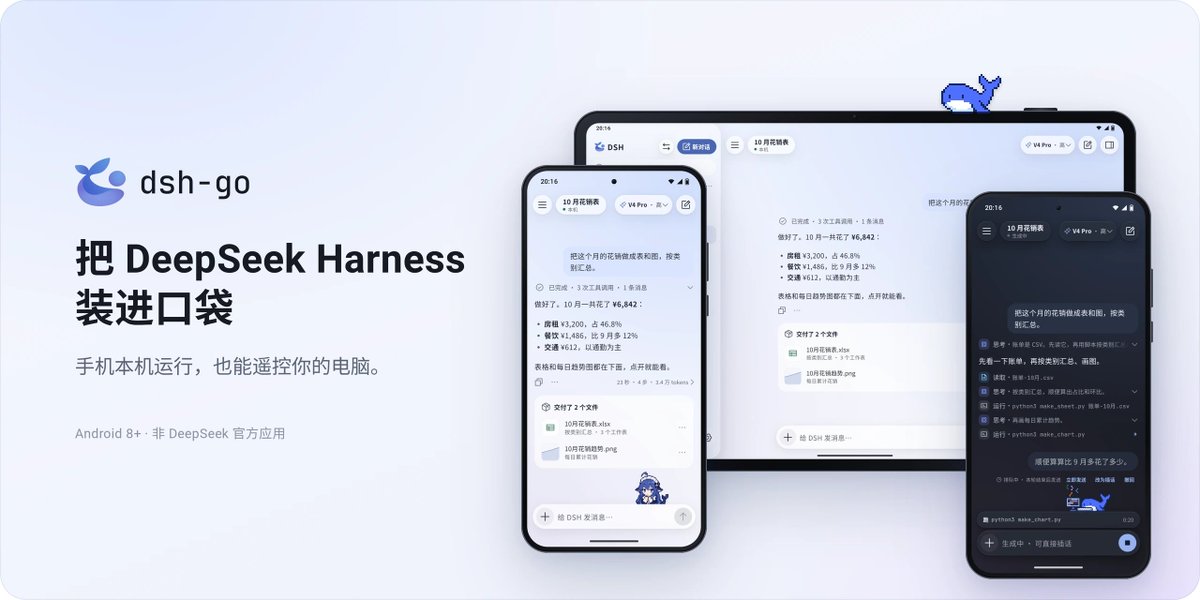
1,605 GitHub stars in 5 days for an unofficial DeepSeek app that runs on your Android phone.
DSH Go is a community project built on the open source DeepSeek agent it takes its name from. DeepSeek itself has no part in it.
To try it today, download the arm64 APK from GitHub Releases. It needs Android 8.0 or newer.
What it does:
1. Runs the engine on the phone with a built-in Linux setup. No root or Termux is needed, and it takes about 1 GB of space.
2. Turns a chat into a link that opens in a browser. The link is end-to-end encrypted.
3. Connects over SSH to the same DSH on your computer or server, so you can pick up a chat where you left it.
4. Reads your screen and taps for you, with three levels of confirmation. Payments, passwords and verification codes always go back to you.
Before you switch on phone control, read the permission notes. The text on your screen can go to the model you set up, and so can screenshots if it reads images.
Giving each bot its own voice and language sounds small, but it's what makes a team of agents feel like different teammates instead of one chatbot with many tabs.